Steven Sim was the choice of Prime Minister Anwar Ibrahim - YES, the Prime Minister has the FULL power of deciding who is MINISTER of what Ministry - who forms Anwar's cabinet in wholly up to the Prime Minister alone - and thus when Cabinet members fail or abuse their powers, or are BIASED > blame falls 100% on the Prime Minister, and of course the said member of the Cabinet..

Interestingly, Anwar REMOVED Steven Sim as Human Resource Minister - December 17, 2025, Steven Sim Chee Keong was moved from his position as Minister of Human Resources to become the Minister of Entrepreneur and Cooperatives Development. Was it because of this case - where Court found Steven Sim to be BIASED - pro-employer?? NO reason was given by the PM as to WHY he was removed as HR Minister.
In that move, he also removed Hannah Yeoh as Sports Minister - again, we ask as to whether it was because of the 'bad' handling of the FAM issue > the forged documents submitted to FIFA, and the questionable citizenship to foreign footballers - December 16, 2025, Hannah Yeoh was replaced as Malaysia's Minister of Youth and Sports by Dr. Mohammed Taufiq Johari during a cabinet reshuffle by Prime Minister Anwar Ibrahim. Yeoh was reassigned to the Prime Minister's Department as the Minister of Federal Territories.
Now, votes of Workers and Sports Fan/Community are very important?
Many have been wondering about the High Court Judgment that decided our now former Human Resource Minister demonstrated a clear bias in favour of EMPLOYER against worker/Union, and thus compromising the role of MHR as a neutral arbiter. SEE below the FULL JUDGMENT
R1’s support demonstrated a clear bias as he had improperly aligned his office with R3, thus compromising the role of MHR as a neutral arbiter.
R1 had violated the trust and confidence reposed in his office when he descended into the arena of dispute and supported R3 on the Festival Aid issue. R1 had subverted the statutory process designed for impartial resolution and violated the objectives of the IRA 1967...65. Thus, R1 had demonstrated bias and his decision to refer the trade dispute to R4 was tainted with unreasonableness.
Follow the Charles Hector channel on WhatsApp: https://whatsapp.com/channel/0029Vb6UokfB4hdNugYmph1B
My comments about the High Court Judgment -
# Final Order - Prayers 1(a), (b) and (e) - but in the whole Judgment, there is no mention what prayer (e) was about. This is basic - and Judges in writing judgments must lay out exactly what the Applicants had prayed. In this judgment, the Judge fails to mention what prayers (c), (d) and (e) was. Whether parayer (c), (d) and (e) was about damages to be paid by the Respondents was about damages, exemplary damages and cost? It is a guessing game now.
## From the judgment prayer (b) was for two alternatives, and it seems the Judge chose the 2nd alternative. '...(b) a declaration that the management of the banks who are members of R3 should pay members of the Applicant one month salary as Festival Aid for year 2024 for their respective religious festivals as was done in 2023 or alternatively, a declaration that the internal negotiation process between the Applicant and R3 on the trade disputes relating to the 1st IC Case and 2nd IC Case shall be continued under Article 4(5) of the 19th Collective Agreement (‘CA’) dated 12.4.2023 between the Applicant and R3...' and later she says '...and the alternative prayer in subparagraph 2(b) above...'
The JUDGE failed to give any REASONS why she chose the 2nd alternative - which means the case is not resolved yet - and it is back to the internal negotiation process all over again. In my humble opinion, it would have been better that it was the 1st alternative - which means that UNION members will speedily get the ONE MONTH SALARY for the Festival Aid for 2024 now, plus interest for the delay...
### In the judgment in para '...33. At this juncture, I can immediately say that the Applicant’s claim for monetary losses and damages, including exemplary and aggravated damages, were not allowed because there was no submission on these in the Applicant’s written submissions....' The only issue would be was it in the APPLICATION - if it was, then the Court can very well make a decision or judgment on this. I have never heard a reason by court - no order because it was not in the submission > I have only heard - no order because it was not PLEADED or in the application > never because it was not in the 'written' submission...
If it was in the application, then JUSTLY, more so since it a industrial relations matter - after deciding in favour of the Applicant on key issues, parties could have been asked to submit on the issue of damages and the court should justly ORDER damages.
Maybe, with regard to the 1 month salary as Festival Aid - it could be delayed in light of the court judgment, that it goes back to the 'internal negotiation process again.
BUT with regard the other claims are, in my opinion, which are justified after this Judgment, i.e. legal fees, cost of fighting in court....and the EXEMPLARY damages to be paid by R1(Minister of Human Resources)
(c) as a result of R1’s and R2’s decisions which were unlawful, the Applicant has suffered losses viz.-
(i) loss of half month’s salary for the Applicant’s members who celebrated Chinese New Year and Hari Raya in 2024.
(ii) legal fees to represent the Applicant in the Industrial Court to handle the 1st IC Case and 2nd IC Case; and
(iii) the time and workforce of the Applicant’s staff which had to be diverted to handle the 1st IC Case and 2nd IC Case; and(d) exemplary damages should be paid by R1 because his actions were gravely unlawful, carried out in a biased manner and in disregard of the rights of workers, namely the B40 and M40 groups who are the Applicant’s members, as guaranteed under Articles 5 and 8 of the Federal Constitution.
Note the Judgment finds the MINISTER to be 'biased' - and it is clearly the Minister's fault by his action that has caused GREAT delay in the Union members enjoying their employment benefit, and as a result having expend a lot of monies/effort in their quest for justice. Thus, JUSTLY the Court should have ordered the Minister of Human Resources(R1) to pay the Applicant EXEMPLARY DAMAGES, and also damages as (ii) legal fees,,,(iii) time and effort of Applicant staff.. > These damages should have been ordered to be paid by the MINISTER by this Court NOW. The half month remaining Festival Aid may be dealt by 'internal process' - but will it cover the interest accumulated by reason of the delay - and NOTE the one who caused this again is the Minister of Human Resource by his own action/decision, which now this COURT has found to be wrong.
#### Why was there no ORDER that the Minister(R1) pay cost to the Applicant? NO EXPLANATION by the High Court Judge who just ordered R3 to pay cost. Whay R2 did not have to pay COST?
##### ODD, the Court finds the MInister did WRONG ---BUT no Order for the Minister to pay DAMAGES, or even COST - The JUDGE ERRED.
THE JUDGMENT OF THE HIGH COURT
IN THE HIGH COURT IN MALAYA AT KUALA LUMPUR
IN THE FEDERAL TERRITORY OF KUALA LUMPUR, MALAYSIA
(SPECIAL POWERS DIVISION)
APPLICATION FOR JUDICIAL REVIEW NO.: WA-25-291-07/2024
BETWEEN
NATIONAL UNION OF BANK EMPLOYEES (NUBE) ... APPLICANT
AND
1. MENTERI SUMBER MANUSIA, MALAYSIA
2. KETUA PENGARAH PERHUBUNGAN PERUSAHAAN
3. MALAYAN COMMERCIAL BANKS’ ASSOCIATION
4. MAHKAMAH PERUSAHAAN MALAYSIA ... RESPONDENTS
GROUNDS OF JUDGMENT
1. This was an application by the Applicant for judicial review (encl.1) of the decisions made by the Minister of Human Resources (‘R1’) on 16.4.2024 and 29.4.2024 to refer two trade disputes between the Applicant and the Malayan Commercial Banks’ Association (‘R3’) to the Industrial Court (‘R4’).
2. Among the reliefs sought by the Applicant were for –
2(a) orders for certiorari to quash the decisions by R1 to refer the trade disputes between the Applicant and R3 to R4, which had been registered as Industrial Court Case No. 22/3–478/24 (‘1st IC Case’) and Industrial Court Case No. 4/2–482/24 (‘2nd IC Case’); and
(b) a declaration that the management of the banks who are members of R3 should pay members of the Applicant one month salary as Festival Aid for year 2024 for their respective religious festivals as was done in 2023 or alternatively, a declaration that the internal negotiation process between the Applicant and R3 on the trade disputes relating to the 1st IC Case and 2nd IC Case shall be continued under Article 4(5) of the 19th Collective Agreement (‘CA’) dated 12.4.2023 between the Applicant and R3.
3. After having considered the cause papers and the oral and written submissions of the parties, I had, on 13.2.2026 allowed prayers 1(a), (b), (e) in encl. 1 i.e. as per subparagraph 2(a) above and the alternative prayer in subparagraph 2(b) above.
4. Dissatisfied with the decision, R3 has filed a Notice of Appeal on 13.2.2026.
5. These are my full grounds of judgment for the decision.
Background Facts
6. The Applicant is a national trade union registered under the Trade Unions Act 1959 [Act 262] representing the special grade clerical, clerical and non-clerical employees in R3’s member banks.
7. R3 is an association of commercial banks in Peninsular Malaysia duly registered as a Trade Union of Employers under Act 262.
8. Over the years, R3 had, on behalf of its members, entered into a series of collective agreements with the Applicant. The terms of employment between R3’s member banks and their employees who are members of the Applicant, are governed by the said collective agreements between the parties.
9. The following facts were discerned from the Statement filed pursuant to O. 53, r. 3(2) of the Rules of Court 2012 (‘RC 2012’).
10. On 12.4.2023, the Applicant and R3 signed the 19th CA whereby the parties agreed that the enforcement of the 19th CA would commence from 1.1.2021.
11. The Applicant and R3 also signed the “Festival Aid Memorandum of Agreement” on 5.4.2023 (‘Festival Aid Agreement’) specifically concerning festival aid for bank employees who are also members of the Applicant. The Festival Aid was the result of a study whereby Malaysian commercial banks operating in Indonesia paid one month’s salary as Festival Aid to Indonesian employees.
12. Basically, R3 agreed that the banks would pay an amount equivalent to one month’s salary to the Applicant’s members as festival aid for only one festival celebrated by the employee in a
year.
13. R3 fulfilled its commitment under the Festival Aid Agreement in 2023. However, payment of one month’s salary was not made to the Applicant’s members in 2024. The Applicant alleged that R3 had distorted the contents of the Festival Aid Agreement and insisted that it only applied for the year 2023.
14. According to the Applicant, all stakeholders in the banking sector obtained substantial profits from banking activities except for B40 and M40 bank employees who are the Applicant’s members. The commercial banks which are members of R3 refused to pay the Festival Payment accordingly to the Applicant’s members despite the banks –
(a) having earned substantial profits in 2023;
(b) paying their directors and management staff very high and substantial salaries and bonuses; and
(c) paying high dividends to their shareholders.
15. The Applicant claimed that, as a result of transparent and sincere negotiations not being honoured by R3, the Applicant declared an industrial dispute on 22.1.2024 and followed up with a letter dated 26.1.2024.
16. At the same time, the parties were in the process of negotiating a new CA, namely the 20th CA.
17. The Applicant cited Article 4(5) of the 19th CA which provides an internal procedure to resolve an industrial dispute before reference is made to the Director General of Industrial Relations (‘R2’), namely to refer the dispute to a Standing Committee and upon such reference, the Standing Committee shall meet to resolve the dispute. If the dispute still cannot be resolved by the Standing Committee, it will then be referred to the Ministry of Human Resources (‘MHR’).
18. The Applicant claimed that R3 did not comply with the procedure stipulated in Article 4(5) of the 19th CA and had unilaterally and without the knowledge of the Applicant referred the industrial dispute to the Department of Industrial Relations (‘JPP’) under the supervision of R2.
19. In respect of the Festival Aid Payment, JPP Kuala Lumpur held one meeting while JPP Putrajaya held one meeting, and informed both parties that “there is still space for discussions in reaching a settlement”. However, unexpectedly, R1 referred the case to R4.
20. In respect of the 20th CA, JPP Kuala Lumpur called for one meeting. When the Applicant objected to JPP’s jurisdiction to conduct a conciliation meeting without the complainant first exhausting internal remedies as stipulated in the CA, JPP Kuala Lumpur swiftly referred the case to R2.
21. R2 did not respond to the queries raised by the Applicant to JPP Kuala Lumpur. Again, unexpectedly, R1 referred the case to R4.
22. The Applicant took the position that, while the conciliation process was ongoing at JPP, R1 was secretly involved in meetings with R3 without the Applicant’s knowledge to discuss the Festival Aid industrial dispute. The Applicant only became aware of this from an announcement made by the management of the bank.
23. R1 and R3 had purportedly reached an agreement to reduce the Festival Aid Payment from one month’s salary to half a month’s salary for the Applicant’s members in Special Grade clerical and clerical categories. R1 also agreed with R3 that the Festival Aid Payment would be a one-off payment for all categories of the Applicant’s members even though this was contrary to the Festival Aid Agreement.
24. Following this, the Applicant contacted R1, R2 and MHR to inquire about this matter, but there was no response.
25. Therefore, the Applicant issued a press statement on 5.4.2024 and lodged a police report on 18.4.2024.
26. Several hours after the police reports were lodged, R4 informed the Applicant via email that the Minister had referred the industrial dispute to R4 and the case was subsequently registered as the 1st IC Case. The Applicant was wrongly referred to as the complainant. The Applicant’s solicitors raised an objection and R2 amended the position of the parties through a letter dated
8.5.2024.
27. On 29.4.2024, the Applicant received an e-mail from R4 stating that R4 had also received a reference from R1 dated 29.4.2024 concerning the dispute between the Applicant and R3 regarding the 20th CA.
28. The Applicant claimed that R1 had suddenly referred the negotiations regarding the 20th CA to R4 without following the internal remedy process as stated in the 19th CA and without any
reason being given and without hearing or properly consulting the Applicant. R3, which ought to have initiated negotiations, failed to do so.
29. Apart from the relies as stated in paragraph 2 above, the Applicant also sought –
(a) an order of prohibition against R4 from proceeding with, or adjudicating, the 1st IC Case and 2nd IC Case or any other related case; and
(b) damages, including aggravated and/ or exemplary damages, to be paid by R1, R2 and R3 to the Applicant.
The Legal Principles
30. The Supreme Court in Minister of Home Affairs, Malaysia v. Persatuan Aliran Kesedaran Negara [1990] 1 CLJ (Rep) 186 at pp 192 - 193 said that:
“In the course of his submission Counsel for Aliran cited several cases in support but we find it sufficient to refer to only one case which fairly sums up the position of judicial review of administrative actions - Council of Civil Service Unions & Ors. v. Minister for Civil Service [1985]1 AC 374 where Lord Diplock had this to say at pp. 410 and 411:
Judicial review has I think developed to a stage today when without reiterating any analysis of the steps by which the development has come about, one can conveniently classify under three heads the grounds upon which administrative action is subject to control by judicial review. The first ground I would call “illegality”, the second “irrationality” and the third “procedural impropriety”.
By “illegality” as a ground for judicial review I mean that the decision-maker must understand correctly the law that regulates his decision-making power and must give effect to it. Whether he has or not is par excellence a justiciable question to be decided, in the event of dispute, by those persons, the Judges, by whom the judicial power of the state is exercisable.
By “irrationality” I mean what can by now be succinctly referred to as ‘Wednesbury unreasonableness’ (Associated Provincial Picture Houses Ltd. v. Wednesbury Corporation [1948] 1 KB 223). It applies to a decision which is so outrageous in its defiance of logic or of accepted moral standards that no sensible person who had applied his mind to the question to be decided could have arrived at it.
I have described the third head as “procedural impropriety” rather than failure to observe basic rules of natural justice or failure to act with procedural fairness towards the person who will be affected by the decision.
This is because susceptibility to judicial review under this head covers also failure by an administrative tribunal to observe procedural rules that expressly laid down in the legislative instrument by which its jurisdiction is conferred even where such failure does not involve any denial of natural justice.”
(see too, the cases which were cited by the parties, namely, Peguam Negara Malaysia v. Chin Chee Kow & Another Appeal [2019] 4 CLJ 561, Holiday Villages Of Malaysia Sdn Bhd v. YB Menteri Sumber Manusia & Anor [2008] 9 CLJ 110)
31. In YB Menteri Sumber Manusia v. Association of Bank Officers, Peninsular Malaysia [1999] 2 CLJ 471, it was held that the decision of the Minister of Human Resources is subject to judicial review and is liable to be quashed by an order of certiorari if it can be demonstrated that the Minister had committed an error of law or jurisdictional error in arriving at his decision.
The Grounds of Application
32. Essentially, the Applicant contended that –
(a) R1’s decision in referring the trade dispute in relation to the Festival Aid Payment matter to R4 was tainted with illegality, procedural impropriety and unreasonableness;
(b) R1 had not taken into consideration relevant facts and took into consideration irrelevant facts when he referred the 20th CA matter to R4 and thus, tainting the decision with illegality, irrationality and procedural impropriety;
(c) as a result of R1’s and R2’s decisions which were unlawful, the Applicant has suffered losses viz.-
(i) loss of half month’s salary for the Applicant’s members who celebrated Chinese New Year and Hari Raya in 2024.
(ii) legal fees to represent the Applicant in the Industrial Court to handle the 1st IC Case and 2nd IC Case; and
(iii) the time and workforce of the Applicant’s staff which had to be diverted to handle the 1st IC Case and 2nd IC Case; and(d) exemplary damages should be paid by R1 because his actions were gravely unlawful, carried out in a biased manner and in disregard of the rights of workers, namely the B40 and M40 groups who are the Applicant’s members, as guaranteed under Articles 5 and 8 of the Federal Constitution.
33. At this juncture, I can immediately say that the Applicant’s claim for monetary losses and damages, including exemplary and aggravated damages, were not allowed because there was no submission on these in the Applicant’s written submissions.
Analysis and Decision of the Court
34. The issues which arose for consideration in this application and the findings of the Court are elaborated below.
A. The Festival Aid Payment Issue
(1) Whether R1 had acted contrary to sub-s 26(3) of the Industrial Relations Act 1967 (‘IRA 1967’) when he failed to address his mind to the internal settlement mechanism agreed between the parties in Article 4(5) of the 19th CA and formed an opinion that the said internal settlement
mechanism would not achieve settlement
35. Sections 18 and 26 of the IRA 1967 provide as follows:
“Reference of disputes for conciliation
18. (1) Where a trade dispute exists or is apprehended, that dispute, if not otherwise resolved,may be reported to the Director General by –
(a) an employer who is a party to the dispute or a trade union of employers representing him in the dispute; or
(b) a trade union of workmen which is a party to the dispute.(2) The Director General shall consider any dispute reported to him under subsection (1) and take such steps as may be necessary or expedient for promoting an expeditious settlement thereof:
Provided that where the dispute relates to the dismissal of a workman, section 20 shall apply.
(3) Where a trade dispute exists or is apprehended, which in his opinion is not likely to be settled by negotiation between the parties, the Director General may, if he deems it necessary in the public interest, take such steps as may be necessary or expedient for promoting a settlement thereof whether or not the trade dispute has been reported to him.
(4) The steps taken by the Director General under subsection (2) or (3) shall include reference of the dispute for settlement to any appropriate machinery which already exists by virtue of an agreement between or applicable to the parties to the dispute, unless –
(a) the dispute has already been referred to such machinery and there has been a failure to reach a settlement; or
(b) in his opinion it is unlikely that the dispute will be promptly settled through such machinery.”(5) Where, after having taken the steps under subsection (2) or (3), the Director General is satisfied that there is no likelihood of the trade dispute being settled, he shall notify the Minister accordingly.
…
Reference of trade disputes to the Court26. (1) Where a trade dispute exists or is apprehended, the Minister may, if that dispute is not otherwise resolved, refer the dispute to the Court on the joint request in writing to the Minister by the trade union of workmen which is a party to the dispute and the employer who is a party to the dispute or a trade union of employers which is a party to the dispute.
(2) The Minister may of his own motion or upon receiving the notification of the Director General under subsection 18(5) refer any trade dispute to the Court if he is satisfied that it is expedient so to do:Provided that in the case of a trade dispute in any Government service or in the service of any statutory authority, reference shall not be made except with the consent of the Yang di-Pertuan Agong or State Authority as the case may require.
(3) If there exists in any industry any arrangement for the settlement of trade disputes, made in pursuance of an agreement between an employer or a trade union of employers and a trade union of workmen, the Minister shall not refer the trade dispute to the Court in accordance with subsections (1) and (2) unless there has been a failure to obtain a settlement by means of those arrangements or in his opinion it is unlikely that the dispute will be expeditiously settled through such arrangements.”
(emphasis added).
36. R3 highlighted the following case authorities in emphasising the importance of the intent behind the IRA 1967:
(a) the Federal Court in National Union of Hotel, Bar And Restaurant Workers v. Minister Of Labour And Manpower [1980] 2 MLJ 189:
“Thus we must construe the Industrial Relations Act, 1967, to determine its policy and object. It cannot be gainsaid that the intention of the Act is to regulate the relations between management and labour and to prevent and settle trade disputes arising therefrom. Briefly, it provides machinery for investigating, determining and settling such disputes by arbitration, conciliation and reference to the Industrial Court, and in implementing it, policy decisions come into play.”.
(b) the Court of Appeal in Hong Leong Equipment Sdn Bhd v. Liew Fook Chuan & Another Appeal [1997] 1 CLJ 665:“That said, it is however, necessary and desirable to identify, with as much precision as possible, the parameters of the discretion conferred by Parliament upon the Minister....It may, I think, be stated as a very general guide that a fair exercise of the discretion in question would be that which best achieves the object of the Act. That object is disclosed in the preamble to the Act which declares itself to be an Act: to provide for the regulation of the relations between employers and workmen and their trade unions and the prevention and settlement of any differences or disputes arising from their relationship and generally to deal with trade disputes and matters arising therefrom.
The approach that ought to be taken in a case where statute confers upon the executive a discretion to refer a dispute to a tribunal specially created for that purpose was stated by Lord Denning MR in his dissenting judgment in Padfield v. Minister of Agriculture, Fisheries & Food [1968] AC 997,1006 as follows:
It is said that the decision of the Minister is administrative and not judicial. But that does not mean that he can do as he likes, regardless of right or wrong. Nor does it mean that the Courts are powerless to correct him. Good administration requires that complaints should be investigated and that grievances should be remedied. When Parliament has set up machinery for that very purpose, it is not for the Minister to brush it on one side. He should not refuse to have a complaint investigated without good reason.”; and
(c) the Industrial Court in O. Y. L Condair Industries Sdn. Bhd. v. Razuan B. Arsad [1994] 1 ILR 493:“It is also clear from s. 26(3) that the provision is directed at the Minister's exercise of his discretion to refer trade dispute to the Court. It does not bar or prohibit the Court from hearing a reference which had been referred to it until and unless the Claimant had first sought his recourse through the agreed arrangement. The Court considers that it is significant that express reference is made to the Minister and not to the Court in this regard. The maxim expressio unius est exclusio alterius would apply here. The Act by its express mention of the Minister when referring to the subject of the arrangement for settlement of dispute as a factor to be taken into account before the Minister refers the dispute to the Court clearly intended that it is the Minister alone who shall have regard to this factor at the point of making the reference to the Court.
The scheme of the Act lends further support to the Court’s view. The Court is seised with jurisdiction over any trade dispute only upon a reference by the Minister. A dispute is gradually processed at each step of the dispute-processing mechanism.
Specific duties are imposed on the persons charged with the responsibility for attempting to bring about a resolution of the dispute. So too are the matters to be considered by each of the officials performing statutory functions under the Act. …”.
37. Article 4 in the 19th CA sets out the provision on “Settlement of Disputes”. Article 4(2) explains the “Grievance Procedure”, in particular, “Complaint or Grievance at Office Level”, “Settlement of Dispute at Office Level”, “Settlement of Dispute at Branch Level” and “Settlement of Dispute at National Level”. Article 4(3) and (4) govern the “Rights of Parties Pending Settlement of Dispute” and “Implementation and/or Interpretation of Collective Agreement”.
38. The Court finds that there is an agreed settlement mechanism as set out in Article 4(5) of the 19th CA which reads as follows:
“Rights of Parties To Invoke MCBA/NUBE Standing Committee
Any party may refer any dispute which is not covered under Clauses (2) and (4) of this Article to the MCBA/NUBE Standing Committee. Upon such reference, the Standing Committee shall be convened to resolve the dispute. If it is still not resolved, the dispute shall be referred to the Ministry of Human Resources.”.
39. R3 submitted that, based on the factual chronology of this case, R1 was obliged to refer the trade disputes to R4 because –
(a) at the conciliation sessions in March 2024 at JPP, the Applicant maintained that it was entitled to one month Festival Aid for 2024, and thereafter failed to attend the session in April 2024. The Applicant also made accusations against R1 about interfering in the matter when R3’s member banks unilaterally decided, as a matter of goodwill, to make a payment of half month Festival Aid in 2024. R1’s decision to refer the trade dispute regarding the Festival Aid Payment was not premature;
(b) the Applicant’s demand for a Standing Committee pursuant to Article 4(5) of the 19th CA was baseless. Article 4(5) was not mandatory; R3 was not statutory and/ or contractually obliged to have first convened a Standing Committee under the 19th CA. The provision does not override a party’s right to raise a complaint under the IRA 1967; and
(c) the Applicant’s call for a Standing Committee was a mockery in the light of its own conduct in initiating industrial action. The Applicant made repeated declarations of a trade dispute and its undertaking of rancorous industrial action. The Applicant itself did not choose to convene a Standing Committee under the 19th CA. Instead, it chose to initiate industrial action, which was the antithesis of seeking an amicable resolution. It was hypocritical for the Applicant to suggest that there was no need for the Applicant to invoke Article 4(5) of the 19th CA as it was supposedly writing and requesting for social dialogue, which R3 had agreed to. The social dialogue, which was a blanket discussion, did not proceed in view of the Applicant’s industrial action, and was the subject matter of other non-compliance actions taken by the Applicant against R3 and its member banks and are currently pending before R4. In the circumstances, the Standing Committee was not the correct medium to resolve a deadlocked collective bargaining process for a new collective agreement.
40. The test applicable in judicial review is an objective test [see Titular Roman Catholic Archbishop of Kuala Lumpur v Menteri Dalam Negeri & Ors [2014] 4 MLJ 765 (FC)]. The objective test requires this Court to consider whether any reasonable Minister would have acted in the manner which R1 had, in referring the matter to R4.
41. At the 1st conciliation meeting, the Applicant had brought Article 4(5) of the 19th CA to the attention of JPP’s officer. Since the officer had knowledge of the internal settlement mechanism, it was incumbent on the JPP to direct R3 to exhaust the said mechanism pursuant to Article 4(5) of the 19th CA. However, from the Minutes of Meeting, JPP’s officer did not address this issue.
R1 and R2 did not at any time challenge the accuracy of the Minutes.
42. In the affidavit affirmed by R1 on his behalf and on behalf of R2, he said:
“14. Merujuk kepada perenggan 34 hingga 36 Afidavit Sokongan Pemohon adalah diakui setakat satu mesyuarat rundingan damai telah dibuat pada tarikh 27.03.2024 dan tiada penyelesaian dapat dicapai diantara pihak-pihak. Pada 16.04.2024 saya telah dimaklumkan oleh Responden Kedua bahawa segala langkah-langkah yang telah diambil di bawah Seksyen 18(2) Akta 177 telah gagal untuk menghasilkan sebarang penyelesaian oleh itu saya telah merujuk pertikaian ini ke Mahkamah Perusahaan.”.
43. Clearly, R1’s affidavit failed to show that R2 had considered the parties’ agreed internal mechanism in Article 4(5) of the 19th CA and consequently formed the opinion as required by sub-s 18(4) of the IRA 1967.
44. In The Attorney General Of Malaysia v. Dato’ Sri Mohd Najib Tun Haji Abdul Razak [2025] 8 CLJ 951, one of the issues for determination by the Federal Court was whether leave is required to introduce new evidence at the appeal stage. This question then turned on the issue of whether an application for leave in a judicial review is an interlocutory proceeding, to which the Court held as follows:
“[41] Coming back to the matter before us, judicial review application is unlike the usual civil suit where in the former there is an application for leave before the applicant can proceed to the substantive hearing of the judicial review application. In an application for leave for judicial review application, in the event there is a dismissal of the leave application, the applicant’s rights would be determined to its finality. There will be no more hearing of the substantive judicial review application. Although the application for leave in a judicial review proceedings is the initial step in the motion towards the hearing of the substantive judicial review application, it is not an interlocutory proceeding/application as the rights of the applicant may be determined at the leave stage, as in the present appeal.
[46] In this regard the minority decision in the Court of Appeal is not far off from what we have elucidated on the issue of the application for leave in the present appeal, namely, that, the application for leave in the judicial review proceedings is not an interlocutory proceeding for the purpose of r. 7(2) of the RCA 1994, and hence leave is required. Therefore, although the application for leave for judicial review is interlocutory in form, it is an application to decide on the rights of the parties, hence as regards evidence it ought not be regarded as an interlocutory
proceeding within the meaning of O. 41 r. 5(2) of the ROC 2012 (see Gilbert v. Endean, Rossage v. Rossage, Tuan Sarip Hamid).”.
45. As leave applications for judicial review are substantive proceedings and not interlocutory because they can definitively determine a party’s rights, I agreed with Mr. Ravi Nekoo’s submission for the Applicant that the reasoning as above quoted would apply with even greater force in the instant case, which was at the stage of substantive hearing, and where the strict rules of evidence apply and hearsay evidence was inadmissible. Therefore, R1’s averment that “saya telah dimaklumkan oleh Responden Kedua” was hearsay and therefore, not admissible.
46. It follows that there was no evidence before this Court for the Court to conclude that R2 had addressed his mind on the internal settlement mechanism and then formed an opinion that it would fail.
47. Sub-s 26(2) of the IRA 1967 gives R1 a discretion to refer the matter to R4. When R2 referred the matter to R1, it was incumbent on R1 to be satisfied, as required under sub-s 26(3) of the IRA 1967, that the dispute between the Applicant and R3 could not be resolved through the internal settlement mechanism as agreed by the parties and therefore has to be referred to R4.
48. In paragraph 25 of R1’s Affidavit In Reply (‘AIR’), R1 affirmed that:
“25. Merujuk kepada perenggan 56 hingga 59 Afidavit Sokongan Pemohon adalah dinafikan. Saya sesungguhnya menegaskan bahawa menjalankan kuasa mengikut budi bicara yang diberikan di bawah subseksyen 26(2) Akta 177 di dalam membuat keputusan untuk merujuk pertikaian antara Pemohon dan Responden Ketiga kepada Responden Keempat, Saya telah mengambil kira dan mempertimbangkan segala fakta yang relevan dan mengenepikan segala fakta yang tidak relevan. Saya selanjutnya menyatakan seperti berikut:
a. Responden Kedua telah mengambil segala langkah-langkah yang telah diambil di bawah subseksyen 18(2) Akta 177 dan ianya gagal untuk menghasilkan sebarang penyelesaian.
b. Selaras dengan subseksyen 18(4) Akta 177, Responden Kedua berpandangan bahawa pertikaian yang wujud tidak dapat diselesaikan melalui remedi dalaman dan memaklumkan saya di bawah subseksyen 18(5) Akta 177 bahawa langkah- langkah yang telah diambil dan ianya gagal untuk menghasilkan sebarang penyelesaian.
c. Pemohon enggan hadir untuk mesyuarat rundingan damai lanjutan yang diadakan oleh Responden Kedua untuk suatu penyelesaian dicapai.
d. Responden Keempat merupakan satu forum yang adil dan sesuai untuk pertikaian yang dirujuk didengar dan satu keputusan dibuat.”.
49. I have considered R1’s to R3’s submissions and I find that the Respondents were unable to surmount the fact that R1’s AIR does not show that R1 had taken into consideration the internal
settlement mechanism as required under sub-s 26(3) of the IRA 1967 and formed an opinion that it is unlikely the dispute will be expeditiously settled through such mechanism. There was also no averment by R1 that there has been a failure to obtain a settlement by means of such mechanism.
50. R3 could not provide a satisfactory answer on the mandatory requirement in sub-s 18(4) of the IRA 1967 and as to the absence of any affidavit evidence by R2 to the effect that R2 had
considered Article 4(5) in the 19th CA and had formed the opinion as stated in sub-s 18(4) of the IRA 1967.
51. The Court accepted the Applicant’s submission that, the fact that both R1 and R2 did not objectively consider if the internal mechanism process agreed by the parties would resolve the
issue, goes against the spirit and intent of sub-s 18(4) and 26(3) of the IRA 1967.
52. Therefore, the reference of the trade dispute to R4 was tainted with procedural impropriety and irrationality.
(2) Whether R1 had undermined the on-going conciliation process at the JPP when he secretly met with R3 to discuss the Festival Aid issue and then supported the inferior payment package made by R3 to members of the Applicant
53. While waiting for the 3rd conciliation meeting with JPP, on 2.4.2024, the Applicant was informed by its members that they had received the Festival Aid Payment from R3’s members. It
came to the Applicant’s attention that this package was inferior to the one that it was bargaining with R3.
54. On 2.4.2024, the Human Resources Division of Hong Leong Bank issued an e-mail titled “Ex-Gratia Festival Aid Payment for 2024” wherein it was stated that:
“We are pleased to inform that the Bank will be extending a one-off Ex-gratia Festival Aid Payment for 2024 to designated categories of employees, to assist them in celebrating their respective festivals during the year. We would like to take this opportunity to thank the Minister of Human Resources for his time and inputs shared with the team at the Malayan Commercial Bank's Association (“MCBA”). We appreciate YB Minister's strong stewardship that has been instrumental in the Bank providing financial assistance to these categories of employees for their respective festival seasons this year.”.
55. Similar Circulars/ Statements were issued by Maybank:
“We are pleased to inform you that Maybank Group has agreed to extend a one-off Ex-gratia Festival Aid Payment for 2024 to designated categories of employees, to assist them in celebrating their respective festivals during the year. We take this opportunity to extend our appreciation to YB Minister of Human Resource, whose guidance in close collaboration with us was instrumental in this matter.”,
by UOB:
“We are pleased to inform you that the Management has decided to extend a one-off Ex-gratia Festival Aid Payment for 2024 to designated categories of employees, to assist you in celebrating your respective festivals during the year. We would like to take this opportunity to thank the Minister of Human Resources YB Steven Sim Chee Keong for his time and inputs shared with the team at MCBA. We appreciate YB Minister’s strong support for the banks to provide some financial assistance to these categories of employees for their respective festive seasons this year.”,
and by CIMB:
“We would like to record our appreciation to the Minister of Human Resources and his team for working alongside Malayan Commercial Banks' Association (MCBA) and providing their guidance on this matter. We appreciate YB Minister’s strong stewardship that has been instrumental in the Banking Industry providing financial assistance to these categories of employees for their respective festive seasons this year.”.
56. Following the issuance of these Circulars/ Statements, the Applicant protested against R1’s interference. The Applicant sent two formal notices to R1 protesting that he had abused his ministerial powers by unilaterally negotiating an inferior Festival Aid package for its members. R1 did not respond to the notices.
57. The Applicant’s members then lodged several police reports against R1.
58. On 18.4.2024, it came to the Applicant’s knowledge that R1 had referred the matter to R4. Between 18.4.2024 and 19.4.2024, the Applicant received four e-mails calling it to attend a case
management. The Applicant was notified by JPP of the reference on 14.5.2024.
59. In paragraph 15 of R1’s AIR, R1 averred that:
“15. Merujuk kepada perenggan 37 hingga 43 Afidavit Sokongan Pemohon, pernyataan Pemohon tersebut adalah dinafikan keseluruhannya. Selanjutnya saya menyatakan bahawa;
a) Tiada sebarang perjumpaan antara saya dengan Responden Ketiga diadakan di bawah peruntukan seksyen 19A Akta 177.
b) Adalah ditegaskan bahawa Responden Kedua telah mengambil langkah-langkah dibawah subseksyen 19B Akta 177 dimana Responden Ketiga dan Pemohon telah dipanggil untuk rundingan damai bagi menyelesaikan pertikaian yang wujud.
c) Saya adalah pihak tidak berkepentingan dan berkecuali dalam pertikaian di antara Pemohon dan Responden Ketiga. Oleh yang demikian, Pernyataan bahawa terdapat perjumpaan rahsia antara saya dan Responden Ketiga merupakan tuduhan semata-mata.”.
60. R3 submitted that it was quite a stretch to purport that a secret meeting had taken place merely following a giving of thanks as indicated in the Circulars/ Statements issued by R3’s member banks. To R3, the Applicant’s accusation of a clandestine meeting remained as a bare averment. In any event, R1 had denied that there was any such meeting.
61. I have scrutinised the Circulars/ Statements, in particular by Hong Leong Bank, Maybank and UOB, and I find that, while R1 had denied any “secret meeting” between himself and R3, he had evidently given his time and input to R3 to discuss matters pertaining to the Festival Aid issue when the matter was undergoing conciliation process at JPP.
62. By doing so, R1 had entered into the arena of dispute and apparently supported R3’s proposal to make the ex-gratia Festival Aid Payment for 2024. R1’s support demonstrated a clear bias as he had improperly aligned his office with R3, thus compromising the role of MHR as a neutral arbiter.
63. In Titular Roman Catholic Archbishop of Kuala Lumpur (supra), Zainun Ali FCJ in her dissenting judgment had made reference to the case of Ex parte Sim Soo Koon [1915] 13 SSLR 57 on the meaning of “discretion” in these words:
“[188] It is appropriate at this stage to cite the antiquated case of Ex parte Sim Soo Koon [1915] 13 SSLR 57 as a reminder of what ‘discretion’ means Earnshaw J, referred to Sharpe v Wakefield [1891] AC 173, which held that ‘discretion means, when it is said that something is to be done within the discretion of the authorities, that something is to be done according to the rules of reason and justice, not according to private opinion, according to law and not humour. It is to be not arbitrary, vague and fanciful, but legal and regular. And it must be exercised within the limit to which an honest man competent to the discharge of his office ought to confine himself ’.”
64. In the instant case, R1 had violated the trust and confidence reposed in his office when he descended into the arena of dispute and supported R3 on the Festival Aid issue. R1 had subverted the statutory process designed for impartial resolution and violated the objectives of the IRA 1967.
65. Thus, R1 had demonstrated bias and his decision to refer the trade dispute to R4 was tainted with unreasonableness.
B. The 20th CA Issue
(1) Whether R1 had sufficiently satisfied himself that the internal settlement mechanism agreed between the parties in Article 4(5) of the 19th CA would not achieve settlement pursuant to sub-s 26(3) of the IRA 1967
66. The Applicant repeated the submission as regards –
(a) paragraph 25 in R1’s AIR which clearly shows that R1 did not address his mind to the internal mechanism settlement process agreed between the parties as required under sub-
s 26(3) of the IRA 1967; and
(b) R1 having relied upon hearsay evidence, which was not admissible, by making the affirmation in subparagraphs 25(b) and (c) in the AIR.
67. The analysis in respect of issue A(1) above applies and accordingly, Issue B(1) was answered in favour of the Applicant. Sub-s 26(2) of the IRA 1967 when he had referred the 20th CA to R4 without the consent of the Applicant
68. The Court did not consider this ground of application in view of R3’s objection that it was not raised in the Statement (encl. 2).
69. The Applicant submitted that this matter was pleaded in paragraph 4.15 of the Statement which reads:
“Pada 29.4.2024, NUBE menerima emel dari Mahkamah Perusahaan yang menyatakan bahawa pihak Mahkamah telah juga menerima rujukan YB Menteri Sumber Manusia bertarikh 29.4.2024 bagi pertikaian di antara MCBA dan NUBE mengenai Perjanjian Kolektif Ke-20 (“Keputusan Menteri Kedua”).
(a) Nampaknya, Menteri telah secara mendedak merujuk rundingan mengenai Perjanjian Kolektik Ke-20 ke Mahkamah Perusahaan tanpa mengikut proses remedi dalaman yang tertera di dalam Perjanjian Kolektif Ke-19.
(b) MCBA yang sepatutnya memulakan rundingan telah tidak lagi berbuat demikian.
(c) Tanpa apa jua alasan diberikan dan tanpa mendengar atau berunding dengan NUBE sewajarnya.”.
70. I was not convinced by the Applicant’s argument. It is trite that the Applicant cannot raise any new grounds which were not pleaded in the Statement filed pursuant to O. 53, r. 3(2) of the RC 2012 (see Lembaga Tatatertib Kumpulan Sokongan (No 1) Jabatan Perlindungan Hidupan Liar dan Taman Negara & Ors v Mariani bt Ramli (2012) 5 MLJ 857 and Minister of Finance & Ors v Natsteel Holdings Pte Ltd(2026) 1 MLJ 699.
Conclusion
71. Premised on the foregoing reasons, the Applicant's application in prayers in 1(a), (b) and (e) in encl 1 was allowed with costs of RM10,000 to be paid by R3 to the Applicant. No order was made as to cost between the Applicant and R1 and R2.
DATED 23.2.2026
sgd
(ALIZA SULAIMAN)
JUDGE
HIGH COURT OF MALAYA
KUALA LUMPUR (BKK 1)
Solicitors for the Applicant:
Ravi Nekoo (Arvin Kumar Mohan with him)
Messrs. NEKOO
Solicitors for the 1st and 2nd Respondents:
Mohd Isa Bin Mohamad, Senior Federal Counsel Attorney General’s Chambers
Solicitors for the 3rd Respondent:
Sivabalah Nadarajah (Chua Kim Lin with him)
Messrs. Shearn Delamore & Co.
**Note, I copied the Judgment from a PDF version of the Judgment - I did my best to ensure that there were no mistakes - but sometime in copying and converting to a different form, errors do happen
NUBE Holds Rally Protesting On Growing Anti-Union Discrimination
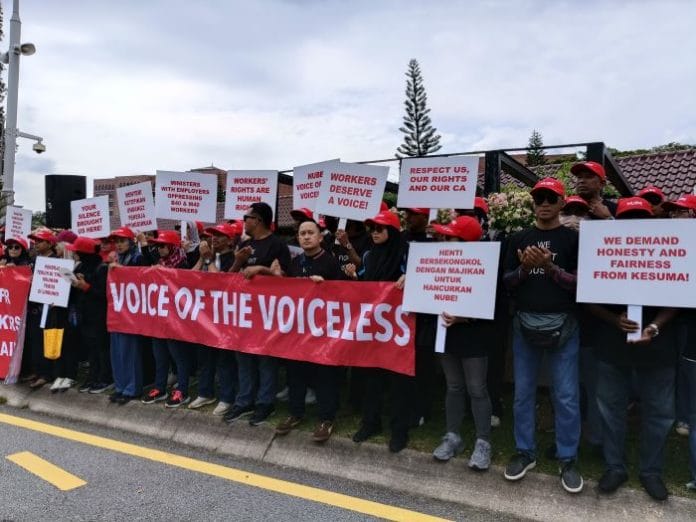
Thousands of bank workers from across Malaysia gathered in front of the Ministry of Human Resources today in a peaceful May Day demonstration to protest what they describe as growing anti-union discrimination under Human Resources Minister Steven Sim.
Themed “Voice of the Voiceless,” the rally was organized by the National Union of Bank Employees (NUBE) and ran from 10 a.m. to 1 p.m. Protesters called for justice, accountability, and the restoration of trade union rights, alleging systemic efforts to undermine union representation in the banking sector.
NUBE’s General Secretary J. Solomon directly held Minister Sim accountable for the alleged actions of 17 banks that he said have collectively undermined the union’s ability to represent its members and violated both Malaysian labor laws and international standards.
“These are not mere bureaucratic oversights — they represent systemic attacks on workers’ dignity and union freedom,” Solomon said during the rally.
One of the union’s key complaints involves what it calls “secret negotiations” between the Ministry and banks, which allegedly resulted in the withdrawal of the one-month Festival Aid payment for approximately 15,000 workers from the B40 and M40 income groups for the year 2024 onward.
NUBE also accused Sim of breaching the Industrial Relations Act 1967 by unilaterally referring the 20th Collective Agreement to the Industrial Court despite employers’ failure to initiate negotiation meetings. Furthermore, the union claims that complaints of workplace harassment were ignored by the Ministry.
The union argues that these actions contravene Malaysia’s commitments under the International Labour Organization’s Convention 98, which protects the right to organize and bargain collectively — a treaty Malaysia has ratified. The protest also highlighted how these issues contradict the goals of the 12th Malaysia Plan, which pledges to strengthen the country’s trade union movement.
NUBE called for the formation of a Royal Commission of Inquiry to investigate the alleged misconduct by the Human Resources Minister, Ministry officials, and CEOs of the 17 implicated banks.
“This May Day rally is a peaceful, lawful expression of workers’ demands and a collective stand against injustice,” Solomon declared. “NUBE calls on all workers and the public to support this movement and stand in solidarity for dignity, justice, and trade union freedom in Malaysia.”
The Ministry of Human Resources has not yet issued a response to the allegations at the time of publication.- Business Today, 2/5/2025
No comments:
Post a Comment