The US-MALAYSIA Agreement is of great concern, as it will have many NEGATIVE impacts on Malaysia ...many have HIGHLIGHTED the problems. BUT PM Anwar still seems like he is going to put the Agreement into FORCE without getting PRIOR approval from Parliament, the States and even the Rulers Conference. It seems he believes, that as PM, he has the power to do as he wants...
Interestingly, this SOLE DISCRETION of the PM to enter into agreements with other countries, other entities is NOT CLEARLY stated in our Federal Constitution or any LAWS currently, thus making it something that maybe OUR COURTS should decide on....
Too many have raised the 'problems' with this rather ONE-SIDED Agreements that also will put pressure on Malaysia to do the needful to
US has sanctions now on so many countries like IRAN, North Korea, ... and many of these countries of the NON-ALLIGNED Movement(NAM) - so will Malaysia also 'implement' US Sanctions against these countries...
'. If the United States imposes a customs duty, quota, prohibition, fee, charge, or other import restriction on a good or service of a third country and considers that such measure is relevant to protecting the economic or national security of the United States, the United States intends to notify such measure to Malaysia for the purpose of economic and national security alignment. Upon receiving such notification from the United States, Malaysia shall adopt or maintain a measure with equivalent restrictive effect as the measure adopted by the United States or agree to a timeline for implementation that is acceptable to both Parties, to address a shared economic or national security concern, guided by principles of goodwill and a shared commitment to enhancing bilateral relations between the United States and Malaysia.'
But, what about Malaysia - if it imposes similar 'customs duty, quota, prohibition, fee, charge, or other import restriction on a good or service of a third country ' - Is US bound to follow? If Malaysia imposes such economic 'sanctions' on Israel, or countries that are pro-Israel that supply arms or monies to Israel that end up being used to kill Palestinians and destroy Palestine?
Then, there is that is another clause - the FREEDOM to enter into agreements ...
(b) Malaysia shall not enter into agreements or understandings with third countries that include non-scientific, discriminatory, or preferential technical standards or third-country SPS measures that are incompatible with U.S. or international standards; or otherwise disadvantage U.S. exports.
WHY TAKE IT TO COURT?
Malaysia is a Parliamentary Democracy - a Prime Minister is decided by the Members of Parliament. Parliament has the duty of 'CHECK and BALANCE' to prevent PM or Executive wrongdoings and abuses ...
HENCE, should not in be RIGHT to secure Parliamentary Approval before the PM can enter into any agreement on behalf of Malaysia, more so whose effect will last beyond the tenure of said Prime Minister?
Malaysia is a FEDERATION OF STATES/REGIONS - should not the approval of the said States/Regions be needed before any Federal Prime Minister enters into any agreement which naturally will affect all States and its citizens too..
Malaysia has a King and Conference of Rulers - the HEAD OF STATE is the KING, not the Prime Minister > and, as such, should not also the CONSENT of the King and the individual Rulers be obtained before any sitting PM enters into any agreement on behalf of Malaysia with any other countries and entitities?
These are, I believe, our Malaysian Courts should consider and decide - more so, since there is NO provisions in our Federal Constitution and/or LAWS that clearly state that the PM has full AUTHORITY to sign any such agreements, that will bind Malaysia even beyond the term of this Prime Minister.
THESE ARE IMPORTANT QUESTIONS THAT MAYBE THE MALAYSIAN COURTS SHOULD CONSIDER AND DECIDE ON...
So, should someone, maybe some politician or a political party or OTHERS take this matter to court, applying also maybe for an INTERIM INJUNCTION preventing the PM from putting this Agreement into FORCE on behalf of Malaysia???
Of late, our former Prime Minister also filed a POLICE REPORT - but no news still whether the police is even going to investigate?
Was the US-Malaysia Agreement even legal - Was it NOT a THREAT by Trump to increase TARIFFS the reason why Malaysia, in fear of the Threat and the consequences of the threat if carried out, 'FORCE" Malaysia into such an agreement?
There is still TIME - Will anyone take this Agreement to COURT?
The said AGREEMENT from the White House website
Preamble
The Government of the United States of America (“United States”) and
the Government of Malaysia (“Malaysia”) (hereinafter referred to
individually as “a Party” and collectively as
“the Parties”),
EMPHASIZING their shared values, including their shared commitment to sovereignty, economic prosperity, and resilient supply chains;
RECOGNIZING the bonds of friendship and cooperation between them, in particular in their trade and investment relations, as reflected in the Trade and Investment Framework Agreement between the Government of the United States and the Government of Malaysia;
INTENDING to enhance reciprocity in their bilateral trade relationship by addressing tariff and non-tariff barriers; and
SEEKING to strengthen their commercial relationship through increased alignment on national and regional economic security matters,
HAVE AGREED as follows:
Section 1. Tariffs and Quotas
Article 1.1: Tariffs
1. Malaysia shall apply a rate of customs duty[1] on originating goods of the United States as set out in Schedule 1 to Annex I.
2. The United States shall apply a revised reciprocal tariff rate on originating goods of Malaysia as set out in Schedule 2 of Annex I.
Article 1.2: Quantitative Restrictions
Malaysia shall not impose quantitative restrictions on imports of originating goods of the United States except in accordance with the General Agreement on Tariffs and Trade 1994 (GATT 1994).
Section 2. Non-Tariff Barriers and Related Matters
Article 2.1: Import Licensing
Malaysia shall not apply import licensing[2] to U.S. originating goods in a manner that restricts the importation of such goods. Malaysia shall ensure that any non-automatic import licensing that it applies is applied only to administer an underlying measure, and in a manner that is transparent, nondiscriminatory, and not unduly burdensome, and that does not reduce the competitiveness of U.S. exports.
Article 2.2: Technical Regulations, Standards, and Conformity Assessment
1. The Parties recognize their existing rights and obligations with respect to each other under the World Trade Organization (WTO) Agreement on Technical Barriers to Trade. Malaysia shall allow U.S. originating goods that comply with applicable U.S. or international standards, U.S. technical regulations, or U.S. or international conformity assessment procedures to enter its territory without additional conformity assessment requirements. In doing so─
(a) Malaysia shall accord to the conformity assessment bodies of the United States treatment no less favorable than that it accords to its own bodies; and
2. Malaysia shall ensure that technical regulations, standards, and conformity assessment procedures are applied in a non-discriminatory manner and do not operate as disguised restrictions on bilateral trade, and shall remove existing technical barriers to trade in areas that undermine reciprocity, including requirements for duplicative or unnecessary testing or conformity assessment.
Article 2.3: Agriculture
Malaysia shall provide non-discriminatory or preferential market access for U.S. agricultural goods as set forth in this Agreement. In doing so─
(a) Malaysia shall ensure that its sanitary and phytosanitary (SPS) measures are science- and risk-based and do not operate as disguised restrictions on bilateral trade, and shall remove unjustified SPS barriers in areas that undermine reciprocity.
(b) Malaysia shall not enter into agreements or understandings with third countries that include non-scientific, discriminatory, or preferential technical standards or third-country SPS measures that are incompatible with U.S. or international standards; or otherwise disadvantage U.S. exports.
Article 2.4: Geographical Indications
Malaysia shall ensure transparency and fairness with respect to the protection or recognition[3] of geographical indications, including pursuant to an international agreement to which Malaysia is a party. Malaysia shall only protect or recognize a term that identifies a good as a geographical indication where there is a given quality, reputation, or other characteristic of the good that is essentially attributable to its geographical origin.
Article 2.5: Cheese and Meat Terms
Malaysia shall not restrict U.S. market access due to the mere use of the individual cheese and meat terms listed in Annex II.
Article 2.6: Intellectual Property
Malaysia shall provide a robust standard of protection for intellectual property.[4] Malaysia shall provide effective systems for civil, criminal, and border enforcement of intellectual property rights and shall ensure that such systems combat and deter the infringement or misappropriation of intellectual property, including in the online environment. Malaysia shall prioritize and shall take effective criminal and border enforcement actions against copyright and trademark infringements.
Article 2.7: Services
This Agreement incorporates, mutatis mutandis, any commitment concerning trade in services that Malaysia has made or hereafter makes in a trade agreement to any third country, jurisdiction, or economy. This Article shall not apply to any commitment to the Association of Southeast Asian Nations (ASEAN) under any ASEAN trade or investment agreement.
Article 2.8: Good Regulatory Practices
Malaysia shall adopt and implement good regulatory practices as set out in Article 2.21 of Annex III that ensure greater transparency, predictability, and participation throughout the regulatory lifecycle.
Article 2.9: Labor
1. Malaysia shall adopt and implement a prohibition on the importation of goods mined, produced, or manufactured wholly or in part by forced or compulsory labor. Malaysia may acknowledge U.S. government determinations on entities under Section 307 of the Tariff Act of 1930 and shall take appropriate action to prohibit importation of goods from those companies. The Parties shall cooperate by sharing best practices on the development and enforcement of forced labor import prohibitions, as appropriate. Malaysia shall implement the obligations in this paragraph within two years of the date of entry into force of this Agreement.
2. Malaysia shall protect internationally recognized labor rights.[5] This includes by adopting or maintaining such rights in its domestic law and practice, and effectively enforcing its labor laws, including by creating or maintaining necessary institutions to protect labor rights. Malaysia shall establish and effectively apply appropriate legal sanctions for violations of those laws. Malaysia shall not weaken or reduce the protections in its labor laws and shall address any such weakening or reduction that has been made to encourage trade or investment to date.[6] In addition, Malaysia shall address issues related to labor rights that contribute to non-reciprocal trade.
Article 2.10: Environment
Malaysia shall adopt and maintain environmental protections, effectively enforce its environmental laws, uphold or institute, as necessary, strong environmental governance structures, and address environment-related issues that contribute to non-reciprocal trade.
Article 2.11: Customs and Trade Facilitation
Malaysia shall facilitate technology solutions that allow for full pre-arrival processing, paperless trade, and digitalized procedures for the cross-border movement of goods.
Article 2.12: Border Measures and Taxes
1. Malaysia shall coordinate and endeavor to align its border measures applicable to third-country imports with relevant border measures that the United States may adopt in the future, such as border-adjusted tax measures or other border measures, to combat regulatory arbitrage that would disadvantage U.S. workers and businesses.
2. No Party shall contest at the WTO a measure adopted by the other Party to rebate or to refrain from imposing direct taxes in relation to exports from that Party.
Section 3. Digital Trade and Technology
Article 3.1: Digital Services Tax
Malaysia shall not impose digital services taxes, or similar taxes, that discriminate against U.S. companies in law or in fact.
Article 3.2: Facilitation of Digital Trade
Malaysiashall facilitate digital trade with the United States, including by─
(a) refraining from measures that discriminate against U.S. digital services or U.S. products distributed digitally;[7]
(b) ensuring the cross-border transfer of data by electronic means across trusted borders, with appropriate protections, for the conduct of business; and
(c) endeavoring to collaborate with the United States to address cybersecurity challenges and matters of mutual interest, which may include exchanging information on threats and best practices, promoting the use of relevant international standards, and understanding capacity-building activities.
Article 3.3: Digital Trade Agreements
Malaysia shall consult with the United States before entering into a new digital trade agreement with another country that jeopardizes essential U.S. interests.
Article 3.4: Market Entry Conditions
1. Malaysia shall not impose any condition or enforce any undertaking requiring U.S. persons to transfer or provide access to a particular technology, production process, source code, or other proprietary knowledge, or to purchase, utilize, or accord a preference to a particular technology, as a condition for doing business in its territory.
2. Nothing in this Article shall─
(a) preclude the inclusion or implementation of terms and conditions related to the provision of source code in commercially negotiated contracts;
(b) preclude a Party from requiring that access be provided to software used for critical infrastructure, to the extent required to ensure the effective functioning of critical infrastructure, subject to safeguards against unauthorized disclosure;
(c) preclude a Party from requiring the modification of source code of software necessary for that software to comply with laws or regulations which are not inconsistent with this Agreement;
(d) apply to government procurement;
(e) preclude a regulatory body or judicial authority of a Party from requiring a person of another Party to preserve and make available the source code of software, or an algorithm expressed in that source code, to the regulatory body for a specific investigation, inspection, examination, enforcement action, or judicial proceeding, subject to safeguards against unauthorized disclosure; or
(f) apply to a Party’s measures adopted or maintained for prudential reasons.[8]
Article 3.5: Customs Duties on Electronic Transmissions
Each Partyshall not impose customs duties on electronic transmissions, including content transmitted electronically, and shall support multilateral adoption of a permanent moratorium on customs duties on electronic transmissions at the WTO. For greater certainty, this Article does not preclude a Party from imposing internal taxes, fees, or other charges on electronic transmissions, including content transmitted electronically, provided that those taxes, fees, or charges are imposed in a manner consistent with Articles I and III of the GATT 1994 or Articles II and XVII of the WTO General Agreement on Trade in Services (GATS).
Section 4. Rules of Origin
Article 4.1: General Provision
The Parties intend for the benefits of this Agreement to accrue substantially to them and their nationals. If benefits of this Agreement are accruing substantially to third countries or third-country nationals, a Party may establish rules of origin necessary to achieve the Parties’ intention for this Agreement.
Section 5. Economic and National Security
Article 5.1: Complementary Actions
1. If the United States imposes a customs duty, quota, prohibition, fee, charge, or other import restriction on a good or service of a third country and considers that such measure is relevant to protecting the economic or national security of the United States, the United States intends to notify such measure to Malaysia for the purpose of economic and national security alignment. Upon receiving such notification from the United States, Malaysia shall adopt or maintain a measure with equivalent restrictive effect as the measure adopted by the United States or agree to a timeline for implementation that is acceptable to both Parties, to address a shared economic or national security concern, guided by principles of goodwill and a shared commitment to enhancing bilateral relations between the United States and Malaysia.
2. Malaysia shalladopt and implement measures, in accordance with its domestic laws and regulations, to address unfair practices of companies owned or controlled by third countries operating in Malaysia’s jurisdiction that result in─
(a) the export of below-market price goods to the United States;
(b) increased exports of such goods to the United States;
(c) a reduction in U.S. exports to Malaysia; or
(d) a reduction in U.S. exports to third-country markets.
3. Malaysia shall adopt, through its domestic regulatory process, similar measures of equivalent restrictive effect as those adopted by the United States to encourage shipbuilding and shipping by market economy countries. The Parties shall discuss the structure and effect of such measures, recognizing the Parties’ commitment to address shared economic or national security concerns in the shipbuilding and shipping sector.
Article 5.2: Export Controls, Sanctions, Investment Security, and Related Matters
1. Malaysia shall, through its domestic regulatory process, cooperate with the United States to regulate the trade in national security-sensitive technologies and goods through existing multilateral export control regimes, align with all unilateral export controls in force by the United States, and ensure that its companies do not backfill or undermine these controls.
2. Malaysia shall cooperate with the United States, in a manner consistent with applicable requirements of domestic laws and regulations, with a view to restricting transactions of its nationals with individuals and entities included in the U.S. Department of Commerce Bureau of Industry and Security Entity List (Supplement 4 of Part 744 of the Export Administration Regulations), as well as the U.S. Department of the Treasury Office of Foreign Assets Control Lists of Specially Designated Nationals and Blocked Persons List (SDN List) and the Non-SDN Consolidated Sanctions List.
3. Malaysia shall explore the establishment of a mechanism to review inbound investment for national security risks, including in connection with critical minerals and critical infrastructure, consistent with widely accepted international best practices, and shall cooperate with the United States on matters related to investment security.
4. If the United States determines that Malaysia is cooperating to address shared national and economic security issues, the United States may take such cooperation into account in administering its domestic laws and regulations pertaining to export controls, investment reviews, and other measures.
Article 5.3: Other Measures
1. The United States shall work with Malaysia to streamline and enhance defense trade.
2. Malaysia shall, in accordance with its domestic laws and regulations,adopt and effectively enforce measures to combat transshipment and other practices to evade or circumvent duties applied by the United States. Malaysia shall enter into a duty evasion cooperation agreement with the United States.
3. If Malaysia enters into a new bilateral free trade agreement or preferential economic agreement with a country that jeopardizes essential U.S. interests, the United States may, if consultations with Malaysia fail to resolve its concerns, terminate this Agreement and reimpose the applicable reciprocal tariff rate set forth in Executive Order 14257 of April 2, 2025.
4. Malaysia shall not purchase any nuclear reactors, fuel rods, or enriched uranium from certain countries, except where there are no alternative suppliers on comparable terms and conditions.
Section 6. Commercial Considerations and Opportunities
Article 6.1: Investment
2. The United States shall work through U.S. institutions such as the Export-Import Bank of the United States (EXIM Bank) and the U.S. International Development Finance Corporation (DFC), if eligible, to consider supporting investment financing in critical sectors in Malaysia in collaboration with U.S. private sector partners, consistent with applicable law.
3. Malaysia shall facilitate, to the extent practicable, approximately USD70 billion in job-creating investment, including greenfield investment, in the United States over the next 10 years.
Article 6.2: Commercial Considerations
1. Malaysia shall ensure that its State-Owned or -Controlled Enterprises (SOEs) operating in its market, when engaging in commercial activities─
(a) act in accordance with commercial considerations in their purchase or sale of goods or services; and
(b) refrain from discriminating against U.S. goods or services.
Malaysia shall refrain from providing non-commercial assistance or otherwise subsidizing its goods-producing SOEs, except for the achievement of their public service obligations. Malaysia shall ensure a level playing field for U.S. companies in Malaysia’s market with respect to SOEs of third countries.
2. Upon the written request of the United States, Malaysia shall provide non-confidential[9] information regarding all forms of non-commercial assistance or subsidies that it provides to a manufacturing enterprise in its territory, and shall take action to address the distortive impacts of those subsidies and support mechanisms that may materially affect bilateral trade and investment with the United States.
Article 6.3: Purchases
Malaysia intends to purchase, or to facilitate the purchase by Malaysian companies, of originating goods of United States, as set out in Annex IV.
Section 7. Implementation, Enforcement, and Final Provisions
Article 7.1: Recognition of Existing Rights and Obligations
The Parties recognize their rights and obligations under the WTO agreements, including provisions of those agreements that reflect a WTO member’s sovereign rights to protect essential security, address unfair trade practices, and pursue other public policy objectives.
Article 7.2: Entry into Force
This Agreement shall enter into force 60 days after the date on which the Parties have exchanged written notifications certifying completion of their applicable legal procedures or on such other date as the Parties may agree.
Article 7.3: Modifications and Amendments
Either Party may request reasonable modifications to any provision of this Agreement. The other Party shall consider such modifications in good faith. The Parties may agree, in writing, to amend this Agreement. An amendment to this Agreement shall enter into force 60 days after the date on which the Parties exchange written notification of the completion of their respective applicable legal procedures or on such other date as the Parties may agree. An amendment shall not affect the rights and obligations of the Parties provided for under this Agreement until the amendment enters into force.
Article 7.4: Enforcement
1. Nothing in this Agreement shall constrain, or otherwise prevent, a Party from imposing additional tariffs to remedy unfair trade practices, to address import surges, to protect its economic or national security, or for other similar reasons consistent with its domestic law.
2. If a Party considers that the other Party has not complied with a provision of this Agreement, the Party may review the terms of this Agreement and take action in accordance with applicable domestic law. A Party shall, when practicable, with a view to finding a mutually satisfactory solution, notify and seek consultations in good faith with the other Party prior to taking any action.
Article 7.5: Termination
Either Party may terminate this Agreement by written notification to the other Party. Termination shall take effect 180 days after the date of the notification.
Article 7.6: Annexes, Appendices, and Footnotes
The annexes, appendices, and footnotes to this Agreement constitute an integral part of this Agreement.
IN WITNESS WHEREOF the undersigned, being duly authorized thereto by their respective Governments, have signed this Agreement.
DONE in duplicate at Kuala Lumpur, this 26th day of October, 2025.
________________________________ _______________________________
FOR THE GOVERNMENT OF FOR THE GOVERNMENT OF THE UNITED STATES OF AMERICA MALAYSIA
[1] Customs duty includes any duty or charge of any kind imposed on or in connection with the importation of a good, and any surtax or surcharge imposed in connection with such importation, but does not include any─
(a) charge equivalent to an internal tax imposed consistently with Article III:2 of GATT 1994;
(b) fee or other charge in connection with the importation commensurate with the cost of services rendered; or
(c) antidumping or countervailing duty applied pursuant to a Party’s law.
[2] For greater certainty, “import licensing”, “automatic import licensing”, and “non-automatic import licensing” have the same meanings as provided in the WTO Agreement on Import Licensing Procedures.
[3] For greater certainty, Malaysia shall not protect or recognize a predetermined list of geographical indications.
[4] For purposes of this Agreement, “intellectual property” refers to all categories of intellectual property that are the subject of Sections 1 through 7 of Part II of the WTO Agreement on Trade-Related Aspects of Intellectual Property Rights. Further, for purposes of this Agreement, the protection of intellectual property includes matters related to technological protection measures and rights management information.
[5] For purposes of this paragraph, internationally recognized labor rights include those in the International Labor Organization (ILO) Declaration on Fundamental Principles and Rights at Work and its Follow-Up (1998), as amended in 2022; a prohibition on the worst forms of child labor; and acceptable conditions of work with respect to minimum wages and hours of work.
[6] For greater certainty, the scope of this paragraph includes special economic zones, including export processing zones, or sector-specific laws or regulations that have lesser labor protections than the overall economy.
[7] For greater certainty, Malaysia has the right to regulate in the public interest. [1] The Parties understand that the term “prudential reasons” includes the maintenance of the safety, soundness, and integrity or financial responsibility of individual financial service suppliers as well as the safety and financial and operational integrity of payment and clearing systems.
[8] For purposes of this paragraph, “non-confidential information” means information other than confidential information, and “confidential information” means information that relates to a specific enterprise and is protected under the laws and regulations of Malaysia.
[9] For purposes of this paragraph, “non-confidential information” means information other than confidential information, and “confidential information” means information that relates to a specific enterprise and is protected under the laws and regulations of Malaysia.
'I, Mahathir bin Mohamad, wish to report sabotage': Historic police report filed against Anwar over Trump deal
The former leader also urges that everyone involved in the preparation, negotiation and finalisation of the Oct 26 trade agreement be questioned.
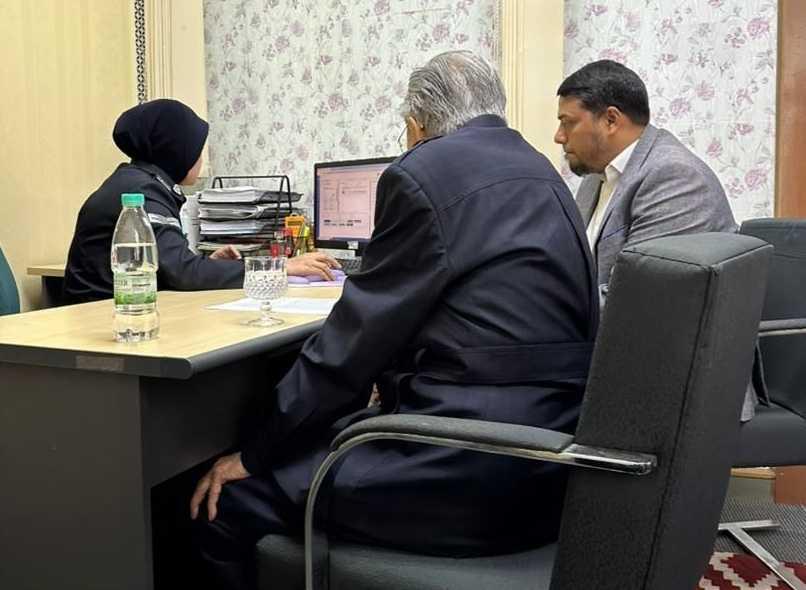
Dr Mahathir Mohamad today called on authorities to investigate Anwar Ibrahim for economic sabotage and undermining the country's sovereignty over an agreement signed with the US, in a historic police report lodged by one of Malaysia's best-known post-independence figures against a sitting prime minister.
In his report lodged at the Putrajaya police headquarters this morning, accompanied by lawyer Rafique Rashid, the centenarian said the Malaysia-US Agreement on Reciprocal Trade (ART) signed by Anwar with President Donald Trump in October could harm Malaysia's position and undermine its economic and political sovereignty.
"I believe that the action was taken without fully considering the national interest and, in my opinion, can be considered an act by someone who disregards the sovereignty of Malaysia as a sovereign country, and has the potential to drag the country into a situation where it is mortgaged to the influence of foreign powers," Mahathir said in his police report seen by MalaysiaNow.
He cited breaches under various sections of the Penal Code, namely sections 124B, 124C and 124K, dealing with acts of sabotage and activities detrimental to parliamentary democracy.
Mahathir also listed at least four major clauses in the agreement which he said effectively surrender Malaysia's sovereignty and trade independence to a foreign power.
They include clauses obliging Malaysia to follow any unilateral sanctions by the US against other countries, and to reveal Malaysia's cross-border data, which has "potential to interfere with the country's regulatory policy".
He also listed 14 negative implications for Malaysia, including those related to regulation of the halal industry, Bumiputera economic empowerment, national strategies for the high-tech sector, and export of critical minerals such as rare earth elements.
"All of these matters raise serious concerns, as in my opinion, they eliminate Malaysia's power to determine foreign policy, economic policy and the use of national strategic resources independently and sovereignly," said Mahathir.
'Probe MITI, AG and everyone involved'
He said any investigation should also probe elements of power abuse and negligence in discharging official duties, including breach of trust regarding decisions involving rare earths and critical minerals.
He said that besides Anwar, police should also question officials of the Ministry of Investment, Trade and Industry (Miti), the attorney-general, and all parties involved in the preparation and negotiation of the agreement.
Today's police report comes four days after Mahathir said Anwar should face charges of treason for signing the agreement.
"It is now clear that the statement by the government on the agreement with the US hid many serious undertakings by Malaysia to submit to the US," said Mahathir, the man widely credited with Malaysia's rapid economic growth throughout the eighties and nineties.
The agreement, which has been hailed by Anwar and government leaders, has sparked public outrage and criticism from experts and politicians over clauses seen as overwhelmingly favouring Washington's interests.
Among them is former attorney-general Tommy Thomas, who said the various commitments imposed on Malaysia showed that those involved in the negotiations – from the Prime Minister’s Office to the Attorney-General’s Chambers – "did not negotiate at all".
"The US handed them their draft. And it was signed lamely by Anwar, who had Trump’s pen to show for it, and a ride in Trump’s car," he said, referring to Trump's gift of a White House pen to Anwar shortly after the latter signed the agreement in Kuala Lumpur on the sidelines of the Asean Summit on Oct 26.
Details of the deal only emerged to the Malaysian public after the White House published them on its official website hours later.
At the heart of the outrage is a provision that obliges Malaysia to become a direct participant in US economic conflicts.
It states that if Washington imposes sanctions or tariffs on any third country for national security reasons, Malaysia "shall adopt or maintain a measure with equivalent restrictive effect", effectively ending Malaysia’s long-held foreign policy of non-alignment and mirroring US sanctions against other nations.
Anwar's defence of the agreement has renewed accusations of the Pakatan Harapan chairman's leaning towards US and Western policies, a claim cited by Mahathir as far back as 1998 when he sacked Anwar from the government during the height of the Asian financial crisis. - Malaysia Now, 2/12/2025
No comments:
Post a Comment