ON HUMAN RIGHTS, JUSTICE AND PEACE ISSUES, LABOUR RIGHTS, MIGRANT RIGHTS, FOR THE ABOLITION OF THE DEATH PENALTY, TOWARDS AN END OF TORTURE, POLICE ABUSES, DISCRIMINATION...
One can understand a few Covid-19 victims brought in dead(BID) - but 14.5% of 2,560 is too many - more than 370???
Explanation is certainly required by the Health Minister - how can this happen in modern Malaysia, which has a pretty good public healthcare system. The sick will go to clinics/hospitals for treatment - and it is natural that death happens in hospitals... so why were this 370 plus brought in dead...
Were the Undocumented migrants( too afraid to go to clinics/hospitals for fear of being arrested, detained and deported?) ...or were they locals. Were they from some 'ulu area' -- because after all every kampung/taman/kampung baru have government politically appointed Ketua Kampungs and JKKK..
Were they persons who died in police custody? Who are these people who were BROUGHT IN DEAD?
WHY DID THE SICK NOT GO TO HOSPITAL? THIS IS A MYSTERY....
EXPLANATION NEEDED
Health minister: A third of brought-in-dead cases linked to Covid-19 in May
Monday, 31 May 2021 10:20 AM MYT
BY SHAHRIN AIZAT NOORSHAHRIZAM
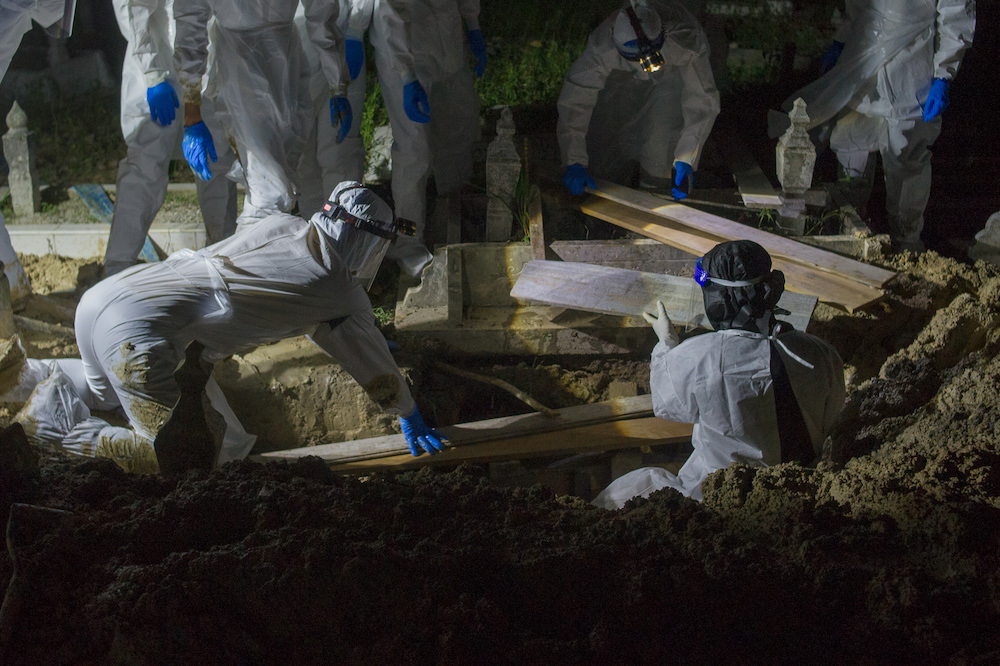
Health workers in personal protective
equipment prepare to bury the body of a Covid-19 victim at the Muslim
cemetery in Kampung Changkat Gombak, Kuala Lumpur May 30, 2021. —
Picture by Shafwan Zaidon
Follow us on Instagram and subscribe to our Telegram channel for the latest updates.
KUALA LUMPUR, May 31 — Brought-in-dead (BID) cases due to Covid-19
complications are rising at an exponential rate, and comprised 106 out
of 386 such cases this month alone, said Datuk Seri Dr Adham Baba.
According to Malay daily Utusan Malaysia, the health
minister attributed the spike to the deceased’s refusal to seek hospital
treatment despite testing positive for the highly infectious
coronavirus.
He cited the case of an 80-year-old man with a history of prostate
cancer who died at home after testing positive for Covid-19 24 hours
before his death.
He had refused to go to hospital despite showing signs of being asymptomatic for a week.
“The case was referred to the hospital but (he) refused to go to
hospital and went home instead. The patient was RT-PCR tested at an
examination centre the next day, where he was referred to a hospital
once again, but (he) returned home.
“A family member found the patient unconscious at 7pm on May 22. He
was pronounced dead at 7.20pm on the same day by a health officer,” he
told the Malay daily.
In total, Dr Adham added that individuals with a pre-existing medical
condition or comorbidity topped the BID list of Covid-19 dead since the
start of the pandemic, at 258 cases or 67 per cent.
This was followed by those with no known medical condition, at 96
cases (25 per cent), and cases with no information, at 32 cases (8 per
cent).
According to the report, the minister stated that 14.5 per cent of
Malaysia’s total 2,650 Covid-19 fatalities involved BID cases as of May
29.
“This month, 19 BID cases involved patients in home quarantine, while
the remaining cases tested positive for Covid-19 after the body arrived
at the hospital,” he added.
Two days ago, Malaysia reported the highest daily number of Covid-19
fatalities since the pandemic outbreak began in Malaysia, with 98
deaths. - Malay Mail, 31/5/2021
- Drug Trafficking still attracting death penalty - despite amendment providing alternative sentence
- Alternative sentence CONDITIONS a violation of right to fair trial(including rights to appeal), undermine judge's sentencing discretion
Madpet appalled by death sentence
13 Jun 2021 / 11:25 H
PETALING JAYA: Does
possession of more than 50gm of Methamphetamine justify death? Madpet
(Malaysians Against Death Penalty and Torture) posed this question in
speaking out against the death sentence passed on an individual in
April.
Madpet is appalled that yet another person is sentenced to
death for drug trafficking despite the perception that Malaysia has
amended the law on drug trafficking abolishing death penalty especially
for minor offenders or drug mules, other than the kingpins of drug
trafficking, its spokseman Charles Hector said today.
In
April 2021, Shahfary Sabri, a widower was sentenced to death by the
High Court here after he was found guilty of trafficking 149.5 grams of
methamphetamine three years ago.
“In Malaysia, if one is found in
possession of 50gm or more in weight of Methamphetamine, he will be
presumed under section 37 DDA to be a drug trafficker, under the
contrary is proved. If less, he would not be presumed to be a drug
trafficker,” Hector said in a statement.
“Dangerous
Drugs (Amendment) Act 2017, which provided the new possibility of a
sentence other than death for drug trafficking was gazetted in December
2017, and came into force on March 15, 2018. There is no justification
for the three months delay in coming into force, as all those who
committed the offence before that date will still be subject to the
mandatory death penalty.”
Shafary was charged with trafficking
the drugs in a hotel room here on Oct 19, 2018, which means that now,
there was the possibility of him not being sentenced to death.
“Sadly, media reports did not mention whether the alternative sentence to death was even considered by the courts,” Hector said.
Hundreds in death row despite changed position for minor drug traffickers, he pointed out.
“Sadly,
the Dangerous Drugs Act 1952, as amended today, still does not deal
with the hundreds still languishing on death row. There must be an Act
of Parliament that will commute the death sentences to imprisonment, or
even provide for a re-sentencing of those on death row.
“The
amended law will also not apply for those who allegedly committed the
offence before March 15, 2018, as all of them will still be subject to
mandatory death penalty.” - The Sun Daily, 13/6/2021
OPINIONS
COMMENT | 'Mandatory' death penalty still being meted out for drug offences
Charles Hector
13 Jun 2021, 8:52 am
COMMENT |
The Malaysians Against Death Penalty and Torture (Madpet) is appalled
that yet another person has been sentenced to death for drug trafficking
despite the perception that Malaysia has amended the law on drug
trafficking by abolishing the death penalty especially for minor
offenders or ‘drug mules’, other than the kingpins of drug trafficking.
In
April, Shahfary Sabri, a widower was sentenced to death by the High
Court after he was found guilty of trafficking 149.5g of methamphetamine
three years ago.
Does mere possession of over 50g of methamphetamine justify death?
In
Malaysia, if one is found in possession of 50g or more in weight of
methamphetamine, he will be presumed under Section 37 of the Dangerous
Drugs Act (DDA) to be a drug trafficker, until the contrary is proved.
If less, he would not be presumed to be a drug trafficker.
The
Dangerous Drugs (Amendment) Act 2017, which provided the new
possibility of a sentence other than death for drug trafficking was
gazetted in December 2017, and came into force on March 15, 2018. There
was no justification for the three-month delay in having it come into
force, as all those who committed the offence before that date will
still be subjected to the mandatory death penalty.
In this case,
Shafary was charged with trafficking the drugs in a hotel room on
October 19, 2018, which means that now, there was the possibility of him
not being sentenced to death. Sadly, media reports did not mention
whether an alternative sentence to death was even considered.
To satisfy conditions for an alternative sentence means abandonment of right to a fair trial.
Section
39B(2A) of the amended DDA, now states that "the court in imposing the
sentence of imprisonment for life and whipping of not less than 15
strokes, may have regard only to the following circumstances: (a) there
was no evidence of buying and selling of a dangerous drug at the time
when the person convicted was arrested; (b) there was no involvement of
agent provocateur; or (c) the involvement of the person convicted is
restricted to transporting, carrying, sending or delivering a dangerous
drug; and (d) that the person convicted has assisted an enforcement
agency in disrupting drug trafficking activities within or outside
Malaysia."
The amended law is unjust as it undermines the right to
a fair trial, as one of the rights of any accused person is the right
to remain silent – being the right not to take the stand and deliver
evidence themselves, which, if he or she does so, that accused shall be
subject to cross examination by the prosecution.
In most criminal
trials, the best advice is for the accused not to personally take the
stand as a witness, and to call other defence witnesses. Remember that
even in PKR president Anwar Ibrahim's trial, he elected not to take the
stand as a witness – but elected to just make a statement, whereby in
such a situation, there will be no cross-examination by the prosecution.
However, in this case, Shahfary took the stand as the only defence
witness.
It also undermines the right to a fair trial, because
after conviction and sentencing at the court of first instance, one has
the right to appeal – two rights of appeal. If the court of first
instance is the High Court, which is the case when one is charged with a
capital offence (death penalty), the right to appeal lies to the Court
of Appeal, and thereafter to the Federal Court.
It will be unjust
for the convicted, to prejudice this rights of appeal simply to ‘admit’
and assist enforcement agencies to save himself from the death penalty,
and hope that he will be sentenced to imprisonment.
At the end of
the day, the amendments may have brought about the possibility of an
alternative sentence to the death sentence, being imprisonment for life
with whipping of not less than fifteen strokes.
Madpet advocates
different sentences depending on the amount of drugs involved, or even
what exactly was done. Possession only may attract a lighter sentence,
compared to selling, distributing or smuggling into Malaysia the drugs.
Given
the conditions imposed, the mandatory death sentence may be abolished,
but practically it can be said that we still have the mandatory death
penalty for drug trafficking.
Judges' sentencing powers must not be inhibited by Parliament
Section
39B(2A) is also wrong, because it prevents judges from considering any
or all mitigation and aggravation factors before deciding on a just
sentence for each case.
Worse is the apparently mandatory
requirement of "the person convicted has assisted an enforcement agency
in disrupting drug trafficking activities within or outside Malaysia".
Note an actually innocent person certainly cannot satisfy this
condition.
Abolish presumptions, restore onus on DPP to prove all elements of crime
Section 37 presumptions remain an affront to justice and a fair trial, especially for death penalty offences.
In normal criminal cases, it is the duty of the prosecution to prove every element of the crime.
With
these presumptions in the DDA, the finding of a person with drugs in
their possession presumes that he/she is a drug trafficker or an
offender, and the accused person has the duty to prove that the drugs
were not his/hers, and he did not commit the offence which is a very
onerous duty, for which the lay person, especially the poor, does not
have the needed skills, capacity or resources.
For death penalty cases especially, the burden of proof of all elements of the crime must always rest with the prosecution.
Note
that besides the weightage presumptions, there are many other
presumptions like ‘"if any dangerous drug is found to be concealed in
any premises, it shall be presumed, until the contrary is proved, that
the said drug is so concealed with the knowledge of the occupier of the
premises." How exactly can you prove that someone else may have hidden
the drugs, possibly without your knowledge, in your room, house or car?
Lawyers
generally may also lack the skills and capacity of conducting
investigations needed to secure evidence and additional witnesses to
rebut presumptions. Many criminal practitioners also do not even visit
the site the alleged offences is said to have been committed.
The
requirement for pre-trial disclosure by the prosecution is also much
lacking, in terms of the needed material that need to be provided to the
accused, and the time that it has to be provided.
Hundreds on death row despite changed position for minor drug traffickers
Sadly,
the Dangerous Drugs Act 1952, as amended today, still does not deal
with the hundreds still languishing on death row. There must be an act
of Parliament that will commute the death sentences to imprisonment, or
even provide for a re-sentencing of those on death row.
The
amended law will also not apply for those who allegedly committed the
offence before March 15, 2018, as all of them will still be subjected to
the mandatory death penalty.
In August 2020, de facto Law
Minister Takiyuddin Hassan said that, as of Aug 11 that year, a total of
918 prisoners were sentenced to death under Section 39B of which 472
are Malaysians and 446 are non-citizens.
Make special review committee's report public
The
special committee to review alternative sentences to the mandatory
death penalty, made up of former Federal Court judges, former
Attorney-General’s Chambers officers, former Prisons Department senior
officers, the Bar Council, Human Rights Commission of Malaysia,
academics, criminologists and civil society organisations submitted
their report to the government on July 17, 2020 but sadly to date the
report is still not made available to the public.
Failure in amending law to abolish death penalty
The
previous BN government and the Pakatan Harapan Plus government were
already on the way towards the abolition of the death penalty, starting
with the mandatory death penalty. The Perikatan Nasional (PN)-BN Plus
government is also of like mind.
With reference to the report of the special committee on alternative sentences, the de facto
law minister also said that: “The findings are expected to answer the
debate on whether the government will propose amending the punishment
for drug trafficking to a minimum jail sentence so that punishments will
be given based on the facts of each case.”
Madpet hopes that the
government will not confine itself to drug trafficking, but will do the
needed for all death penalty offences.
Despite Malaysia’s
representation for the abolition of the death penalty, especially the
mandatory death penalty, little has been done to amend necessary laws.
The death penalty still even exists for offences where there are no
victims who suffered bodily harm or death during the commission of the
offence.
The possibility of miscarriage of justice, where an
innocent person may be wrongly sentenced to death or even hanged is very
real – noting that human beings are not infallible. Mistakes can happen
on the part of the police, enforcement officers, prosecutors, lawyers
and even judges. Once dead, nothing can be done to correct such mistakes
justly.
Madpet calls for the following:
The
removal of the restriction in the Dangerous Drugs Act 1952 on factors
that can be considered by judges before the imposition of a just
sentence;
The abolition of legal presumption in the Dangerous
Drugs Act 1952, and place on the prosecutors the burden of proving all
elements of the crime, as is the norm in most criminal cases;
Enactment
of law that will enable the commutation of death sentence, or the
provision of the ability for courts to review death sentence of drug
traffickers as even the amended law, does not address offences committed
before March 15, 2018 or the many hundreds that are still languishing
on death row;
The government to immediately disclose the
findings and report of the Special Committee to Review Alternative
Sentences to the Mandatory Death Penalty for we also ought to be given
the right to know or even make further inputs;
For a review of
the offence of drug trafficking, and the introduction of different
alternative, more just sentences depending on the facts of each case,
emphasising also on the principle of rehabilitation and second chances;
For the abolition of the death penalty, and the imposition of a moratorium on executions pending abolitions; and
For
Malaysia to respect the right to a fair trial, and remove provisions in
law that unjustly compels one to abandon one’s fair trial rights simply
to avoid the death penalty.
CHARLES HECTOR represents Malaysians Against Death Penalty & Torture (Madpet). - Malaysiakini, 13/6/2021
Drug Trafficking Still ‘Mandatory’ Death Penalty, Unjust Conditions For
Alternative Sentence Violates Rights Of Fair Trial And Justice
BN, PH Plus and Perikatan Nasional-BN Plus for abolition
MADPET(Malaysians Against Death
Penalty and Torture) is appalled that yet another person is sentenced to death for
drug trafficking despite the perception that Malaysia has amended the law on
drug trafficking abolishing death penalty especially for minor offenders or ‘drug
mules’, other than the kingpins of drug trafficking.
In April 2021, Shahfary Sabri, a
widower was sentenced to death by the High Court here after he was found guilty
of trafficking 149.5 grams of methamphetamine three years ago. (Malay Mail 22/4/2021, also Utusan Malaysia).
Does mere passion of more than 50 grams of Methamphetamine justify death?
In Malaysia, if one is found in
possession of 50 grammes or more in weight of Methamphetamine, he will be presumed
under section 37 DDA to be a drug trafficker, under the contrary is proved. If
less, he would not be presumed to be a drug trafficker.
Dangerous Drugs (Amendment) Act
2017, which provided the new possibility of a sentence other than death for
drug trafficking was gazetted in December 2017, and came into force on
15/3/2018. There is no justification for the 3 months delay in coming into
force, as all those who committed the offence before that date will still be
subject to the MANDATORY death penalty.
In this case, Shafary was charged
with trafficking the drugs in a hotel room here on October 19, 2018, which
means that now, there was the possibility of him not being sentenced to death.
Sadly, media reports did not mention whether the alternative sentence to death
was even considered by the Courts.
To satisfy conditions for alternative sentence means abandonment of right
to fair trial
Section 39B(2A) of the amended DDA,
now states that ‘…the Court in imposing the sentence of imprisonment for life
and whipping of not less than fifteen strokes, may have regard only to the
following circumstances:(a) there was
no evidence of buying and selling of a dangerous drug at the time when the person
convicted was arrested; (b) there was no involvement of agent provocateur; or
(c) the involvement of the person convicted is restricted to transporting,
carrying, sending or delivering a dangerous drug; and (d) that the person convicted has assisted an enforcement
agency in disrupting drug trafficking activities within or outside
Malaysia.
The amended law is unjust as it
undermines the right to a fair trial, as one of the rights of any accused
person is the right to remain silent – being the right not to take the stand
and deliver evidence themselves, which, if he or she does so, that accused
shall be subject to cross examination by the prosecution. In most criminal
trials, the best advice is for the accused not to personally take the stand as
a witness, and to call other defence witnesses. Remember that even in the
infamous Anwar Ibrahim trial, he elected not to take the stand as a witness –
but elected to just make a statement, whereby in such a situation, there will
be no cross-examination by the prosecution. However, in this case, Shahfary
Sabri took the stand as the only defence witness.
It also undermines the Right to a
Fair Trial, because after conviction and sentencing at the Court of first
instance, one has the right to appeal – 2 rights of Appeal. If the Court of 1st
Instance is the High Court, which is the case when one is charged with a
capital offence (death penalty), the right to appeal lies to the Court of
Appeal, and thereafter to the Federal Court. It will be unjust for the
convicted, to prejudice this rights of appeal simply to ‘admit’ and assist
enforcement agencies simply to save himself from death penalty, and hope that
he will be sentenced to imprisonment.
At the end of the day, the
amendments may have brought about the possibility of an alternative to death
sentence, being imprisonment for life with whipping of not less than fifteen
strokes. MADPET advocates different sentences depending on the amount of drugs
involved, or even what exactly was done. Possession only may attract a lighter
sentence, compared to selling or distributing or smuggling into Malaysia the
drugs.
Given the conditions imposed, the
mandatory death sentence may be abolished, but practically it can be said that
we still have the mandatory death penalty for drug trafficking.
Judges Sentencing powers must not be inhibited by Parliament
Section 39B(2A) is also wrong,
because it prevents judges from considering any or all mitigation and
aggravation factors before deciding on a just sentence for each case.
Worse, is that apparently mandatory
requirement that ‘…the person convicted has assisted an enforcement agency in
disrupting drug trafficking activities within or outside Malaysia…’. Note an actually
innocent person certainly cannot satisfy this condition.
Abolish presumptions, restore onus on Prosecution to prove all elements
of crime
The section 37 presumptions is remains
an affront to justice and a fair trial, especially for death penalty offences.
In normal criminal cases, it is the
duty of the prosecution to prove every element of the crime.
With these presumptions in the DDA,
the finding of a person with drugs in their possession presumes that he/she is
a drug trafficker or an offender, and the accused person has the duty to prove
that the drugs were not his/hers, and he did not commit the offence which is a
very onerous duty, for which the lay person, especially the poor, does have the
needed skills, capacity or resources.
For death penalty cases especially,
the burden of proof of all elements of the crime must always rest with the
prosecution.
Note that besides the weightage
presumptions, there are many other presumptions like ‘if any dangerous drug is
found to be concealed in any premises, it shall be presumed, until the contrary
is proved, that the said drug is so concealed with the knowledge of the
occupier of the premises..’[S.37(g)]. How exactly can you prove that someone
else may have hidden the drugs, possibly without your knowledge, in your room,
house or car?
Lawyers generally may also lack the
skills and capacity of conducting investigations needed to secure needed
evidence and additional witnesses to rebut presumptions. Many criminal
practitioners also do not even visit the site the alleged offences is said to
have been committed. The requirement for pre-trial disclosure by the
prosecution is also much lacking, in terms of the needed material that need to
be provided to the accused, and the time that it has to be provided.
Hundreds in death row despite changed position for minor drug traffickers.
Sadly, the Dangerous Drugs Act
1952, as amended today, still does not deal with the hundreds still languishing
on death row. There must be an Act of Parliament that will commute the death
sentences to imprisonment, or even provide for a re-sentencing of those on
death row.
The amended law will also not apply
for those who allegedly committed the offence before 15/3/2018, as all of them
will still be subject to mandatory death penalty.
In August 2020, the de facto Law
Minister Datuk Takiyuddin Hassan said that, as of Aug 11, a total 918 prisoners
have been sentenced to death under Section 39B of which 472 are Malaysians and
446 are non-citizens. (Malaysian Reserve,
14/8/2020)
Report of the Special Committee To Review Alternative Sentences To The
Mandatory Death Penalty
The special committee to review
alternative sentences to the mandatory death penalty, made up of former Federal
Court judges, former Attorney General’s Chambers officers, former Prisons
Department senior officers, the Bar Council, Human Rights Commission of Malaysia,
academics, criminologists and civil society organisationssubmitted their
report to the government on July 17, 2020 but sadly to date the report is still
not made available to the public.
Failure in amending law to abolish death penalty
The previous Barisan Nasional
government and the Pakatan Harapan Plus government were already on the way
towards the abolition of the death penalty, starting with the mandatory death
penalty. The Perikatan Nasional-BN Plus government is also of like mind.
With reference to the report of special
committee on alternative sentences, the de facto law Minister also said that “The findings are expected to answer the
debate on whether the government will propose amending the punishment for drug
trafficking to a minimum jail sentence so that punishments will be given based
on the facts of each case,”. MADPET hopes that the government will not confine
itself to drug trafficking, but will do the needed for all death penalty
offences.
Despite Malaysia’s representation
for the abolition of the death penalty, especially the mandatory death penalty,
little has been done to amend necessary laws. Death penalty still even exists
for offences where there are no victims who suffered bodily harm or death
during the commission of the offence.
The possibility of miscarriage of
justice, where an innocent person may be wrongly sentenced to death or even
hanged is very real – noting that human beings are not infallible. Mistakes can
happen on the part of the police, enforcement officers, prosecutors, lawyers
and even judges. Once dead, nothing can be done to correct such mistakes
justly.
MADPET calls for the removal of current
restriction in the Dangerous Drugs Act 1952 on factors that can be considered
by judges before the imposition of a just sentence;
MADPET calls for the abolition of
legal presumption in the Dangerous Drugs Act 1952, and place on the prosecutors
the burden of proving all elements of the crime, as is the norm in most
criminal cases;
MADPET calls for enactment of law
that will enable the commutation of death sentence, or the provision of the ability
for courts to review death sentence of drug traffickers as even the amended law,
does not address offences committed before 15/3/2018 or the many hundreds that
are still languishing on death row;
MADPET calls on the government to
immediately disclose the findings and report of the Special Committee To Review
Alternative Sentences To The Mandatory Death Penalty for we also ought to be
given the right to know or even make further inputs;
MADPET also calls for a review of
the offence of drug trafficking, and the introduction of different alternative more
just sentences depending on the facts of each case, emphasizing also on the
principle of rehabilitation and second chances;
MADPET reiterates its call for the
abolition of the death penalty, and the imposition of a moratorium on
executions pending abolitions; and
MADPET calls on Malaysia to respect
the Right To Fair Trial, and remove provisions in law that unjustly compels one
to abandon one’s fair trial rights simply to avoid the death penalty.
Charles Hector
For and on behalf of MADPET(Malaysians Against Death
Penalty and Torture)
Kuala Lumpur High Court sentences widower to death for drug trafficking
Thursday, 22 Apr 2021 04:12 PM MYT
Judicial Commissioner Datuk Azhar
Abdul Hamid handed down the sentence to Shahfary Sabri, 47, after
finding that the defence had failed to raise reasonable doubts against
the prosecution case.— Reuters pic
KUALA LUMPUR, April 22 — A widower was sent to the gallows by the
High Court here today after he was found guilty of trafficking 149.5
grams of methamphetamine three years ago.
Judicial Commissioner Datuk Azhar Abdul Hamid handed down the
sentence to Shahfary Sabri, 47, after finding that the defence had
failed to raise reasonable doubts against the prosecution case.
The father of six was charged with trafficking the drugs in a hotel
room here on October 19, 2018, under Section 38B(1)(a) of the Dangerous
Drugs Act 1952 and punishable under Section 39B(2) of the same law,
which provides the mandatory death sentence upon conviction.
The prosecution called a total of five witnesses while the accused
was the sole defence witness who testified at the trial which began on
September 3, 2020.
Deputy public prosecutor Annur Atiqah Abd Hadi prosecuted, while
Shahfary was represented by lawyer Haris Salleh Hamzah. — Bernama - Malay Mail, 22/4/2021
Dadah berbalut plastik ‘Thank You’, ejen hotel digantung
Oleh NORLIZAH ABAS
22 April 2021, 1:10 pm
KUALA
LUMPUR: Seorang bapa tunggal kepada enam orang anak dijatuhi hukuman
gantung selepas didapati bersalah oleh Mahkamah Tinggi di sini hari ini
terhadap tuduhan mengedar dadah Methamphetamine seberat 149.5 gram di
sebuah hotel, tiga tahun lalu.
Pesuruhjaya Kehakiman Datuk Azhar Abdul Hamid mensabitkan Shahfary
Sabri, 47, terhadap tuduhan itu selepas berpuas hati tiada keraguan
munasabah ditimbulkan oleh pihak pembelaan dalam kes itu.
Ejen bebas yang bertugas mendapatkan pelanggan hotel itu didakwa
mengedar dadah kira-kira pukul 11 malam, 19 Oktober 2018 di hadapan
bilik sebuah hotel di sini.
Dia didakwa mengikut Seksyen 39B(1)(a) Akta Dadah Berbahaya yang
boleh dihukum di bawah Seksyen 39B(2) akta sama yang memperuntukkan
hukuman mati mandatori.
Pendakwaan dikendalikan oleh Timbalan Pendakwa Raya Annur Atiqah Abd.
Hadi manakala tertuduh diwakili oleh peguam Haris Salleh Hamzah.
Perbicaraan terhadapnya bermula pada 3 September tahun lalu dengan
lima saksi pendakwaan memberi keterangan manakala tertuduh adalah saksi
tunggal pihak pembelaan.
Ketika perbicaraan berlangsung, mahkamah diberitahu bahawa tertuduh
ditahan oleh pihak polis di lobi hotel berkenaan sebelum dibawa naik ke
salah sebuah bilik hotel itu untuk pemeriksaan lanjut.
Siasatan polis menemukan dadah berbalut plastik hitam bertulis
perkataan ‘Thank You’ dalam seluar di celah pinggangnya. – UTUSAN ONLINE, 22/4/2021
Cabinet to mull scrapping death penalty for drug offences
THE Cabinet will review options to abolish capital
punishment for drug trafficking offences, de facto Law Minister Datuk
Takiyuddin Hassan said.
Following the final report by the special committee to
review alternative sentences to the mandatory death penalty, which was
submitted to the government on July 17, the minister said discussions
will be held before a decision is made on the matter.
“The final report contains recommendations on alternative
punishments for 11 offences that carry the mandatory death sentence,
offences under the Dangerous Drugs Act 1952 (Act 234), and 21 offences
that carry the discretionary death sentence,” he told the August house
yesterday.
He was responding to Ramkarpal Singh (Pakatan Harapan
[PH]-Bukit Gelugor) who asked the prime minister whether the government
would abolish the death sentence for drug trafficking.
Takiyuddin added that the committee had also made recommendations for long-term improvements to the country’s justice system.
“The report is expected to be presented at a Cabinet meeting for consideration and approval.
“The findings are expected to answer the debate on whether
the government will propose amending the punishment for drug
trafficking to a minimum jail sentence so that punishments will be given
based on the facts of each case,” he said.
According to the law minister, as of Aug 11, a total 918
prisoners have been sentenced to death under Section 39B of which 472
are Malaysians and 446 are non-citizens.
Under section 39B of the Dangerous Drugs Act, those in
possession of 15g or more heroin and morphine; 1,000g or more opium (raw
or prepared); 200g or more cannabis; and 40g or more cocaine will
receive the mandatory death sentence.
Last year, a special committee was established to carry
out the Compensation Penalty Study on Mandatory Death Penalty within
four months from Sept 20, 2019, to Jan 31, 2020.
“The special committee submitted the study on July 17 instead of January as they needed more time.
“Regardless, it is the government’s intention for the
changes to be implemented as soon as possible. Malaysia continues to
engage in smart partnerships with countries that use their laws to curb
drug abuse in addition to other measures used to address drug
trafficking,” Takiyuddin said.
He emphasised that the government also takes international conventions into consideration.
“My predecessor has initiated this matter, for the
national interest. We have conducted the study and I will evaluate as
best as possible which stems from the previous government’s intent to
make sure that justice is served.
“I give my assurance that we will fully consider the recommendations that have been set out by the committee,” he added.
The special committee members comprise former Federal
Court judges, former Attorney General’s Chambers officers, former
Prisons Department senior officers, the Bar Council, Human Rights
Commission of Malaysia, academics, criminologists and civil society
organisations. - The Malaysian Reserve, 14/8/2020
Recently, heard that even golf clubs and courses got exemptions to operate during the strict MCO starting 1st June - Maybe the government can clarify?
Azmin Ali's Ministry of INTERNATIONAL Trade and Industry have been giving exemptions - WHY? Do we not have aMinistry of Domestic Trade?
'Full' Lockdown will only work if the government is STRICT - no exemption to any other businesses save the most essential - health, food, garbage collections, petrol stations, ...
Why has the government still not come out with a paid COVID leave for workers - for those who are forced to quarantine themselves, for those living in EMCO areas, those who cannot work because workplaces close because of Covid, etc
Full lockdown extended till June 28, says Ismail Sabri
Updated 7 hours ago ·
Published on 11 Jun 20
The government is extending
the movement-control order for another two weeks from June 15 to June
28, says Senior Minister Ismail Sabri Yaakob. – The Malaysian Insight
pic by Afif Abd Halim, June 11, 2021.
PUTRAJAYA has
extended the movement-control order (MCO 3.0) for another two weeks from
June 15 to June 28, said Senior Minister Ismail Sabri Yaakob.
He said the decision was made as the number of new Covid-19 cases is
still more than 5,000 despite the country being in full lockdown for the
past 10 days.
The extension follows recommendations by the Health Ministry at a
meeting this morning chaired by Prime Minister Muhyiddin Yassin.
“The standard operating procedure (SOP) remain the same and I hope there will be no more confusion,” said Ismail Sabri.
“For further information, the public can access the government’s website at www.mkn.gov.my,” he added.
The full lockdown was imposed for two weeks from June 1 as a measure
to flatten the Covid-19 curve, following a sharp rise in the daily
number of cases since early April.
No social activities are permitted and only a few essential economic activities can continue.
Restaurants, food stalls, laundry services (including self-service
laundries), pet care and food stores, eyewear and optical goods stores,
hardware stores, vehicle repair and spare part shops, e-commerce (all
product categories) as well as wholesale and distribution (for essential
products only) are allowed to operate.
During the lockdown period, 80% of government staff and 40% of private sector workers are to work from home.
Malaysia reported 6,849 fresh Covid-19 cases in the past 24 hours, an
increase of more than a thousand infections reported yesterday, said Dr
Noor Hisham Abdullah.
The health director-general said Selangor reported the greatest
number of cases by states, as it recorded 2,558 infections as of noon
today, followed by Kuala Lumpur (884) and Sarawak (699).
This would be the 50th consecutive day that Selangor has topped the cases among the states. – June 11, 2021.
Eighteen manufacturing, MRS sectors are allowed to operate during MCO -- MITI
30/05/2021 07:21 PM
KUALA LUMPUR, May
30 -- The Ministry of International Trade and Industry (MITI) has
announced 18 manufacturing and manufacturing-related services (MRS)
sectors that are allowed to operate under the Movement Control Order
(MCO) from June 1 to 14, 2021.
The ministry said it is,
however, subject to the companies getting an approval letter from the
ministry, which can be downloaded from the COVID-19 Intelligent
Management System (CIMS) 3.0.
Thirteen of the sectors
are allowed to operate at 60 per cent workforce capacity while the
remaining five are permitted to operate with 10 per cent workforce.
"The
manufacturing and MRS sectors are allowed to operate to ensure minimal
disruption to the supply chain of critical parts, components and
finished products.
“This is essential to
support the continued operations of critical infrastructures and
front-liners such as security, healthcare systems, information and
communications, as well as ensure adequate supply of basic necessities
for the rakyat,” MITI said in a statement today.
Effective 8pm today (May
30), manufacturing companies that have already registered with CIMS 3.0
are required to download the new MITI approval letter and where
necessary, update their workers' list while for those that have yet to
register, submission can be made starting 1pm on Monday (May 31).
"In
addition, workers in the manufacturing and MRS sectors will be required
to present MITI's approval letter, together with their company-issued
letter of employment or staff identification card, to the enforcement
authorities to enable their movement to and from their work premises.
“Manufacturing and MRS
sectors that are allowed to operate must ensure strict adherence to the
standard operating procedures (SOPs) set by the National Security
Council (MKN) and MITI. Failure to comply with the SOPs is a serious
offence and may result in fines and/or closure of premises,” it said.
To ensure effective
compliance with the SOPs, the ministry said, comprehensive and stringent
enforcement will be carried out by federal and state enforcement
agencies.
The sectors
allowed to operate at 60 per cent workforce capacity are aerospace
including maintenance, repair and overhaul (MRO); food and beverage;
packaging and printing materials; personal care products and cleaning
supplies; healthcare and medical care including dietary supplement;
personal protective equipment (PPE) including rubber gloves and fire
safety equipment; medical equipment components; electrical and
electronics; oil and gas, including petrochemical and petrochemical
products; chemical products; machinery and equipment; textiles for
manufacturing of PPE only; and production, distillation, storage, supply
and distribution of fuels and lubricants.
Meanwhile, the five
sectors allowed to operate with 10 per cent workforce are automotive
(vehicles and components); iron and steel; cement; glass; and ceramics.
Details on how to register at CIMS 3.0 (via notification.miti.gov.my) can be accessed through www.miti.gov.my.
Workplace ClusterJalan Equine in Petaling, Selangor (29 cases) - what is the name of the factory/business that is this workplace cluster?
WHY IS THE GOVERNMENT HIDING THE NAME OF THE FACTORY/BUSINESS - TO PROTECT THE OWNERS...THE COMPANY? The name of the company and factory must be disclosed.
If we know this, then ALL of us can immediately exercise caution and stay away from workers from these particular factory/workplace at least for 14 days...
FOR WORKERS, it is very important for them to know that they have been infected at the Workplace - this is important so that they can claim SOCSO/PERKESO or workplace insurances, and get the needed benefits easily. [If not some insurance companies may claim that they were infected somewhere else]
REMEMBER, that a worker who gets SOCSO and/or work insurance benefits STILL CAN SUE THE EMPLOYER/OWNER OF WORKPLACE for additional damages and compensations.
THUS, when a worker gets Covid-19 at the workplace, the Department of Safety and Health(DOSH) and other relevant government departments must immediately INVESTIGATE and determine whether the employer/owner of the workplace has been in full compliance of the laws that requires the employer/owner to provide a SAFE AND HEALTHY WORKING ENVIRONMENT - if the employer was found to be in breach of the law, this would have resulted an increased RISK - hence, the infected worker can SUE for higher damages/compensation from their employer/owner.
NOW, if this factory/business was not an original 'essential service' business, but one that got SPECIAL EXEMPTION from MITI or some other Minister, then the worker may also be able to SUE the said Minister, Ministry and government for damages as well...
When a worker gets infected at Covid-19, then AUTOMATICALLY, the workplace must be shut down, and all workers quarantined, be it home quarantine or other wise for 14 days - not for any lesser period.
WHY 14 DAYS - well, the government itself has acknowledged that immediate testing of whether one is infected is not enough.
14 days quarantine - why not immediate release after the person tested is found to be negative. Well, the reason is that a person infected may not be detected by tests a few days after infection - He/she may show negative results until maybe much later, the 10th, 12th day....Now, quarantine period for persons arriving in Malaysia from certain countries have been extended to 21 days...
Therefore, when we read of people being tested for Covid - one wonders whether they are also re-tested after the 12th day of contact with an infected?
The current strict nation-wide MCO is for 14 days - but the effectiveness may already be compromised by so many 'exemptions' granted to businesses, which reasonably are 'non-essential'...
There have been so many WORKPLACE CLUSTERS - which reasonably would mean, the first infection that infects many others started at that workplace, and now fellow workers(and maybe even their family members are all getting infected)...
REMEMBER, THE WORKER CAN SUE THE EMPLOYER/OWNER OF THE WORKPLACE FOR DAMAGES/COMPENSATIONS - this is over and above the benefits the workers may have got from SOCSO/PERKESO or any other work insurance schemes.
Now, those who gets later infected from such 'workplace clusters' reasonably can also SUE the employer/owner of the factory where it all started - this can include friends and family that were infected by Covid-19 that were in close contact with a worker who got Covid-19 from their workplace.
15 of the 24 new clusters are from workplaces, says Health D-G
There are 730 active
clusters in the country, including 24 new ones reported today, says
Health Ministry director-general Dr Noor Hisham Abdullah. – The
Malaysian Insight pic by Hasnoor Hussain, June 8, 2021.
WORKPLACES accounted for more than half of the 24 new Covid-19 clusters reported by the Health Ministry today.
Health Ministry director-general Dr Noor Hisham Abdullah said there were 15 workplace clusters on the list today.
They were:
1) Jalan Satu Olak Dua in Kuala Langat, Selangor (six cases)
2) Jalan Equine in Petaling, Selangor (29 cases)
3) Jalan Enam C in Hulu Langat, Klang, Petaling and Sepang, Selangor (21 cases)
4) Bukit Rahman Lapan in Gombak, Selangor (19 cases)
5) Coral in Kota Kinabalu, Sabah (nine cases)
6) Ocean Blue in Kota Kinabalu, Sabah (99 cases)
7) Segara in Kota Kinabalu, Sabah (11 cases)
8) Industri Tanjung Agas in Tangkak, Johor (eight cases)
9) Jalan Kesang in Tangkak, Johor (19 cases)
10) Dah Mahang Merah in Kulim and Kuala Muda, Kedah (19 cases)
11) Muda 2 construction site in Titiwangsa, Kuala Lumpur (33 cases)
12) Jalan Alamanda Presint Satu in Putrajaya (11 cases)
13) Jalan Seruling in Seberang Perai Selatan (23 cases)
14) Jalan Kota Jelasin in Kota Baru and Tumpat, Kelantan (10 cases)
15) Jalan Sri Jaafar in Bentong, Pahang (32 cases)
The Segara cluster was discovered at an oil rig while Jalan Alamanda Presint Satu cluster involved workers of a restaurant.
The other workplace clusters were discovered at factories, companies and public institutions.
Apart from the workplace clusters, health authorities also reported five new community clusters.
The community clusters were:
1) Kg Bundu in Kuala Penyu, Sabah (39 cases)
2) Tg Aru Baru in Kota Kinabalu, Sabah (30 cases)
3) Ulu Teru in Miri and Beluru, Sarawak (46 cases)
4) Ulu Sebakong in Mukah, Sarawak (61 cases)
5) Rantau Kenanga in Hilir, Perak (39 cases)
The Ulu Sebakang cluster was linked to a funeral.
Rounding up the list of clusters today were the Jalan Logah Segamat
religious activities cluster and the Teluk Kabung, Jalan Melang and
Jalan Cempedak 2 clusters which involved high-risk communities.
Jalan Cempedak 2 (17 cases) in Kepong was detected following
screening of residents of an old folks’ home while Teluk Kabung (47
cases) involved residents of a shelter.
The Jalan Melang cluster in Kuala Pilah, Negeri Sembilan, which saw 47 cases involved staff of a medical centre.
Covid-19 MCO - was meant to be a response to reduce the spread and infection amongst us in Malaysia - Workplaces/Business were shut down to ensure that people stay home and do not move around to reduce the spread. Only essential business/workplaces allowed to operate....it was for 14 days...
But then Azmin Ali's Ministry of International Trade and Industry (and other Ministers and government bodies) started giving exemptions again to certain businesses/workplaces, which may not be 'essential services' during this pandemic - hence DEFEATING the effectiveness of the MCO ...
...128,150 companies with some
1.57 million employees had been approved to remain operational during
the two-week lockdown.
This is not the first time the government and its Ministers have done this ...and today Malaysia still remains with very high daily infections...and increasing deaths... Logging firms also 'essential businesses'? Remember, Parliament has not been operating - so OK for workers to face risks, but not MPs and ADUNs?
WHERE IS THE LIST OF BUSINESS GIVEN EXEMPTION? Show it to us...
When exemptions are granted, workers have NO CHOICE but to return to work...and after work return home to their families...The owners stay at home safe?
Traffic should have been minimum ...but still we see large number of vehicles in the road..
The 'indiscipline' of the PN-BN Plus government fails to suppress Covid-19 transmission, infections and death...
Remember, everyone wants business and income as usual, and everyone must jointly do the needed - no exceptions.
When companies/businesses gets exemptions - is there CORRUPTION, Abuse of Powers... Maybe MACC should be investigating all exemptions granted to the clearly 'non-essential' businesses..
The ESSENTIAL businesses that ought to be operating ought to be medical/health/pharmaceutical businesses, food production/distribution/retail, and the related distribution/transportation needed to ensure no shortages of food/medicine.
Other than that, maybe petrol stations, mechanics, public transportation...
REMEMBER, it is a total lockdown as Malaysian infections are very high - According to one statistics, Malaysia was yesterday the country with the 9th highest Covid-19 new cases...
The reason for the continuing high numbers of Covid cases, is the bad decisions made by the PN-BN Plus government --- The exemptions granted to businesses, the Ramadan bazaars...
For those who have strictly adhered to the SOPs, who have suffered income/business losses - we feel CHEATED ... For minor offences like forgetting to wear masks, moving ...people are being offered too HIGH compounds
Does the PN-BN Plus government really have the intention to speedily combat Covid-19 and the deaths that is rising? Or is other reasons governing their decision making during this pandemic?
Are businesses that really are providing 'essential services' enriching some individuals to get these exemptions?
NEW CASES - well, these really depends on the numbers being tested and who is being tested.
1 person found to infected would have come in contact with hundreds of persons in the community and places he visited...
Once tested is not enough - as it was pointed out, symptoms can arise much later to be detected after many days ....NOW, the compulsory quarantine period has been again extended from 10 days to 14 days...WHY? Because the infected may only be tested 10 to more days after being infected.
So, repeat testing of the infected are needed..
The Ministry of Health is struggling to cope with the numbers - and required facilities are becoming unavailable thanks to the numbers..
14 days MCO - but still MITI and some others are giving un-needed EXEMPTIONS - Why?
Hence, most likely this 14-day nation-wide MCO will not work...Logically, it should have been longer, at least 28 days ...noting the 14-day quarantine requirement, and detection can happen 10-12 days after being infected...
WORKPLACE Clusters continue to appear - and which company/factory is not made known - WHY?
More than half – or 18 – of the new clusters originated from workplaces, Health Director-General Dr Noor Hisham said(6/6/2021)
If a worker is infected with Covid-19, logically it should be a 14-day shut down - if not why a '14-day Quarantine' - All workers should be also tested on the 10-12th day before being allowed to return. That will be for the good of workers - after all, many business owners/shareholders stay home safe but workers are put at risk?
MITI and other Ministries should not be giving any exemptions - it should be done by the HEALTH Ministry or the MKN - not individual Ministries of local governments...
EITHER MCO for all businesses - or just allow business total freedom to choose - If later, best that PM Muhyiddin just resign now - too many people are suffering...
WHAT IRKS MALAYSIANS IS THAT SUCH IRRESPONSIBLE 'EXEMPTIONS' WILL PROLONG COVID IN MALAYSIA - AND IT HAS ALREADY BEEN 15 MONTHS PLUS...
Ask Miti, Ismail says of 128,000 permits during lockdown
Ismail
Sabri Yaakob has refused to answer questions on the number of companies
allowed to operate, passing the buck instead to Azmin Ali, who is
minister of international trade and industry.
PETALING JAYA: Questions about why so many companies are receiving
exemptions and being allowed to operate during the lockdown should be
directed at the international trade and industry ministry (Miti), says
senior minister for security Ismail Sabri Yaakob.
The senior minister had been asked to comment on public confusion
surrounding the operation of essential service sectors during the June 1
to 14 lockdown, but he deflected the matter to Miti.
“It’s difficult for me to answer, because we have handed the
matter over to Miti. So, Miti will answer,” he said at a virtual press
conference today.
This comes after a Bernama report that 128,150 companies with some
1.57 million employees had been approved to remain operational during
the two-week lockdown.
According to Azmin Ali, who is minister of international trade and
industry, a total of 586,308 companies involving 10.2 million workers
have also registered under Miti’s Covid-19 Intelligent Management System
(CIMS) 3.0 as at 7.30am today.
Azmin also clarified that the chemical and electrical and electronics
sectors were listed as essential services as they were “closely linked
to ensuring that the people’s safety and health are protected”. FMT, 3/6/2021
Azmin Ali, Malaysia’s power grab architect, under fire for ‘half-baked’ coronavirus lockdown
Over
80,000 people have signed a petition calling for the International
Trade and Industry Minister to resign after non-essential businesses
including a furniture firm were granted exemptions from a supposedly
‘total’ lockdown
Malaysia
has been setting back-to-back records in daily new cases and critics
say the waivers will pile more pressure on a health-care system already
at breaking point
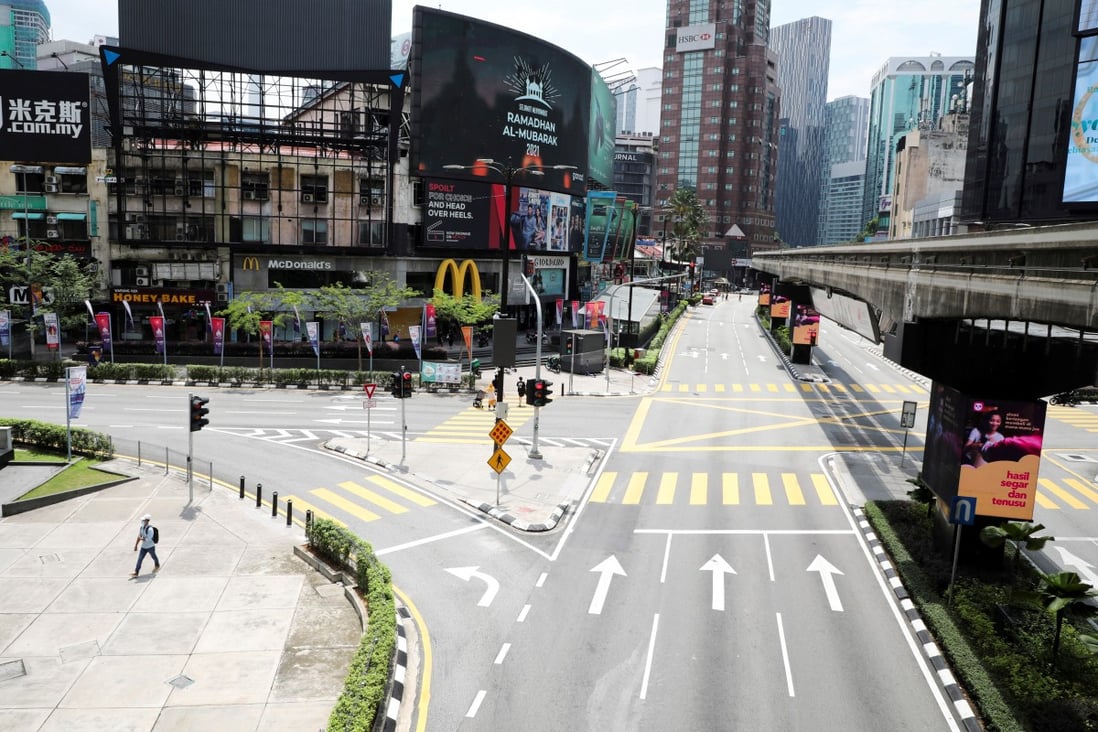
A deserted street during a coronavirus lockdown in Kuala Lumpur. Photo: Reuters
Tens of thousands of people on Thursday signed an online petition calling for the resignation of Malaysia’s International Trade and Industry Minister Azmin Ali as anger brewed over the large number of businesses granted permission to operate during an ongoing Covid-19 “total lockdown”.
Critics said the waivers, some of which were handed to non-essential businesses, would severely compromise the impact of the June 1 to June 14 lockdown just as the health-care system was reaching breaking point.
An earlier partial lockdown failed to stem a surge in cases which has brought on back-to-back records in daily new cases and fatalities.
Amid online vitriol against him on Thursday, Azmin – second in command in Prime Minister Muhyiddin Yassin’s government – issued a statement clarifying that his ministry was not the sole government department responsible for vetting and approving applications.
Instead, he said 15 ministries were involved in the approval process as part of the country’s Covid-19 Intelligent Management System (CIMS). International Trade and Industry Minister Azmin Ali. Photo: EPA-EFE
“The Ministry of Trade and Industry is not the sole decision maker on whether a business sector is considered an essential service or not,” Azmin said.
As of Thursday morning, 128,150 of 586,308 companies that applied for permission to operate during lockdown had obtained approval to do so, he said.
The approved companies had a total of 1.57 million workers.
Part of the controversy had to do with whether individual ministries would handle approvals for businesses under their regulatory purview.
The government had on Sunday said this was the case, but reversed course on Monday, saying instead that approvals had to go through CIMS – which is administered by Azmin’s ministry.
The local news portal Malaysiakini reported that a photography business and a leather furniture company were among businesses that had been granted permission to operate during the two-week lockdown. The government had earlier said the so-called “full lockdown” would shut down most businesses except those deemed essential.
Online, frustrations were compounded by a veiled comment by Security Minister Ismail Sabri. The official, who is the government’s point person on lockdown matters, wrote on social media on Wednesday: “I shut the front door, but…”
Some commentators speculated that he was venting his frustrations about the waivers Azmin had been granting, but asked about the matter on Thursday, the minister said there was no metaphorical meaning to his words
Out of the 30 new Covid-19
clusters reported in the country in the past 24 hours, 18 are traced to
workplaces. – The Malaysian Insight file pic, June 6, 2021.
THIRTY new
Covid-19 clusters were reported today, the most ever in a day, raising
the number of active clusters in the country to 713.
More than half – or 18 – of the new clusters originated from workplaces, Health Director-General Dr Noor Hisham said.
The 18 clusters and their number of infections, respectively, are:
1. Jalan Silat Harimau 21 in Johor Baru, Johor (12)
2. Jalan Bertam 23 in Johor Baru, Johor (6)
3. Jalan Teknologi Perintis Dua in Johor Bahru, Johor (15)
4. Jalan Kebun Sayur in Muar, Johor (55)
5. Jalan Parit Haji Zain in Muar, Johor (33)
6. Ladang Tereh in Klang, Johor (25)
7. Taman Aman in Kluang and Batu Pahat, Johor (17)
8. Jalan Utama in Sandakan, Sabah (15)
9. Sawit Kinabatangan in Kinabatangan, Sabah (29)
10. Jalan Ketiau Tombovo in Putatan, Sabah (9)
11. Persiaran Bak 26 in Petaling and Klang, Selangor (30)
12. Jalan Baja Enam Belas in Kuala Langat, Selangor (22)
13. Sri Cemerlang in Kota Baru and Pasir Mas, Kelantan (17)
14. Industry Chain Ferry in Seberang Perai Utara and Seberang Perai Tengah, Penang (25)
15. Hilir Sg Kluang Tiga in Barat Daya, Timur Laut and Seberang Perai Utara, Penang (71)
16. Industri Bukit Nian in Alor Gajah, Malacca (41)
17. Dah Saga in Kota Setar, Pendang and Sik, Kedah (42)
18. Jalan Alamanda Dua in Putrajaya, Hulu Langat, Petaling and Sepang, Putrajaya (8)
Other than the workplace clusters, seven community clusters were also reported.
They are:
1. Gusi in Papar, Sabah (25)
2. Tamalang in Kota Belud, Sabah (27)
3. Murni C in Nabawan and Penampang, Sabah (22)
4. Bukit Jong in Machang and Kota Baru, Kelantan (13)
5. Kg Bakong in Pasir Mas, Kelantan (8)
6. Kg Jejawi in Pasir Mas, Kelantan (7)
7. Jaya Gading in Kuantan, Pahang (53)
Two education clusters were also reported.
The Japan Kasturi Satu cluster in Hulu Langat, Selangor involved 15
cases, while the Behrang Station education cluster involving an
institute of higher education in Muallim, Perak reported 37 cases.
A cluster involving a high-risk group was reported in Bukit Gasing in
Petaling, Selangor, while a religious cluster was reported in Jasin and
Melaka Tengah in Malacca.
One cluster linked to a detention centre was reported in Pagar Jalan Sultanah in Mersing, Johor. – June 6, 2021. -Malaysian Insight
This is how Tabung Haji lost RM10bn
-
Mr Money TV breaks down the massive Tabung Haji scandal following the
declassification of the report by the royal commission of inquiry. How did
a fund c...
BN-PN topple PH in Negeri Sembilan
-
The Negeri Sembilan state assembly has 36 seats. Actual results: BN 18
seats + PN 7 seats = 25 seats PH 11 seats Ilham Centre’s prediction: Ong
Kian Ming’s...
APA PADA NAMA
-
1. Sejarah Malaysia dikait rapat dengan UMNO, Parti Kebangsaan Melayu
Bersatu. Parti UMNO pula dikenali dengan pemimpinnya. 2. Demikian di
peringkat permul...
China and HK may be barred from Asia Team meet
-
PETALING JAYA: The status of next week’s Asia Team Champion-ships in
Manila, the Philippines, is in quandary as two badminton nations – China
and Hong Kong...
PRU14 - Keputusan TEMERLOH - Parlimen dan DUN
-
Keputusan di Temerloh, harus kita analisa
1- Parlimen dimenangi Pakatan Harapan, yang juga menang DUN Mentakab,
tetapi BN menang DUN Lancang dan DUN Kuala ...
Thank you, Malaysians
-
Before the lights go out on The Malaysian Insider at midnight, we say
"Thank You" to our readers. TMI started on February 25, 2008. Today, after
eight year...
I believe in the freedom of expression - and everyone is free to use, reproduce, quote, copy and circulate, etc... materials published here. Please credit the source: http://charleshector.blogspot.com/.
For those of you who do have Blogs/Websites, it would be good if you could add a link to CHARLES HECTOR Blog. Please do promote the BLOG.
Anonymous comments or those containing profanities and obscenities (or irrelevant matters) will be rejected. Note that all comments made in post are personal opinions.
Number of Visits
Over 4 million visits. On an average, we have about 700-750 visits per day.Thank you all for your support and encouragement..







 There are 730 active
clusters in the country, including 24 new ones reported today, says
Health Ministry director-general Dr Noor Hisham Abdullah. – The
Malaysian Insight pic by Hasnoor Hussain, June 8, 2021.
There are 730 active
clusters in the country, including 24 new ones reported today, says
Health Ministry director-general Dr Noor Hisham Abdullah. – The
Malaysian Insight pic by Hasnoor Hussain, June 8, 2021.




 Posts
Posts