Should we CRIMINALIZE use of FAKE accounts or 'hired' account holders to generate FALSE impression of public support of PM, Madani Government policies/practices, Ministers, politicians or even political parties...??? Investigate allegations first - not whistleblowers, media or even online commentators...
The government does not intend to take any action against news portal Malaysiakini over a report that alleged fake accounts were set up to boost Prime Minister Datuk Seri Anwar Ibrahim's popularity, Deputy Communications Minister Teo Nie Ching told Dewan Rakyat today.
This is GOOD that the Malaysian government decided not to take action against Malaysiakini that EXPOSED this issue - BUT, the government MISSES THE POINT - Will action be taken against those who created/used this FAKE Accounts that gave the FALSE IMPRESSION that Malaysians support the Prime Minister or the Government? It is not TRUE because it is REALLY not the honest views of real Malaysians - but an attempt to create a FAKE impression that so many Malaysians support our PM.
Does it affect PUBLIC PERCEPTION? YES. Further many Malaysians may believe the FALSE impressions that many Malaysians out there support our PM or Government - which may cause some Malaysians to also support because 'so many' support...
Why did you CLAP in support of what that speaker said? Some may say because 'a lot of people were clapping' - so, because they believed the majority were in support - they too 'joined in'. YES, the impression that many SUPPORT do affect how some may also 'support'. It is common for such tactics to be used by makers of commercial products BUT certainly government/PM/Ministers should be HONEST and not use such tactics...
Product placement is used in movies because it is a powerful marketing tool that generates revenue for filmmakers while promoting brands to a captive audience. It allows brands to appear non-intrusively within a story, increasing brand awareness, fostering emotional connections, and creating aspirational associations with popular characters. By seamlessly integrating products, companies can improve brand recognition and potentially boost sales without the audience feeling overtly advertised to
Some may choose that product because prominent actors(which they like) are drinking Brand X - so, it must be good and OK, thus I too will start drinking Brand X.
It may be OK as a 'marketing strategy' - OR is it NOT? Is it an attempt to deceive consumers - into believing that it must be good.
BUT, is it OK for the Prime Minister and/or the Malaysian Government to use SIMILAR strategies like creating a FALSE IMPRESSION that so many more Malaysians will support the PM - when in fact, it a 'FALSE IMPRESSION' created online by false accounts or by persons 'hired' to do this - not an expression of their HONEST views - but an expression of a VIEW they were paid to promote...so, it can be said to be a DISHONEST ACT or method.
The Prime Minister and the Government especially must be HONEST - as such, any attempts of using 'FAKE accounts' or hired help to generate a FALSE IMPRESSION that may deceive the Malaysian public(and the world) into believing wrongly that MANY Malaysians support the PM or the MADANI government must be CRIMINALIZED. No offence if any Malaysians use social media or online communication to reveal their TRUE personal opinion or view.
From, the media report, it seems that META had acknowledged the existence of these 'FAKE ACCOUNTS' but said in this case 'it found no abnormal activity' - yes, it may not to promote scams, online gambling or pornography'
But was it used to promote the PM Anwar Ibrahim and/or the MADANI government/Ministers/etc...- IS THIS WRONG OR NOT?
What META decides or says is not that important - the question is whether it is RIGHT or WRONG according to Malaysians? according to the Malaysian government?
The issue of using online communications to affect Election outcome in US and other countries have already surfaced before.
So, in this case - will such online activity using faked accounts or 'hired help' not be seen as also trying to keep PM Anwar Ibrahim as Prime Minister OR maybe to affect the outcome of Elections in Malaysia?
The Minister in the statements in Parliament - seem to RE-focus the REAL ISSUE to whether action should be taken as the 'WHISTLEBLOWER' or the Media that highlighted this issue through 'investigative journalism' - into an issue of media freedom > rather than focusing on the allegations/wrongs raised.
Will the government ACT against the use of such 'fake accounts' or 'hired' help to manipulate public perception of the PM, Government,....?
"While Meta did admit the existence of fake accounts, they are mostly used to promote scams. In this case, Meta said it found no abnormal activity, so I think we should accept this fact," Teo said in reply to a question from Tanah Merah MP Ahmad Fadhli Shaari (PAS).
WRONG Minister, we should not accept this FACT - we should decide as Malaysians - is this wrong or not, especially when the 'beneficiary' of these actions is the PM or the incumbent government.
We recall what happened when Bloomberg, Murray Hunter(that writer) highlighted 'abuse' of the Ministers or government entities/Commissions - whereby in those cases, again actions were taken as them that highlighted PUBLIC Interest concerns.
Police report was filed against Bloomberg and Murray Hunter - hoping they will be charged for some crime maybe 'defamation' or sedition or some other crime.
Again, in these cases - matters HIGHLIGHTED seems to have still not been investigated.
Will
Malaysia file a police report in Thailand,etc against Bloomberg, like
it did for Murray Hunter? Have the allegations against Anwar, MACC, etc
been INVESTIGATED yet? Will a civil suit be commenced...?
MCMC has set up a portal https://sebenarnya.my/ some time back - that will investigate and inform the Malaysian public - What is FAKE and what is not? WHY? THIS was a VERY GOOD initiative by the Government of Malaysia - and it would be better, when the response is substantiated with proof.
Has the MCMC considered the 'comments/statements' of support of PM Anwar or government - and made a 'determination' of whether this is FAKE or NOT > I would consider it FAKE because it is from fake accounts, or from 'hired' help who are not expressing their honest real personal views - but a view/opinion that they were asked to do, paid to do,... Have the MCMC portal https://sebenarnya.my/ looked into this yet? WHY not? Does MCMC consider this TRUE simply because it is 'positive' for PM and government?
HAS MCMC or the Government of Malaysia still not come up with a POSITION on the usage of fake accounts or 'hired' help to BOOST the image of the PM, Government, any politician or Political Party - which must be seen as LIES, if it is not the TRUE HONEST views of the user of this online accounts?
Did META really say there was NO 'coordinated boost of Anwar's popularity'? Well, in the past, we may have believed anything the Minister or government says - BUT TODAY, many just do not trust mere words - SHOW us the said META letter, and all correspondences related. As it is, from the media report, it seems all that Meta may have said that they found BE TRANSPARENT
Teo Nie Ching: No probe into news portal after Meta denies coordinated boost for Anwar’s popularity

KUALA LUMPUR, Nov 12 — The government does not intend to take any action against news portal Malaysiakini over a report that alleged fake accounts were set up to boost Prime Minister Datuk Seri Anwar Ibrahim's popularity, Deputy Communications Minister Teo Nie Ching told Dewan Rakyat today.
Teo's ministry had previously dismissed the report, citing Meta's response that it found no “abnormal activity” to suggest there was a campaign to artificially bolster Anwar's approval rating.
Meta is the company that operates popular social media platforms such as Facebook and Instagram.
The deputy communications minister said today that the government will continue to respect press freedom even if it disagrees with some media reports that are critical of the ruling coalition.
"While Meta did admit the existence of fake accounts, they are mostly used to promote scams. In this case, Meta said it found no abnormal activity, so I think we should accept this fact," Teo said in reply to a question from Tanah Merah MP Ahmad Fadhli Shaari (PAS).
"And the Madani government's position, as repeatedly pointed out by PMX, is that we respect media freedom. Even if we disagree with some media reports, we will still state our disagreement, but this doesn't mean we need to summon them to record statements," the Kulai DAP MP added.
Malaysiakini had alleged that hundreds of accounts were involved in “coordinated inauthentic behaviour” (CIB) linked to Anwar's Facebook page.
Meta denied the allegation shortly after, but the news portal said it stood by the report.
CIB typically involves an organised effort by multiple fake or deceptive online accounts, often controlled by the same actors, to mislead people by pretending to be genuine individuals or entities.
These accounts work together in a coordinated way to amplify certain messages, manipulate public opinion, spread disinformation, or push political and social agendas.- Malay Mail, 12/11/2025
Summary
A Malaysiakini investigation finds a network of 263 Facebook accounts engaged in astroturfing to artificially boost support for Prime Minister Anwar Ibrahim.
The highly coordinated campaign, which uses shared phrases and a professional work schedule, includes an account of a state-level PKR Youth official.
Following the investigation, 76 accounts - including the high-priority ones - were removed or made inaccessible, though Anwar’s office denies involvement.
(Editor’s note: This article has been updated with a response from Meta.)
A Malaysiakini investigation has uncovered a network of at least 263 accounts engaging in a coordinated campaign to artificially boost support for Prime Minister Anwar Ibrahim on his official Facebook page.
The operation includes the Facebook account of Syukur Aiman Shukri, a state-level PKR Youth official.
The discovery comes two years after Meta removed a separate, 600-account network engaged in pro-government manipulation, which it linked to the police.
While the two networks operated under different administrations, and the police have denied involvement, the findings suggest that the use of coordinated inauthentic tactics to shape political discourse in Malaysia persists.
Experts who reviewed the findings said the patterns clearly indicate professional astroturfing – a campaign designed to create a false impression of grassroots support.
“(These patterns are) a strong indication of astroturfing, where a small organised set of actors tries to create the appearance of broad grassroots support,” said Nuurrianti Jalli, an expert on online propaganda at Oklahoma State University.
Over a three-month period, comments from this 263-account network comprised nearly one-quarter of all comments sampled by Malaysiakini from the prime minister's posts.
The shared script
The network relied on a shared script of pre-written phrases. These include generic praise like “bukti kerajaan Madani…” (proof that the Madani government is…) and specific talking points such as “gaji minima RM1,700” (RM1,700 minimum wage).
This tactic was designed to create an “illusion of consensus”, according to Ross Tapsell, an expert on Southeast Asian digital media at the Australian National University.
“If voters check the comments, they usually only read the first five to 10, and those comments form their opinion,” he said.
A professional operation
The evidence of coordination goes beyond shared text. The network's most revealing pattern is its work schedule.
An analysis of over 6,000 comments showed the network's activity consistently peaks during weekday afternoons and evenings, with sharp drops on weekends.
In stark contrast, authentic users show the opposite pattern, with their highest engagement occurring during evenings and on weekends.
A compartmentalised structure complemented this professional schedule.
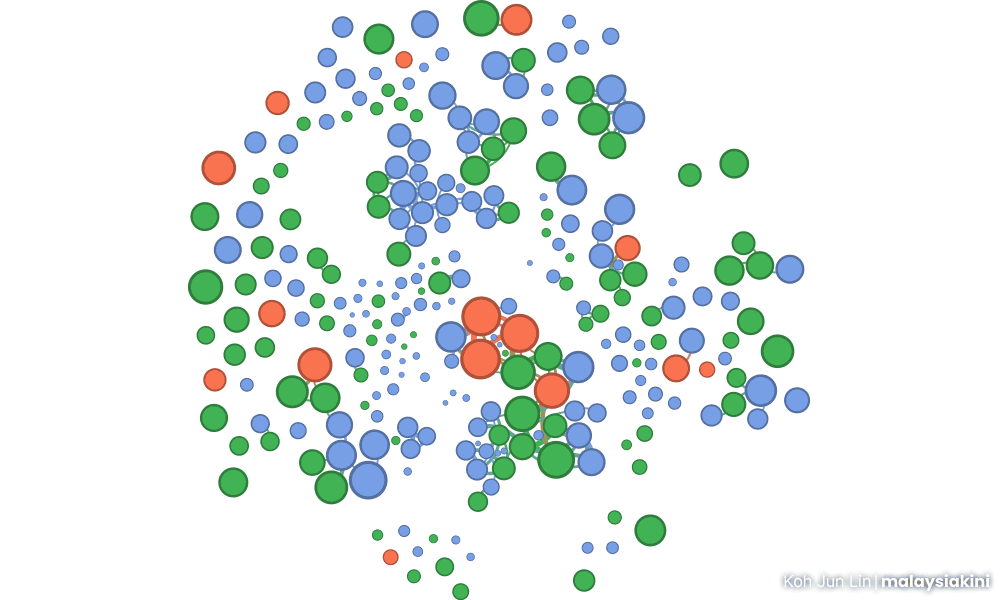
A network analysis revealed the operation is organised into 27 distinct clusters of accounts that frequently post within the same 10-minute windows.
This cellular structure indicates that different groups are activated in coordinated pockets, rather than acting as a single, spontaneous mob.
Unsophisticated machine
While the evidence pointed to a professional and organised campaign, experts who reviewed the findings noted that the operation itself appeared to be of low quality.
A linguistic analysis found the accounts’ vocabulary to be significantly more repetitive and less diverse than that of authentic users on the page.
Benjamin Loh, a researcher who studies Malaysian cybertroopers, described the operation as “lazy and clearly lackadaisical”.
“Cybertroopers of yore... were far more adept at varying their posts,” Loh said, comparing the current network to more sophisticated operations that existed before 2018.
The PKR connection
After the data established the existence of this machine, further investigation identified one of its operators as Syukur, the communications director for the Perlis PKR Youth wing.
When contacted by Malaysiakini, Syukur denied being a “cybertrooper” and stated that he acted independently out of genuine support for his party's president.
“I am a party man, not a cybertrooper,” he said in a text message.
“I comment on my own because I am a party person and the prime minister is the party president, so when he does good things, I comment in support.”
However, Syukur's claim that he comments "on his own" is inconsistent with the on-platform data from his account.
The investigation found that Syukur's account used the same pre-written scripts as the wider network and engaged in rapid crossposting.
On July 23, for example, his account posted six comments on five different posts in under two minutes, using the network's signature phrases.
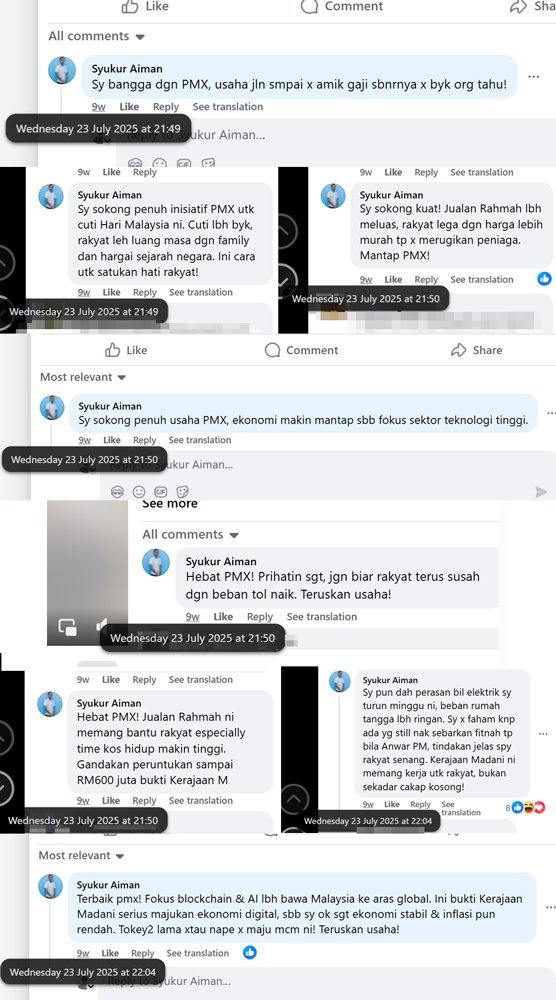
Furthermore, the data confirmed he was not acting in isolation. His account is a member of one of the 27 coordinated clusters, frequently posting in the same 10-minute windows as other network members.
These behaviours - using shared scripts and posting at around the same time with a larger network - are inconsistent with the spontaneous, individual support he described.
Denial and disappearance
The Prime Minister's Office (PMO) denied any knowledge of or involvement with the network, stating there is “no basis or necessity” to direct the MCMC to investigate.
In a response to Malaysiakini, the office confirmed that no taxpayer funds were used and stated that “neither the government, the party leadership, nor its youth wing has issued any directive or provided any funding for such an operation.”
The PMO attributed the activity to individuals exercising their freedom of expression.
However, evidence of shared scripts, professional work schedules, and a coordinated cluster structure contradict this explanation.
Furthermore, in the days following Malaysiakini's enquiries, a significant portion of the network was dismantled.
At least 76 of the 263 identified accounts (29 percent) were removed or made inaccessible.
The removals targeted the network's most important assets: 11 of the 13 high-priority accounts flagged in a dossier sent to Meta – including that of the PKR Youth official Syukur – were among those that vanished.
It remains unclear whether Meta removed the accounts or if the operators acted pre-emptively. Both possibilities point to inauthentic, coordinated activity.
‘Consequences for democracy’
Experts warned that such operations, regardless of their scale or sophistication, pose a risk to democratic discourse.
The Centre for Independent Journalism (CIJ) warned such behaviour can “distort perceptions of public sentiment, drown out dissenting voices, and weaken the public's ability to engage meaningfully in debate”.
Nuurrianti echoes this view. “That has consequences for how citizens interpret online debate and for the health of democratic discourse,” she said.
In response to Malaysiakini’s queries, Meta emphasised it has policies in place to prevent coordinated inauthentic behaviour (CIB), but has yet to find signs of wrongdoing on Anwar’s Facebook page.
“At this time, our review has not found evidence of violations of our CIB policy related to the prime minister’s Facebook page,” a spokesperson said.
This is despite the dossier detailing specific instances where CIB accounts have engaged in rapid crossposting and commenting from a shared script, as well as examples where the accounts have misrepresented their identity to lend authority to their comments.
Part 2: Deception and data: Inside the investigation of pro-Anwar CIB network
Part 3: Experts: Systemic challenges enable persistent influence networks
Analysis by Koh Jun Lin. Additional reporting by B Nantha Kumar and Qistina Nadia Dzulqarnain. - Malaysiakini, 30/9/2025
Summary
The pro-Anwar CIB network was identified using a two-criterion test - boilerplate phrases and “rapid crossposting” - on a dataset of over 25,000 comments.
Malaysiakini is releasing an anonymised dataset for scrutiny.
The network operated for months without apparent action from Meta, raising questions about the platform's content moderation.
Yesterday, Malaysiakini revealed the existence of a 263-account network engaged in a coordinated campaign to artificially boost support for Prime Minister Anwar Ibrahim on his official Facebook page.
But proving that such a campaign is a centrally coordinated, inauthentic operation - and not just the work of passionate supporters - requires more than just suspicion. It calls for a rigorous, evidence-based methodology.
This report details how that case was built.
Building the case
The investigation began with a dataset of over 25,000 public comments.
The first step was to build a reliable tool to identify the network's shared script.
After a computational analysis identified thousands of frequently repeated phrases, a final manual selection was made to create a “boilerplate library”.
This curation was guided by a single, conservative principle: to distinguish between common topic keywords and specific, repeated linguistic artefacts that are unlikely to be generated independently.
For example, while many authentic users might comment about “batik” on a post about an Asean event, the analysis identified the exact five-word phrase “tgk delegasi asean pakai batik” (to see the Asean delegation wear batik) being used verbatim at a frequency that suggests a shared script rather than spontaneous expression.
With this library established, a high and conservative bar was set to define the network.
An account was only included in the coordinated inauthentic behaviour (CIB) network if it met two independent criteria simultaneously: it used at least two phrases from the boilerplate library and engaged in spam-like “rapid crossposting”.
To prove this network's behaviour was truly abnormal, its activity was benchmarked against a control group of 171 active commenters.
While no on-platform analysis can know a user's true intent, this group serves as a rigorous proxy for authentic behaviour for one key reason: by definition, its members exhibited zero of the specific, coordinated inauthentic signals this investigation was designed to detect.
Nuurrianti Jalli, an expert on online disinformation at Oklahoma State University who reviewed the investigation, endorsed this multi-layered approach.
“By requiring both conditions (boilerplate phrases and rapid crossposting), you minimise the chance of mistaking ordinary supporter behaviour for something more coordinated.
“The other checks you ran strengthen the case,” she told Malaysiakini.
For full transparency, Malaysiakini acknowledges that this investigation was based entirely on public data, lacking access to non-public information like IP addresses, which only Meta can access.

Furthermore, a different investigation might have used looser or stricter rules, or picked different phrases for the boilerplate library. These could produce a slightly different list of accounts.
To allow full scrutiny, Malaysiakini is publishing its complete dataset of over 25,000 comments and the full boilerplate library.
It has been anonymised in line with ethical best practices for social media research, and some data - such as the exact posts where comments were collected - have been removed to reduce the risk of de-anonymisation.
An organised, artificial network
With the network and its control group defined, the investigation could then analyse the network's collective character. The results paint a picture of an operation that is both organised and artificial.
A linguistic analysis known as a Type-Token Ratio (TTR) test, which measures vocabulary diversity, found the CIB network's language to be quantifiably artificial.
The accounts' vocabulary was significantly more repetitive and less diverse than that of both the “organic” proxy group and casual, one-off commenters on the page.
This artificiality was matched by a high degree of organisation.
To understand the network's internal structure, the investigation mapped out which accounts frequently posted in the same 10-minute time windows.
This analysis revealed that the network is not a random mob, but is compartmentalised into 27 distinct, coordinated clusters.
This cellular structure is a strong indicator of organised activity, where different groups of accounts appear to be activated in coordinated pockets.
Anatomy of deception
This artificial language was often deployed through deceptive personas designed to lend credibility to the scripted messages.
One of the network's most central operators, identified as “User08812” in the public dataset, provides a striking example.
In one comment, the account claimed to be a “university student” to praise the government's focus on Islamic heritage. In another, it claimed, “I myself work with foreign investors” to lend authority to a comment about foreign investment.

Both claims contradict the account's own public profile, which states its holder has been an engineer since 2013.
The network also frequently used religious framing to advance political messages.
Benjamin Loh, a researcher at Monash University Malaysia who studies Malaysian cybertroopers, noted this serves a strategic purpose: to “astroturf public support for Madani to show that ‘people’ are accepting that it is a more religiously considerate conservative government and not ‘liberal’.”
A test of policy
The 263-account network operated for months without any apparent public action from Meta, raising questions about the platform's content moderation practices.
Experts argue that platforms have a fundamental responsibility to act.
Ross Tapsell of the Australian National University suggests that platforms can be “complicit in the masking of influence operations” when they fail to act, as they “rely on consumers believing that what appears on their sites is largely useful and trustworthy.”
The call for such platform accountability has been the policy of the current government.
In an April 2024 meeting with social media companies, Communications Minister Fahmi Fadzil - who is also the PKR information chief - publicly urged Facebook and TikTok to increase their monitoring and “review the efficiency of algorithms” to detect CIB.
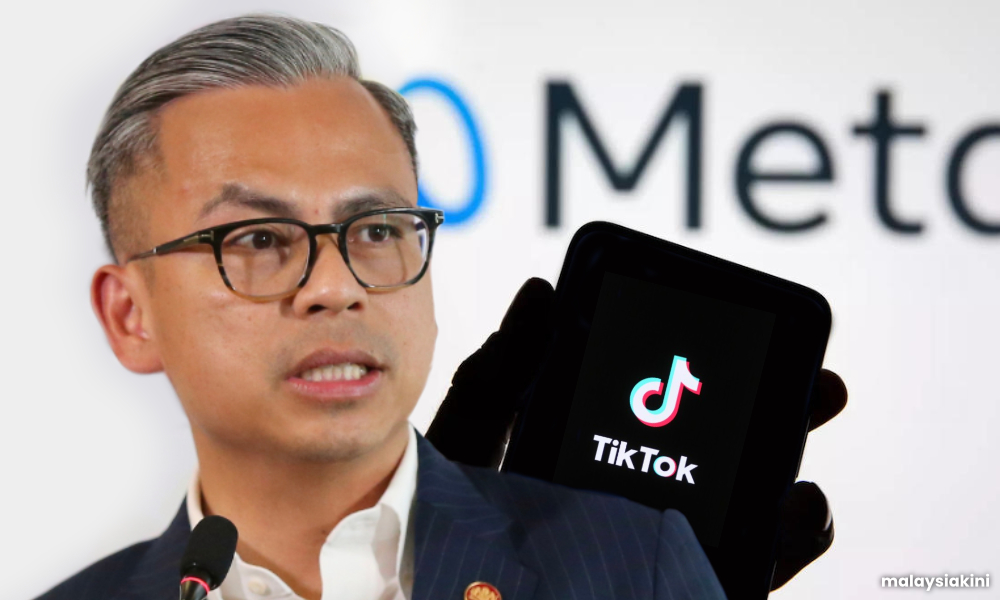
The discovery of this 263-account network, operating for months in 2025 in support of the government, now puts that stated policy and the platform's response to the test.
Unanswered questions
The coordinated disappearance of 76 accounts after official inquiries were made leaves the responsibility for a full accounting with Meta.
The platform's internal data, including non-public information like IP addresses, holds the key to definitively identifying the operators behind this network.
In response to Malaysiakini’s queries, Meta said its review “has not found evidence of violations of our coordinated inauthentic behaviour policy”.
The statement does not address the evidence of coordinated scripts and temporal clustering documented in this investigation.
It does not clarify whether this activity violates other platform policies, such as those against spam or “inauthentic behaviour”.
The Centre for Independent Journalism warns that CIB, if left unchecked, can “distort perceptions of public sentiment, drown out dissenting voices, and weaken the public’s ability to engage meaningfully in debate”. - Malaysiakini, 1/10/2025
Summary
Experts warn platforms face systemic challenges, including political pressure from Malaysia’s social media licensing scheme, which a researcher said may risk Meta’s licence if it removes accounts linked to the prime minister.
The Centre for Independent Journalism (CIJ) urges Meta to conduct forensic reviews and apply technical measures, while calling on regulator MCMC to focus on public literacy campaigns and avoid censorship.
Although key parts of a pro-Anwar Ibrahim cybertrooper network have been dismantled following media enquiries in the lead-up to Malaysiakini’s exposé on Tuesday, the official responses from both the government and the platform have left key questions of accountability unanswered.
The Prime Minister's Office has denied any knowledge of or involvement with the network. Meta, meanwhile, stated that its review has not found evidence of violations of its coordinated inauthentic behaviour (CIB) policy.
A similar dynamic of official denial in the face of platform action occurred in 2022. After Meta announced its investigation had found links between a 596-account CIB network and the Royal Malaysia Police, the police issued a statement denying any involvement.
The persistence of these networks, experts said, points to systemic challenges that go beyond any single operation. They identify a situation where platforms face political pressure, and the burden of discovery often falls on outsiders.
Catch-22
Benjamin Loh, a researcher at Monash University Malaysia, highlighted the Catch-22 situation platforms now face under Malaysia’s social media licensing scheme, which took effect on Jan 1, 2025.
He argued that this new regulation creates a Catch-22 situation for platforms operating in the country.
“Given the presence of the licensing system and this report directly implicating the prime minister, Meta would risk having their licence revoked for removing these accounts,” he said.
This specific political pressure is a recent development. However, experts note that a more general, systemic issue has long existed.
“Even when tech platforms do act, they often rely upon the exhaustive work of under-resourced journalists or researchers to uncover the widespread and abundant influence campaigns on their platforms,” said Ross Tapsell of the Australian National University.
This mirrors the discovery of the 2022 police-linked network, which was also initially flagged not by Meta, but by academic researchers at Clemson University. -
A roadmap for platforms
However, social media platforms are far from powerless. The Centre for Independent Journalism (CIJ) insisted that Meta has the tools to act decisively.
“Meta has the resources to carry out forensic (backend) reviews,” the CIJ said in a statement to Malaysiakini, noting that the platform’s “internal backend logs can determine if the accounts are coordinated or managed by the same operator or command centre.”

The NGO outlined several concrete steps Meta could take, urging its content moderation to include “additional resources to address the context and language specificities” of the Malaysian environment.
CIJ also recommended technical measures, such as tightening rules on how quickly multiple accounts are allowed to post near-identical comments, and automatically flagging accounts that use repeated templates.
MCMC’s role
Beyond the platform, CIJ also point to the crucial role of regulators like the MCMC.
It recommended that the MCMC focus on proactive, public-facing solutions, such as launching digital literacy and public awareness campaigns to help citizens spot inauthentic behaviour themselves.
The NGO also called for transparent multi-stakeholder engagements to review policies on political communication and establish rapid-response procedures for identified CIB networks.
However, the CIJ stressed that any regulatory action must be carefully balanced.
Any response, it said, must “respect freedom of expression and avoid becoming a tool for censorship”, and should be grounded in a clear "harm test" to protect public discourse from heavy-handed interventions.
Despite challenges, Loh argued that pressure from the public and civil society can break the cycle of inaction.
“It is still worth trying. And if done on a large scale when working with other civil society members, it might be effective through using the public to pressure the government to either admit they are doing this or not to interfere if Meta were to remove these accounts,” he said. - Malaysiakini, 2/10/2025


 Posts
Posts




No comments:
Post a Comment