Wednesday, October 24, 2012

MADPET welcomes move towards abolition of mandatory death penalty for drug offences


Media Statement – 23/10/2012

MADPET welcomes move towards abolition of mandatory
death penalty for drug offences

MADPET (Malaysians Against Death Penalty and Torture) welcomes the Malaysian government move to abolish the mandatory death penalty for drug trafficking, and hope that this is but a start that will end with a total abolition of the death penalty in Malaysia. We also call for an immediate moratorium on all executions pending abolition especially the lives of about 640 people on death row in Malaysia currently for drug offences.

Minister in the Prime Minister's Department Datuk Seri Nazri Aziz stated that Malaysia is considering withdrawing the mandatory death sentence for drug offences and replacing it with jail terms.(Star,21/10/2012, Death penalty may be scrapped for drug offences). It is hoped that this indication becomes reality soonest, and that Malaysia would also renew its efforts to save the lives of about “… 250 Malaysians arrested as drug mules and sentenced to death abroad, including in China, Venezuela and Peru..”

The Malaysian government also did acknowledge in the past(Star, 1/11/2009, Malaysian girls easily duped), that many of those who ended up being sentenced to death for drug trafficking were generally ‘drug mules’, and not the real drug traffickers.
Malaysia’s past efforts to save lives of Malaysians sentenced to death, including that of young Sabahan, Yong Vui Kong, who was convicted by the Singaporean courts for drug trafficking and sentenced to death, is most appreciated. The removal of the mandatory death penalty for drug trafficking from the Malaysian law, would certainly add greater credibility and strength to Malaysia’s plea for clemency for its citizens on death row for drug offences in other jurisdictions.

The Malaysian Dangerous Drugs Act 1952, in particular section 39B provides that any person involved in trafficking of drugs shall be guilty of an offence against this Act and shall be punished on conviction with death. The judges and courts, by reason of the mandatory sentence, are deprived of the option of imposing a lesser sentence, and MADPET believes that this is very wrong. We agree with  what the Human Rights Commission of Malaysia (SUHAKAM) stated, amongst others, that the abolition of the mandatory death sentence will also restore to the judiciary the liberty and discretion to determine punishment based on the gravity of the offence as it should always be.

There are presumptions in the Malaysian Dangerous Drugs Act 1952 Act, amongst others, that one ‘…shall be presumed, until the contrary is proved, to be trafficking in the said drug...’ if one is found in the possession of certain amounts of certain drugs. By reason of this legal presumption, the onus of proving one’s innocence then shifts to the accused, and this not only onerous but also unjust. This is also contrary to the normal rules of criminal justice whereby the onus of proving one’s guilt beyond reasonable doubt is always be with the prosecution. We urge the Malaysian government remove these unjust legal presumptions, and return the burden of proving the elements that constitute the offence to the prosecution especially for the offence of drug trafficking.

MADPET reiterates its call for the abolition of the death penalty, and for an immediate moratorium on all executions pending abolition.


Charles Hector
for Malaysians Against Death Penalty and Torture (MADPET)

Tuesday, October 23, 2012

SUHAKAM: Proposed Review Of The Death Penalty For Drug Offences Is Welcomed

PRESS STATEMENT 

PROPOSED REVIEW OF THE DEATH PENALTY FOR DRUG OFFENCES IS WELCOMED 

The Human Rights Commission of Malaysia (SUHAKAM) welcomes the proposal to review and ultimately to abolish the mandatory death penalty for drug offenders, as announced by the Minister in the Prime Minister’s Department Datuk Seri Mohamed Nazri Abdul Aziz, which will allow the court the liberty and discretion to determine punishment based on the gravity of the offence.This move is in line with the spirit of Article 3 and Article 6 of the Universal Declaration of Human Rights (UDHR) and the International Covenant on Civil and Political Rights (ICCPR) respectively that reaffirm the right of a person to life and the right not to be subject to torture, or to cruel, inhuman or degrading treatment or punishment. It is also in line with the United Nations General Assembly Resolutions, first adopted in 2007, calling for a moratorium on executions, with a view to eventually abolishing the death penalty. 

The Commission has consistently called for the Government to consider a moratorium on the death penalty or commuting this form of punishment to life imprisonment, especially for those who have been on death row for more than five years. It also wishes to call upon the Government to review the relevance and effectiveness of capital punishment and to join the other 140 UN member states to completely abolish the death penalty. The Commission will continue to support the Government in realising full compliance with international human rights principles and norms specifically the UDHR.

- END -

“HUMAN RIGHTS FOR ALL”

TAN SRI HASMY AGAM
Chairman
The Human Rights Commission of Malaysia (SUHAKAM)
22 October 2012

“Hak Asasi Untuk Semua”
“Human Rights For All”

Monday, October 22, 2012

Good that Malaysia may at last abolish the mandatory death penalty

MADPET (Malaysians Against Death Penalty and Torture) reiterates its call for the abolition of the death penalty. It is good that the Malaysian government is seriously looking into the 'possibility' of withdrawing the mandatory death penalty for drug mules.

In Malaysia, when you are found to be in possession drugs above a certain weight, you are presumed in law to be a 'drug trafficker', when the fact of the matter is that these persons are more likely just 'drug mules', and in some cases were even ignorant of the fact that they had any drugs in their possession.  

When drugs are found in your car, your room or in your possession, the law presumes that it is your drugs, and you then have to prove that it is not yours. How exactly would you be able to prove that the drug that was found in your car boot or under your bed was not yours? After all, it could very well have been placed by some other... 

Our current laws concerning drug trafficking is unjust as it relies very much on legal presumptions, rather than placing the burden of proof beyond reasonable doubt of all elements that constitute the crime on the prosecution as is done for almost all other crimes. 

Mandatory sentences remove from the judges the discretion when it comes to sentencing, which normally depends not just on the proof of guilt but also other factors and circumstances. A plea of guilty by the accused person normally would result in reduction of the sentence by a third - but alas, when the only available sentence is a mandatory sentence, more so the death penalty, these factors that a judge will normally take into account in sentencing becomes irrelevant.

Mandatory death penalty, as a first step, must be removed from our statute books. Legislative can fix minimum and/or maximum sentences, but the didiscretion as to sentencing must always rest with the judiciary.   


PADANG RENGAS: The Government is looking into the possibility of withdrawing the mandatory death sentence for drug offences and replacing it with jail terms.

Minister in the Prime Minister's Department Datuk Seri Nazri Aziz said the Attorney-General's (A-G) Chambers would study the suitability of the move.

“One of the main reasons is because there are close to 250 Malaysians arrested as drug mules and sentenced to death abroad, including in China, Venezuela and Peru.

“It is difficult to justify our appeal to these countries not to hang them when our own country has the mandatory death sentence,” he said in a press conference in Sauk, near here yesterday.

Convicted drug traffickers in the country now face the mandatory death sentence under Section 39B of the Dangerous Drugs Act.

Nazri, who is also the de facto Law Minister, said he would need to seek Prime Minister Datuk Seri Najib Tun Razak's view before discussing the suggestion with the A-G.

“If the Government is going ahead with the suggestion, we need to have a moratorium on death sentences from being carried out for those who are convicted in Malaysia.

“We are considering an alternative of 30 years' jails or more and allowing judges to have discretionary power under the Act,” he said.

On the issue of porn blog duo Alvin Tan and Vivian Lee, Nazri said he would refer the matter to the A-G's Chambers.
 
“We need to look into what Malaysian laws they have broken. But also we need to remember that anything that is morally wrong does not necessarily mean that it is legally wrong.

“We definitely do not condone the act. This is what happens when there is absolute freedom of expression,” he said. - Star Online, 21/10/2012, Death penalty may be scrapped for drug offences

Sunday, October 21, 2012

AEPF says no to 'outsourcing' and short-term contracts

What was interesting was the outcome of the workshop entitled "Combating Erosion of Worker and Trade Union Rights'', which was attended by about 80-100 participants, who did at the end of the 3 1/2 hour program on the 18th afternoon come up with recommendations, all of which were discussed and adopted unanimously. (See below)

The call was for the abolition of outsourcing [i.e. the contractor for labour system], and short-term employment contract..
 
Regular employment with security of tenure until retirement
 
2-party employment relationships between principals or owners of workplaces as employers, and workers that work in the said workplaces as employees of the said principals and owners. 


9th Asia-Europe People’s Forum

aepf9
“People’s Solidarity against Poverty and for Sustainable Development: Challenging Unjust and Unequal Development, Building States of Citizens for Citizens”
Vientiane, Laos, 16-19 October, 2012


Conclusions/Recommendations from the participants of the Combating Erosion of Worker and Trade Union Rights Workshop, that took place at 2pm, 18/10/2012

A. Employment and Employment Relationship


1. Ensure that workers have the right to regular employment with security of tenure until retirement.


2. Abolish short-term or fixed duration employment contracts, and if still needed in exceptional situation should be limited in its use.


3. Ensure 2-party employment relationships between principals or owners of workplaces as employers, and workers that work in the said workplaces as employees of the said principals and owners.


4. Labour suppliers, contractors for labour or labour outsourcing companies should never be employers of workers.


5. Abolish manpower/labour outsourcing and all forms of triangular employment relationships/ arrangements.


B. Worker Rights & Access To Justice


1. Ensure that all worker rights are respected, including rights of access to avenues of justice, social security, healthcare, compliance with occupational health and safety standards and decent work. 

2. Migrant workers shall be allowed to work and stay legally until their complaints and claims are finally adjudicated and settled.


3. All workers, irrespective of their nationality or legal status, shall have the right to labour rights, including a right to form and/or join trade unions and collective bargaining, consistent with the international core labour standards.

C. Recommendation about UN/Regional Standards and Instruments
1. In cases of rights abuse, human rights defenders, including CSR/TNC compliance monitoring bodies, should issue alerts, lobby companies and governments, raise awareness among the general population and support workers who want to fight for their rights.


2. Trade unions and CSR/TNC monitoring bodies should inform the workers of codes of conduct of companies and their supply chain, as well as relevant government policies.


3. Trade unions and CSR/TNC monitoring bodies should lobby the governments to ensure that trade agreements include guarantees for labour conditions and rights of workersใ


4. CSOs in countries where the production is based and where the investment is coming from to strengthen their collaboration.


5. Trade unions and CSR/ TNC monitoring bodies should connect workers and their representatives with the global movement, including AEPF. 


D. Recommendation about Trade Unions


1. When governments and/or ASEM have discussions/engagements with Investors, Trade Union must always be part of the process.


2. Trade unions must be included in law and decision making processes at the national regional and international levels.


3. Stronger collaboration between trade unions across sectors and regions is needed, and a strong transnational network of trade unions should be developed.


4. Trade unions of countries of origin and destination countries of migrant workers shall collaborate to ensure protection of the rights of migrant workers. Portable trade union membership shall be promoted.


5. Trade unions shall strengthen their role in monitoring labour law enforcement and CSR compliance.


This workshop was organized by Workers Hub For Change(WH4C), Network of Action for Migrants in Malaysia (NAMM), MAP Foundation, Mekong Migration Network (MMN), Clean Clothes Campaign(CCC), GoodElectronics Network and Asia Pacific Forum  On Women Law and Development(APWLD)

The recommendations/position of this workshop was included in the Final Statement of AEPF, that have been handed over to the relevant Minister of Laos, who has given his assurance that this statement will be handed over and hopefully considered by the leaders of the European and Asian nations that will be meeting in a few days time.


Wednesday, October 10, 2012

In politics for the good of the nation - not some 'self-enrichment' agenda..

GUIDELINES FOR THE AVOIDANCE OF CORRUPTION AND ABUSE OF POWER

1 - All MPs, ADUNs and Senators should be FULL TIME people's representative and shall attend all Parliamentary, Senate and State Assembly sessions. 

2 - No MP, ADUN and/or Senator shall not be made Directors of GLC Companies who receive Director's salary/allowance/etc - all payments, save for maybe transportation allowance, received by such State/Federal Government shall be paid into the government coffers. Why? Because these appointments are for and on behalf of the people, and shall not serve to additionally enrich the 'wakil rakyat'. In addition all government appointed Directors shall be civil servants, and shall not be entitled to additional enrichment by reason of the said appointment.

3 - No member of the families of the said MP/ADUN/Senator and/or they themselves should be associated with companies/businesses/persons that put in and/or are awarded government projects and/or tenders. 

4 - No businesses and/or paying work shall be given to businesses, law firms and/or other companies owned by totally and/or in part by the MPs/ADUNs/Senators and/or Local Councillors. {There has been allegations that local council legal work are being given to firms of lawyers of MPs/ADUNs/Senators and/or Local Councillors and/or office bearers/Majlis Tertinggi of the ruling party at any level)

5 - There must be guidelines for all GLCs - limiting the wages of the CEO and higher management, and also Director allowances and benefits. CEO wages shall not be higher than the salary of the Prime Minister and/or Menteri Besar, as it is.

6. There must be similar control for all public listed companies - since the payment of high salaries, allowances and bonuses is really directly affecting the share of these individual small investors directly or indirectly (i.e. through KWSP). Investors must get their truly deserved share of the profits usually paid out by means of dividends.

7 .... and other guidelines that Malaysians need to suggest

FAILING WHICH .... THINGS MAY CONTINUE AS IT WAS UNDER THE BN GOVERNMENT ALL THESE YEARS... 

There has always been the perception that people try to become branch leaders, division leaders and leaders of political parties as they expect to be rewarded with 'projects' and tenders... and a study, if done, may reveal that this may not be far from the truth for many 'leaders' have certainly enriched themselves much more than the rakyat... this is a trend that must be stopped...people involve themselves in politics and political life for the good of all Malaysians and Malaysia - not for some 'self-enrichment' agenda...


Thursday, October 04, 2012

Buruh Indonesia Tolak Outsourcing dan tuntut gaji minima adil

Indonesia

Buruh Indonesia Tolak Outsourcing

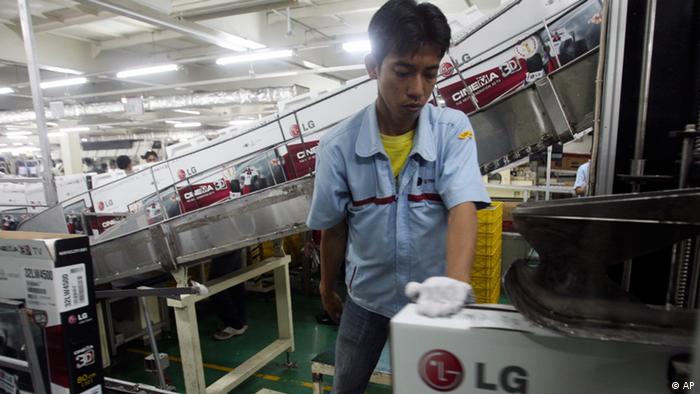
Ribuan buruh Indonesia melakukan aksi mogok nasional menuntut perbaikan kondisi kerja dan penghapusan sistem outsourcing menyusul seruan serikat buruh untuk turun ke jalan hari Rabu (03/10). 

Ratusan pabrik di Jakarta dan yang  berlokasi di pinggiran ibukota terpaksa tutup, karena para buruh mogok dan melakukan konvoi sepeda motor yang menyebabkan kemacetan lalu lintas.

Nining Elitos, ketua Aliansi Buruh Indonesia mengatakan sebanyak 3 juta pekerja ikut ambil bagian dalam aksi mogok nasional kali ini.

“Tuntutan kunci kami adalah sebuah sistem pembayaran yang lebih baik dan lebih transparan serta penghapusan sistem outsourcing,“ kata dia.

Juru Bicara Kepolisian Jakarta, Rikwanto mengatakan15.000 polisi dikerahkan untuk mengamankan aksi buruh.

Di kota industri Cikarang, yang menjadi sentra produksi komoditas penting seperti mobil dan barang-barang elektronik, ribuan buruh bernyanyi dan menari saat para aktivis melakukan orasi menuntut perbaikan kondisi kerja. Protes serupa juga dilaporkan terjadi di beberapa kota lain.
dpa (AB/ AS)


Hari Ini, 3 Juta Buruh Mogok!
Penulis : Aditya Revianur | Rabu, 3 Oktober 2012 | 06:14 WIB
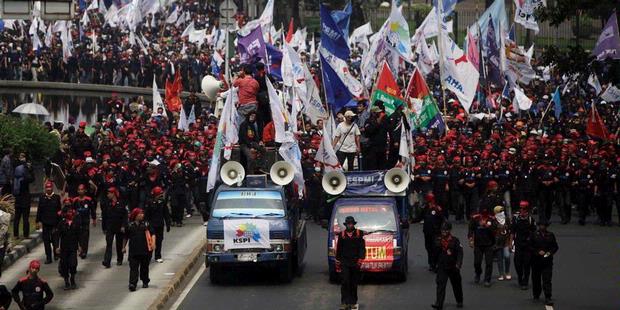
KOMPAS/LUCKY PRANSISKARibuan buruh dari Konfederasi Serikat Pekerja Indonesia berjalan menuju Istana Merdeka, Jakarta untuk berunjuk rasa, Kamis (12/7/2012). Mereka memprotes peraturan menteri tenaga kerja yang mengatur pekerja kontrak (outsourching). 
 
JAKARTA, KOMPAS.com — Majelis Pekerja Buruh Indonesia (MPBI) menyampaikan, sekitar 3 juta buruh di seluruh Indonesia siap melakukan aksi mogok massal di beberapa wilayah Jakarta, Bogor, Depok, Tangerang, dan Bekasi (Jabodetabek) pada Rabu (3/10/2012) ini. Massa akan berunjuk rasa untuk menuntut upah yang layak berkeadilan sesuai dengan upah minimum provinsi dan penghapusan sistem outsourcing.

"Aksi mogok nasional akan dilaksanakan Rabu esok dari jam sembilan pagi sampai enam sore. Kami akan melakukan mogok kerja atau stop produksi di delapan puluh kawasan atau sentra industri di dua puluh satu kabupaten," kata Presiden Konfederasi Serikat Pekerja Indonesia (KSPI) Said Iqbal saat dihubungi, di Jakarta, Selasa (2/10/2012).

Iqbal merinci, di luar 80 kawasan industri, massa buruh akan melakukan aksi di kantor DPRD seluruh Indonesia yang antara lain mencakup DPRD Provinsi Kalimantan Timur, Kalimantan Barat, Papua, Sulawesi Utara, Gorontalo, dan lainnya. Ia menjelaskan, aksi buruh yang terbesar dipusatkan di tujuh kawasan industri di Bekasi, khususnya Kawasan Ejip dengan massa 500.000 orang.

"Masyarakat diimbau untuk menghindari lokasi-lokasi tempat aksi mogok massal buruh tersebut. MPBI memohon maaf kepada seluruh masyarakat Indonesia bila terganggu kenyamanannya dan terjebak macet," terangnya.

Ia menyatakan, untuk wilayah Jabodetabek, buruh beraksi di sekitar Pulogadung, Sunter, KBN Cakung, Tanjung Priok, Tol Bekasi Barat, Bekasi Timur, Cibitung, Tambun, Bantar Gebang, Cikarang, Karawang Barat, Karawang Timur, Jatake, Cikupa, Balaraja, Serpong, Jalan Raya Bogor, Simpang Depok, Citereup, Gunung Putri, dan Wanaherang.

Para pengguna jalan diimbau menghindari area tersebut untuk menghindari kemacetan.
Editor :
Glori K. Wadrianto - KOMPAS.com

LBH Jakarta: Mogok Buruh Dibenarkan
Penulis : Ambrosius Harto Manumoyoso | Rabu, 3 Oktober 2012 | 11:15 WIB
Dibaca: 6630

Kompas/Ambrosius Harto
Massa buruh di Jalan Inspeksi Tarum Barat Raya (Kalimalang) di Kabupaten Bekasi hendak menyapu semua perusahaan terkait aksi mogok nasional, Senin (3/10/2012).

BEKASI, KOMPAS.com — Mogok nasional oleh para buruh di Indonesia, Senin (3/10/2012), dibenarkan dalam Undang-Undang Ketenagakerjaan.

Mogok nasional menuntut penghapusan sistem kerja outsourcing (alih daya) dan kontrak, penghapusan politik upah murah, serta jaminan kebebasan berserikat.

Direktur LBH Jakarta Febi Yonesta mengatakan, kasus perburuhan adalah permasalahan yang paling banyak diadukan di LBH Jakarta. Jumlah pencari keadilan berlipat karena satu kasus bisa melibatkan ratusan bahkan ribuan pekerja.

"Lima tahun ini, kami menilai pelanggaran terhadap Undang-Undang Ketenagakerjaan semakin buruk dan meningkat. Hal ini diperparah dengan sangat lemah dan tidak berfungsinya pengawasan oleh Pengawas Ketenagakerjaan," kata Febi dalam siaran persnya.

LBH Jakarta juga mencatat bahwa hampir tidak ada penegakan hukum atas pelanggaran-pelanggaran dan kejahatan terhadap aturan ketenagakerjaan. Pemberian upah di bawah ketentuan upah minimum regional dan pelarangan berserikat adalah tindak pidana.

Namun, hingga hari ini, hampir tidak ada pengusaha yang terkena proses hukum. Padahal, pengaduan sudah sangat sering dilakukan oleh buruh kepada Polri dan Pengawas Ketenagakerjaan.

LBH juga menilai hampir tidak ada tindakan dari pemerintah terhadap pelanggaran sistem kontrak dan outsourcing. Pemerintah semakin melegalkan dan mempermudah pelaksanaan outsourcing.

Buruh diarahkan untuk berhadapan dengan perusahaan melalui Pengadilan Hubungan Industrial.
Muhamad Isnur, Kepala Bidang Penelitian dan Pengembangan LBH Jakarta, menyebutkan Pasal 137 Undang-Undang Nomor 13 Tahun 2003 tentang Ketenagakerjaan bahwa mogok kerja adalah sebagai hak dasar pekerja/buruh.

Dalam Pasal 143 ditegaskan, siapa pun tidak dapat menghalang-halangi pekerja/buruh dan serikat pekerja/buruh untuk menggunakan hak mogok kerja yang dilakukan secara sah, tertib, dan damai.
Pemerintah dan perusahaan tidak boleh melarang, apalagi melakukan penangkapan, kekerasan, dan mengurangi hak pekerja/buruh yang mogok kerja. LBH Jakarta siap membantu dan mendampingi buruh/pekerja yang mendapatkan permasalahan dalam melaksanakan haknya untuk melakukan mogok kerja.
Editor :
Agus Mulyadi - KOMPAS.COM

Indonesian workers go on strike against 'contractor for labour' and short term contracts

Well, Indonesian workers went on strike against 'contractor for labour' system....and also against short-term employment contracts.

Justly, all workers should be regular employees - permanent employees until retirement, retrenchment, closure of employer's business, or maybe termination by reason of some misconduct at the workplace.

Workers' employment security is most important for the well-being of the worker, their families and dependents. Remember, where a worker finds employment determines where the spouse and family will live, where a home may be purchased, where the children will be sent to school, where community relationship and involvement are started. In modern Malaysia, most workers are also burdened with the obligation of monthly payments towards housing/car loans, etc...The problem with fixed-term contracts is that there is no needed security for workers that they will still be employed at the said workplace (or even be able to find subsequent employment in that vicinity/town/...) As fixed term contract periods end, the stress suffered is great... Of course, employers prefer short-term contracts for workers will be most docile, easily exploited and just too fearful to claim rights, join/form unions, etc.. In India, for example, there are laws that limit the kind of work for which the employer can use short-term employees and all other workers are regular employees (permanent employees)...Using outsourced workers supplied by third parties, without the factory/workplace owner becoming the employer is even more worse for workers...

Will Malaysian workers also escalate their struggle for the worker rights....they may unless this Malaysian government starts to take worker rights and welfare as being more important...

More Than 2 Million Workers Strike in Indonesia


“There are many cases where employees can work for five years without being given any proper rights,” said Widyantoro Setya Purwandaru, a 32-year-old quality assurance clerk, as he picketed the Yamaha piano factory in Pulo Gadung, East Jakarta, along with hundreds of his colleagues. “The government must do something about this because the gap between the rich and poor is getting wider and this will create social jealousy.”

Although Indonesia’s economy, south-east Asia’s biggest, has grown rapidly over the last decade, social inequality has also risen.

Meanwhile, trade unions have become increasingly combative, threatening to undermine attempts by the government to turn Indonesia into a key regional manufacturing hub.

There have been dozens of major strikes this year, including a number where workers on full-time contracts have been taken hostage by those employed on less favourable terms, demanding better pay and conditions.
Indonesia already has some of the toughest labour regulations in Asia but they are not implemented uniformly.

This has left trade unionists unhappy with the way many workers are treated, while companies are reluctant to hire new workers because of the difficulties they face when trying to terminate contracts.

The rigidity of Indonesia’s labour law has harmed job creation, according to a recent report by the Organisation for Economic Co-operation and Development, with around 60 per cent of the country’s workforce still employed informally.

Andrew White, the managing director of the American chamber of commerce in Indonesia, said that many employers feel the labour law is “counter-productive”.

“Although the intention of the law is to create solid jobs, companies are reluctant to hire because they realise that it is very difficult to terminate a contract, even if you have a legitimate cause,” he said.

To circumvent the rigid law, many companies in need of a flexible workforce have turned to labour outsourcing companies, agencies that provide workers on temporary contracts.

However, trade unionists say this practice is often used in an exploitative and illegal manner, depriving workers of benefits such as pensions, social security and other basic labour rights.

“Outsourced workers get nothing,” said Ridwan Pandjaitan, a shop steward for the United Federation of Indonesian Metalworkers at a Mitsubishi car factory in east Jakarta. “Too many companies don’t want to take on permanent employees because they have to pay pensions and give workers other rights.”

Keith Loveard, who advises foreign investors on security and political risk issues in Indonesia, said that strikes are becoming more frequent and that tensions between trade unions and employers are likely to grow in the run-up to the 2014 national elections as politicians play the populist card.

Prabowo Subianto, the former special forces general who has emerged as an early frontrunner in the 2014 presidential race, said on his Facebook page that he would revise the regulations on outsourcing, which he described as “degrading, discriminatory and exploitative”. - Financial Times, 3/10/2012, Indonesian national strike shuts factories

Tuesday, October 02, 2012

Najib, we need a stronger women rights movement and you must listen to them

Again, our Prime Minister has done it when he allegedly stated that  there is "no need for a women's rights movement in Malaysia". He is ignorant of the importance of Malaysia's women rights movement and their many contributions to the promotion of not just women rights but also human rights in Malaysia. Next, he may say that there is no need for human rights movement....worker rights movement...environmental rights movement in Malaysia..

There is "no need for a women's rights movement in Malaysia" as equality has been given from the start, Prime Minister Najib Abdul Razak has claimed.Speaking at the 50th National Women's Day celebration this morning, he said that Malaysia is even more advanced than developed nations in this aspect. - Malaysiakini, 2/10/2012, PM: No need for women's rights movement in M'sia

PM Najib, is there gender equality in Malaysia?  

Yes, there is in some areas but in Malaysia discrimination based on gender is still permissible - and the government has not done enough to end gender-based discrimination despite the fact that Malaysia has also ratified the CEDAW (The United nations Convention on the Elimination of All Forms of Discrimination Against Women) in 1995. 

It must be acknowledged that it was the efforts of Malaysia's women rights movement that finally moved the Malaysian government, who finally after about 15 years to  acceded to CEDAW on 5 July 1995 with reservation on 3 articles. CEDAW was adopted by the UN General Assembly on 18 December 1979.It took Malaysia another 6 years to  amend the Federal Constitution, and include 'gender' in Article 8(2)...Some Acts were amended as well - but the best option would have been to pass a law incorporating the CEDAW into Malaysian Law. 


It would have been good if our Federal Constitution was amended to include the 'doctrine of incorporation' - which will automatically ensure that all conventions that Malaysia ratifies becomes part of the domestic law in Malaysia. 

Malaysia, however relies on the 'doctrine of transformation', which means that these international obligations like those in CEDAW only becomes part of domestic law if enacted by subsequent domestic laws (or judicial decisions). The piecemeal approach by the Malaysian government of amending this and that law has resulted that there are many areas of Malaysian law that still do not incorporate the principles and obligations in CEDAW.

So, are women still being discriminated against in Malaysia?

YES, they are.

For example, in Malaysian women workers can still be discriminated against by reason of their gender. Employers in the private sector still do discriminate women on the basis of gender, and this happens because the Malaysian government FAILED women workers when they failed to enact/amend necessary laws to ensure an end of discrimination based on gender. In fact, it is still allowed for individual persons, private corporations to discriminate women on the basis of their gender.

When an employers can force women to retire at 50 and men at 55 at the same workplace, this is DISCRIMINATION based on GENDER, and our Malaysian courts said that it is OK. Why? Because the amendment to Art. 8(2) of the Federal Constitution only prevents public authority from discriminating against their employees...not employers in the private sector.

(2) Except as expressly authorised by this Constitution, there shall be no discrimination against citizens on the ground only of religion, race, descent, place of birth or gender in any law or in the appointment to any office or employment under a public authority or in the administration of any law relating to the acquisition, holding or disposition of property or the establishing or carrying on of any trade, business, profession, vocation or employment.

In the recent case of  Noorfadilla Ahmad Saikin V. Chayed Basirun & Ors (Shah Alam High Court, 12 July 2011), here Noorfadilah was an employee of the government....BUT if she was an employee in the private sector, the outcome would not have been the same...

It is also the defendants' submission that based on the Federal Court's decision in the case of Beatrice AT Fernandez v. Sistem Penerbangan Malaysia & Anor [2005] 2 CLJ 713, art. 8 of the Federal Constitution does not apply to a contractual relationship. With due respect, what was held in Beatrice's case (supra) inter alia, is as follows:
To invoke Article 8 of the Federal Constitution, the applicant must show that some law or action of the Executive discriminates against her so as to controvert her rights under the said article. Constitutional law, as a branch of public law, deals with contravention of individual rights by the Legislative or the Executive or its agencies. ...
By virtue of art. 160 of the Federal Constitution, the defendants are definitely public authorities and therefore agents of the Executive. To me, the defendants' act of revoking and withdrawing the Placement Memo because the plaintiff was pregnant constitute a violation of art. 8(2) of the Federal Constitution. It was the contravention of the plaintiff's rights by the defendants as agents of the Executive. As such, the requirement of Beatrice's case has been fulfilled....

The Court of Appeal today(21/3/2012) dismissed an application by female workers claiming gender discrimination in being forced to retire earlier than male colleagues.A three-man bench led by Datuk K. N. Segara upheld a 2010 High Court ruling on the 11-year-old case, which had overturned an initial Industrial Court’s 2008 decision in favour of the eight plastic industry workers. They were forced to retire in June 2001 after the company, Guppy Plastic Industries, enforced a then-new employee handbook rule stipulating a retirement age of 50 for female employees and 55 for male employees. - unfortunately the Judgment is still not available to me, and when it is, I will share it with you.

In short, court decisions seem to indicate that only the Government is barred from discriminating its employees on the basis for gender but it is alright for all other employers, including even Government-linked companies.

Article 11 of CEDAW
1. States Parties shall take all appropriate measures to eliminate discrimination against women in the field of employment in order to ensure, on a basis of equality of men and women, the same rights, in particular:
(a) The right to work as an inalienable right of all human beings;

(b) The right to the same employment opportunities, including the application of the same criteria for selection in matters of employment;
(c) The right to free choice of profession and employment, the right to promotion, job security and all benefits and conditions of service and the right to receive vocational training and retraining, including apprenticeships, advanced vocational training and recurrent training;
(d) The right to equal remuneration, including benefits, and to equal treatment in respect of work of equal value, as well as equality of treatment in the evaluation of the quality of work;
(e) The right to social security, particularly in cases of retirement, unemployment, sickness, invalidity and old age and other incapacity to work, as well as the right to paid leave;
(f) The right to protection of health and to safety in working conditions, including the safeguarding of the function of reproduction.
2. In order to prevent discrimination against women on the grounds of marriage or maternity and to ensure their effective right to work, States Parties shall take appropriate measures:
(a) To prohibit, subject to the imposition of sanctions, dismissal on the grounds of pregnancy or of maternity leave and discrimination in dismissals on the basis of marital status;
(b) To introduce maternity leave with pay or with comparable social benefits without loss of former employment, seniority or social allowances;
(c) To encourage the provision of the necessary supporting social services to enable parents to combine family obligations with work responsibilities and participation in public life, in particular through promoting the establishment and development of a network of child-care facilities;
(d) To provide special protection to women during pregnancy in types of work proved to be harmful to them.
3. Protective legislation relating to matters covered in this article shall be reviewed periodically in the light of scientific and technological knowledge and shall be revised, repealed or extended as necessary.
To name some other laws/policies that do have a tendency discriminate against women directly or indirectly, amongst others, are:-

- the Anti Human Trafficking law in Malaysia that do not provide victims of trafficking any remedies like compensation and damages - this law today provides only temporary protection, which really is a period for the authorities to gather evidence only. Thereafter, local women are sent for 'rehabilitation' and foreign women handed over to Immigration Department to be send back. What about the compensation for these victims from their perpetrators....which may also include wages owed to them as Malaysia defines victims of trafficking as persons exploited and these include workers who are exploited. see also Malaysia's Anti-Trafficking Act will cause injustice to workers...especially migrant workers

- then  we have the recent amendment to the Employment Act with regard to sexual harassment, for here again there is nothing about compensation or damages for the victim. All that the law seem to say is that these victims can end their employment without the giving of notice. Further, inquiry is done generally by a panel set up by the employer. There seem to be not even the ability to lodge the complaint at the labour department, where the matter could be better adjudicated by a third party, i.e. the Labour Department, whereby thereafter parties aggrieved by the decision could appeal to the High Courts and appeal courts if dissatisfied. Many of the victims are women and certainly this law does not aid the victim much at all ...and Najib is saying that we do not need a women rights movement...see also Why 'Sexual Harassment' proposed amendments to Employment Act must be withdrawn and repealed? and JAG :- Employment Act amendments piecemeal and unjust

- How many women in the private sector on fixed-term contracts who got pregnant did get their contracts renewed, and enjoyed the maternity leave rights? Most, if not all, will just not renew these contracts when the women is pregnant - not will they offer employment to women who are pregnant?. Malaysia, rather than protecting worker rights for regular employment until retirement, retrenchment, etc allowed the use of short-term contract employment - which is certainly a form of precarious work, and is also an effective tool of control of workers. Short-term contract employment should be restricted to what is really short term work - not work which is regular in nature and is part of the core operations of the employer.  See also BN government is NOT on the side of workers - Workers also need to reclaim their lost rights ...

- Malaysia cancels a migrant worker's employment/work pass just because she got pregnant. How she got pregnant has no bearing? See also MEDICAL SCREENING is very wrong & should be STOPPED immediately

- When young women are arrested at night spots - so easily are they highlighted in the media or commented on as being 'prostitutes' (sex workers), and this 'name calling' undermines the presumption of innocence until proven guilty. How many of these women have really gone through a full trial, whereby the court found them guilty of soliciting for sex for money? see also Police and Media must be held accountable for antics at "anti-vice' raid

There certainly are so many BN women MPs and Senators who could be made the Minister of Women Affairs - but our male Prime Minister chooses to hold on to that position himself - it is so patriarchal....and also an indication that this PM really have not much confidence in his own BN women MPs and Senators...I am quite disappointed that the BN women leaders never protested strongly this...

There is certainly a need for a stronger women rights movement in Malaysia, and there is a need for a much stronger struggle for women rights especially in Malaysia where the BN government has failed to ensure that all women enjoy freedom from discrimination by reason of gender...

Monday, October 01, 2012

RM502.4 Billion debt - a clear indication of the failure of BN government

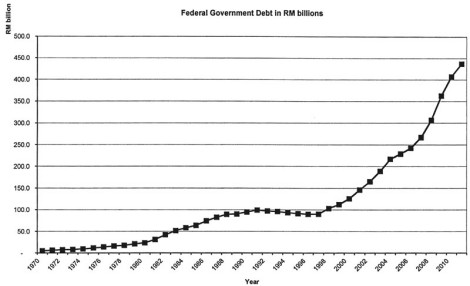
Looking at the rise of Malaysia's debt, I must say that the Barisan Nasional government has failed all Malaysians when the federal government debt continued to rise 10.1 percent to a new height of RM502.4billion or 53.7 percent of the GDP this year. Until the early 80's it was less than RM50b,until around 1998 it was about RM100b...it was about RM250b in 2006, and in the last 6 years it has doubled... We have had no other government but the UMNO led BN government - so blame can lie on no other. 


This anxiety is readily transferred to national debt -- the debt owed by a government to its creditors. How, people ask, will governments repay all of the hundreds of billions of dollars that they owe? As British Prime Minister David Cameron put it: "Government debt is the same as credit-card debt; it's got to be paid back."

The next step readily follows: in order to repay, or at least reduce, the national debt, the government must eliminate its budget deficit, because the excess of spending over revenue continually adds to the national debt. Indeed, if the government fails to act, the national debt will become, in today's jargon, "unsustainable".

Again, an analogy with household debt readily suggests itself. My death does not extinguish my debt, reasons the sensible citizen. My creditors will have the first claim on my estate -- everything that I wanted to leave to my children. Similarly, a debt left unpaid too long by a government is a burden on future generations: I may enjoy the benefits of government extravagance, but my children will have to foot the bill. - Does Debt Matter by By Robert Skidelsky, as appeared in a column in New Straits Times on 23/1/2012

It may be an Election Budget - when this BN government tries to dish out 'goodies' to recover support from Malaysians - but it is still irresponsible and do not look into protection of individual Malaysians today and in the future. Malaysia is country blessed with a lot of natural resources, and with a small population of less than 30 million, and as such we should never have ended up in this state of affairs.

 
Source: Figure 1: Outstanding debt of the Malaysian federal government - Source: Bank Negara Malaysia - ALIRAN Monthly

 azlan
Any good corporations will not give their employees bonuses when it doing badly - incurring greater debt, but here we have our BN government promising one and a half months bonus to public servants - which this government would like to call 'government servants'. 

CIVIL servants will get one-and-a-half month bonus under Budget 2013, in recognition of their work implementing government policies.

Prime Minister Datuk Seri Najib Tun Razak said the civil service was an invaluable part of the Government’s administrative machinery at all levels....- Star, 29/9/2012, Bonus for civil servants

'Work implementing government policies' - what about all those other workers in Malaysia who certainly also worked hard for the good of Malaysia and its people. What about those EX-CIVIL SERVANTS who lost their status and other benefits when the government privatized telecommunications, electricity and water supply, waste management, rail transportation....TELEKOM, TNB, KTM, INDAH WATER,...and all the other workers who without their hard work, Malaysia would not have developed and Malaysians would not be served...Giving incentives to workers is a good thing (i.e. if we can afford to do so) - but when it is given it must be given to ALL workers, especially those who are earning low incomes....likewise all ex-workers also need to enjoy these benefits. (Will those in the civil service then who were convinced by the government to opt for EPF and who today would not be pensioners or 'PESARA' - have not this government forgotten them? Remember, it has been shown that many workers under the EPF scheme are in dire straits now with insufficient monies to sustain their livelihood today...and certainly up to the time they pass on. This government sadly is concerned only for 'Pensioners' - not the rest of the former workers - now called 'Warga Mas')
The pension scheme is intended to provide financial security for retired Government employees.
Retirees who opt for the pension scheme will be paid a fixed monthly income, a service gratuity payment and enjoy benefits such as free medical treatment at Government hospitals.- myGovernment website

  “Effective 2013, the government will implement an annual pension increment of two per cent without having to wait for any review of the remuneration system or salary adjustments,” he[Prime Minister Datuk Seri Najib Tun Razak] said.- IMalaysia Website


The federal government debt continued to rise 10.1 percent to a new height of RM502.4billion or 53.7 percent of the GDP this year, pushing the country one step nearer to the legislated debt ceiling of 55 percent.

The figure, which has doubled since 2006, is equivalent to nearly RM17,000 for every Malaysian.

This is the first time in the nation’s history that the debt has passed the RM500 billion line while the 53.7 percent figure is the highest since the early 1990s.

According to the Economic Report 2011/2012, Malaysia has accumulated RM456.1 billion of debt in 2011.

It stated that the hike in debt is due to “higher domestic borrowings to meet funding requirements”.

However, it stressed that “the level remains within the prudent limit of 55 percent of GDP, a fiscal rule observed by the government”.

At least two international rating agencies have warned that Malaysia’s sovereign credit rating may be cut if the government does not deliver promised reforms to cut spending to reduce its fiscal deficits.

The report pointed out that debt service charges in 2012 are projected to increase by 15.4 percent to RM20.5 billion but it will remain manageable at 10.1 percent of operating expenditure.

In 2011, it was increased by 13.4 percent to RM17.7 billion, or 9.7 percent of the operating expenditure.

“Although the debt level has increased in recent years, debt servicing capacity remains affordable.

“To ensure fiscal sustainability and macroeconomic stability, the government will ensure total federal government debt does not exceed 55 percent of GDP while debt service charges will be capped below 15 percent of revenue,” read the report.

Subsidy bill to rise

Expenditure on subsidies is expected to increase sharply by 17 percent to RM42.4 billion or 4.5 percent of GDP in 2012, but it is still lower than the sharp hike of 56.9 percent in 2011.

The category, which comprises various subsidies (RM31.5 billion), social assistance programmes (RM10 billion) and incentives (RM854 million), accounts for 20.9% of operating expenditure.

“These include subsidies for fuel, sugar, cooking oil and various incentives to increase food production as well as educational assistance and social welfare programmes to improve social-economic mobility of the rakyat,” said the report.

Allocation for fuel subsidy, the largest component in the category of subsidies, is expected to increase by 23.5 percent to RM25.2 billion in 2012 on account of high refined petroleum prices as well as the one-off cash transfers and vouchers given to various target groups to ease the rising cost of living.

The increase was most significant in 2011 when it recorded a 112.1 percent jump to reach RM20.4 billion.

The special financial assistance programmes announced under Budget 2012, namely the one-off cash transfers, incentive payments and book vouchers, cost the government RM3.2 billion and were accommodated within the allocation for fuel subsidies.


azlan