ON HUMAN RIGHTS, JUSTICE AND PEACE ISSUES, LABOUR RIGHTS, MIGRANT RIGHTS, FOR THE ABOLITION OF THE DEATH PENALTY, TOWARDS AN END OF TORTURE, POLICE ABUSES, DISCRIMINATION...
Malaysia must SUE, not protect,
Malaysian companies overseas that is responsible for hazardous haze people in
Malaysia suffers
Tort of Nuisance and other legal means already there – no need to wait
for any new laws
Recently, the Natural Resources, Environment
and Climate Change Minister Nik Nazmi Nik Ahmad indicated that Malaysian
companies operating overseas, including in Indonesia, may be contributing to
transboundary haze, which all in Malaysia now suffer from.
“We have reminded plantation companies
operating in neighboring countries that we will
not defend them if they are involved in open burning (especially) in
Indonesia,” the Natural Resources, Environment and Climate Change Minister said
during Ministers' Question Time in the Dewan Rakyat on Thursday (Oct 12).(Star)
Haze Affects
Health/Environment And Cost The Government
In a 2014 study that ‘…assessed the economic value
of health impacts of transboundary smoke haze pollution in Kuala Lumpur and
adjacent areas in the state of Selangor, Malaysia. Daily inpatient data from
2005, 2006, 2008, and 2009 for 14 haze-related illnesses were collected from
four hospitals. …A smoke haze occurrence was associated with an increase in
inpatient cases by 2.4 per 10,000 populations each year, representing an
increase of 31 percent from normal days. The average annual economic loss due to the inpatient health
impact of haze was valued at MYR273,000 ($91,000 USD)….’ – Abstract from
research by Jamal Othmen and 3 Ors.
Today, in 2023 we are still faced with the haze
problem, and possibly the economic loss suffered is much greater. Then, there
is also to health issues suffered by
individuals and their family, and this loss is yet to be computed, as it could
also include loss of personal income, cost of healthcare and even unnecessary
impacts to person’s health which could be long-term too. Then, there is an
impact to the environment.
Why is Malaysia not
taking legal action against companies? Will Not Defend Position Inadequate
It is good that Malaysia will not defend
Malaysian companies responsible for the haze Malaysians are suffering from, but the question is WHY is Malaysia NOT
taking legal action against these companies who by their action/omission is
affecting Malaysian peoples’ health, environment and even our right of quiet
enjoyment of our land.
Tort Of Nuisance Is
Possible Cause Of Action Against Companies
Malaysian government can sue on behalf of all
in Malaysia for public nuisance, or assist private persons to sue. One possible
cause of action is the tort of nuisance, be it public nuisance or private
nuisance
Public nuisance arises when the action or
activities by the perpetrators interfere
with the comfort and convenience of public within a particular community. It is
sufficient to show that there is a class of people from that community who have
suffered the consequences of the said nuisance
Private Nuisance is "doing on his own land
something which he is lawfully entitled to do. His conduct only becomes a nuisance when the consequences of his acts are not
confined to his own land but extend to the land of his neighbour by: (1)
causing an encroachment on his neighbour's land, when it closely resembles
trespass; (2) causing physical damage to his neighbour's land or building or
works or vegetation upon it; or (3) unduly interfering with his neighbour in the comfortable and convenient
enjoyment of his land.", as stated by then Court of Appeal Judge
Mary Lim[i].
Here, in the case of private nuisance, it does not matter whether if what the
preparator is doing is LEGAL or not – but the fact that the consequence of what
he is doing is spilling over and affecting lives of people in other lands, just
like HAZE or smoke from burnings.
Use the Courts Against
Perpetrators – Companies/Individuals
There is remedy in law against the actual
perpetrators that have affected our air quality by their actions/ommission,
which have affected the health and even the environment of the people of
Malaysia.
We can commence legal action even if the
perpetrators do it in a neighbouring country, like Indonesia.
As such, Malaysia must immediately sue the
Companies responsible, its Directors, relevant officers and maybe also majority
shareholders, without even having to commence any legal action against
Indonesia. Are any of these government-linked companies(GLCs)?
Indonesia Not Willing
To Cooperate Irrelevant For Legal Action Against Perpetrators
It is ignorant for Minister Nik Nazmi to say ‘“As
it involves the sovereignty of a neighbouring country and if they are not
willing to cooperate, we will not be able to enforce the law,”(Star, 11/10/2023).
There are ways of taking action against any other sovereign nation.
With or without a Transboundary Act in place,
Malaysia directly and/or through persons in Malaysia can already commence
required legal action against companies who are responsible for the fires in
Indonesia that is causing the haze problems.
The legal action can be commenced in Malaysia,
or even in Indonesia. It is not necessary to even add the Indonesian government
as a party as you can just sue the companies or persons responsible.
Commence Action in
Malaysian Courts or Indonesian Courts
After all, we are suffering the consequence,
being the poor air quality that is also causing health issues in Malaysia. It
is absurd to even suggest that Malaysia or Malaysians cannot take action because
the companies or their actions that result in fire that causes haze are in
Indonesia.
Legal action can be commenced in the Malaysian
Courts, and if needed also in the Indonesian courts.
Besides tort actions, other actions even
criminal proceedings are also possible options especially when the perpetrators
are Malaysian companies, Malaysian Directors or shareholders. The ultimate
responsibility for actions/omissions of any company lies with the shareholders.
Malaysian Government
Resources Needed for Anti-Haze Legal Actions
Malaysian government has the needed resources for investigation and
evidence gathering even overseas, and they can use it to identify companies that caused the fire or burnings that may
also have spread causing forest fires in Indonesia. Malaysia can find needed evidence to show that the haze we suffer in
Malaysia is linked to a company’s action/omission. The government also can
get evidence to show the link between
haze and diseases/medical conditions or even to the environment.
For an individual alone to do this, it may be
onerous but with the government’s
assistance, including the Ministry of Natural Resources, Environment and
Climate Change, it becomes a possibility for Malaysia (representing the
people) or private individuals (with the assistance of the government) to be
able to take legal action to get justice.
Besides compensation, an important remedy in a
court action could be an injunctions to get these companies, usually plantation
companies, to stop open burning or even to impose conditions to prevent haze if
burning is to be done.
Sue the
Directors/Managers/Shareholders Not Just the Company
When actions are taken against companies,
including Malaysian companies, the Directors, Manager, officers and even
shareholders ought to be made parties and sued. It should not matter if they
are government-linked entities/persons.
Prioritize People over
Profits
Malaysia must prioritize the well being of all
in Malaysia over profits/income of corporations, even if they are Malaysian
companies.
Blaming Indonesia or other countries has so far
sadly been the approach generally taken by Malaysia, but Malaysia really must
act now against the companies or persons that caused the fires by their
action/omission, which may have even caused forest fires that caused this haze.
MADPET (Malaysians Against Death Penalty and
Torture) calls for action now against all who caused this haze and air quality
problem that is also affecting our health and the environment.
Our comfort, our right to good health and the
right to enjoy a clean and safe environment has been affected.
Charles
Hector
For
and on behalf of MADPET(Malaysians Against Death Penalty and Torture)
[i]
CIVIL APPEAL NO: B-02(NCVC)(W)-1163-06/2017]10 JULY 2019
Govt will not defend Malaysian companies contributing to the haze
By RAGANANTHINI VETHASALAM, MARTIN CARVALHO, ARFA YUNUS and MAHADHIR MONIHULDIN Nation
Thursday, 12 Oct 2023 12:18 PM MYT KUALA LUMPUR: The government will not defend Malaysian companies operating overseas which contribute to transboundary haze, says Nik Nazmi Nik Ahmad.
“We have reminded plantation companies operating in neighbouring countries that we will not defend them if they are involved in open burning (especially) in Indonesia,” the Natural Resources, Environment and Climate Change Minister said during Ministers' Question Time in the Dewan Rakyat on Thursday (Oct 12).
Nik Nazmi said his ministry and the Foreign Ministry had submitted a diplomatic note to the Indonesian government informing Jakarta of the haze situation in Malaysia and the intention to work together on operations to put out fires at affected areas.
Nik Nazmi said the transboundary haze issue cannot be resolved solely through the enactment of laws or by pointing fingers.
“We have to admit that aside from Malaysia, Indonesia too had taken steps to address the issue of burning at plantations and peat fires in the past few years, through a presidential decree and other measures,” he said.
He said there were several impediments to enacting transboundary laws such as coordinates, location, and the details of landowners and companies operating in the affected areas. “As it involves the sovereignty of a neighbouring country and if they are not willing to cooperate, we will not be able to enforce the law,” he said.
He said while Singapore has a Transboundary Act in place, it has not been successful when it comes to mounting legal charges.
“We will adopt the diplomatic approach and also (seek) technical and scientific cooperation under the Asean Agreement on Transboundary Haze Pollution (AATHP).
“This agreement (has) existed since 2002 and Malaysia was among the first nations to sign,” he said.
Moving forward, Nik Nazmi said Asean member states must work towards improving the AATHP to combat the cross-boundary haze situation affecting the region.
He said under the current Asean agreement there are no provisions for punitive action to be initiated against companies or countries which induce haze.
“This is a constraint we have under the current framework,” he said.
Nik Nazmi was responding to a question from Datuk Idris Ahmad (PN-Bagan Serai) on whether or not existing Acts suffice in terms of enforcement against neighbouring countries.
The annual haze which results from forest fires in Indonesia has been a bone of contention in the region for several years.
Every dry season, the region is covered in smog due to smoke from fires in Indonesia. These fires are usually from land clearing for oil palm and other plantations.
Indonesian Environment and Forestry Minister Siti Nurbaya Bakar said on Oct 6 that forest fires in some parts of Sumatra and Kalimantan had declined with no haze detected moving to Malaysia.
Her remarks came after Nik Nazmi said in a recent interview with Reuters that he had asked his Indonesian counterpart to address the haze as air quality in the country was worsening, saying haze should not be a new normal. - Star, 12/10/2023
World Day Against the Death Penalty Media
Statement – 10/10/2023
Malaysia Still Retains The Death
Penalty For About 33 Offences – No Change After Mandatory Death Penalty
Abolished
Abolish Death Penalty and Torture
10th October is the World Day Against the Death Penalty.
Every year, on this day, focus is given to a specific issue, and in 2023, the
theme is Torture and the Death Penalty.
It highlights, amongst others, the use of
torture, be it physical, psychological or sexual during investigations before
one is charged and tried. Other focus include torture suffered by those on
death row awaiting execution – known as the death row phenomenon, and torture
during execution due to methods used. Lastly, it highlights the torture
suffered by family and children of persons on death row, and when executed –
noting this a category of innocent persons are also severely affected by the
death penalty.
Torture During Investigation Must End
In Malaysia, even though torture is prohibited
by law, nonetheless it still is being used by the police, other law enforcement
and even the prosecution in some cases, allegedly for the purpose of securing ‘necessary evidence’ . This is an
unacceptable justification, and the use of torture must end.
Allegation of torture by police and law
enforcement are extremely difficult to prove by the accused, more so when there
is no CCTV with recording capacity in all places of the station, or that will
be able to confirm no torture by police from the point of arrest.
Getting suspects to confess was perceived as
the main reason behind torture in police custody, and Parliament in Malaysia
since 2007 has amended the Criminal Procedure Code that now do not allow the prosecution to use any statements made
by accused during the course of a police investigation like confessions.
Section 113(1) of the Criminal Procedure Code states that ‘…no
statement made by any person to a police officer in the course of a police
investigation made under this Chapter shall be used in evidence…’ Only the
accused can use such statements in court.
However, the problem remains that other
statements, not confessions, could still be used to recover other evidence
other than confessions.
In the case of the murder Altantuya Shaariibuu
in 2006, the fact that the accused for an offence that then carried the
mandatory death penalty ‘… had also
independently led the police to the scene of crime which was a remote and
isolated place up in the hills…’. Why would anyone lead the police to evidence for
an offence that will result in their being executed? Was there torture used?
Was there ‘other promises’? Most suspects reasonably will keep quite, and most
lawyers will have advised against doing anything that will assist the police
get evidence needed to convict.
Malaysia and the Death Penalty
In 2018, on the World Day Against Death
Penalty, it was announced that the ‘Malaysia's Cabinet has reached a consensus
that the death penalty for 33 offences as provided for under eight Acts of law
should be abolished…’(Bernama/Straits Times 13/11/2018).
However, on 13th March 2019, Malaysian cabinet
did a U-turn on abolishing the death penalty for all 33 offences, and instead
agreed to only abolish the mandatory death penalty for all 11 mandatory death
penalty offences. The Pakatan Harapan then lacked the political will and
courage to abolish the death penalty.
The Bill to abolish mandatory death penalty was
finally tabled in October 2022, by the then Perikatan Nasional government
during the premiership of Ismail Sabri. Thereafter, Parliament was dissolved
and there was General Elections, and a change of government.
Then, the new Pakatan Harapan ‘unity government’
or coalition government tabled the law to abolish mandatory death penalty and
life imprisonment. The Abolition Of
Mandatory Death Penalty Act 2023 came into force on 4/7/2023, but sister
Act that would allow those on death row to apply to court to review their death
sentence was delayed.
Revision of Sentence
of Death and Imprisonment for Natural Life (Temporary Jurisdiction of the
Federal Court) Act 2023 finally came into force on 12/9/2023,
now allowing about 1,020
prisoners (of which about 850 on death row who had been handed mandatory death
penalty) or the rest serving life
imprisonment sentences to now file applications in court to review these
sentences.
The result of the abolition of mandatory death penalty now means that judges now have
a choice in sentence other than just the death penalty, but the reality is
that the Death Penalty remains in all
the still about 33 offences.
Courts Continue To Hand
Down Death Sentences
Despite the abolition of the mandatory death
penalty, it is disturbing that the courts are still handing down the death penalty.
As examples, on 1/8/2023, Two men charged with murdering a woman were sentenced
to death by the High Court; and on 2/8/2023, the Court of Appeal in Putrajaya
today upheld the death sentence imposed on a businessman for trafficking in
9.528kg of cannabis. (Malaysia Now).
Number Of Offences That
Provide For Death Sentence Remains The Same
MADPET (Malaysians Against Death Penalty and
Torture) notes that things will still remain the same as death sentence is
still available for about 33 offences, many of which do not even result in any death
or grievous bodily harm of any victim whatsoever. For so long, as death penalty
is not abolished, people will still continue to be sentenced to death by the
Courts.
Even after the
revision of death sentence of the about 850 on death row, it is likely that
many will still end up with the death sentence. Not all will receive the alternative sentence
of imprisonment plus whipping. So death row will still have people waiting to be
hanged.
Courts cannot be blamed for sentencing people
to death for so long as the death penalty remains in the law. Only the government, now Anwar Ibrahim’s
Pakatan Harapan led ‘unity government’ can totally abolish the death penalty in
law.
Malaysia’s position which had been declared to
the world, when Malaysia voted in favour of the UN General Assembly Resolution
in 2018, 2020 and 2022 has been than Malaysia will abolish the death penalty.
Malaysia committed to a moratorium on execution pending abolition. Will Anwar
Ibrahim led government have the courage and political will to abolish death
penalty?
In Indonesia, at the end of 2022, the revised
Criminal Code introduced an automatic 10-year probation for convicts on death
row to demonstrate good behavior for the possibility of having their sentences
commuted.
The global trend has been towards abolition – as
countries no longer believe in ‘murdering’ the convicted, but rather imposing a
punishment that will allow for repentance, rehabilitation and a second chance.
MADPET reiterates the call for the total
abolition of the death penalty in Malaysia, and a moratorium on execution pending
abolition;
MADPET urges Judges to consider not sentencing
any person to death at the risk of miscarriage of justice, noting that the innocent
can be wrongly executed just like what happened the case of Chiang Kuo-ching,
who was executed in Taiwan in 1997 after being convicted of sexually abusing
and murdering a five-year-old girl. After his death, in 2011, Taiwan’s Ministry
of Justice admitted that Chiang had been executed in error;
MADPET calls for the abolition of
Torture, especially by the police and law enforcement, and urge the speedy installation
of CCTV with recording capacity be installed at all areas of police station,
and body-cams be mandatory for police and other law enforcement. From the point
of arrest until he/she is charged, there must be evidence that no torture or
wrongdoings were committed by the police or law enforcers in violation of the
law, in violation of a suspect’s rights and justice; and
Noting that death penalty cannot be
abolished unless by law, MADPET calls on Prime Minister Anwar Ibrahim, the
Executive and Parliament to speedily amend laws that will effectively abolish
the death penalty in all lows. If not Courts that are bound to follow the written
law may continue sentencing persons to death when convicted for any of the
about 33 offences that still carry the death penalty.
Charles Hector
For and on behalf of MADPET (Malaysians Against
Death Penalty and Torture)
LETTER | No change after abolishment of mandatory death penalty
Charles Hector
Published: Oct 10, 2023 11:14 AM
⋅
Updated: 11:14 AM
LETTER
| Oct 10 is the World Day Against the Death Penalty. Every year, on
this day, focus is given to a specific issue, and in 2023, the theme is
Torture and the Death Penalty.
It
highlights, amongst others, the use of torture - be it physical,
psychological, or sexual - during investigations before one is charged
and tried.
Other focuses
include torture suffered by those on death row awaiting execution -
known as the death row phenomenon - and torture during execution due to
methods used.
Lastly, it
highlights the torture suffered by the families and children of persons
on death row, noting this a category where innocent persons are also
severely affected by the death penalty.
Torture during investigation must end
In
Malaysia, even though torture is prohibited by law, it still is being
used by the police, other law enforcement, and even the prosecution in
some cases, allegedly for the purpose of securing “necessary evidence”.
This is an unacceptable justification and the use of torture must end.
Allegations
of torture by police and law enforcement are extremely difficult to
prove by the accused, more so when there is no CCTV with recording
capacity in the places of detention or any other methods that are able
to confirm that there has been no torture by police from the point of
arrest.
Getting
suspects to confess was perceived as the main reason behind torture in
police custody and the Malaysian Parliament since 2007 has amended the
Criminal Procedure Code that now does not allow the prosecution to use
any statements made by the accused during the course of a police
investigation like confessions.
Section
113(1) of the Criminal Procedure Code states that “…no statement made
by any person to a police officer in the course of a police
investigation made under this Chapter shall be used in evidence…”. Only
the accused can use such statements in court.
However,
the problem remains that other statements, not confessions, could still
be used to recover other evidence other than confessions.
In
the murder of Altantuya Shaariibuu in 2006, the fact that the accused
for an offence that then carried the mandatory death penalty “… had also
independently led the police to the scene of the crime, which was a
remote and isolated place up in the hills…” was suspicious.
Why
would anyone lead the police to evidence for an offence that will
result in their being executed? Was there torture used? Were there
“other promises”?
Most
suspects would reasonably have kept quiet and most lawyers would have
advised against doing anything that would assist the police in getting
the needed evidence to convict.
Malaysia and the death penalty
In
2018, on World Day Against Death Penalty, it was announced that
“Malaysia’s cabinet has reached a consensus that the death penalty for
33 offences as provided for under eight Acts of law should be
abolished…” (Bernama/Straits Times 13/11/2018).
However,
on March 13, 2019, the Malaysian cabinet did a U-turn on abolishing the
death penalty for all 33 offences and instead agreed to abolish the
mandatory death penalty for all 11 mandatory death penalty offences.
Pakatan Harapan then lacked the political will and courage to abolish
the death penalty.
The bill
to abolish the mandatory death penalty was finally tabled in October
2022 by the then Perikatan Nasional government during the administration
of Ismail Sabri Yaakob. After that, Parliament was dissolved and there
was a general election and a change of government.
Then, the new Harapan-led coalition government tabled the law to abolish the mandatory death penalty and life imprisonment.
The
Abolition Of Mandatory Death Penalty Act 2023 came into force on July
4, 2023, but a sister Act that would allow those on death row to apply
to the court to review their death sentence was delayed.
The
Revision of Sentence of Death and Imprisonment for Natural Life
(Temporary Jurisdiction of the Federal Court) Act 2023 finally came into
force on Sept 12, 2023, now allowing about 1,020 prisoners (of which
about 850 on death row who had been handed mandatory death penalty) or
the rest serving life imprisonment sentences to now file applications in
court to review these sentences.
The
result of the abolition of the mandatory death penalty now means that
judges now have a choice in sentence other than just the death penalty,
but the reality is that the death penalty still remains in all the 33
offences.
Courts continue to hand down death sentences
Despite the abolition of the mandatory death penalty, it is disturbing that the courts are still handing down the death penalty.
For
example, on Aug 1, 2023, two men charged with murdering a woman were
sentenced to death by the High Court and on Aug 2, 2023, the Court of
Appeal in Putrajaya upheld the death sentence imposed on a
businessperson for trafficking in 9.528kg of cannabis.
Offences that carry death sentence remain the same
Madpet
(Malaysians Against Death Penalty and Torture) notes that things will
still remain the same as the death sentence is still available for 33
offences, many of which do not even result in any death or grievous
bodily harm of any victim whatsoever.
For so long, as the death penalty is not abolished, people will still continue to be sentenced to death by the courts.
Even
after the revision of the death sentence of about 850 on death row, it
is likely that many will still end up with the death sentence. Not all
will receive the alternative sentence of imprisonment plus whipping.
So,
death row will still have people waiting to be hanged, and the courts
cannot be blamed for sentencing people to death for so long as the death
penalty remains in the law.
Only the government, now Anwar Ibrahim’s Harapan-led coalition government can totally abolish the death penalty.
Malaysia’s
position which had been declared to the world, when Malaysia voted in
favour of the UN General Assembly Resolution in 2018, 2020 and 2022 has
been that Malaysia will abolish the death penalty.
Malaysia
then committed itself to a moratorium on execution pending abolition.
Will Anwar’s government have the courage and political will to abolish
the death penalty?
In
Indonesia, at the end of 2022, the revised Criminal Code introduced an
automatic 10-year probation for convicts on death row to demonstrate
good behaviour for the possibility of having their sentences commuted.
The
global trend has been towards abolition as countries no longer believe
in “murdering” the convicted, instead imposing a punishment that will
allow for repentance, rehabilitation, and a second chance.
Madpet
reiterates the call for the total abolition of the death penalty in
Malaysia and a moratorium on execution pending abolition.
Madpet
also urges judges to consider not sentencing any person to death at the
risk of miscarriage of justice, noting that the innocent can be wrongly
executed just like what happened in the case of Chiang Kuo-ching, who
was executed in Taiwan in 1997 after being convicted of sexually abusing
and murdering a five-year-old girl.
After his death, in 2011, Taiwan’s Ministry of Justice admitted that Chiang had been executed in error.
Madpet
calls for the abolition of torture, especially by the police and law
enforcement, and urges the speedy installation of CCTV with recording
capacity in all holding areas, and body-cams be mandatory for police and
other law enforcement.
From
the point of arrest until he/she is charged, there must be evidence that
no torture or wrongdoings were committed by the police or law enforcers
in violation of the law, in violation of a suspect’s rights and
justice.
Noting that the
death penalty cannot be abolished unless by law, Madpet calls on Prime
Minister Anwar, the executive, and Parliament to speedily amend laws
that will effectively abolish the death penalty.
If
not, the courts that are bound to follow the written law may continue
sentencing persons to death when convicted for any of the about 33
offences that still carry the death penalty. - Malaysiakini, 10/10/2023
1,020 can now apply to review mandatory death, life imprisonment sentences
This
follows the coming into force of the Revision of Sentence of Death and
Imprisonment for Natural Life (Temporary Jurisdiction of the Federal
Court) Act 2023.
Deputy law and institutional reform minister Ramkarpal Singh says the application can only be made once.
KUALA LUMPUR: The 1,020 prisoners who had been handed mandatory death
or life imprisonment sentences can now file applications in court to
review these sentences, says deputy law and institutional reform
minister Ramkarpal Singh.
This follows the coming into force of the Revision of
Sentence of Death and Imprisonment for Natural Life (Temporary
Jurisdiction of the Federal Court) Act 2023 (Act 847) today, as well as
the Abolition of Mandatory Death Penalty Act 2023 (Act 846) on July 4.
“The
application to review the sentence must be made within 90 days from the
effective date of the Act (847),” Ramkarpal said during a briefing,
adding that the court will deliver its verdict in six months to a year.
“Subject to reasonable grounds, the court can consider an extension of the period to submit a review application.
“The request for a review of the sentence can only be submitted once.”
All applications will be filed by the prisons department on behalf of the prisoners.
Ramkarpal added that the prisoners may hire their own lawyers, use
those appointed by the court, or those from the National Legal Aid
Foundation (YBGK).
The court may either approve or reject the applications of those
handed the mandatory death sentence, or propose a replacement punishment
for those handed a life imprisonment sentence.
If the court decides to maintain the sentence, the prisoner may appeal to the state pardons board for a pardon.
“In reviewing the application, the court will call and
examine the records of the proceedings, the reasons for the judgment,
and other related documents, if any,” Ramkarpal said.
Of the 1,020 prisoners, 573 are Malaysians, and the rest foreigners.
Yesterday, law and institutional reform minister Azalina
Othman Said had confirmed that 1,020 prisoners who had been sentenced to
mandatory death or life imprisonment may file applications in court to
review their sentences with Act 847 coming into force. - FMT, 12/9/2023
High Court sentences duo to death for 2018 Pulau Kerto murder
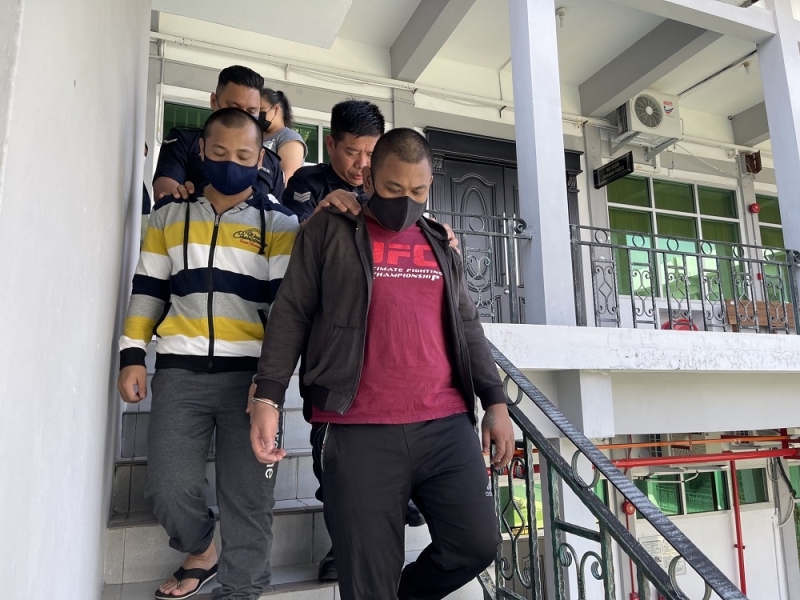
Syahadan (left) and Ting are escorted from the court after sentencing. — Borneo Post Online pic
Follow us on Instagram, subscribe to our Telegram channel and browser alerts for the latest news you need to know.
Tuesday, 01 Aug 2023 7:16 AM MYT
SIBU,
Aug 1 — Two men charged with murdering a woman in Pulau Kerto here in
2018 were sentenced to death by the High Court yesterday.
Jeeji
Ting Kim Leong, 32, from Nanga Assan and Syahadan Othman Sabang, 29,
from Kapit were convicted of causing the death of Ting Poh Sing, 58, at
an unnumbered house in Pulau Kerto between 1am and 7.10pm on June 27
that year.
They
were each charged under Section 302 of the Penal Code read together
with Section 34 of the same Code, which provides for the death penalty
or imprisonment for a term of not less than 30 years but not exceeding
40 years, and if not sentenced to death, shall be punished with whipping
of not less than 12 strokes, upon conviction.
In delivering his
verdict, judge Datuk Christopher Chin said the prosecution had succeeded
in proving its case beyond a reasonable doubt.
He
said a forensic pathologist had testified that the woman’s death was
caused by traumatic asphyxia and smothering, in addition to blunt force
trauma to the chest and back causing multiple fractures to the right and
left ribs.
“There
is nothing in my mind to doubt the evidence of the forensic
pathologist. The two accused are regular drug consumers, and they had a
clear motive to rob the deceased for money to feed their drug habit.
“In
fact, there is undisputed evidence that the upper portion of the
deceased’s house was used by two accused with others as a drug den.
“The
acts of the two accused were therefore done in furtherance of a common
intention to rob the deceased as a result of which the murder occurred,”
he said.
The judge also said the evidence given by the two
accused in their defence was insufficient to cast reasonable doubt on
the prosecution’s case which had been established earlier.
“I find
that Syahadan was the main perpetrator of the injury and smothering of
the deceased. But I equally find that Jeeji had a common intention to
commit murder as happened in this case.
“He made no direct
attempts to save the deceased and in fact was found to have willingly
taken a share of the spoils of the murder. There is no evidence to show
that he did his best to distance himself from the events in the Pulau
Kerto house resulting in the sad demise of the deceased.”
During
mitigation, lawyer Yap Hoi Liong representing Jeeji said the accused
regretted his action and hoped for a minimum sentence to be imposed.
Lawyer
Ben Lau representing Syahadan said his client had shown his remorse in
court and had submitted that his intention was merely to rob rather than
kill the victim.
“It just happened that things went wrong in
between. There was no reason for the second accused (Syahadan) to kill
the deceased, knowing at that material time he was married and with a
child of four years.
“The second accused hopes for the court to
pass a custodial sentence on him so that he will still have the chance
to see his child upon his release from prison,” said Lau.
Deputy
Public Prosecutor Mark Kenneth Netto called on the court to impose the
death sentence to reflect the seriousness of the crime.
He said the case was premeditated whereby the offenders invaded the sanctity of the deceased’s home.
“The
offenders chose to diabolically attack the deceased when she was most
vulnerable. After the commission of the offence, the offenders escaped
leaving the helpless deceased behind, and then in cold-hearted fashion
sold the deceased’s personal belongings at a goldsmith.
“Nothing
can bring the deceased back to her family members and loved ones. No
imprisonment term can begin compensating the loss that the family
members and friends of the deceased have suffered.
“There is no
imprisonment sentence that can be passed which can relieve the loss that
these offenders have caused. Hence the sentence passed must reflect the
seriousness of the crime and the need to deter others from committing
it,” the DPP said. — Borneo Post Online, Malay Mail, 1/8/2023
Appeals court upholds businessman's death sentence for drug trafficking
Mohammad Firdaus Mohsin has one more avenue of appeal – the Federal Court.
Malaysian
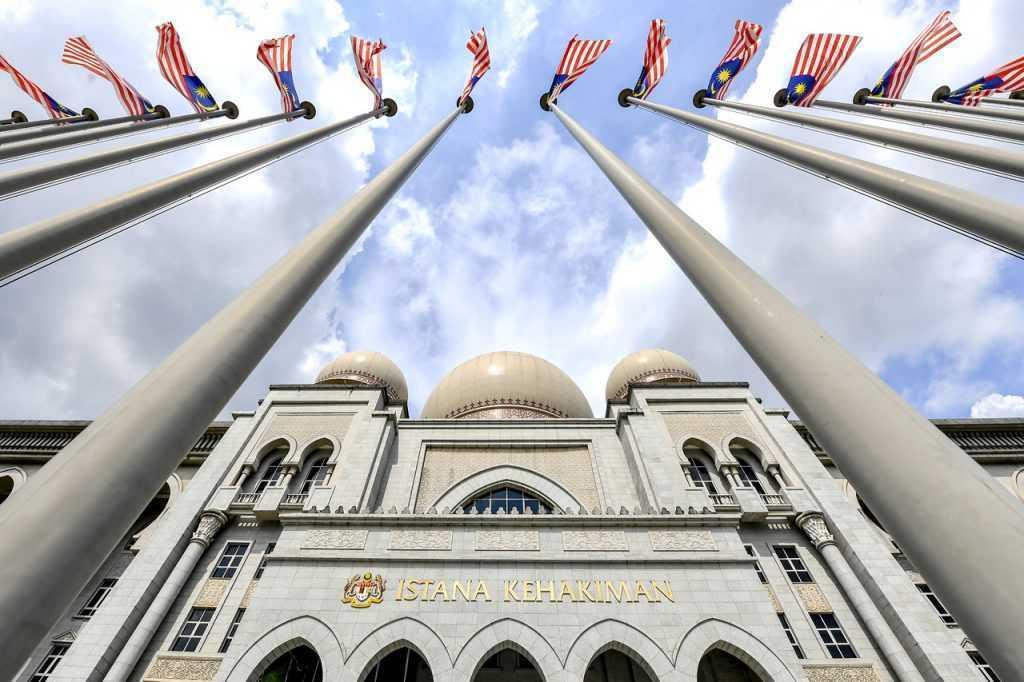
flags wave in the breeze outside the Istana Kehakiman complex in
Putrajaya which houses the Court of Appeal and Federal Court. Photo:
Bernama
-
The
Court of Appeal in Putrajaya today upheld the death sentence imposed on
a businessman for trafficking in 9.528kg of cannabis.
This followed a decision by a three-man panel of the Court of Appeal,
comprising justices Hadhariah Syed Ismail, See Mee Chun, and Azmi
Ariffin, dismissing the appeal by Mohammad Firdaus Mohsin, 38, to set
aside his conviction and death sentence.
Justice Hadhariah, in delivering the court's decision, said there were no merits in the appeal by Firdaus.
She said Firdaus's conviction was safe to be upheld.
On Dec 3, 2021, the High Court in Shah Alam found Firdaus guilty of
trafficking in the drug by the roadside of Jalan Bukit in front of the
Kajang KTMB train station in the Hulu Langat district, Selangor, at 10pm
on March 28, 2017.
Firdaus has one more avenue of appeal, which is to the Federal Court.
According to the facts of the case, a police team, acting on
information, went to the area and saw Firdaus, who was behaving
suspiciously and carrying two bags.
A police officer approached him and asked him to open the bags. They
found several slabs of compressed dried leaves in one of the bags, which
were later confirmed by the chemistry department to be cannabis.
In his defence, Firdaus claimed that the bag was not his but belonged
to an Uber driver, and he was taking care of the bag while waiting for
the Uber driver to park the car.
He claimed that he came to Kuala Lumpur from Penang to attend an
event and was waiting for his uncle to fetch him to his (uncle's) house
in Sungai Ramal, Kajang.
During the trial, the Uber driver, Mohd Sabri Salleh, testified that
he received a booking from Firdaus through the Uber apps to send the
latter from KL Sentral to the Kajang KTM station.
He said he saw Mohammad Firdaus carrying the bags, and he (Firdaus)
had put the bags next to him (Firdaus) in the back seat of the car.
Lawyer Afifuddin Ahmad Hafifi represented Firdaus, while deputy
public prosecutor Mohd Fairuz Johari appeared for the prosecution.- Malaysia Now, 2/8/2023
New penal code offers hope of abolishing death penalty in Indonesia
Human rights activists stage a rally in Kota Tua, West Jakarta, to commemorate the World Day against the Death Penalty in this undated file photo. - The Jakarta Post
JAKARTA (The Jakarta Post/Asia News Network): A recent report from Amnesty International suggests that Indonesia's revised Criminal Code is a step in the right direction toward abolishing capital punishment, even as the country’s justice system continues to hand down high numbers of death sentences.
Passed at the end of last year, the revised Criminal Code introduced an automatic 10-year probation for convicts on death row to demonstrate good behavior for the possibility of having their sentences commuted.
After the probation elapses, the sitting president may decrease the sentence to life in prison or 20 years in prison.
The policy will take effect in 2026. Amnesty International Indonesia researcher Ari Pramuditya said that although Indonesia still had a long way to go before the death penalty was completely abolished, the new penal code was "a positive step" that deserved recognition.
"However, we still need to closely monitor its implementation. Amnesty will continue to push for the total abolition of the death penalty.
Although the probation for people sentenced to death is a step in the right direction, it's not enough, and we still have a long way to go," Ari said at a press conference on Tuesday. Amnesty International Indonesia executive director Usman Hamid said the country had to use the opportunity to significantly reduce instances of capital punishment after years of what he said were shockingly high figures.
Indonesia has continued to record-high numbers of death sentences in recent years, with 112 instances 2022, just two fewer than in 2021, according to Amnesty. In 2020, it recorded 117 death sentences. As of Monday, there were 452 convicts awaiting execution. Zero-tolerance policy Ari said one of the main reasons for Indonesia's high level of death sentences was President Joko "Jokowi" Widodo's "zero-tolerance" policy against drugs, with drug crimes accounting for 94 per cent of all death sentences last year.
"Some judges even mentioned Jokowi's zero-tolerance approach to drugs as a contributing factor for handing out the death penalty to drug offenders," he said.
According to Ari, support for the zero-tolerance approach was partly based on the misguided idea that the death penalty deterred drug-related crimes.
Despite the high number of drug convicts sentenced to death, he noted, Indonesia continued to see a growing number of drug users. - Star, 17/5/2023
Will Tun M get a fair trial against PM Anwar Ibrahim before a judicial commissioner?
By
FocusM
12 hours ago
A NON-GOVERNMENTAL orgniasation (NGO) has expressed concern about
the independence of judicial commissioners (JCs) in light of former
twice premier Tun Dr Mahathir Mohamad failing to get the High Court’s
permission to obtain certain documents that purportedly support his
RM150 mil defamation lawsuit against Prime Minister (PM) Datuk Seri
Anwar Ibrahim.
Noting that the judge in that case was JC Zaharah Hussain (appointed
to her post on Jan 17 this year), the Malaysians Against Death Penalty
and Torture (MADPET) is concerned that unlike judges, they do not have
the security of tenure, and that they are “ultimately appointed by the
Yang di-Pertuan Agong acting on the advice of the PM”.
“Given that Anwar is the present PM, would any JC not worry about
offending him and/or at risk of not being appointed a judge or having
their generally two-year contract as JC extended?” asked the NGO’s
co-founder Charles Hector in a media statement.
Zaharah Hussain
“Zaharah herself may be a good judge – not affected by any such
consideration and may perform her functions as a ‘judge’ without fear or
favour – but the concern is public perception of the independence of
these JCs. The concern is about the fairness of such trial when one of
the parties is Anwar who is the current PM.”
Hector further lamented that rather than amending the Federal
Constitution to increase the number of High Court judges, the Federal
Constitution was amended in June 1994 to introduce JCs instead.
Charles Hector
“What should have been done was to simply increase the number of
judges so that all judges – after their appointment by the King – will
enjoy the safeguards to protect the independence of judges, especially
the security of tenure right up to retirement age of 66,” opined the
human rights activist-cum-lawyer.
“Now, persons qualified to be judges are appointed generally as JCs
for a term of two years and this contract can be extended from time to
time.”
As a solution, MADPET called for judges to be appointed directly
without having to go through any ‘probation’ or ‘trial period’ as JCs
“and on appointment, judges must immediately enjoy security of tenure
where the end date must be their fixed retirement age”.
“Some JCs may become judges fast even before the two years have
lapsed, others much later and some may even never get appointed,” added
the NGO. – Oct 5, 2023, Focus Malaysia
Najib’s ‘house arrest’
-
Aliran has released a statement on the latest developments: The news has
made headlines both at home and abroad, and for good reason. For many, this
decisi...
Beyond the Bandung nostalgia
-
Sixty years on, the spirit of 1955 needs updating for today's world.
The post Beyond the Bandung nostalgia appeared first on Aliran.
APA PADA NAMA
-
1. Sejarah Malaysia dikait rapat dengan UMNO, Parti Kebangsaan Melayu
Bersatu. Parti UMNO pula dikenali dengan pemimpinnya. 2. Demikian di
peringkat permul...
China and HK may be barred from Asia Team meet
-
PETALING JAYA: The status of next week’s Asia Team Champion-ships in
Manila, the Philippines, is in quandary as two badminton nations – China
and Hong Kong...
PRU14 - Keputusan TEMERLOH - Parlimen dan DUN
-
Keputusan di Temerloh, harus kita analisa
1- Parlimen dimenangi Pakatan Harapan, yang juga menang DUN Mentakab,
tetapi BN menang DUN Lancang dan DUN Kuala ...
Thank you, Malaysians
-
Before the lights go out on The Malaysian Insider at midnight, we say
"Thank You" to our readers. TMI started on February 25, 2008. Today, after
eight year...
I believe in the freedom of expression - and everyone is free to use, reproduce, quote, copy and circulate, etc... materials published here. Please credit the source: http://charleshector.blogspot.com/.
For those of you who do have Blogs/Websites, it would be good if you could add a link to CHARLES HECTOR Blog. Please do promote the BLOG.
Anonymous comments or those containing profanities and obscenities (or irrelevant matters) will be rejected. Note that all comments made in post are personal opinions.
Number of Visits
Over 4 million visits. On an average, we have about 700-750 visits per day.Thank you all for your support and encouragement..








 Posts
Posts