Fishermen's livelihood and environmental jsutice versus Development and Money for State government > This is the issue surrounding Penang government's plan to build artifical islands...
The group said the PSR will jeopardise the livelihood of 4,909 fisherfolk and 511 fish farmers.Sand mining involving the PSR will negatively impact 6,000 fisherfolks and fish farmers in northern Perak, it alleged.
Indigenous people(Orang Asli) customary land rights land and 'DEVELOPMENT:...
Lynas or its surrounding communities health and livelihood versus 'DEVELOPMENT' and monies for mining companies and others..
There are many such issues that arise ...It is an issue for all Malaysians - not just Penangites ...Pakatan Harapan helping fisherfolk in Tanjong Piai but then what about Penang...?
As CLIMATE CHANGE becomes a concern - this project also will cause climate change?
Is it even WISDOM spending so much monies, affecting the environment, livelihood of fishing communities...in an area that was affected by the recent TSUNAMI?
Now, when Penang was governed by the Opposition, and the Federal government by Barisan Nasional, Opposition states may have to find ways to make monies for the State's development BUT today both the Federal government and the Penang government are ruled by the same Pakatan Harapan government ...should Penang State government re-consider their plans which will impact the environment and the livelihood of some 4,000 over fisherfolk whose livelihood will be impacted by these artificial islands - the impact may be long term ...Will compensation only be JUST to the fisherfolk? The project will affect their livelihood ...not not but also in the future...and this building of an artificial islands will impact not just their fishing grounds but also other areas from where sand/soil will have to be taken and moved in the island building process...
Is there a shortage of land like Singapore? Not really, as there is so much more land available in Malaysia....remember that the MAIN reason for Penang government to build these 3 artificial islands is for MONEY for other purposes ...
Why is Penang even building 3 artificial island - we are not land-deprived like Singapore... Apparently the reason is to raise money to pay for LRT projects and highway projects..."to three artificial islands to be reclaimed south of Teluk Kumbar to be later sold to the highest bidder, as payment for building highways, a Light Rail Transit line and other modes of transport'
Penang government is going ahead and recently announced that it has identified 5 international teams ...and each given RM508,000 to submit plans...
Now, this '3 artificial island' issue in Penang is an issue that is being opposed not just by the affected fisherfolk...but by a lot of people and civil society ...including Penang Forum...[The peacelful assembly or protest in Panang MAY have had hundreds of thousands people taking to the street BUT allegedly the police placed a condition that permission given ONLY if less than 1,000? But over 4,000 fisherfolk, who could not participate had a HARTAL on that day - they did not go out to work to fish...The Penang government has shortlisted five international teams to design the three reclaimed islands in the Penang South Islands (PSI) project, following a RM2.5 million master-planning competition held since last November....Chief Minister Chow Kon Yeow said the five teams – each consisting of a foreign company with a Malaysian partner – were selected from a list of 27 chosen from an initial 124 submissions...He said the five teams were chosen based on their capability and experience in similar projects. A honorarium of US$125,000 (RM508,000) will be paid to each of the five teams. - FMT
Silence on the part of Pakatan Harapan leaders...relevant Ministers...and the Cabinet on this issue is disturbing ...something that many of us would not have expected from this Coalition of HOPE (Pakatan Harapan) government ...
Penang is not ruled by DAP - but by Pakatan Harapan made out of Amanah, PKR, BERSATU and DAP...and Warisan too
See some earlier related posts:-
Penang fishermen peaceful assembly only allowed if NOT MORE than 1,000? Totally unjust?
Freedom of Assembly Curtailed - the Penang Fisherfolk and now the Dong Zong conference?
Press statement by Penang Tolak Tambak, SUARAM and [other CSOs], and memorandum handed over to SUHAKAM on Thursday, 16 January 2019
Reclamation is a Travesty of Environmental Justice and Human Rights for vulnerable coastal communities
BACKGROUND
Environmental justice is about promoting the “fair” distribution of environmental benefits and burdens, as well as ensuring that vulnerable low-income communities do not bear the brunt of pollution, environmental degradation, and climate change.
Penang Tolak Tambak is an alliance between the Persatuan Nelayan Pulau Pinang and Penang Forum formed in mid-2019 to stop the destructive large-scale coastal reclamation projects in Penang, particularly the Penang South Reclamation (PSR).
This memorandum focuses on the PSR project. The Penang government’s project to reclaim 3 islands measuring 4,500 acres will produce major negative outcomes for environmental justice and human rights. The creation of three supposedly “smart and green” artificial islands which aims for affluent buyers and investors will be undertaken at the expense of vulnerable groups and the future generation.
This memorandum raises 5 issues of Environmental Justice affecting traditional /inshore/artisanal fishers (nelayan) and fishing communities which should be raised to the Penang State Government as project proponent and approver of the PSR project.
A. The PSR project will inflict “permanent damage” on Penang’s richest fishery and sensitive coastal ecosystem, impacting the livelihoods of 4,909 nelayan and 511 marine aquaculture operations. Sand mining for the PSR will affect an additional 6,000 nelayan and aquaculture operations in northern Perak.
B. Have the Penang government and the Department of Environment failed to observe the “precautionary principle” in climate mitigation and environmental protection?
C. Are the state authorities ignoring, overruling and undermining the traditional nelayan’s rights of tenure and access to the fisheries commons, by planning a project which destroys and pollutes the marine ecosystem?
D. Are the state authorities violating the principle of Free Prior and Informed Consent by deciding to proceed with the project despite the explicit objections of local fisher communities?
E. Did the authorities attempt to obstruct the fisherfolk’s protest and memorandum handover on Hari Solidariti Nelayan, 4 November 2019, by trying to deny the use of public space, imposing restrictive conditions, erecting police barricade and – despite permission given in the police letter – denying entry to the state assembly venue?
MEMORANDUM
The current trend of coastal reclamation projects as a development strategy in Malaysia is creating thousands of “victims of development” among vulnerable low-income coastal communities. Penang South Reclamation is an important test case for the defense of traditional nelayan’s human rights, against the “sea grab” of the fisheries commons by state and business interests. The deliberate erosion of fisheries rights for Penang and Malaysia’s nelayan, and the implications for our national food security and cost of living, poses a direct and monumental threat to the well-being of our country’s B40 population.
Two petitions to stop the Penang South Reclamation have been signed by more than 250,000 supporters (change.org, rainforest rescue). The numbers clearly demonstrate the groundswell of local, national and international support for these fisherfolk and for the protection of our marine ecosystems.
We have appealed to the Prime Minister of Malaysia and the Chief Minister of Penang to observe the “precautionary principle” for environmental protection and to stop/cancel the proposed Penang South Reclamation project.
We call upon SUHAKAM to advise the Penang State Government, developers, government officers, and fisheries authorities, to respect the fishing communities’ rights to Free, Prior and Informed Consent, and to conduct any consultations fairly and transparently with all legitimate representatives on board and observing mutually agreed due process. Any attempts to undermine the Persatuan Nelayan Pulau Pinang’s collective position by any party through, e.g., one-to-one negotiation and offering of incentives, or the exertion of undue pressures through malafide acts such as intimidation, coercion, or abuse of power in removal of normal subsidies or use rights, obstruction of access to fisheries, arbitrary demotion or disqualification of any nelayan, undermining the right to freedom of association, or de-platforming of the Persatuan Nelayan in any manner, should be forewarned and investigated.
We appeal to SUHAKAM to ensure that local fishing communities are not disenfranchised of their rights to the fisheries commons which has been their source of livelihood for generations. To protect the human rights of the nelayan, we call upon SUHAKAM to conduct a full investigation of the plight of the Penang and Perak nelayan threatened by the proposed Penang South Reclamation project.
We also call upon political representatives, government, civil society and the public at large to recognise coastal reclamation as an environmental justice issue affecting tens of thousands of nelayan and their fishing communities, and to support the nelayan’s rights by calling for the national proscription or ban on coastal reclamation proposals for urban development, as advised in the National Physical Plan 2020.
APPENDIX
A. Potential socio-environmental adverse impacts
The long list of negative environmental and social impacts of the Penang South Reclamation (PSR) are contained in various memoranda and petitions by Penang Tolak Tambak to the government. The points in brief:
1. The extent of environmental damage is acknowledged in the Malaysian Department of Environment’s letter of approval for the PSR project, dated 25 June 2019:
“…the development of the project will cause permanent and residual impact on mudflat ecosystems, fishing ground, turtle landing area, and some coral reefs in Pulau Rimau which is an important source of resources fishery. This permanent destruction will have a significant negative impact on the country's fisheries resources, fisheries and food security.” (translated)
Furthermore, the PSR project will generate 3.2 million tonnes of carbon emissions. Sand mining will destroy 820 square kilometres of seabed in Perak leading to the loss of fisheries, coastal erosion, and destruction of corals and turtle landing sites.
2. The extent of loss or impairment of nelayan’s livelihood is acknowledged by the Minister of Agriculture, speaking in Parliament on 16 July 2019:
“Penang South Reclamation (PSR) will affect 4909 nelayan on the island of which 1,422 comprise the traditional nelayan of Zone A. It is estimated that 51,184 metric tonnes worth RM595 million a year in marine fishery landings in Penang will be affected by this permanent destruction. The PSR project will also affect 511 aquaculture operations with a production of 45,742 metric tonnes worth RM 1.67 billion a year.” (translated)
Sand mining will also affect an additional 6,000 nelayan in northern Perak.
3. Small-scale fisheries will be devastated. In times of climate crisis and declining global fisheries resources, the UN Food Administration Organization (FAO) view sustainable small-scale fisheries as a key to food security and human rights. The impacts of marine pollution on inshore nelayan’s catch and the nearby fish farms will trigger price hikes in and beyond Penang, threatening the supply of seafood to B40 families and jeopardising national food security.
4. The National Physical Plan (2010) has clear policy statements forbidding coastal land reclamation (except for reclamation for the development ports of strategic national importance). It proposes an amendment to the Town and Country Planning Act 172 to include coastal land reclamation projects under Section 22(2A) to bring them within the purview of the National Physical Planning Council to provide advice. This recommendation should be immediately implemented.
5. The PSR project goes against the principles of socio-economic inclusivity and UNDP’s Sustainable Development Goals, especially: SDG1 (no poverty), SDG8 (decent jobs & economic growth), SDG10 (reduced inequalities), SDG11 (sustainable cities & communities), SDG13 (climate action) and SDG 14 (life below water).
B. Not applying the precautionary principle in protecting the environment
Principle 15 of the Rio Declaration notes:
"In order to protect the environment, the precautionary approach shall be widely applied by States according to their capabilities. Where there are threats of serious or irreversible damage, lack of full scientific certainty shall not be used as a reason for postponing cost-effective measures to prevent environmental degradation.”
Decision-makers have a responsibility to anticipate harm before it occurs. Caution should be further observed where there are indications of uncertainty and irreversibility, and it is the responsibility of an activity-proponent to establish that the proposed activity will not (or is very unlikely to) result in significant harm.
1. Large-scale reclamation projects will cause environmental degradation, leading to a decline in fisheries. The Seri Tanjung Pinang 2 (STP2, 760 acres) and Gurney Wharf (131 acres) undertaken in the seas north of Penang Island, is showing signs of time and cost overruns, marine pollution and damage to fisheries. At the Sessi Aduan Nelayan undertaken at Tanjung Tokong and Bagan Ajam, the majority of nelayan complained that their catch has dwindled by 50–70% since the project started.
2. The authorities have not responded adequately to rectify this existing case of environmental degradation. The Penang State Government and Department of Environment have a duty to assess the impacts of previous reclamation projects and to evaluate whether future reclamation is advisable. While politicians may talk about the nelayan “leading better lives”, mitigating negative impacts and rehabilitating the fisheries, such an optimistic outlook has not been borne out by the STP2 experience.
3. The PSR project is expected to generate 3.2 million tonnes of carbon annually. If reported accurately, this will compromise Malaysia’s pledge to fulfilling its global climate goals.
4. The failure of the authorities to address environmental degradation suffered by existing stakeholders and future generations results in issues of gross environmental injustice. The issue of coastal reclamation must be more widely understood so that the culprits harming the ecosystem can be held accountable.
C. Ignoring the traditional nelayan’s tenure rights to the commons
Productive coastal areas are not mare nullis (empty sea), but the fishing grounds and main source of livelihood to these fishing communities. Island creation and coastal land reclamation projects imposed through top-down policies are “stealing our seas”, inflicting sudden and long-term distress to our fishing communities, and threatening their very survival. The Food Administration Organisation (FAO) explains the concept of governing tenure rights to the commons:
“Commons are natural resources such as land, fisheries and forests that a community, group of communities or group of people owns, manages and/or uses collectively to support their food security and sustain their livelihoods and well-being. Collective tenure rights are crucial for millions of people worldwide. Poor, marginalized, vulnerable and landless people rely most on commons, as they represent a source of income as well as a safety net in times of hardship for them. Commons are of important cultural, social and spiritual value to many communities worldwide and provide essential environmental services at local and global levels. The recognition of collective tenure rights to commons is, hence, a cornerstone to achieving sustainable development and the realization of the right to food.” http://www.fao.org/3/a-i5771e.
1. Nelayan will lose the richest fishery in Penang waters. For generations, the traditional nelayan has been fishing in the sheltered, shallow seabed of Kawasan Selatan, and fishing communities have flourished along with the southern coast of Penang. Yet their rights to the fisheries commons are not being recognized and respected.
2. The nelayan will lose access to fisheries. The channels between the 3 PSR islands are created ostensibly to allow nelayan future access to the sea, but this is a moot point as the marine ecosystem and fisheries will be irreversibly damaged and regular siltation of the channels will impede access. Frequent conflicts are anticipated to arise between the local fisherfolk and the developers’ dredgers and tugboats at sea, as well as between local community and developers’ workers overland access to beaches, amenities, road space, etc.
3. Rich developers will gain a reclamation site but at the expense of the poor nelayan. The appropriation of sea and seabed of Kawasan Selatan for real estate development can be construed as a “sea grab” or “ocean grab” by state and big business, mainly to benefit privileged groups, including investors and property buyers. The state government is “trading off” the sustainable fisheries, fisheries commons, nelayan’s livelihood and food security for speculative economic gains.
4. The PSR project will put unprecedented demographic, environmental and housing pressures on local communities. Many residents, including nelayans’ families who are not property-owners, will be forced out by land price hikes and evictions. The breakdown of social cohesiveness will be speeded up, leading to loss of culture, heritage and way of life.
5. Current development in Penang Island South is already stressing the Kawasan Selatan community. Currently, 3 hostels for a total of 30,000 foreign workers are being built/proposed in the south; in some areas, residents will be overwhelmed 5 to 1 by foreign workers. The demographic changes caused by the projected 400,000 population on the PSR islands will further destabilize and displace the existing population of the kampung nelayan.
D. Not observing process of Free Prior and Informed Consent
Traditional fishing communities, like any indigenous peoples and long-settled local communities, are entitled to have a say in their own future. The Free Prior and Informed Consent (FPIC) principle is enshrined in the UN Declaration of the Rights of Indigenous Peoples and is also widely used to uphold the rights of local communities. Development for local communities without their FPIC – without them being involved in deliberations every step of the way – can be construed as a form of “takeover” of territory through “development aggression” foisted upon the stakeholders.
The Persatuan Nelayan Pulau Pinang formed under the Akta Persatuan Nelayan 1971 (Akta 44)), are the legitimate representatives of thousands of nelayan and other members engaged in the fisheries industry..
1. In a previous project (STP2), the fisheries authorities negotiated with the nelayan on behalf of the developers, bypassing the Persatuan Nelayan Pulau Pinang and pressuring the nelayan to accept the compensation or rather “consolation” (saguhati) offered by the developers, within a tight deadline, failing which the fisherfolk “would receive nothing”. The fisheries authorities which should be protecting the nelayan’s livelihoods were implicated in influencing the nelayan to give up their livelihoods for a small “consolation” – this indicates a conflict of interest and possible abuse of power. In the deliberations for the PSR project, the fisheries authorities seem to be playing the same role. The LKIM should be called out and held to account.
2. The PSR EIA was approved by the DoE even though the Social Survey component showed that only 17 nelayan agreed to the reclamation and 94.5% of the nelayan rejected it. In a poll of 635 respondents in the Impact Area made in 2016 (breakdown 300 general public, 200 fishing communities, 100 local business operators, 35 beach users), 51.1% of respondents agreed to the reclamation, but the vast majority of those who agreed were not nelayan stakeholders. In addition, a Social Impact Assessment under the KPKT was conducted in early 2019, but not made public.
3. The Penang State Government has decided to go ahead with the PSR project without the Free Prior Informed Consent (FPIC) of the main stakeholders. The Department of Environment also did not seek the nelayan’s views before granting the EIA Report a hasty approval on June 25, 2019. The Persatuan Nelayan has repeatedly voiced their objections to PSR starting with a demonstration of 1,500 nelayan in December 2015, and has written memoranda appealing to the Prime Minister, the Governor of Penang, and the Penang Chief Minister, copied to various ministers, MPs, and government agencies.
E. Attempts to obstruct the nelayan’s protest and memorandum handover
On 4 November 2019, the Persatuan Nelayan Pulau Pinang organised a protest called “Hari Solidariti Nelayan” in Padang Kota, Penang, participated by about 1,000 nelayan and civil society. The intention was to hand over a memorandum to the Chief Minister who was presiding over the Penang State Assembly in a session that Monday.
Although the protestors followed the rules, it appears that the authorities attempted to obstruct or restrict the peaceful assembly, as shown by this sequence of events.
1. The Persatuan Nelayan wrote to MBPP on 13 Sept 2019 to use the public space at Padang Kota, The Penang Island Municipal Council (MBPP) only replied on 25 Oct – that is, 10 days before the event – to say the request could not be considered because the field was undergoing repairs, asking them to postpone or find another venue. In fact, only small areas of the field were being repaired and right up till the day of protest, normal public use of the field could be observed.
2. After several meetings with the police, a letter was issued by the police on Fri 1 Nov 2019, stipulating the conditions to be observed during the peaceful assembly on Monday, 4 Nov. Among the conditions: no procession, and only 5 representatives would be allowed to enter Dewan Sri Pinang to hand over the memorandum.
3. After initial speeches, 5 leaders of Penang Tolak Tambak walked from Padang Kota to the Dewan Sri Pinang to present the memorandum. The other protestors tailed behind. Halfway, the protestors were met by a barricade erected by policemen dressed in riot gear and armed with plastic shields. This “show of force” by the police in a peaceful protest might be construed as subtle intimidation.
4. Only 5 representatives were allowed to proceed but when they arrived at the fence of the Dewan Sri Pinang, they were stopped from entering the compound, despite the police letter. The Chief Minister refused to meet the representatives of the 1,000 strong protestors and only sent the state information officer to receive the memorandum.
5. The Persatuan Nelayan Pulau Pinang and Penang Forum are very disappointed that the Penang government has refused to engage with the representatives of the protestors on Hari Solidariti Nelayan, 4 November 2019. This was the first protest in Malaysia to be held after the amendments to the Peaceful Assembly Act came into force on 1 November 2019, and we are disappointed that this government is not honouring the spirit of the amendments, guaranteeing greater freedom of assembly.
This memorandum and statement is endorsed by:
1. Agora Society
2. Aliran
3. Angkatan Belia Islam Malaysia (ABIM)
4. Artivist Network
5. Beyond Borders Malaysia
6. Center to Combat Corruption & Cronyism (C4)
7. Consumers Association of Penang (CAP)
8. Desa Ria Residents Association, Penang
9. Gerakan Pembebasan Akademik (GPA)
10. Greenpeace Malaysia
11. Greensmiths
12. Klima Action Malaysia (KAMY)
13. Klimate Action Utara Malaysia
14. Majlis Perundingan Pertubuhan Islam Malaysia
15. Malaysia Muda
16. Malaysians Against Death Penalty and Torture (MADPET)
17. Natural Farming Association
18. PEKA Malaysia
19. Persatuan Aktivis Sahabat Alam (KUASA)
20. Persatuan Kebangsaan Pelajar Islam Malaysia (PKPIM)
21. Persatuan Kesedaran Komuniti Selangor (EMPOWER)
22. Persatuan Penduduk Petaling Jaya
23. Persatuan Persaudaraan Muslimah Malaysia
24. Persatuan Promosi Hak Asasi Manusia (PROHAM)
25. Persatuan Sahabat Wanita Selangor
26. Pertubuhan Alam Sekitar Sejahtera Malaysia (GRASS Malaysia)
27. Pertubuhan Kebajikan Nasiatul Aisyiyah / Aisyah Home
28. Pertubuhan Solidariti Hijau Kuantan (PSHK)
29. Pertubuhan Warisan Tanah & Teroka Bandar Pulau Pinang (NGO Teroka)
30. Sahabat Alam Malaysia
31. Save Malaysia / Stop Lynas (SMSL)
32. Suara Rakyat Malaysia (SUARAM)
33. Tanjung Bungah Residents Association
34. Teras Pengupayaan Melayu
35. University of Malaya Association New Youth (UMANY)
36. WH4C (Workers Hub For Change)
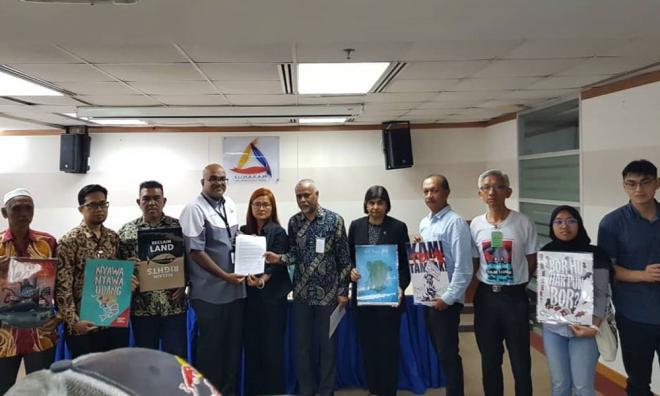
Penang anti-reclamation coalition submits memorandum to Suhakam
Penang Rejects Reclamation, a group of NGOs and fisherfolk
associations, have submitted a memorandum to the Malaysian Human Rights
Commission (Suhakam) to plead for their help to stop the Penang South Reclamation (PSR).
Suhakam
commissioner Jerald Joseph received the memorandum from the group which
was represented by Penang Forum's committee member Khoo Salma Nasution
and Penang Fishermen Association chairperson Nazri Ahmad.
Organised by Suaram, the memorandum is supported by 38 organisations.
A
petition addressed to Prime Minister Dr Mahathir Mohamad calling for
the reclamation to be halted has collected some 250,000 signatures since
it was started last year.
The group - a collaboration between Penang Forum and Penang Fishermen Association - urged Suhakam to advise the state government, developer, and fishery authorities to respect the fishing communities' right to "Free, Prior and Informed Consent".
They
called on the state government to hold fair and transparent
negotiations by involving all stakeholders, urging the authorities to
respect the proses of consensus between the groups.
"Any attempt
by any party to disallow the collective standing of the Penang
Fishermen's Association through, for example, one-on-one negotiations
and offering of incentives, or to impose undue pressure through acts of mala fide
such as intimidation, coercion, or abuse of power in the removal of
subsidies or common rights, obstructing access to fisheries, arbitrary
actions to downgrade or disqualify any fisherman, deny the right to
freedom of association, or otherwise restrict the fishermen's union by
any means, should be warned and investigated," the memorandum read.
"We
urge Suhakam to ensure that local fishermen are not denied their rights
to the fisheries resource area that has been their source of livelihood
for generations," the memorandum added.
They also called on
Suhakam to conduct a full investigation of the Penang and Perak
fisheries problem threatened by the South Penang Reclamation project.
The
group also urged political representatives, governments, civil society
and the general public to
recognise that coastal reclamation is an issue
of environmental justice involving tens of thousands of fishermen.
They
asked that the rights coastal fishermen be protected by prohibiting
reclamation as stated in the National Physical Plan 2020.
"Environmental
justice is to ensure that low-income communities do not suffer the
effects of pollution, environmental degradation and climate change," the
group insisted.
Involving three artificial islands
covering 4,500 acres (1,820 hectares), the reclamation project's
negative impact on environmental justice and human rights, are the main
focus of the memorandum.
Located on Bayan Lepas, the islands,
which will supposedly be "smart and green", are targetted at property
buyers and investors, but activists claimed it will marginalise the
lower income group, as well as future generations.
The memorandum
raises five points on environmental justice which involves traditional
and coastal fisherfolks, who should be the concern of the Penang
government, as the implementor of the project.
The group said the PSR will jeopardise the livelihood of 4,909 fisherfolk and 511 fish farmers.
Sand mining involving the PSR will negatively impact 6,000 fisherfolks and fish farmers in northern Perak, it alleged. - Malaysiakini, 17/1/2020
Penang land reclamation group submits memorandum to Suhakam, wants project probed for rights violations

KUALA LUMPUR, Jan 16 — The Penang Tolak Tambak ad hoc group today
appealed to the Human Rights Commission of Malaysia (Suhakam) to conduct
a full investigation of the plight faced by fishermen affected by the
proposed Penang South Reclamation (PSR) Project.
Penang Forum committee member Khoo Salma Nasution, when submitting a
memorandum to Suhakam over the matter, said the deliberate erosion of
fisheries rights posed a monumental threat to the nation’s food security
and inflict ‘permanent damage’ on Penang’s richest fishery and
sensitive coastal system.
The adverse effect, Khoo added, would harm the livelihoods of some 4,900 fishermen and 500 marine aquaculture operations.
“We call upon Suhakam to advise the Penang state government,
developers, government officers and fisheries authorities to respect the
fishing communities’ rights and to conduct any consultations fairly and
transparently with all legitimate representatives on board.
“Any attempts to undermine the Persatuan Nelayan Pulau Pinang’s
collective position by any party in any a manner should be forewarned
and investigated,” she said at the Suhakam headquarters here.

Penang Tolak Tambak — an ad-hoc coalition between Penang’s Fishermen
Association and Penang Forum — was formed mid-2019 to stop the
destructive large-scale coastal reclamation projects in Penang.
Khoo also said they were appealing to Suhakam to ensure that local
fishing communities are not disenfranchised of their rights to the
fisheries commons which has been a source of livelihood for generations.
“To protect the human rights of the nelayan (fishermen), we call upon Suhakam to conduct a full investigations of the plight of the Penang and Perak nelayan threatened by the proposed PSR project,” she said.
The memorandum submitted to Suhakam today was also endorsed by 36
civil societies group including prominent environmentalist groups such
as Greenpeace Malaysia, Sahabat Alam Malaysia and Klima Action Malaysia
(KAMY).
The memorandum titled “Reclamation is a Travesty of Environment
Justice and Human Rights for vulnerable coastal communities” outlined
five issues to be raised to the Penang state government as project
proponent and approver of the PSR project.

Suhakam commissioner Jerald Joseph, who received the memorandum, said
Suhakam was well-aware of various complaints it had received the past
several months over the PSR project.
“We will continue to meet with the stakeholders. We will continue to
find out more information as we understand meetings have taken place
with the affected NGOs.
“The framework here is transparency and involvement of all
stakeholders in the matter,” he said while acknowledging the group’s
concerns.
Lawyer Datuk Ambiga Sreenevasan, who is the legal representative for
Penang Tolak Tambak, urged the Penang state government to be extremely
responsibly by the manner on how they were proceeding with the
reclamation plan
“The basis for the reclamation, I am not sure whether it is wholly
justified... the Penang Transport Master Plan (PTMP) I am not sure that
is a good basis.
“Our concern is that we have the National Physical Plan in place but
we are not sure if the PSR have accorded to this plan,” she said.

She also expressed delight that Suhakam was looking into the matter,
saying she also hoped absolute transparency prevails as the matter
concerned the lives of people living at present time and the future
generations.
“I am appealing to the Penang state government to please deal with
this issue extremely responsibly in light of climate change and
environmental disaster that we are seeing over the world,” she said.
Under the PSR project, the state government is proposing to reclaim
4,500 acres of the sea through three man-made islands south of Penang
International Airport towards the east around Permatang Damar Laut to
create a land bank to fund the PTMP.
The state plans to sell the reclaimed land to raise funds for the
PTMP that includes a Light Rail Transit (LRT) and the controversial Pan
Island Link 1 (PIL1) highway.
PIL1 is a 19.5km highway that is estimated to cost RM7.5 billion
while the LRT, to cover 29.5km, is estimated to cost RM8.4 billion.
Environmentalists opposed to the PSR project have argued that such a
project would adversely impact the livelihood of fishermen and the
marine ecosystem in the southern part of the island. - Malay Mail, 16/1/2020
Penang shortlists 5 teams to design ‘3 islands’ reclamation project
598
Shares
 405
405
 96
96
 23
23


Chief Minister Chow Kon Yeow said the five teams – each consisting of a foreign company with a Malaysian partner – were selected from a list of 27 chosen from an initial 124 submissions.
He said the five teams were chosen based on their capability and experience in similar projects. A honorarium of US$125,000 (RM508,000) will be paid to each of the five teams.
The teams are Bjarke Ingels Group (Denmark) with Hijjas Architects and Planners; Foster + Partners (UK) with GDP Architects Sdn Bhd; MVRDV (Netherlands) with aLM Architects; Tekuma Frenchman Urban Design (United States) with Eowon Architects; and UN Studio (Netherlands) with Architects 61 Sdn Bhd.
It will also get to propose the names for the islands which, for now, will be collectively known as the Penang South Islands, as opposed to Penang South Reclamation (PSR) previously.
The winners will also help the government decide what activities should be carried out on the islands.
The state government wants Island A – near the airport runway – to be largely devoted to industries, although all three islands will have mixed development projects.
Chow said a master jury panel will begin to deliberate the five teams’ proposals early next month, adding that he hopes they would “capture the diverse and unique Penang qualities and characteristics”.
The competition was jointly organised with the Malaysian Institute of Architects (Northern Chapter) and the Board of Architects Malaysia.
The estimated RM46 billion PSI reclamation project will help finance public transport and new highways, with the reclaimed land to be sold to the highest bidder.
The project measures nearly 17 sq km, with the islands – measuring 9.3 sq km, 4.45 sq km anf 3.23
sq km – to be located off the coast of Permatang Damar Laut, near Bayan Lepas. It has obtained approval from Putrajaya.
The project will be undertaken by SRS Consortium Sdn Bhd, a joint venture between Gamuda Bhd and Penang real estate development firms Loh Phoy Yen Holdings Sdn Bhd and Ideal Property Development Sdn Bhd. - FMT, 16/1/2020


.jpg "Tan Siew Lin, mother of Annie Kok Yin Cheng, holds back tears as she speaks during a news conference at the Legal Affairs Division of the Prime Minister's Department in Putrajaya January 14, 2020. — Picture by Yusof Mat Isa")
.jpg "Representatives and family members of murder victims who refuse to accept the abolishment of the death penalty pose for a group photo in Putrajaya January 14, 2020. — Picture by Yusof Mat Isa")
.jpg "Tan Siew Lin (left) holds up news clippings of her daughter Annie Kok Yin Cheng as she speaks during a news conference at the Legal Affairs Division of the Prime Minister's Department in Putrajaya January 14, 2020. — Picture by Yusof Mat Isa")




 Posts
Posts