Do Malaysians want JUDGES picked by PM Anwar Ibrahim or Judges picked by an INDEPENDENT Commission?
Remember in Courts today, there are many cases commenced by Anwar Ibrahim OR against Anwar Ibrahim? Against the government, and maybe even 'friends' or 'political 'colleagues' of the Prime Minister?
I want INDEPENDENT Judges, who can make Judicial decisions without fear or favour, even if one of the party is the government, PM or 'friends' of the PM. For that to happen, the Prime Minister's role and/or power in picking/appointing, elevating and deciding who occupies high Judicial Office must be removed totally...
We have to RECALL our history in Malaysia..
# When the Courts bravely declared UMNO illegal - it led to the Judicial Crisis of 1988, where senior Judges were removed..
# Then, we had the Lingam Tape Scandal of 2007, which exposed the possibility of judges being 'picked' by lawyers, corporate personalities, PM or politicians, and even Judges so that they get a desired result in certain cases... See below a Malaysiakini report 'Revisiting the VK Lingam tape' which showed how the DAP Bukit Bintang MP lost his seat, allegedly how Vincent Tan won his defamation suit against journalist MGG Pillai and others which led to a record-setting RM10 million in damages, the commercial dispute between Ayer Molek Rubber Company and Insas Bhd in April 1995, the High Court ordered Ayer Molek to transfer its shares to Insas within 48 hours. The article also talks about Mohd Hishamudin Mohd Yunus(now SUHAKAM Chairman), the then High Court Judge that did declare the Federal Court judgment in the Ayer Molek case was invalid as the Federal Court panel then comprised of an High Court Judge - this Judge was then by-passed for elevation, and ended up retiring as a Court of Appeal judge..(read the Malaysiakini report 'Revisiting the VK Lingam tape' below).
Hence, the question was Whether the Prime Minister ALONE decides on who to be appointed Judge, who to be made Court of Appeal Judge or Federal Court Judge, or Who will be appointed Chief Justice of Malaysia, etc?
The popular view is that the Prime Minister(and/or the Executive) should no longer have the power to pick Judges, or decide on which Judge be elevated or appointed to higher positions in the Judiciary.
Let's take Anwar Ibrahim versus Yusoff Rawther's case? Can there be a FAIR TRIAL if the presiding Judge is one chosen by Anwar?
Anwar has asserted that he NEVER interfered in court cases, and that may be true, but the fact that he chose the Judge, and has the power 'to reward' judges by elevation to higher courts or judicial positions makes one wonder when one of the parties is Anwar himself or a 'friend' of Anwar himself, can JUSTICE be done or seen to be done?
As I stated, we wanted an INDEPENDENT body to pick Judges, and to decide which Judge should be elevated to higher courts or higher Judicial office - BUT, the then BN government when they tabled the Judicial Appointments Commission Act 2009, failed to do the NEEDFUL - and as a result, the Prime Minister still can not follow or IGNORE the recommendation of the Judicial Appointments Commission, and the then government also failed to amend the Federal Constitution, which could have provided that the KING appoints acting on the advice of the Judicial Appointments Commission, and totally remove the Prime Minister's power to decide who becomes Judges, Judges of Higher Courts and even occupy high Judicial Office.
When LAWYERS march, Malaysians must realize that something is very wrong, and the Malaysian Bar is again marching on 14/7/2025 - the peaceful walk will start at 2pm on July 14 from the Palace of Justice’s (POJ) main entrance, with lawyers to trek 2.6km to the Prime Minister’s Office to hand over a memorandum on judicial independence and the judiciary.
The Malaysian Bar today clarified that its march to the Prime Minister’s Office in Putrajaya next Monday is not meant to protest the government’s decision to not extend the tenure of the two highest-ranking judges in Malaysia. Instead, the Malaysian Bar said the upcoming “Walk to Safeguard Judicial Independence” is about defending the independence of the judiciary as an institution.
Can others, who are not Lawyers, JOIN? YES, they can - as this is not an issue that merely concerns lawyers, judges, the courts - but ALL Malaysians. In 2007, there were over 2,000 that participated in that peaceful assembly
“This is not just a Walk for lawyers; it is a Walk for the Judiciary, the Bar, and for every Malaysian who values justice. When judicial independence is weakened, the whole nation suffers,” he [Bar president Mohamad Ezri Abdul Wahab] said.
It is sad that 'Acting Chief Justice Hasnah Hashim has rejected a request by the Malaysian Bar to adjourn cases fixed for July 14 to facilitate a gathering on judicial independence next week.'(FMT, 9/7/2025) Hasnah Hashim, sadly, is the Chief Judge of the High Court of Malaya, appointed after about a 9 month vacancy of that position - and there is doubts whether she was recommended by the Judicial Appointments Commission(JAC) or was it a decision of PM Anwar alone, not recommended by the JAC.
Now, reasonably, the JAC would have already decided on persons to be appointed Judge, or to fill vacancies in Judicial Offices before the vacancy occurs - hence, allowing the replacements to be appointed FAST - hence, there may be also names of recommended replacement of the Chief Justice, and the President of the Court of Appeal - so, why has the King not speedily appointed the Chief Justice of Malaya or the President of Court of Appeal, OR the other 24 High Court Judges, 2 Court of Appeal Judges,
According to the JAC5, there are at present 29 vacancies among superior court Judges: two in the Federal Court, three in the Court of Appeal, and 24 in the High Courts (comprising 13 in Malaya and 11 in Sabah and Sarawak). There does not appear to be ready data for projected vacancies (taking into account impending retirements at all levels) but it is clear that the numbers would be even greater than this.
Court Level
Total Positions
Current Judges
Vacancies
Federal Court
11
9
2
Court of Appeal
32
29
3
High Court (Malaya)
75
62
13
High Court (Sabah & Sarawak)
19
8
11
Total
141
112
29
Coupled with the fact that six Federal Court Judges are projected to retire by the end of this year (of whom, even if three are extended, all six would still retire by January and February 2026), the Judiciary faces an impending leadership vacuum as all four Office Bearers of the Judiciary fall within this category. The delays in appointments, promotions and extensions are no longer tenable and must be addressed posthaste. - Malaysian Bar Media Statement, 5/6/2025
Was it the JAC that failed in its responsibilities, or was the Prime Minister who FAILED to take the JAC's recommendations and advice the King to appoint the needed Judges? The 'DELAYS' raise serious questions.
There was a SIGNIFICANT change on how we perceived a Prime Minister - after former Prime Minister Najib Razak was tried and convicted for crimes whilst in office(Prime Minister and Finance Minister), and still facing investigations and charges. Subsequently, other Prime Ministers have been investigated or are currently facing trials. This makes it even more dangerous NOW, than in 2007, for the Prime Minister to continue to decide on the who will be appointed Judges, Judges of higher courts or for High Judicial office.[Remember, even the Rulers Conference in late 2022, did call for the removal of Prime Minister's appointees from the Judicial Appointments Commission]
If the Independence of the Judiciary is compromised, people will lose faith in Malaysian Courts - something we have been struggling to RESTORE since the 1988 Judicial Crisis, and then the 2007 Lingam Tape Scandal - but now Prime Minister Anwar Ibrahim may have just 'dismantled' all we achieved.
TRUE, Anwar Ibrahim may be still 'angry' with Judges and Judiciary - who convicted him for Corruption/Abuse of Power, and the SODOMY. The Courts then also RULED against the government for the SEIZURE of SWATCH watches(Malay Mail, 25/11/2024), and in several other cases, even reducing Zuraida Kamaruddin damages to PKR from RM10 million to RM100,000 for breaching the party bond(Malay Mail, 12/12/2024). Now Anwar, in the sexual assault suit by Yusoff Rawther is trying to ask the Federal Court whether he possesses immunity from a civil suit filed by his former researcher, Yusoff Rawther, four years ago whilst he is PM? (Malay Mail, 31/5/2025). YES, it will be good for Anwar, if the Judges are with him - but, that is NOT RIGHT - we need INDEPENDENT Judges, free from the PM, Government or anyone, who will independently judge based on law and justice ONLY - with no worry that their judgments will impact their chances of promotion or not. That is why we need to remove the PM's role in choosing judges, elevating Judges, or getting appointed to high Judicial Office.
BUT Anwar must not be acting based on his personal feelings or interest - he must be acting for the GOOD of Malaysia - thus should support the push for a MORE Independent JUDICIARY - even if it means abandoning the power of the PM to pick Judges, or pick members of the JAC..
See also earlier posts:-
Current Judiciary Crisis - like the Lingam Tape Scandal - read to remember what it was?
Who DIRECTED the Registrar to decide who is Acting Chief Justice? DAP again voices opinion TOO late...
Judicial Crisis - The worry that PM Anwar not following JAC recommendations in JUDGE appointments? Why only CJM and 2 judges not offered 6 month extension?
Federal Court declares Selangor fatwa partially invalid, no more ‘sesat’ or deviant label for SIS - Panel includes 3 Federal Court Judges still waiting for their 6-month extension after they reach retirement age of 66?
Roz Mawar Rozain must recuse herself from Yusoff Rawther - Anwar Ibrahim case for justice to be seen to be done. Will judges 'picked' by Anwar be INDEPENDENT in cases involving Anwar, family/friends or even his government?
Change of Judge in Sexual Assault suit filed by Yusoff Rawther against PM Anwar Ibrahim may raise questions? Can't the same Judge still hear the case?
Anwar chooses and appoints a Federal Court Judge as member of JAC - When will the recommendation of the Conference of Rulers be acted on?
Strengthening Independence of Judiciary - CJ Tengku Maimun, Nazri Aziz, Malaysian Bar, Anwar, etc all talking about it - REMOVE PM's role in choosing Judges? Constitutional Amendment needed, not simply review of Judicial Appointments Commission Act...
Chief Judge of Malaya - none since February 29? Why is Anwar delaying? Appoint NOW...
SPECIAL REPORT | In 1995, the DAP lost the Bukit Bintang constituency for the first time since the parliamentary seat was created in 1986.
The party's defeat was not through the ballot box, but rather due to a declaration by a man who, more than a decade later, would become embroiled in one of the most serious judicial scandals in the country.
On Aug 2, 1995, High Court Judge Ahmad Fairuz Abdul Halim, in presiding over the Bukit Bintang election petition, disqualified Wee Choo Keong as MP due to a prior contempt of court conviction. Wee was with the DAP at the time.
Ahmad Fairuz then went on to make an unprecedented decision of declaring that Wee's defeated MCA rival Lee Chong Meng was the winner, without ordering for a by-election.

The chief justice who headed the judiciary at the time was Eusoff Chin.
Twelve years later in 2007, when YouTube was in its infancy, a series of grainy recordings of a conversation between a lawyer and Fairuz were uploaded onto the video-sharing platform, setting the internet abuzz among Malaysians.
In the video recordings, the lawyer had, among others, revealed his role in getting Ahmad Fairuz confirmed as chief judge of Malaya, the third most senior position in the judiciary, and also promised to seek his advancement to Court of Appeal president.
That lawyer was VK Lingam.
Although the video became public on Sept 19, 2007, the conversation took place in 2002. Within months from the exchange, Ahmad Fairuz was confirmed as the Court of Appeal president in December 2002 and by 2003, was made chief justice.
Lingam claimed he had consulted with Eusoff on appointment of judges.
He also claimed that he had tycoon Vincent Tan and then deputy minister Tengku Adnan Tengku Mansor "whisper" in Dr Mahathir Mohamad's ear, during the latter’s first tenure as prime minister.
Lingam's colourful speech, such as his repetition of "correct, correct, correct" in the conversation may have become one of the earliest Internet memes for Malaysians, but for legal observers, the contents of the recordings were disturbing.

They suggested that external forces were deciding on who became judges and potentially controlling how they decided on cases.
"No, don't worry, Datuk, I know how much you suffered for Tun Eusoff Chin. And Tun said Datuk Ahmad Fairuz 110 percent loyalty (sic). We want to make sure our friends are there for the sake of PM and for the sake of the country...
"Well, you suffered so much, so much you have done - for the election petition, Wee Choo Keong, everything. How much, nobody would have done all these," Lingam had told Fairuz in the recording.
The reference to the Bukit Bintang election petition in the conversation deepened suspicions about the court decision and raised questions about a string of past cases.
Six days after the Lingam tapes were made public, the government agreed to the setting up of a Royal Commission of Inquiry (RCI) to look into the matter.
A window to the past
It was not the first time the figures mentioned in the video recordings - Lingam, Eusoff and Vincent - had come together.
In 1994, the same year Eusoff became chief justice, he holidayed with Lingam's family and also Tan Chong Paw, who was the bodyguard to Vincent, in New Zealand.

This was detailed in 2000 based on reports by UK private investigation firm Bowman Investigations. Both Lingam and Eusoff would later claim the trip was a mere coincidence.
But the RCI into the VK Lingam tapes, which also looked into the holiday trip, would later note: "Given the amazing number of alleged coincidences... we need no more than mere common sense to detect the incredulity of that proposition. In the circumstances, we are unable to accept the veracity of the denials".
The observation is significant as Lingam and Eusoff would in the years to come, appear in the same court. In any normal circumstances, the judge would have recused him or herself due to a conflict of interest.
In 1996, Lingam appeared as a lawyer for Vincent in a defamation suit against journalist MGG Pillai and others, where the tycoon was awarded a record-setting RM10 million in damages.
Pillai appealed the case all the way to the Federal Court, which came before a three-member panel led by Eusoff. The panel upheld the decision against Pillai, but reduced the damages to RM2 million.
Twelve years later in 2008, Lingam's former secretary G Jayanti would testify to the RCI that Lingam had written the judgment for the RM10 million defamation suit and that she and two other secretaries were involved in the "confidential typing".
Pillai passed away in 2006.
The controversial Federal Court panel
In an earlier case involving a commercial dispute between Ayer Molek Rubber Company and Insas Bhd in April 1995, the High Court ordered Ayer Molek to transfer its shares to Insas within 48 hours.
Ayer Molek applied to set aside the order, but the High Court judge set the hearing date beyond the 48-hour period and refused to grant a stay on the order (temporary postponement), leaving Ayer Molek with no choice, but to transfer the shares. Insas was represented by Lingam.
After the shares were transferred, Ayer Molek still appealed at the Court of Appeal, where a panel led by Court of Appeal judge NH Chan concluded that an injustice had been “perpetrated by a court of law".
The panel said that while it can no longer stay the order as the shares were already transferred, it restrained Insas from doing anything to its newly-owned shares, stressing that it must "correct" an injustice.
Chan concluded his July 31, 1995 judgment by quoting Shakespeare's Hamlet: "Something is rotten in the state of Denmark", in reference to Denmark House in Kuala Lumpur, where the High Court was located at the time.
A Federal Court panel led by Eusoff overturned the Court of Appeal's decision 12 days later and expunged parts of the Court of Appeal decision, including that Insas' lawyers, Lingam among them, had abused the court process.
However, the three-member panel put together by Eusoff raised eyebrows as it comprised a High Court judge.
While a Court of Appeal judge can be co-opted into a Federal Court panel, a High Court judge is not allowed to make a "double jump" to sit in the apex court.
Lingam's younger brother K Thirunama would later testify to the RCI that Lingam, two months after that decision, brought Eusoff and his wife to visit a house in Petaling Jaya, which Lingam offered to them.

According to Thirunama, who accompanied Lingam there, the couple was unhappy with the house and wanted a bigger piece of land to build a house of their own choosing, which Lingam agreed to and asked Thirunama to look for a suitable one.
Thirunama also testified that he delivered gifts on behalf of Lingam to Eusoff's family in 1996, including a handbag, wallet and mobile phone.
Twenty years after the Ayer Molek case, retired Court of Appeal Judge KC Vohrah, who sat on the panel together with Chan, would also reveal that Eusoff tried to interfere with their decision.
The other panel member was Court of Appeal judge Siti Norma Yaakob.
The judge who dared stand up to Lingam
The Pillai and Ayer Molek cases caught global attention and the International Commercial Litigation magazine, in its November 1995 edition, published an article titled "Malaysian Justice on Trial", suggesting that Lingam and Vincent had links to judges.
Lingam filed an RM100 million suit against several lawyers, journalists and others over the article.
He argued that the Court of Appeal judgment in the Ayer Molek case had been expunged by the Federal Court led by Eusoff. However, his defamation suit was dismissed by the High Court judge Mohd Hishamudin Mohd Yunus in 2006.
In a bold decision, Hishamudin ruled that the Court of Appeal decision in the Ayer Molek case was "intact" and "binding" as the Federal Court panel only comprise two legally competent judges, while the third, the high court judge, was not legally competent to sit on the panel.
Hishamudin, who retired as a Court of Appeal judge in 2015, was subsequently denied promotion to the Federal Court three times.

The Bukit Bintang election petition to the Pillai defamation suit and Ayer Molek case, the Lingam tapes and subsequent RCI in 2007 helped provide context to several anomalous cases that took place more than a decade prior.
Although the RCI recommended action against the personalities in the video recording, no measures were ever taken.
The RCI concluded its finding by saying that not only must the patient be treated, but the disease eradicated.
“In other words, a determined effort must be made to get to the root of the malaise which has been uncovered,” it said.
Two years later in 2009, the Judicial Appointments Committee (JAC) came into force just two months before then-prime minister Abdullah Ahmad Badawi retired.
It was meant to help vet and ensure independent judges, but the final say still lay with the prime minister with no means of veto. Questions about the judiciary persisted.
Today, amid renewed debate about the judiciary’s integrity and independence, has the root of the malaise been addressed? - Malaysiakini, 19/6/2019
Malaysian Bar: Lawyers’ walk to PM’s office on July 14 not to protest CJ’s non-extension, but to defend courts’ independence

KUALA LUMPUR, July 9 — The Malaysian Bar today clarified that its march to the Prime Minister’s Office in Putrajaya next Monday is not meant to protest the government’s decision to not extend the tenure of the two highest-ranking judges in Malaysia.
Instead, the Malaysian Bar said the upcoming “Walk to Safeguard Judicial Independence” is about defending the independence of the judiciary as an institution.
In a press statement today, Malaysian Bar president Mohamad Ezri Abdul Wahab said it was misleading to describe the walk as a protest against the government’s decision not to extend the tenures of the former Chief Justice of Malaysia (CJ) and the President of the Court of Appeal (PCA).
Last week, Tun Tengku Maimun Tuan Mat and Tan Sri Abang Iskandar Abang Hashim retired as both the CJ and PCA, as they had reached the mandatory retirement age for judges at 66 years old and they had not been given a six-month extension.
“The Walk is not about individuals; it is a stand for institutional integrity,” Ezri said.
On behalf of the Malaysian Bar, Ezri said: “Let there be no misunderstanding: The Malaysian Bar walks not in protest of individuals, but in defence of the institution.”
Among other things, Ezri said the Malaysian Bar’s walk is for the sake of justice and also for the public.
Ezri explained that the Bar Council — acting on a mandate given by Malaysian Bar members in the Bar’s 79th annual general meeting (AGM) on March 15 — had decided to organise next Monday’s walk after carefully thinking about it.
The Malaysian Bar said the walk is aimed at expressing grave institutional concerns about the state of the judiciary, prolonged vacancies, the need for leadership continuity, and to call for reforms to safeguard the judiciary’s independence.
The Malaysian Bar said its focus is on structural and systemic issues affecting the judiciary.
It said recent developments have raised deep concerns, referring to examples such as alleged unexplained delays in appointments to fill up vacancies in the courts and alleged possible interference in judicial affairs.
Stressing the need to protect the judiciary from external influence, Ezri said the upcoming walk is a “lawful, peaceful and symbolic act of civic responsibility”.
“This is not just a Walk for lawyers; it is a Walk for the Judiciary, the Bar, and for every Malaysian who values justice. When judicial independence is weakened, the whole nation suffers,” he said.
Yesterday, the Malaysian Bar informed its 23,000-odd members that the peaceful walk will start at 2pm on July 14 from the Palace of Justice’s (POJ) main entrance, with lawyers to trek 2.6km to the Prime Minister’s Office to hand over a memorandum on judicial independence and the judiciary. - Malay Mail, 9/7/2025
Summary
The Malaysian Bar decided to hold another march on July 14 to demand judicial independence.
As lawyers plan another procession, Malaysiakini revisits occasions when they took to the streets to defend democracy.
The Malaysian Bar has decided to stage another public march on July 14 to demand judicial independence.
This follows former chief justice Tengku Maimun Tuan Mat’s retirement on July 1, with no successor yet appointed. Currently, Chief Judge of Malaya Hasnah Hashim has been appointed as the acting chief justice.
In addition, Court of Appeal president Abang Iskandar Abang Hashim also retired on July 3, with no replacement named. Federal Court judge Zabariah Yusof has temporarily assumed the role.
Malaysian Bar president Ezri Abdul Wahab said the planned “Walk to Safeguard Judicial Independence” event is to voice grave concerns on the state of the judiciary, and not for any judge in particular.

The Malaysian Bar has a long history of marches dating back to 1947, notably its April 7, 1981, walk from the Royal Lake Club to Parliament, protesting the government’s amendments to the Societies Act and Federal Constitution.
In December 2005 and 2006, peaceful marches took place from Dataran Merdeka to the Lake Gardens to mark International Human Rights Day on Dec 10.
Malaysiakini now revisits some of the Malaysian Bar’s recent protests over the years and what prompted them.
2007: VK Lingam tapes
On Sept 26, 2007, around two thousand lawyers staged a protest demanding a probe into allegations that brokering of judges was occurring within the judiciary.
This was after Anwar Ibrahim-then not yet opposition leader- released a video clip captured in 2002, purportedly showing senior lawyer VK Lingam revealing his role in getting Ahmad Fairuz Abdul Halim elevated as Chief Judge of Malaya, the third most senior position in the judiciary.
It was during this walk that then-Bar Council president Ambiga Sreenevasan famously said: “Lawyers don’t walk every day. When lawyers walk, something is wrong.”
READ MORE: Revisiting the VK Lingam tape
The rally began from the Palace of Justice to Seri Perdana, and was also joined by DAP and PKR members.
The late Abdullah Ahmad Badawi served as prime minister then. The group later handed a memorandum demanding that a royal commission of inquiry (RCI) be established to investigate the matter.
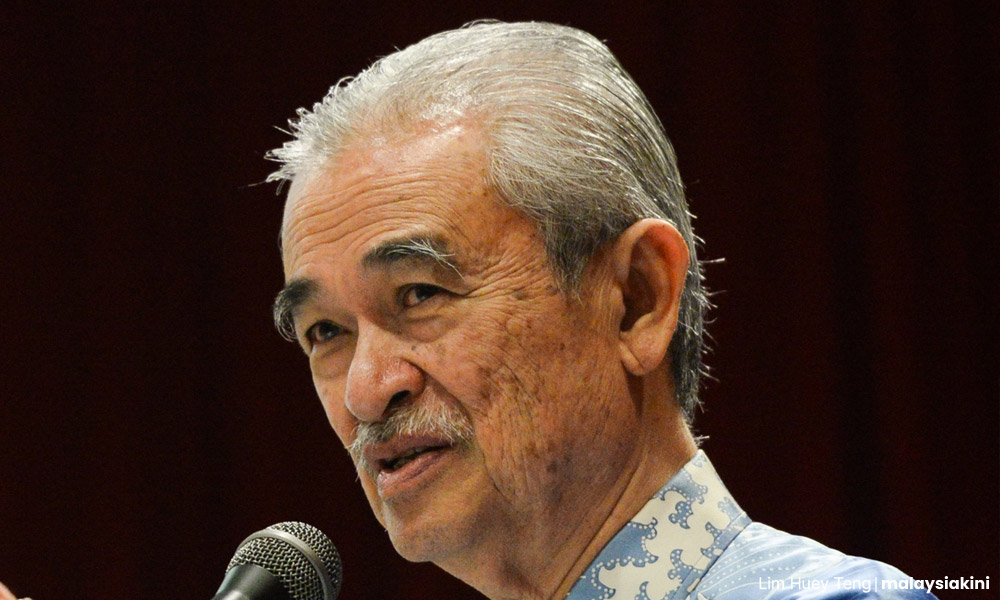
Under pressure, Abdullah formed the RCI, with the investigations concluding that Lingam and several others had seriously undermined the judiciary.
After losing BN’s long-held two-thirds majority following the 2008 general election, Abdullah embarked on several reforms, including forming the Judicial Appointments Committee (JAC) in February 2009.
2011: Walk for Freedom
In 2011, the Bar Council staged a rally in Kuala Lumpur to protest against the tabling of the Peaceful Assembly Act (PAA) during Najib Abdul Razak’s premiership.
Led by then-Bar Council president Lim Chee Wee, the rally saw hundreds marching from the Royal Lake Club to the Parliament building.

They deemed the law to be against freedom of expression and imposed tough penalties against rally organisers. The lawyers then submitted a memorandum to then-deputy minister in the Prime Minister’s Department, Liew Vui Keong.
The PAA eventually became law in April 2012, requiring rally organisers to submit a notice at a minimum of 10 days in advance to the police before organising a protest. This was later reduced to five days.
On July 1 this year, the Federal Court ruled Clause 9(5) of the PAA unconstitutional.
The clause stipulates that an organiser can be slapped with a fine of not more than RM10,000 for failure to provide a notice to the police, five days before a planned gathering.
2014: March for Freedom
On Oct 16, 2014, around 1,000 protesters, mostly lawyers, marched from Padang Merbok to the Parliament to voice their protest against the Sedition Act 1948.
Among those who participated were then-Malaysian Bar president Christopher Leong, his predecessor Ambiga, and then-PSM secretary-general S Arutchelvan.
Several prominent DAP leaders, including Gobind Singh Deo and Nga Kor Ming, who are now part of Anwar’s cabinet, were also present.
After the march, then-minister in Prime Minister’s Department Mah Siew Keong received a memorandum from the group on Najib’s behalf.
While the former Pakatan Harapan coalition promised to repeal the Sedition Act when it was still in the opposition, it has emerged that the coalition government is now only considering amending the law.
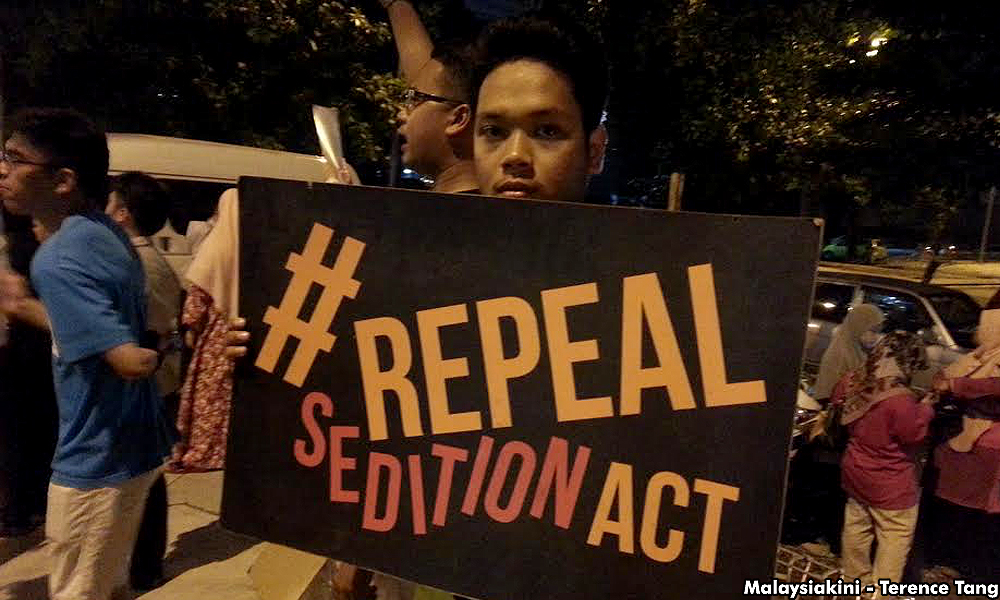
According to Minister in the Prime Minister’s Department (Law and Institutional Reform) Azalina Othman Said, the decision was made after she submitted findings from a dialogue session on legal approaches to handle the current issue of religion, race, and royalty (3R).
2022: Walk for Justice
On June 17, 2022, the Malaysian Bar held the “Walk for Justice” event in response to the MACC launching an investigation against then-High Court judge Nazlan Ghazali, after a politically linked blog claimed he had unexplained wealth.
Nazlan, who had presided over Najib’s trial and convicted him in the RM42 million SRC International corruption case, denied the allegation and lodged a police report on the matter.
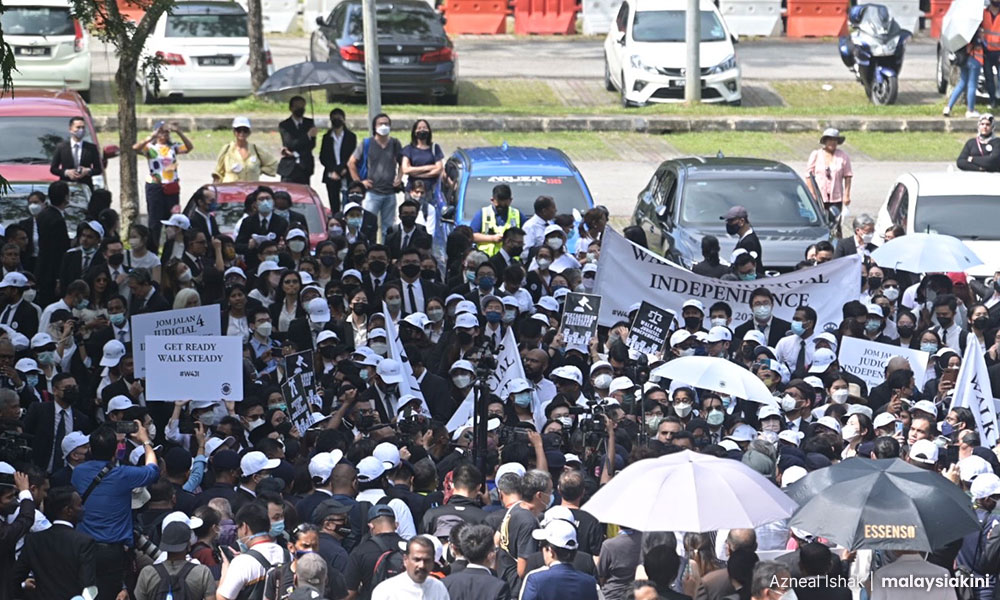
The rally did not proceed smoothly as participants were blocked by police while gathering at Padang Merbok, preventing them from walking to Parliament despite the group having sent the required notice under the Peaceful Assembly Act 2012.
Then-deputy minister in the Prime Minister’s Department (Parliament and Law) Mas Ermieyati Samsudin, who was initially expected to receive the memorandum from the Bar Council at Parliament, later walked to the lawyers to receive it.
Unimpressed with the situation, then-Bar Council president Karen Cheah and several others filed a suit against the police. The police, however, claimed that the procession was disallowed due to objections from nearby premises.
On March 20 this year, the High Court ruled that the police had acted ultra vires (beyond powers) to impose a condition that prohibited the rally in 2022. - Malaysiakini, 12/7/2025


 Posts
Posts




No comments:
Post a Comment