Disappointingly, DAP came in at the eleventh hour about the failure of offering the 6 month extension to the Chief Justice - but have been silent about other issues about judicial independence and the Prime Minister, noting the issue was raised at the beginning of the year by the then Chief Justice..and thereafter by others, including the Malaysian Bar...
In an eleventh-hour move, DAP has declared its support for Chief Justice Tengku Maimun Tuan Mat’s service extension, just as she marks her last day before mandatory retirement. Noting that it had recently discussed matters of national importance, the party’s central working committee also backed extending the tenure of Court of Appeal president Abang Iskandar Abang Hashim, who is set to retire on July 2.
TOO LATE, I would think. The biggest party in Pakatan Harapan with 40 MPs should have expressed their view long time ago. Hence, they have the strongest voice, not just in PH but also the UNITY Government - and their 'silence' can be read as support for what ever PM Anwar has been doing, or failed to do.
Did DAP object to the cabinet discussion about the future Chief Justice - when they very well understands that Cabinet should 'never' interfere in the selection and appointment of Judges...[Remember that the lesson we learned from the 2007 Lingam Tape scandal - is that NO ONE should try to influence the appointment of Judges, and that includes Ministers and the Cabinet].
Malaysians also were of the opinion that when it comes to choosing Judges or elevating Judges, it is best left to an INDEPENDENT Commission - and even the Prime Minister should not be involved...
Does DAP agree that we should remove the Prime Minister from the appointment, elevation...of judges - as proposed? Or will they decide after PM Anwar tells them what their position should be?
Malaysia is a democracy, and not a dictatorship of the Prime Minister > which means that all component parties of the current government have a VOICE and a right to have an OPINION - and, if they are SILENT - Malaysians will imply that they agree to everything that PM Anwar is doing... [See also:- Only MPs can remove a Prime Minister - Should we not ask MPs to remove or keep the PM, based on the will of the people? MPs use your constitutional powers]
The proposed changes to remove the prime minister in the appointment of judges will reinforce the impartiality of the selection process, says Chief Justice Tun Tengku Maimun Tuan Mat. She said the amendments, which would fall under the Judicial Appointments Commission (JAC) Act 2009 and the Federal Constitution, would ensure judicial appointments remain free from any perception of political influence. "Of late, there have been proposals to amend the JAC Act 2009 and the Federal Constitution to remove the role of the Prime Minister in the appointment of judges. "Such changes, in my view, would reinforce the impartiality of the selection process, ensuring that judicial appointments remain firmly grounded on merit and free from any perception of political influence," she said in her speech at the 24th Commonwealth Law Conference in St Julian's Bay, Malta, today.- NST, 8/4/2025
In this post, I have also included a report/opinion below entitled ' Freeing Najib & Controlling Judiciary – Preparing “Yes Man” Terrirudin As Next Chief Justice After Fearless CJ Maimun Retires', which is an interesting read, which is the writer's viewpoint, some of which I do not agree. He raises an interesting point about how Chief Justice Tengku Maimun Tuan Mat was chosen, where it suggests that she was chosen by Prime Minister Mahathir, on the recommendation of then AG... and I am of the position that this was WRONG - the CJ should have been chosen by the already existing Judicial Appointments Commission, and the then PM Mahathir or Tommy Thomas had no business in choosing or causing Tengku Maimun to be chosen and appointed the Chief Justice...So, was Tengku Maimun chosen by the JAC? Likewise, the Malaysian Cabinet should not be influencing who should be the next Chief Justice or the President of Court of Appeal.
Whether you like or hate Mahathir, one of the right things he did was the appointment of the brave Tengku Maimun in May 2019 as the Chief Justice, who was suggested by then-Attorney General Tommy Thomas.
I am of the position that the PM, Cabinet or anyone else, other than the INDEPENDENT Judicial Appointments Commission, should decide on who should be the next Chief Justice...and the Prime Minister/King should rightly follow the JAC's recommendation.
Recently, it was reported that the Registrar's office announced that the present Chief Judge of Malaya will be the acting Chief Justice - and, I ask as to who gave that Chief Registrar or the Federal Court Registrar's Office the power to 'appoint' the Acting CJM - the JAC should be the one who recommends to the King/Prime Minister as to who should be appointed Acting or new Chief Justice. Who gave the Federal Court Registrar's Office the 'DIRECTION" - was it the 2 remaining heads of Judiciary, or WHO...WHO?
The Chief Judge of Malaya (CJM) Tan Sri Hasnah Mohamed Hashim will assume the responsibility and task of the chief justice (CJ) until the post has been filled. In a statement, the Federal Court registrar's office said it had been directed that, in line with Article 131A of the Federal Constitution and Section 9(1)(b) and Section 9(3) of the Courts of Judicature Act (CJA), the CJM will have the power and do the job and function of the CJ until the post has been filled. “The judiciary will continue its task as the guardian of justice, and would continue its service with full dedication for the people and country,” the statement said.
Summary
DAP calls for a six-month extension for Chief Justice Tengku Maimun Tuan Mat and Court of Appeal president Abang Iskandar Abang Hashim, citing their integrity and contributions to judicial reform.
The party denies politicising the issue, arguing that the move aligns with the Madani government’s reform agenda and addresses upcoming vacancies in the Federal Court.
This comes amid criticism from the Malaysian Bar over government inaction, and Prime Minister Anwar Ibrahim’s warning against lobbying to influence judicial appointments.
In an eleventh-hour move, DAP has declared its support for Chief Justice Tengku Maimun Tuan Mat’s service extension, just as she marks her last day before mandatory retirement.
Noting that it had recently discussed matters of national importance, the party’s central working committee also backed extending the tenure of Court of Appeal president Abang Iskandar Abang Hashim, who is set to retire on July 2.
The committee said a tenure extension for the judges would be consistent with the reformist agenda of the Madani government.
It also cited the duo’s achievements in carrying out their duties "impeccably and with utmost integrity” in calling for their services to be extended a further six months, in accordance with the Federal Constitution.
“Although such extensions are not as of right, we note the extensions of previous senior judges upon their mandatory retirements and see no reason why the same should not extend to the current chief justice and president of the Court of Appeal,” the committee added in a statement today.
Denying that DAP’s support of the extensions is an attempt to politicise the matter, it asserted that the stance is the result of a genuine recognition of the top judges’ contributions to the development and reform of the judiciary.
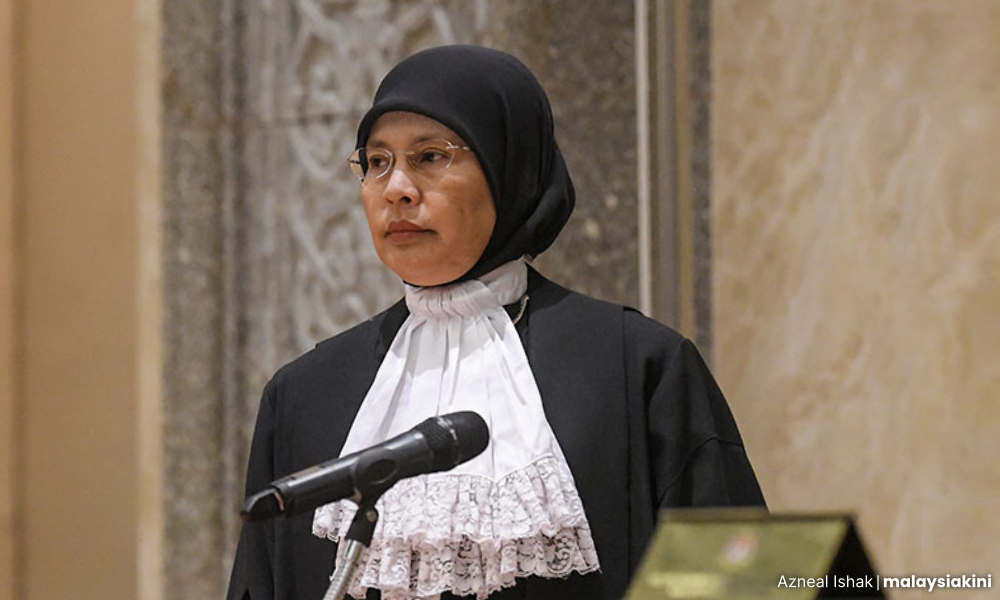
“Given their contributions and performances, we are of the view that extending the tenures of (Tengku Maimun and Abang Iskandar) would enhance the government’s commitment to the improvement of the administration of justice and the judiciary.
“We further note that there will be many vacancies left in the Federal Court due to the recent and impending retirements of Federal Court judges.
“This makes it all the more important to retain the current chief justice and president of the Court of Appeal to ensure a smooth transition of new appointees to the Federal Court in due course,” the committee added.
Ongoing silence
Yesterday, the Malaysian Bar slammed the ongoing silence and hesitation over Tengku Maimun’s service extension.
Its president, Ezri Abdul Wahab, cautioned that a breakdown in governance risks damaging public confidence in the judiciary and opens the door to speculation and unhealthy conjecture.
He also stressed that the situation is not one of lobbying or preference, but rather concerns urgency, transparency, and the proper operation of constitutional democracy.
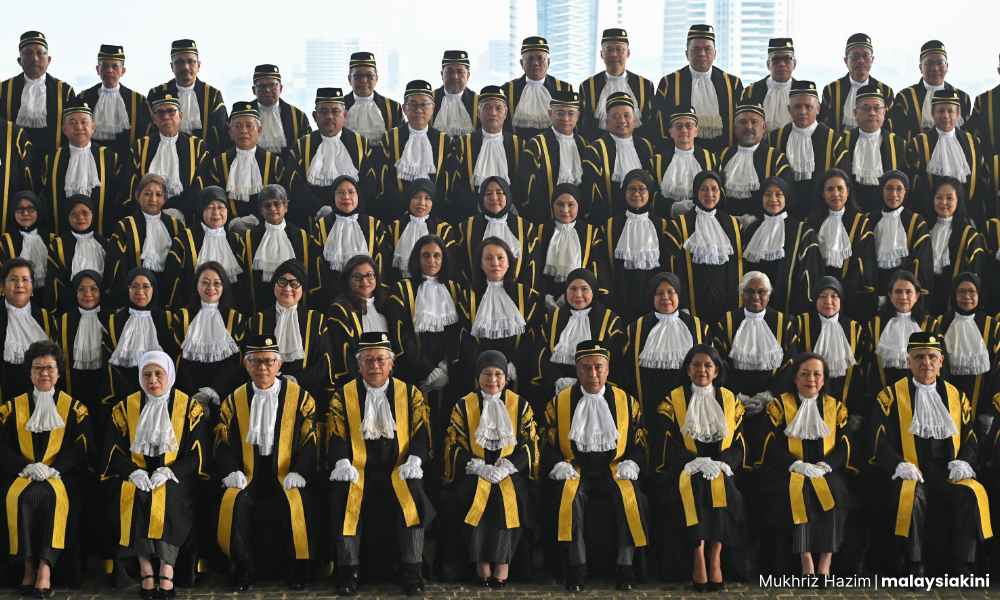
DAP lawmaker and former deputy law minister Ramkarpal Singh also shared similar sentiments on Sunday, saying it is imperative to allow for a continuation of the status quo of the current administration of the judiciary to ensure a smooth transition when the new batch of Federal Court judges takes over.
Prime Minister Anwar Ibrahim has since slammed alleged attempts to lobby the government into extending Tengku Maimun’s tenure.
The prime minister called the move an attempt to politicise the judiciary, insisting that it should not happen with such an independent institution.
Anwar sarcastically said that if such a practice were to be allowed by the government, they would soon see other civil servants, such as the chief secretary to the government, lobbying to keep their jobs. - Malaysiakini, 1/7/2025
Appointment of new Chief Justice briefly discussed by Cabinet


He said yesterday’s meeting did discuss the replacement for outgoing Chief Justice Tun Tengku Maimun Tuan Mat.
“We did discuss the matter (appointment of the Chief Justice) but it was not a deep discussion. The meeting centred around what Prime Minister Datuk Seri Anwar Ibrahim had mentioned on the matter during the monthly assembly of the Prime Minister’s Department on June 30,” he said yesterday.
Anwar had stated that the extension of service of civil servants, including top judges, is not automatic and must follow procedures in accordance with the Federal Constitution.
Tengku Maimun ended her service as the nation’s 16th Chief Justice on Tuesday. She had made history as the first woman Chief Justice when she was appointed to the post in May 2019.
Tengku Maimun celebrates her 66th birthday today, therefore reaching the mandatory retirement age.
Additionally, the second most senior judge in the country, Court of Appeal president Tan Sri Abang Iskandar Abang Hashim, retired yesterday.
Justice Abang Iskandar was the first judge from Sabah and Sarawak to hold the position.
Fahmi, who is the government spokesman, said yesterday’s meeting also discussed actions to be taken against businesses suspected to be involved in profiteering after the expanded Sales and Service Tax (SST) came into force on Tuesday.
The meeting also discussed the heatwave currently affecting parts of the country, he added.

Fahmi said the Cabinet briefing touched on the resumption of consultation talks between Malaysia and Indonesia.
“During the Prime Minister’s last visit to Jakarta on June 27, it was agreed that the two countries will revive the annual consultation.
“The Prime Minister will be visiting Jakarta on July 29 for the annual consultation and Asean Secretariat meeting.
“The annual consultation would be a good forum to raise issues between the two countries, such as the Ambalat Block,” he said.
The Ambalat Block is a sea block covering an area of 15,235 sq km. It is located in the Sulawesi Sea, or Makassar Strait, and borders Malaysian waters.
The dispute between the two nations over the Ambalat Block has been ongoing for decades and is yet to be resolved.
The border issue in Ambalat arose because of the overlapping territorial waters of the exclusive economic zone and the continental shelf between the two countries, whose measurement refers to the 1982 UN Convention on the Law of the Sea. Star, 3/7/2025
Chief Justice: Removing PM from appointment of judges will reinforce impartiality of selection process

KUALA LUMPUR: The proposed changes to remove the prime minister in the appointment of judges will reinforce the impartiality of the selection process, says Chief Justice Tun Tengku Maimun Tuan Mat.
She said the amendments, which would fall under the Judicial Appointments Commission (JAC) Act 2009 and the Federal Constitution, would ensure judicial appointments remain free from any perception of political influence.
"Of late, there have been proposals to amend the JAC Act 2009 and the Federal Constitution to remove the role of the Prime Minister in the appointment of judges.
"Such changes, in my view, would reinforce the impartiality of the selection process, ensuring that judicial appointments remain firmly grounded on merit and free from any perception of political influence," she said in her speech at the 24th Commonwealth Law Conference in St Julian's Bay, Malta, today.
Tengku Maimun said Article 122B of the Federal Constitution sets out the process of consultation among the prime minister, the top judges, the Yang Di-pertuan Agong and the Conference of Rulers before any judicial appointment is made.
However, these constitutional provisions, she said, were deemed insufficient.
"As such, this constitutional framework was further bolstered by the JAC, which was established under the JAC Act 2009," she said.
Tengku Maimun said while appointments ultimately remain a prerogative exercised by the prime minister within the constitutional structure, the JAC plays a pivotal role in identifying and assessing candidates.
She said the JAC, established through the JAC Act, serves as an institutional safeguard to enhance the transparency, integrity and merit-based selection of candidates for judicial office.
This, she said, is done through a structured and rigorous evaluation process including assessing integrity, competence, experience and industriousness; ensuring that only the most qualified individuals are selected for judicial office.
She said there are other express provisions in the Federal Constitution to safeguard judicial independence such as the security of tenure, financial security, power to punish for contempt any person who interferes with the administration of justice or undermines the dignity and independence of the courts, and others.
She said while constitutional safeguards provide a strong foundation for judicial independence, history such as the 1988 judicial crisis and other scandals had shown that institutional protections are not always sufficient to shield the judiciary from external pressures.
"The resulting friction between the executive and the judiciary culminated in an unprecedented event — the removal of the then Lord President, the late Tun Salleh Abbas, and the suspension of five Supreme Court judges, two of whom were later dismissed.
"The 1988 crisis dealt a severe blow to judicial independence and public confidence in the judiciary. It cast a long shadow over the institution, fuelling concerns about political interference in judicial affairs," she said.
Tengku Maimun said a constructive and balanced relationship between the judiciary and the other branches of government is essential to preserving judicial independence while respecting the democratic mandate of Parliament.
"This relationship is not a contest for supremacy but a partnership in governance — one founded not just on mutual respect but on a clear understanding of our respective constitutional roles.
"While our functions remain distinct, both institutions ultimately serve the same fundamental purpose of safeguarding constitutional democracy and protecting the fundamental rights of citizens," she said.
She added that through perseverance and collective efforts, the Malaysian judiciary has reaffirmed its standing as a truly independent institution, steadfast in its constitutionally-ordained oath to protect, preserve and defend the Federal Constitution.
"This effort is not the judiciary's alone but from all stakeholders involved in the administration of justice. When the judiciary enjoys support from key institutions such as the Bar Council, it strengthens judicial resolve and bolsters judicial independence," she said.- NST, 8/4/2025
Freeing Najib & Controlling Judiciary – Preparing “Yes Man” Terrirudin As Next Chief Justice After Fearless CJ Maimun Retires
|
|
|
|
|
July 2nd, 2025 by financetwitter
|
Mahathir fearlessly charged Najib, while Muhyiddin boldly convicted Najib, and Ismail stubbornly sent Najib to prison. But Anwar cowardly rewarded Najib with not only a royal pardon, but appears to be on the track to arrogantly drop all remaining corruption charges on Najib after a fearless and respected Chief Justice Tengku Maimun Tuan Mat retired without a 6-month extension many believe she highly deserved.
That is how history will remember Prime Minister Anwar Ibrahim and the last three prime ministers ever since the corrupt ruling government of Barisan Nasional was defeated for the first time in history in the May 2018 General Election, allowing Mahathir Mohamad to return to power for the second time, only to lose it after 22 months thanks to Muhyiddin’s infamous betrayal.
Even the clueless “turtle egg” Ismail Sabri now looks like a hero compared to forked-tongue Anwar, who screams about anti-corruption, reforms, good governance, integrity and whatnot but does exactly the opposite. The best part is Mr Anwar thinks he could still hoodwink all the people all the time. Worse, having lost touch with the ground after tasting power, his unpopularity is fast turning into hatred.
The increasing hatred for Anwar can be seen when students involved in an anti-corruption rally in Sabah had resorted to burning a caricature of the prime minister. There’s only one explanation to the extreme action – the students were extremely sick and tired with the premier. But it also hurts narcissist Anwar where it hurts the most as he could not stomach protests of such magnitude.
Mr Anwar, who enjoyed celebrity status initially, has been struggling to maintain his popularity as his 5-year term entered the mid-term. For a man who can only accept nothing but praise, police force was unleashed to intimidate the students with investigation – even possible expulsion. Anwar conveniently forgot that when he was a student activist, he too had burnt a book written by Malaysia’s first Prime Minister Tunku Abdul Rahman.
So, the 100 students from Universiti Malaysia Sabah (UMS) cannot burn a caricature of Anwar in their rally against corruption, but a University Malaya student in the 1970s called Anwar can burn a book – titled “13 Mei, Sebelum Dan Selepas” – which was a perspective on the 13 May 1969 racial riot incident written by Malaysia’s Father of Independence?
If the students from UMS can today be investigated and charged with nine offences, including incitement involving the 3Rs (race, religion and royalty), burning in a public space and bringing flammable materials to the gathering, then Anwar Ibrahim was equally guilty of the same offences. The fact that the PM was so fearful of merely 100 students speaks volumes about his insecurity and hypocrisy.
Coincidentally, in her last judgement before retirement, Chief Justice Tengku Maimun gave PM Anwar a slap in the face when she led the Federal Court to rule that it is unconstitutional to criminalise the failure to notify the police five days in advance of holding a peaceful assembly. The decision came after a constitutional challenge brought by former Muda secretary-general Amir Hadi, who was charged in 2022 with failing to give the police five days’ notice.
She said Section 9(5) of the Peaceful Assembly Act 2012 imposes a punishment that exceeds the limits permitted under Article 10(1)(b) of the Federal Constitution, which guarantees the freedom of speech, assembly, and association. And this is the type of verdict that Anwar does not like as he slowly limits the freedom of speech to only those supporting the government.
The 2022 election manifesto of Anwar’s Pakatan Harapan coalition had pledged to review and repeal “provisions of acts that can be abused to restrict free speech.” Anwar came to power through forging an alliance with former foe UMNO, a race-based party that represents the country’s Malay-Muslim majority. But about a year after taking office, he made a U-turn and warned there would be some limits on speech.
Sure, it was a hung parliament in the November 2022 General Election that forced Pakatan Harapan and UMNO-led Barisan Nasional to form the Unity Government. However, not only Anwar has done little to restore democracy and repeal draconian provisions, but has started targeting journalists, human rights defenders, cartoonists, not to mention opposition figures, just to silence critics in order to control public narratives.
Therefore, taking a page from the old playbook of UMNO, chameleon Anwar had to get rid of fearless top judges like Tengku Maimun, as well as all other judges who refuse to kowtow to the executive branch in Malaysia, which is headed by the Prime Minister. Even the 21,400-member Malaysian Bar comprising advocates and solicitors have voiced concern over the PM’s “silence” over Maimun’s extension.
When grilled, the genius premier argued that judicial appointments and service extensions are not automatic, but must follow constitutional procedures. Yet, the same man did not talk about procedures when he unilaterally extended the contract of the corrupt MACC Chief Commissioner Azam Baki for the third time. Of course, Azam Baki is a “yes man”, while Tengku Maimun isn’t.
Under Article 125(1) of the Federal Constitution, judges may be granted such an extension with the consent of the Yang di-Pertuan Agong, but based on the prime minister’s advice and after consultation with the Conference of Rulers. Hence, the service of Tengku Maimun, who reaches the retirement age of 66 on July 2, can be extended by another 6 months if PM Anwar wanted to.
Like it or not, Anwar cannot claim that Tengku Maimun’s extension isn’t his business because he does not interfere in the judiciary independence. The King Sultan Ibrahim cannot extend the Chief Justice’s service without the Prime Minister’s advice. To ignore her is tantamount to rejecting her extension. It’s also hilarious that Anwar boldly defended Najib’s royal pardon and DNAA, but pretends to be independent when he refused to renew Mainum’s service.
Madam Maimun is one of nine members of the apex court – including the second and third-highest ranked judges – who have left or are due to retire in the seven months from April to November. With only two new appointments to the Bench since November 2024, the Federal Court could soon be left with just six judges – most of whom have just joined recently.
You don’t need a rocket scientist to tell why despicable Anwar deliberately leaves the country’s judiciary to be leaderless.The plan, hatched by UMNO and agreed by the power-hungry PM, is to fast track former Attorney-General Terrirudin Salleh, who was appointed directly to the apex court in November while still serving as attorney-general, to lead the judiciary as the next Chief Justice.
He had in September 2023, during his first week as public prosecutor, decided not to appeal against former premier Najib Razak’s acquittal in the 1MDB audit-tampering case. Mr Terrirudin was eventually made a Federal Court judge in November 2024 at the same time when Hasnah Hashim was appointed Chief Judge of Malaya. The installation of both judges sparked concerns over judicial interference due tothe required quorum at the time to make such appointments.
Crucially, Terrirudin will serve till 2033 if promoted again, giving UMNO tonnes of time to work hand-in-glove with the tainted Attorney General’s Chambers (AGC) to free not only Najib Razak, but also to drop all charges related to UMNO politicians. When Terrirudin was first promoted in Sept 2024 as a friendly attorney general by PM Anwar, it was to make him a member of the Pardons Board so that Najib could get his royal pardon.
Mr Anwar, desperately needed UMNO’s support to cling to power, hopes that allowing the Malay nationalist party to broker and control the judiciary would appease them so that Pakatan Harapan and Barisan Nasional coalitions could still work together to form the next government after the 16th national polls, with Anwar getting his wish to serve his second term.The writing was already on the wall when Anwar granted anti-graft chief Azam Baki’s third 12-month extension in May, and deputy police chief Ayob Khan Mydin Pitchay being passed over for the top job of Inspector-General of Police in June. Those who were serious about fighting corruption and sending crooks to prison are shown the exit, while lapdogs are being promoted.
It didn’t help that the increasingly toothless tiger Democratic Action Party (DAP), which has the most MPs in the Anwar administration, issued a statement just hours before Madam Maimun clocked out for the last time on July 1. Under the leadership of Anthony Loke, DAP has become subservient to both Anwar and Najib, while pretending to disagree with the exit of Maimun.
When former King Sultan Abdullah chaired the Pardons Board and reduced Najib’s jail sentence from 12 to six years, with 75% discount thrown in for his RM210 million fines, at the eleventh hour before the Pahang monarch ended his 5-year reign as the nation’s 16th Agong (King) on January 30, 2024, it was seen by many insiders as a mockery and insult to the judiciary system.
After all, it was the Court of Appeal on Dec 8, 2021 led by Judge Abdul Karim Abdul Jalil who had not only upheld Najib’s conviction, but also laughed and ridiculed at the ex-PM’s claims that he (despite stealing money) was acting in the national interest, calling it a “national embarrassment” instead. It was already bad that the Sultan and Anwar decided to pardon a crook that the Judicial branch considered a national humiliation.
Led by Tengku Maimun Tuan Mat – the first woman Chief Justice – the judiciary system was attacked by Najib minions when the top judge revealed she received death threats when she chaired the panel of Federal Court judges that heard Najib Razak’s final appeal. But she refused to be intimidated, bravely dismissing the crook’s appeals and sent him to the prison on Aug 23, 2022.
By hook or by crook, UMNO must send Chief Justice Tengku Maimun into early retirement, and Anwar Ibrahim gladly did what he was told for the sake of power. But there’s another compelling reason why the prime minister wanted a Kangaroo Court. He was upset with a High Court’s decision last month to dismiss his request for immunity from lawsuits filed by his former research assistant, Muhammed Yusoff Rawther, concerning an alleged sexual assault seven years ago.
From the beginning, the Judiciary has always been a powerful political tool for the prime minister, despite Anwar’s lies that he has never interfered in judicial matters. His actions – extensions were given to four Federal Court judges but not the Chief Justice and the president of the Court of Appeal – already shows he is a serial liar like buddy Najib Razak.
Whether you like or hate Mahathir, one of the right things he did was the appointment of the brave Tengku Maimun in May 2019 as the Chief Justice, who was suggested by then-Attorney General Tommy Thomas. Without these two legal eagles, Najib would not spend even a night in prison for stealing billions of dollars in the 1MDB scandal.n - https://www.financetwitter.com/2025/07/freeing-najib-controlling-judiciary-preparing-yes-man-terrirudin-as-next-chief-justice-after-fearless-cj-maimun-retires.html

Chief Judge of Malaya Tan Sri Hasnah Mohamed Hashim (The Edge filepix by Patrick Goh)
PUTRAJAYA (July 3): The Chief Judge of Malaya (CJM) Tan Sri Hasnah Mohamed Hashim will assume the responsibility and task of the chief justice (CJ) until the post has been filled.
In a statement, the Federal Court registrar's office said it had been directed that, in line with Article 131A of the Federal Constitution and Section 9(1)(b) and Section 9(3) of the Courts of Judicature Act (CJA), the CJM will have the power and do the job and function of the CJ until the post has been filled.
“The judiciary will continue its task as the guardian of justice, and would continue its service with full dedication for the people and country,” the statement said.
The statement did not state who would undertake the role and task of Court of Appeal (COA) president. It is understood that a statement will be issued on who would assume that role.
Article 131A stipulates that in the event of vacancy, the roles and responsibilities of the country’s top two judges (CJ and COA president) can be temporarily filled by a chief judge of the High Court.
Section 9(1) (b) of CJA meanwhile stipulates that in the event of vacancy or if the CJ is not able to perform his/her duty, the task or responsibility shall be held by the CJM, or the chief judge of Sabah and Sarawak.
Tun Tengku Maimun Tuan Mat retired as the 16th CJ, without a six-month extension, on July 1.
Meanwhile, COA president Tan Sri Abang Iskandar Abang Hashim retired on Wednesday (July 2), also without a six-month extension, leaving a vacuum for the top two posts.
Hasnah was appointed as CJM in November last year.
Her six-month extension was granted in March this year, as she reached the age of 66 in May, and is scheduled to compulsorily retire on Nov 14.
Chief Judge of Sabah and Sarawak Tan Sri Abdul Rahman Sebli is undergoing his six month-extension, which began in January this year, and his tenure is expected to end later this month (July). - Edge, 3/7/2025


 Posts
Posts




No comments:
Post a Comment