ON HUMAN RIGHTS, JUSTICE AND PEACE ISSUES, LABOUR RIGHTS, MIGRANT RIGHTS, FOR THE ABOLITION OF THE DEATH PENALTY, TOWARDS AN END OF TORTURE, POLICE ABUSES, DISCRIMINATION...
Stop Depriving over 30,000 Suspects
in Remand for investigation, and Remand Prisoners who have yet to be tried,
convicted and sentenced their ability to exercise their RIGHT to vote in Malaysian
Elections.
State must
ensure that every qualified Elector has the ability to exercise the right to
Vote to ensure FREE and FAIR Elections.
The Federal Constitution guarantees
the basic right of every Malaysians 18 years and above the RIGHT to VOTE in
State and Federal Elections, and the law explicitly denies this right ONLY to just
those with a mental disability and those convicted criminals serving a prison
sentence.
Article 119 Clause 3 of the
Malaysian Federal Constitution states ‘A person is disqualified for being an
elector in any election to the House of Representatives or the Legislative
Assembly if—(a) on the qualifying date
he is detained as a person of unsound mind or is serving a
sentence of imprisonment; or(b)
having before the qualifying date been convicted in any part of the
Commonwealth of an offence and sentenced to death or imprisonment for a term
exceeding twelve months, he remains liable on the qualifying date to suffer any
punishment for that offence.’
Thus, it is clear, that suspects in
remand detention by police and other law enforcement agencies, and remand
prisoners in Malaysian prisons have right to Vote in State and Federal
Elections.
Remand Prisoners are those yet to
be tried, convicted and sentenced, and they are in detention because either
they could not afford Bail because of poverty, or they have been denied Bail by
law or the courts. There are presumed innocent until tried and convicted by a
court of law.
27,877 Remand
Prisoners, and maybe 10,000 or more remanded suspects
It must be noted that currently
there are about 27,877 remand prisoners in Malaysian prisons(Star, 7/10/2025), and the
number of suspects in remand for the purpose of investigation in police and
other law enforcement detention facilities fluctuates, but it could be as high
as 5,000 -10,000 or even more. Then, we have persons under Detention Without
Trial laws who are being detained, and/or restricted from moving out from a
particular area, and those in other kinds of Detention facilities.
If they in State detentions were
given the ability to exercise the right to VOTE, it may have the effect of
changing the outcome of elections, be it at the Constituency level, and may
also affect who ultimately will be Prime Minister or Chief Minister or even the
State/Federal government.
Note that these are not electors
who choose not to VOTE but electors whose ability to vote is denied by State
and state agencies.
If they VOTED,
Election outcome can change
For example, In the last Sabah
State Elections, N16 Karambunai State seat was won by majority of just 16, N23 Petagas by a majority of 261, and N50 Gum Gum by a majority of 269.
For example, in the Sabah
Parliamentary elections, P173 Putatan was won by a majority of 124, and P170 Tuaran
had a majority of just 233.
Thus, it is very possible that if these
electors, now denied the ability to vote, did VOTE – it may have affect the final
outcome of elections.
The Election Commission MUST ensure
that every Malaysian with a right to vote has the ability to exercise that
right in every election. Considering that these places of detention are known
State facilities, one option is EARLY VOTING – which will also give time for
the Election Commission to send the marked ballots back to reach the relevant
Constituencies in time to be counted.
Extend EARLY Voting
to State Facilities That Hold Remand Prisoners
At present, EARLY voting is already
used for personnel in the armed forces, police, public servants and also EC
officers who will be on duty on Election Day.
Thus, it is no big problem to also
have EARLY VOTING in places of Detentions.
The Election Commission can also use
other methods to ensure that all qualified Electors in State detention have the
ability to exercise their right to VOTE in Malaysia’s elections, that usually
happens once every 4 or 5 years.
Magistrates should
facilitate the Ability to Exercise Voting Rights
Magistrates could also consider
Elector’s right to vote, and thus should try no not grant remand order during election
period so as not to prevent a suspect’s ability to go and vote on voting day. Criminals
like Najib Razak, Zahid Hamidi, some politicians and others were never remanded
for the purpose of investigations.
Alternatively, Magistrates can
order the detaining authority to ensure that suspect is able to exercise
his/her right to VOTE if remand orders are made – a most fundamental right of
all Malaysians, 18 years and above.
No POSTAL VOTE for
Malaysians in other States?
It was shocking that ‘The Election
Commission (EC) has ruled out allowing Sabahans living in Peninsular
Malaysia to cast their ballots by postal vote in the upcoming state
election, EC chairman Datuk Seri Ramlan Harun said.’ (Malay Mail,
16/10/2025).
This is shocking if Malaysians have
to travel far or even fly back to Sabah or Peninsular just to be able to VOTE. This
affects all Malaysians, even those who will have to travel 100-300 kilometers
just to vote.
It is also a serious failure to
consider the current financial reality of Malaysians, making it very
difficult for many Malaysians to expend monies, effort and time just to return
to their relevant Constituency to vote on Election day – and this includes
students, workers, business persons and others. For some, this means also
having to drag their children out of school for the parents to have to travel
to relevant Constituencies just to VOTE.
All Malaysians living, working or
studying away from their Constituency should be accorded the RIGHT to POSTAL
VOTING, or even EARLY VOTING in whichever State they are, so that Malaysia and
the Election Commission not be seen as guilty of denying Malaysians the right
to VOTE.
If Malaysians overseas have the
right to vote by POSTAL VOTES – there is no justification why Malaysians
working and living in other States or far from their Constituency cannot be
accorded the right to vote by Postal Vote.
Paid Leave for
Workers To Vote
Further, in Malaysia there is still
NO Paid leave for Malaysians to travel back to their Constituencies to cast
their vote. For some, they may have to take at least 3 days to be able to
go back to vote and come back.
It is still NOT a Crime if employers
prevent their employees the ability to return to their respective constituency in
time to VOTE.
As such, we, the 12 undersigned groups,
organizations and Trade Unions call on the Malaysian government, including
the Malaysian Election Commission, to take all needed steps that ensure all
qualified Malaysian voters, including those in detention in State facilities, are
able to exercise their individual right to vote in all Malaysian State and
Federal Elections.
Malaysia must not just simply recognize
the right to Vote, but more importantly ensure that every qualified Elector has
the ability to exercise that most important, fundamental and democratic right
to vote both in State and Federal elections.
Charles Hector
On behalf of the 12 listed groups below
ALIRAN
MADPET (Malaysians Against Death
Penalty and Torture)
COAC (Center for Orang Asli
Concerns), Malaysia
National Union of Bank Employees (NUBE), Malaysia
National Union of Flight Attendants Malaysia (NUFAM)
North South Initiative (NSI), Malaysia
Parti Rakyat Malaysia (PRM)
Parti Sosialis Malaysia (PSM)
Social Protection Contributors Advisory Association Malaysia.
(SPCAAM)
Nearly 28,000 prisoners currently on remand, awaiting resolution of court cases, says Azalina
By GERARD GIMINO, MARTIN CARVALHO and TEH ATHIRA YUSOF
KUALA LUMPUR: Some 27,877 prisoners are currently
being remanded while awaiting the resolution of their court cases, says
Datuk Seri Azalina Othman Said(pic).
The
Minister in the Prime Minister’s Department (Law and Institutional
Reforms) said the government, through the Chief Registrar of the Federal
Court of Malaysia, has also issued a guide to judges and magistrates to
manage and resolve cases efficiently.
“Based
on information from the Office of the Chief Registrar of the Federal
Court of Malaysia and the Prisons Department, the average waiting period
for the resolution of criminal cases is between three to 24 months,
subject to case developments,” she said in a written reply on Tuesday
(Oct 7).
In the same reply, Azalina said the Chief Justice in 2011
had set a general 12-month timeline to conclude criminal cases in
court.
The minister also cited a 2017 circular, which set a 12-month
resolution timeframe for criminal and civil case resolutions in lower
courts, beginning from the date the case is registered.
She
further cited a 2019 circular on the timeline for the resolution of
civil and criminal cases, applicable for courts in Sabah and Sarawak.
Here,
criminal cases in the High Court must be resolved within six months,
cases in the Sessions Court to be resolved within nine months, and cases
in the Magistrates' Courts to be resolved between three to nine months
from the date the case is registered.
She said the government is committed to ensuring the justice
system is upheld without any delays or postponements unless there are
unavoidable circumstances.
However, she noted that the resolution
of criminal cases are influenced by multiple factors including the
cases’ complexity, large number of witnesses or accused persons, and the
availability of parties or witnesses for subsequent hearings.
“If
courts were to strictly adhere to set timelines, there are concerns
this could compromise fairness and affect judgments. Judges and
magistrates will make every effort to conclude cases within a reasonable
time frame,” she said.
She said trials of criminal cases will proceed without any delay to ensure a timely resolution.
“The
government is also committed to upholding the principle that all
persons are equal before the law and have the right to get equal
protection in accordance with Article 8(1) of the Federal Constitution,”
she said.
She was responding to a question by Datuk Seri Madius
Tangau (PH-Tuaran) who asked about the number of prisoners currently
being remanded whilst awaiting trial.
He had also asked about the
average waiting period before going for trial, the targeted maximum
waiting period and plans to reduce any delays. - Star, 7/10/2025
EC: No postal votes for peninsula-based Sabahans ahead of November polls
Election
Commission (EC) chairman Datuk Seri Ramlan Harun points to a map of
Sabah State Assembly seats during a press conference announcing key
dates for the Sabah state election in Kota Kinabalu October 16, 2025. —
Bernama pic
By Julia Chan
Thursday, 16 Oct 2025 1:46 PM MYT
KOTA
KINABALU, Oct 16 — The Election Commission (EC) has ruled out allowing
Sabahans living in Peninsular Malaysia to cast their ballots by postal
vote in the upcoming state election, EC chairman Datuk Seri Ramlan Harun
said.
He added that no final decision has been made, meaning
Sabahans will have to fly back to their home state if they wish to vote
on November 29.
“For now, the decision has not yet been made.
Sabahan voters who are outside the state will have to return here to
vote,” Ramlan said when asked if postal voting would be extended to
Sabahans living outside the state.
Asked about potential clashes
with the Form Five Sijil Pelajaran Malaysia (SPM) exams, Ramlan said the
EC had taken this into consideration and assured voters there would be
no conflict.
“We’ve
taken into account all our logistical facilities and there won’t be any
issues with the voting process and the exam which starts on November
22. Moreover, the voting process will be held on Saturday, so it won’t
clash with the SPM,” he said.
Several leaders and advocacy groups,
including Bersih and Sabah civil society organisations, have urged the
EC to allow postal voting for Sabahans based in the Peninsula. Some
200,000 Sabahans work in Peninsular Malaysia and would have to bear the
cost of flying home to vote.
Meanwhile, when asked about the
possibility of a by-election if a parliamentary seat is vacated before
the government completes three full years, Ramlan remained
non-committal.
He
said it was up to the parliamentary speaker to declare a seat vacant,
and the EC had the duty to call for an election within 60 days of the
notice.
However, when asked whether a by-election would be held if
a seat was vacated after three years of the Madani government, he said
the EC would decide at that time.
The 17th Sabah state election is set for November 29, with nomination day on November 15 and early voting on November 25. - Malay Mail, 16/10/2025
Poyne B. Tudus @ Patrick Payne (GTA - PEJUANG) 0.6% (394)
Registered voters: 63,173
Majority: 124
Allow remand prisoners and suspects the right to vote in Malaysian elections
Over
30,000 remand prisoners and suspects in Malaysia are being denied their
constitutional right to vote. Twelve civil society groups urge
authorities to ensure all eligible voters, including those in detention,
can participate in elections through measures like early or postal
voting.
Heidoh5 Nov 2025
Joint
Media Statement (12 Groups): Stop depriving over 30,000 suspects in
remand for investigation, and remand prisoners who have yet to be tried,
convicted and sentenced their ability to exercise their RIGHT to vote
in Malaysian elections
The State must ensure that every qualified elector has the ability to
exercise the right to vote to ensure free and fair elections.
The Federal Constitution guarantees the basic right of every
Malaysian 18 years and above the RIGHT TO VOTE in State and Federal
elections, and the law explicitly denies this right only to those with a
mental disability and those convicted criminals serving a prison
sentence.
Article 119 Clause 3 of the Malaysian Federal Constitution states:
‘A person is disqualified for being an elector in any election to the House of Representatives or the Legislative Assembly if— (a) on the qualifying date he is detained as a person of unsound mind or is serving a sentence of imprisonment; or (b)
having before the qualifying date been convicted in any part of the
Commonwealth of an offence and sentenced to death or imprisonment for a
term exceeding twelve months, he remains liable on the qualifying date
to suffer any punishment for that offence.’
Thus, it is clear that suspects in remand detention by police and
other law enforcement agencies, and remand prisoners in Malaysian
prisons, have the right to vote in State and Federal elections.
Remand prisoners are those yet to be tried, convicted and sentenced,
and they are in detention because either they could not afford bail due
to poverty, or they have been denied bail by law or the courts. They
are presumed innocent until tried and convicted by a court of law.
27,877 remand prisoners, and maybe 10,000 or more remanded suspects
It must be noted that currently there are about 27,877 remand prisoners in Malaysian prisons (The Star,
7 October 2025), and the number of suspects in remand for the purpose
of investigation in police and other law enforcement detention
facilities fluctuates, but could be as high as 5,000–10,000 or more.
Then, we have persons under Detention Without Trial laws who are
being detained and/or restricted from moving out from a particular area,
and those in other kinds of detention facilities.
If these individuals in State detentions were given the ability to
exercise the right to vote, it may have the effect of changing the
outcome of elections, whether at the constituency level, or in
determining who ultimately becomes Prime Minister, Chief Minister, or
forms the State/Federal Government.
Note that these are not electors who choose not to vote, but electors
whose ability to vote is denied by State and state agencies.
If they voted, election outcome can change
For example, in the last Sabah State Elections,
N16 Karambunai State seat was won by a majority of just 16,
N23 Petagas by a majority of 261, and
N50 Gum Gum by a majority of 269.
In the Sabah Parliamentary Elections,
P173 Putatan was won by a majority of 124, and
P170 Tuaran had a majority of just 233.
Thus, it is very possible that if these electors — now denied the
ability to vote — did vote, it may have affected the final outcome of
elections.
The Election Commission must ensure that every Malaysian with a right
to vote has the ability to exercise that right in every election.
Considering that these places of detention are known State
facilities, one option is early voting – which will also give time for
the Election Commission to send the marked ballots back to reach the
relevant constituencies in time to be counted.
Extend early voting to State facilities that hold remand prisoners
At present, early voting is already used for personnel in the armed
forces, police, public servants and Election Commission officers who
will be on duty on election day.
Thus, it is no big problem to also have early voting in places of detention.
The Election Commission can also use other methods to ensure that all
qualified electors in State detention have the ability to exercise
their right to vote in Malaysia’s elections, that usually happen once
every 4 or 5 years.
Magistrates should facilitate the ability to exercise voting rights
Magistrates could also consider electors’ right to vote, and thus
should try not to grant remand orders during the election period so as
not to prevent a suspect’s ability to go and vote on voting day.
Criminals like Najib Razak, Zahid Hamidi, some politicians and others were never remanded for the purpose of investigations.
Alternatively, Magistrates can order the detaining authority to
ensure that a suspect is able to exercise his/her right to vote if
remand orders are made – a most fundamental right of all Malaysians aged
18 years and above.
No postal vote for Malaysians in other states?
It was shocking that:
“The Election Commission (EC) has ruled out allowing Sabahans living
in Peninsular Malaysia to cast their ballots by postal vote in the
upcoming state election,” EC chairman Datuk Seri Ramlan Harun said. (Malay Mail, 16 October 2025)
This is shocking if Malaysians have to travel far or even fly back to Sabah or Peninsular just to be able to vote.
This affects all Malaysians, even those who must travel 100–300 kilometres just to vote.
It is also a serious failure to consider the current financial
reality of Malaysians, making it very difficult for many to expend
money, effort and time just to return to their relevant constituency to
vote on election day.
This includes students, workers, business persons and others. For
some, this means also having to drag their children out of school for
the parents to travel to vote.
All Malaysians living, working or studying away from their
constituency should be accorded the right to postal voting, or
even early voting in whichever state they are, so that Malaysia and the
Election Commission not be seen as guilty of denying Malaysians the
right to vote.
If Malaysians overseas have the right to vote by postal votes, there
is no justification why Malaysians working and living in other states or
far from their constituency cannot be accorded the right to vote by
postal vote.
Paid leave for workers to vote
Further, in Malaysia there is still no paid leave for Malaysians to travel back to their constituencies to cast their vote.
For some, they may have to take at least 3 days to be able to go back to vote and return.
It is still not a crime if employers prevent their employees from returning to their constituency in time to vote.
As such, we, the 12 undersigned groups, organisations and trade
unions, call on the Malaysian Government, including the Malaysian
Election Commission, to take all needed steps that ensure all qualified
Malaysian voters, including those in detention in State facilities, are
able to exercise their individual right to vote in all Malaysian State
and Federal elections.
Malaysia must not just simply recognise the right to vote, but more
importantly ensure that every qualified elector has the ability to
exercise that most important, fundamental and democratic right to vote.
Charles Hector On behalf of the 12 listed groups below
ALIRAN
MADPET (Malaysians Against Death Penalty and Torture)
COAC (Center for Orang Asli Concerns), Malaysia
National Union of Bank Employees (NUBE), Malaysia
National Union of Flight Attendants Malaysia (NUFAM)
North South Initiative (NSI), Malaysia
Parti Rakyat Malaysia (PRM)
Parti Sosialis Malaysia (PSM)
Social Protection Contributors Advisory Association Malaysia (SPCAAM)
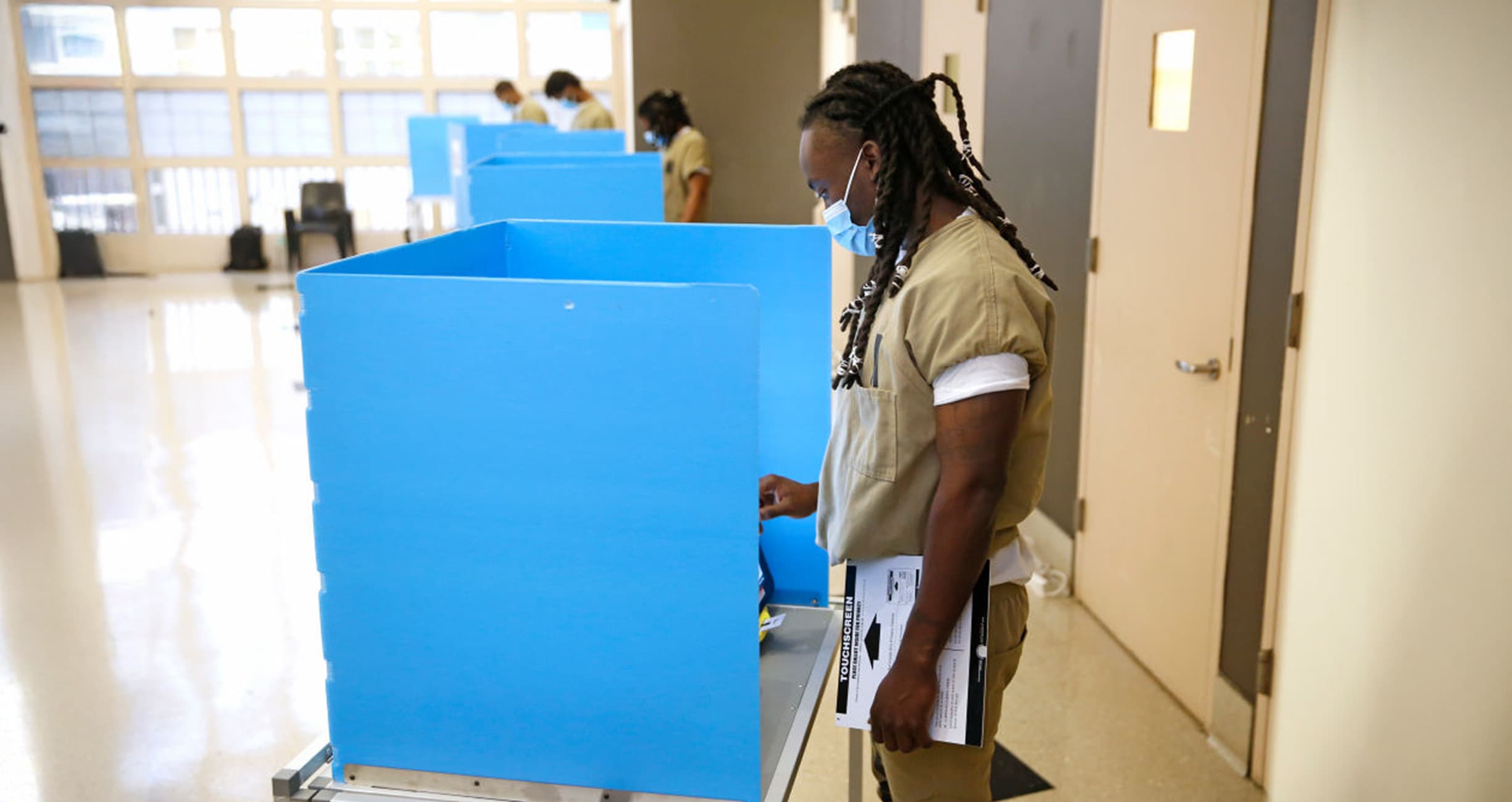
On Election Day, approximately 448,000 legally innocent people
will be held in more than 3,000 local jails across the United States.
Since they have not been convicted of a crime, they are eligible to
vote. But few will get the chance to exercise that right.
In 1974, the U.S. Supreme Court ruled that people who are held in jail and haven’t been convicted of a crime maintain their right to vote. However, because the court did not require jails to provide people with voting booths or write-in ballots, only a tiny percentage of incarcerated people who are eligible to vote actually do. Many people who are detained pretrial are not even aware
that they can still vote. This is understandable, because it is sadly
common for people convicted of crimes to lose the right to vote after
being released from prison, an injustice that many states have moved to rectify
in recent years. Even if people who are incarcerated pretrial are aware
that they can still vote, the logistical obstacles are often
insurmountable. In 2022, the Prison Policy Initiative could locate only seven jails
across the whole country that offered in-person voting.
De facto disenfranchisement due to pretrial detention has a
disproportionate effect on racially and economically marginalized
communities, depriving them of needed political power. Pervasive overpolicing and criminalization of Black communities nationwide helped drive the number of people held in jail while awaiting trial up more than 433 percent between 1970 and 2015.
People experiencing poverty are also disproportionately affected. In many parts of the United States, money bail
systems criminalize poverty by forcing people who are legally innocent,
but cannot afford to buy their freedom, to sit in jail before the their
cases are decided. Nearly 40 percent of people in the United States are unable to easily cover a $400 emergency expense, let alone the $10,000 average bail set on a felony case or the 10 percent partially secured option of $1,000.
It is wholly unfair and ineffective to confine people behind bars pretrial because they can’t afford bail. Research
has shown that, rather than making communities safer, detaining people
who are awaiting trial actually increases the likelihood that they’ll be
arrested again in the future. Additionally, people who are jailed
pretrial are more likely to plead guilty,
be convicted, and have longer sentences compared with people who were
released to the community. The damages of pretrial detention are
serious, including job loss, housing loss, family separation, and—on Election Day—unjust disenfranchisement.
Some places in the United States are working to address this wrong
and expand voting access in local jails. This past June, Colorado became
the first state to mandate that election officials offer voting services
in jails and detention centers. Now, incarcerated people who have
maintained their right to vote because they are being held pretrial or
serving time for misdemeanors should be able to cast their ballots in
the upcoming presidential election.
In 2019, Illinois required counties with populations of over three million to establish polling places in their jails. After Chicago’s Cook County Jail established a polling location, the jail saw a 40 percent turnout in the 2020 general election. In the June 2022 primary, the jail’s polling station reported the highest voter turnout in the 24th Ward, which covers 20 precincts in Chicago.
Cook County Sheriff Tom Dart told Vera that the jail’s polling place
helps people maintain productive ties to the outside world. “In all
seriousness, what better way [is there] to get a person committed to
their community?” he said. “They’re voting for the people that are
running their community.”
Additionally, a growing number of jurisdictions, including Illinois, New Jersey,New York, and Washington, DC,
are reforming pretrial systems to reduce or eliminate money bail. These
reforms allow for detention for people who pose a serious flight or
safety risk, while ensuring that most legally innocent people are spared
days, months, or even years in jail.
The ballot box offers a path to reform some of the many injustices
that flow from broken and racist systems, including overpolicing, money
bail, and mass incarceration. Making voting accessible to people who
have been harmed by these systems is essential. Those who are jailed
while awaiting trial need to be given fair opportunities to vote and
steer their communities toward a safer, healthier, and more prosperous
future.
“You’re not even guilty until you’re actually proven guilty,” said Amjad Asaad, who voted
from the Cook County jail in 2023 while being held pretrial. “There’s so
many people who are incarcerated that need to be heard.” - VERA, 24/9/2024
BN retains Johor in state election
-
Total seats up for grabs: 56 Unofficial results: Let’s see if the dark
horses Bersama and the progressive block of Muda and PSM can upset the
durian cart a...
APA PADA NAMA
-
1. Sejarah Malaysia dikait rapat dengan UMNO, Parti Kebangsaan Melayu
Bersatu. Parti UMNO pula dikenali dengan pemimpinnya. 2. Demikian di
peringkat permul...
China and HK may be barred from Asia Team meet
-
PETALING JAYA: The status of next week’s Asia Team Champion-ships in
Manila, the Philippines, is in quandary as two badminton nations – China
and Hong Kong...
PRU14 - Keputusan TEMERLOH - Parlimen dan DUN
-
Keputusan di Temerloh, harus kita analisa
1- Parlimen dimenangi Pakatan Harapan, yang juga menang DUN Mentakab,
tetapi BN menang DUN Lancang dan DUN Kuala ...
Thank you, Malaysians
-
Before the lights go out on The Malaysian Insider at midnight, we say
"Thank You" to our readers. TMI started on February 25, 2008. Today, after
eight year...
I believe in the freedom of expression - and everyone is free to use, reproduce, quote, copy and circulate, etc... materials published here. Please credit the source: http://charleshector.blogspot.com/.
For those of you who do have Blogs/Websites, it would be good if you could add a link to CHARLES HECTOR Blog. Please do promote the BLOG.
Anonymous comments or those containing profanities and obscenities (or irrelevant matters) will be rejected. Note that all comments made in post are personal opinions.
Number of Visits
Over 4 million visits. On an average, we have about 700-750 visits per day.Thank you all for your support and encouragement..







 Posts
Posts




No comments:
Post a Comment