- Austerity measures: Loans often require cutting public spending, which reduces funding for healthcare, education, and social programs.
- Privatization: Governments must frequently sell off state-owned industries and public utilities to private or foreign investors.
- Market deregulation: Requirements to rapidly lower trade barriers or remove local subsidies can overwhelm domestic businesses.
- Policy dictation: Conditions undermine local democratic control, forcing leaders to implement reforms that anger citizens.
- External control: Governments feel treated like subordinates rather than independent decision-makers.
- Western dominance: Major shareholder nations (like the US and European countries) hold disproportionate voting power.
- Geopolitical alignment: Lending practices can reflect the strategic interests of wealthy donor nations rather than local needs.
- Debt traps: Strict repayment schedules can force nations to borrow more just to service existing interest.
- Flawed growth models: Pushing export-driven economic models can fail to build genuine domestic wealth.
- Statement of the People’s Network Against the World Bank and IMF
Protest call! Stop Destructive Capital. People Must Determine Our Future.
We are a people’s movement bringing together many communities, generations, and struggles. We live with and resist the consequences of a development model that gives capital, markets, and economic growth power over our lives. We are people defending land, forests, rivers, energy, clean air, and the seas; farmers and landless people; urban poor and railway communities; workers, women human rights defenders, service workers, students, Indigenous Peoples and ethnic communities, people living with HIV, mothers and care workers; communities resisting mining, dams, power plants, economic zones, and large-scale development projects; as well as people struggling for the right to self-determination in conflict-affected areas and for democracy.
The power of the World Bank and the IMF does not lie only in lending. It also lies in their ideological influence over what counts as “development,” which direction the economy should take, what role the state should play, and how much power markets and capital should have.
Today, we see the consequences of this system in people’s everyday lives. Communities across the country are facing floods. Homes and farmland have been damaged. People cannot get to work, incomes have disappeared, and people are forced to use their own money, labour, and time to rebuild their lives. The floodwaters may recede, but people’s debts do not recede with them. Crises do not harm everyone equally, and recovery does not enable everyone to get back on their feet equally.
People suffering from the floods need a state that does its job not a prime minister handing out one thousand baht from his own pocket, where those who happen to be nearby receive it while those who cannot get close receive nothing. The right to assistance should not depend on who happens to be standing within reach of those in power.
This is the same system we have been fighting all along. When development projects generate profits, capital takes the benefits. But when damage is done, people lose their land, rivers, nature, ways of life, livelihoods, and the ecosystems that sustain life—and are then made to share the burden of debts incurred in the name of the country. The World Bank is therefore not merely a lender; it also helps open the way for capital to extract profit from people’s land, nature, and lives.
This is economic imperialism in the contemporary world. It does not require the occupation of territory. It operates through the power of capital, debt, knowledge, and the language of “development,” opening the way for capital to pursue profit through destructive forms of extraction, while people are left to pay the bill for the damage.
When the state cuts public spending, sick people do not disappear; care work is shifted onto women and families. When companies cut costs, workers still need to eat, pay rent, and support their families. When cities increase land values, urban poor and railway communities still have to find somewhere else to live. When projects generate profits, communities are left living with damaged land, rivers, livelihoods, and lives. And when the economy grows, many people are still sinking deeper into debt, paying higher electricity bills, and reaching the end of the month with less money—or almost nothing at all.
This is the “bill” of the economic system. And this is destructive capital.
Profits and wealth are pulled upwards, while debt, risk, and the costs of sustaining life are pushed downwards for people to bear. Capital does not exercise power on its own. It grows through policies, laws, public budgets, concessions, and state power. In Thailand, it is also intertwined with networks of power that we understand through the framework of the “Blue Regime,” connecting capital, powerful local political families, the state apparatus, independent bodies, and exceptional powers.
What is called the “cost of development” inside conference rooms is not an abstract cost floating in the air. It is the lives of people outside those rooms—on the streets, along railway tracks and riverbanks, in forests, fields, factories, and communities.
For this reason, when the World Bank and the IMF meet in Bangkok, we will gather in front of the Queen Sirikit National Convention Center. We will bring the lives and demands of people outside the conference rooms directly to the place where our future is being discussed and decided.
We will gather peacefully. But nonviolence does not mean silence. We will engage in peaceful expression and symbolic action to affirm that people have the right to speak, the right to assemble, and the right to challenge the powers that shape our lives.
We oppose the economic conditions attached to loans. We also oppose the ideological power through which the World Bank, the IMF, and international financial institutions influence the direction of our country’s economy. We challenge Thailand’s 14th National Economic and Social Development Plan and every policy that prioritises growth, investment, and competitiveness while reducing people’s power to determine their own lives, land, work, welfare, and future.
We do not want mere “participation” after the direction has already been decided. Participation without decision-making power is not people’s power.
The Network was initially granted permission to use a meeting room at the Social Research Institute of Chulalongkorn University for this press conference. We were subsequently informed that permission had been withdrawn because of concerns about the word “Against” in the name of our Network.
We condemn this restriction as a violation of academic freedom and freedom of expression. Chulalongkorn University, as a public university sustained by public resources and taxpayers’ money, must not forget its responsibility to the people. A university should be a space for thinking, critique, questioning, and scrutiny of power. It has no right to dictate what language people must use in order to be allowed a space to speak, when the institution itself has been built and sustained through the labour and taxes of the people.
Closing a space simply because the word “Against” is considered unacceptable reflects the very problem we are challenging. Participation that permits people to speak only in language acceptable to those in power is not participation in which people have the power to determine their own future.
We therefore call on people to join us in closely watching, questioning, criticising, and scrutinising the World Bank and IMF Annual Meetings, Thailand’s 14th National Economic and Social Development Plan, and the economic policies being shaped in the name of development.
This struggle is not only about opposing the World Bank and the IMF. It is about building the power of people’s movements to transform the economic model from the grassroots up, redistribute wealth and power back to the people, build universal welfare, and ensure that people have power over land, water, forests, energy, work, care, and everything that sustains our lives.
Because those who create, care for, and sustain life, society, and this planet should not merely be the ones who pay the bill for development. They must also have the power to determine the future.
If people are the ones who must pay the bill and live with the consequences of development, then people must have the power to determine their own future.
And when destructive capital and state power under the Blue Regime reinforce one another’s interests, civil disobedience is one of the means through which people defend their rights, freedoms, and power to determine their own lives.
Civil Society Opposes World Bank–IMF, Critiques Their Support for Big Capital, Calls for Overhaul of Thai Economy
*This English content is automatically translated from Thai version by AI. Thairath does not guarantee accuracy, completeness, or reliability of the translation. Please refer to the Thai version
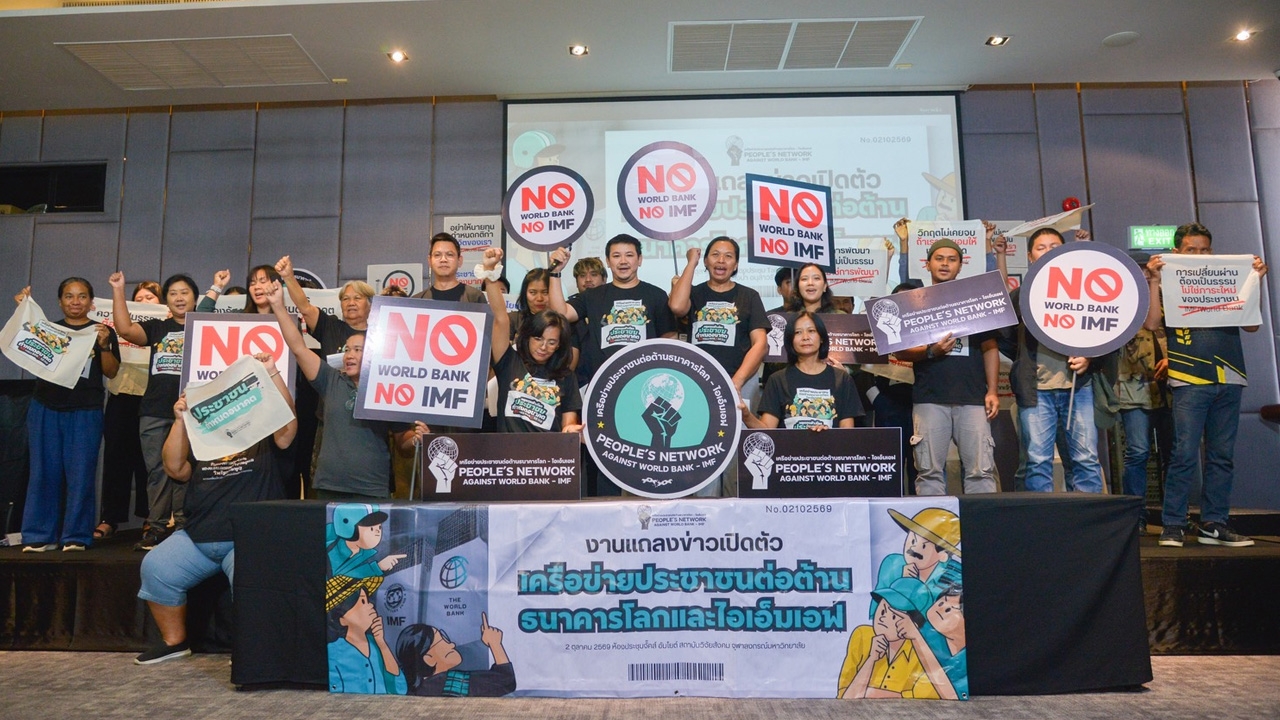
Civil society opposes the World Bank and IMF, criticizing their support for big capital and calling for a complete overhaul of Thailand's economic structure, with the state acting as market guard and stall renter to stop blue capital's monopoly.
On 2 Oct 2026, the People's Network Against the World Bank and IMF held a press conference to officially launch their network and hosted a discussion titled “Who Pays This Bill?” at Tailor Hall, 9th floor, Deprime Hotel, Rangnam. They highlighted the silent costs borne by the people in exchange for unchosen dreams, reflecting structural impacts ahead of Thailand hosting the World Bank and IMF Annual Meetings from 12–18 Oct. Representatives from civil society, activists, women’s groups, and urban poor gathered to unite in opposition.
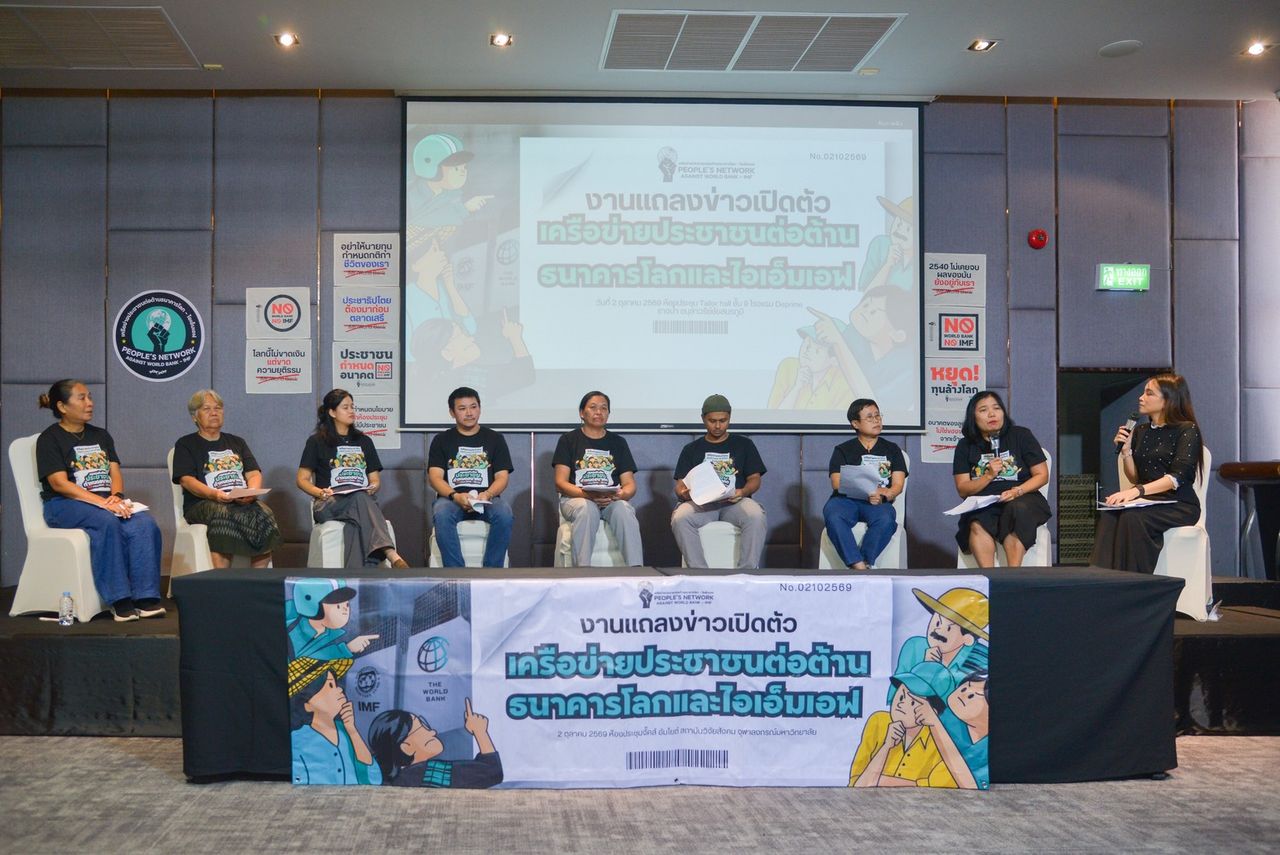
Network representatives jointly read a statement titled “Stop Capital's Global Takeover, People Decide the Future: NO WORLD BANK × NO IMF.” They oppose the system where capital dominates lives—not just opposing institutions but rejecting neoliberal capitalism and economic imperialism. The state is not shrinking but shifting costs from public budgets onto citizens’ shoulders while shielding big capital and privatizing essential life services into commodities.
The 1997 crisis taught that when the economy collapses, it is the people who pay the repair bills. The 1.32 trillion baht debt from the Financial Sector Restructuring Authority became public debt payable until 2031. Millions lost jobs, and women bore increased family burdens.
Land is not empty space for investment but home, food, and democracy—not merely a market asset. Green investments, carbon credits, or mining must not infringe on communities' rights to manage their resources.
Justice for the urban poor means recognizing that cities belong to those who build them. Workers like street sweepers and drivers have the right to live in the city. Forced evictions destroy life networks; housing must be secure, not subject to price speculation benefiting the wealthy.
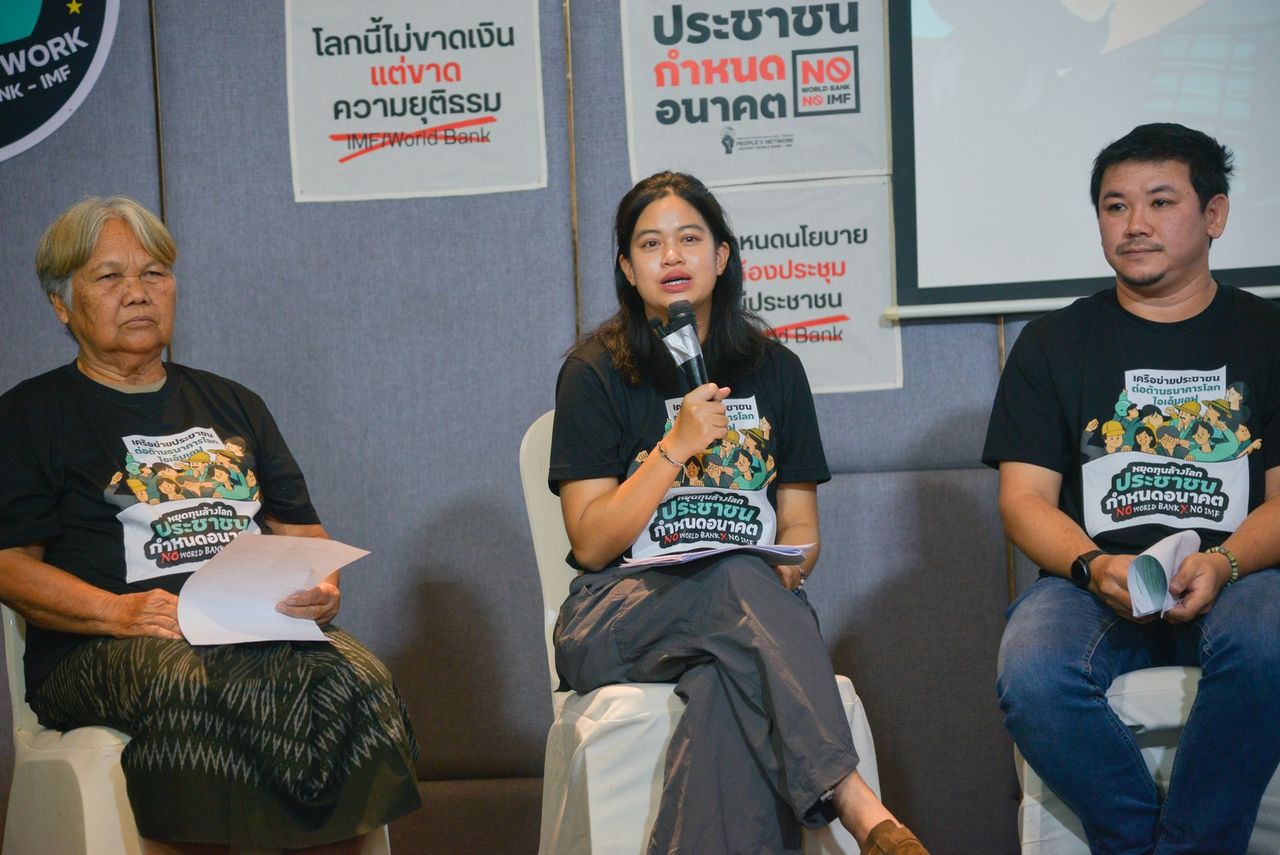
People bear the costs even before mines open. Loans for resource exploration shift debt and ecological risks onto communities from the start, without villagers having decision-making rights.
Universal welfare means reclaiming wealth collectively created by the people to care for lives, not mere welfare handouts or poverty tests, but restoring power to the people.
An economy that ignores women is an economy that ignores life. Care work, which supports society, must be recognized and compensated. Women should not be unpaid labor filling gaps for the state and capital groups.
A green transition must shift power, not just change from fossil fuels to new technologies while allowing big capital to monopolize transmission or greenwash through carbon credits. The people must own the energy.
GDP growth is insufficient if wealth concentrates at the top while the bill falls on the bottom. The country may appear richer statistically, but workers’ wages remain inadequate, monopolized by the “blue regime” linking influential families, state mechanisms, and big capital.
Seeds, medicine, labor, and bodies should not be dictated by profit. Monopoly over basic life necessities must end. Farmers must have seed rights, patients must access medicines, and workers must receive social protections.
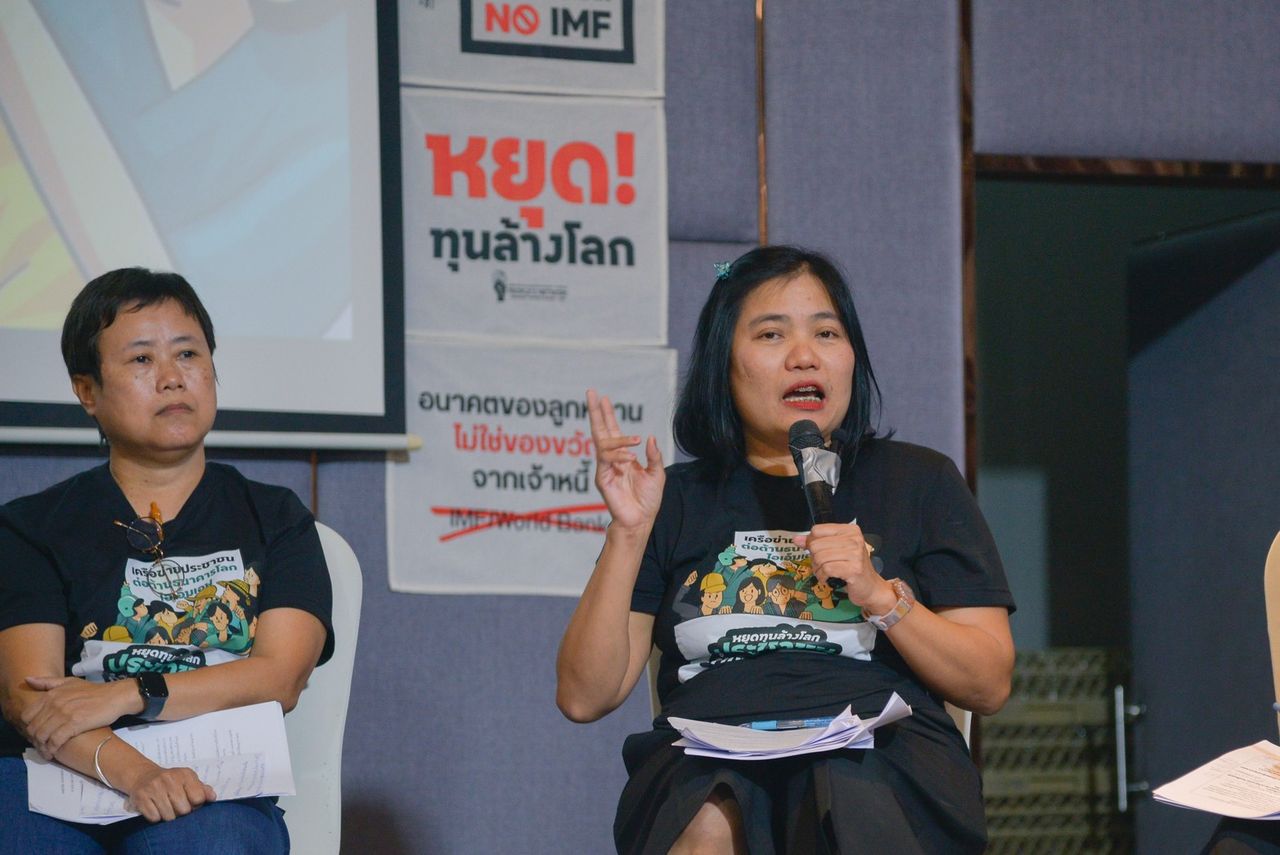
Statement from the network representatives.
Saengsiri Treemarka said the coalition formed from social workers, women’s groups, people living with infections, and urban poor who see that the 'neoliberal capitalist system' is creeping to dominate Thai society under the blue regime. People question how far the state will follow big capital and how long it will keep burdening citizens. Their goal is to oppose neoliberal capitalism, where the state reduces welfare burdens but keeps power unchanged, lets big capital monopolize, and pushes citizens to face fate and land grab struggles.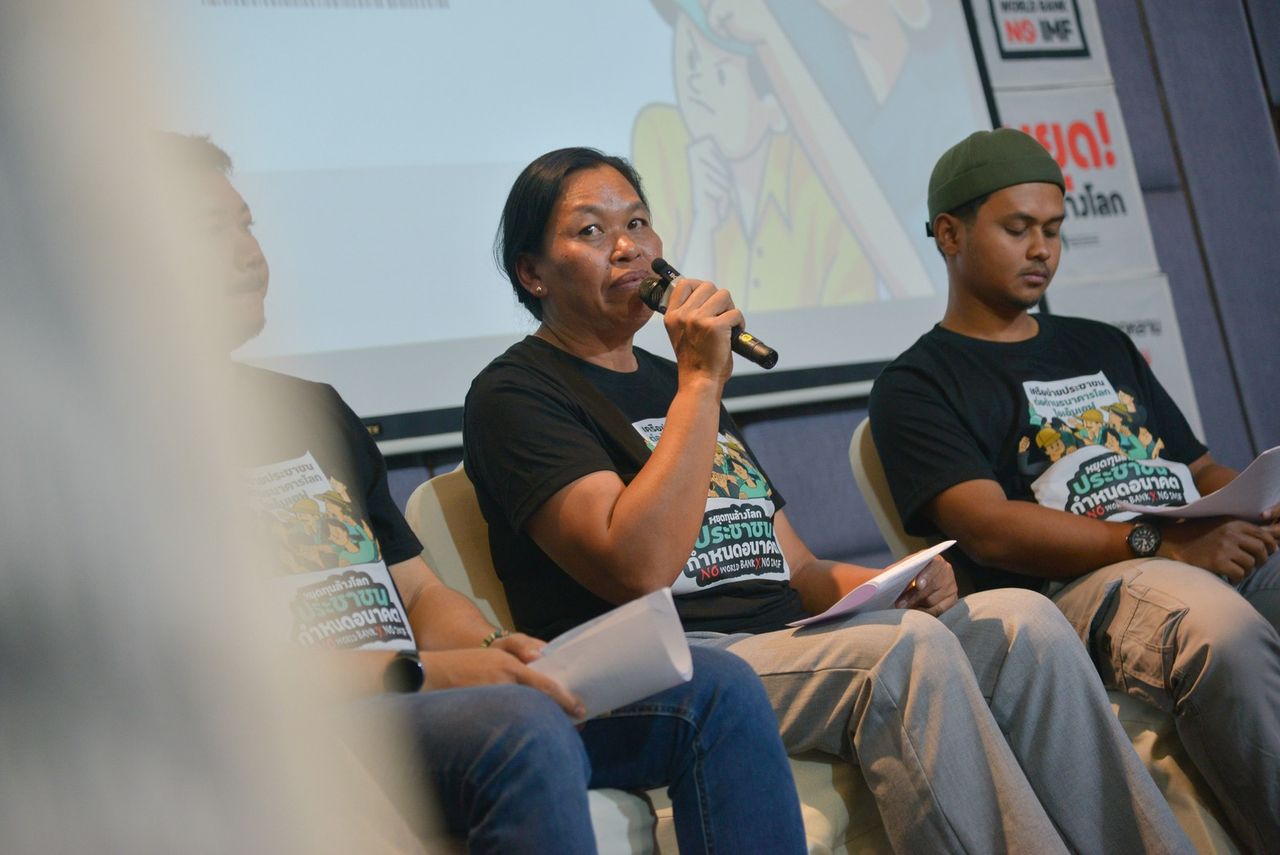
Charassri Chan-ai said blue capital policies have severely undermined community rights, including "community land titles" and "land banks," which communities should manage. Especially land banks aim to distribute land ownership to the poor, not to be treated as commodities benefiting foreigners. If blue capital or foreign investors are allowed to buy and seize land, the poor cannot build secure lives. Land, minerals, and underground resources should belong to the people to determine their own future.
Meanwhile, Nattawut Krompakdee said those bearing these "bills" most heavily are the urban poor, vulnerable groups, and those without life capital at society’s bottom. As development encroaches, it becomes a mechanism that pressures and pushes them far away—away from visibility, family, and opportunities for a better quality of life.


 Posts
Posts




No comments:
Post a Comment