Media Statement – 25/9/2022
Zahid Hamidi’s Acquittal by High Court Must be Appealed to the Court of Appeal, and Prosecution Failures Must be Investigated
Reforms Needed to Ensure Independence of Deputy Public Prosecutors
MADPET (Malaysians Against Death Penalty and Torture) notes that prosecution failure in the recent Zahid Hamidi’s case raises questions on the independence, competence and professionalism of prosecutors in Malaysia, and the need for reform and laws to safeguard independence of deputy public prosecutors, and to criminalize wrongful actions/omissions of prosecutors done intentionally or negligently for the benefit of the accused.
Former Deputy Prime Minister, UMNO President and Barisan Nasional Chairperson Ahmad Zahid Hamidi in this case was facing 33 charges of receiving bribes amounting to S$13.56 million (RM42 million) from UKSB as inducement for himself in his capacity as a civil servant and the then home minister to extend the contract of the company as the operator of the One Stop Centres in China and the VLN system as well as to maintain the agreement to supply VLN integrated system paraphernalia to the same company by the Home Ministry. He was also charged with another 7 counts as home minister who obtained S$1.15 million, RM3 million, CHF15,000 and US$15,000 in cash from the same company for himself in connection with his official work. (Malay Mail, 23/9/2022)
It was reported that the High Court Judge on 23/9/2022 found that prosecution failed at the close of prosecution case to successfully prove a prima facie case against Ahmad Zahid Hamidi, who is also Bagan Datuk MP, on not just some charges but all 40 bribery charges. The judge found that the prosecution failed to call ‘material witnesses’ and adduce certain evidence. (Malay Mail, 23/9/2022). Zahid Hamidi was acquitted without even having to enter his defence.
Before anyone is charged of an offence, prosecutors must verily belief that they have sufficient evidence to present in court to prove guilt beyond reasonable doubt. To not do so may be considered an abuse of power on the part of the prosecution. In any event, at the end of the day, prosecution still needs to convince the Judge or court, that an accused person is guilty beyond reasonable doubt, or at the close of prosecution case that a prima facie case has been established against the accused.
Failed To Call Material Witness
In the Zahid Hamidi case, the judge was reported that the prosecution failed to important witnesses to ascertain the source of the funds allegedly paid to Ahmad Zahid, amongst others, one “…'Nicole Tan' was not called to testify to provide clarifications on the missing link by explaining the nature of the arrangement between UKSB and the Hong Kong subcontractors of which the monies allegedly paid to Ahmad Zahid was derived from…. "The witness from Hong Kong including Nicole would be able to provide an explanation on the actual source of funds especially given that all three key prosecution witnesses confirmed the source of the monies paid to the accused did not originate from UKSB," he {Judge Datuk Mohd Yazid Mustafa] said….”
Of concern also, is the fact of not calling material witnesses has happened before in cases involving politicians and those allegedly connected to politicians. Similar findings arose in the cases of Kasitah Kaddam’s (then Minister of Energy and Natural Resources of Malaysia 1999–2004) and business tycoon Eric Chia.
In the Kasitah Kaddam’s case, it was reported ‘…Justice Suraya said the failure of the prosecution in not calling six board members who were present in the meeting was detrimental to the case as it had created a big gap over the question of whether the board members were actually cheated by the accused….’(Star, 13/8/2009, Kasitah freed of corruption charges)
In Eric Chia’s case, ‘…Akhtar[then Sessions Court judge Akhtar Tahir now High Court Judge] said the most glaring setback was the prosecution’s failure to call two material witnesses, who would have been able to confirm whether payment was needed for the technical assistance agreements (TAA) signed between Perwaja Rolling Mill Development and NKK Corporation. (Star, 27/6/2007, Eric Chia acquitted of CBT)
Failed to adduce CCTV footage, toll receipts and envelope
It was reported that ‘the prosecution did not produce any sample envelope used for the alleged cash payments, remarking that he found it hard to imagine what kind of envelope could fit the bill stacks amounting to hundreds of thousands at the material time….Neither close-circuit television footage nor toll receipts on delivery visits to Ahmad Zahid's house or the deputy prime minister's official residence — where the offences allegedly took place — were produced in court to support the prosecution's case.’
There is a need to now question whether the Deputy Public Prosecutors acted independently and professionally, or whether they were compromised by ‘corruption’ or orders/instruction from their superiors or others. MADPET (Malaysians Against Death Penalty and Torture) believes that Deputy Public Prosecutors handling any criminal case should be independent even from the orders/instruction of the Public Prosecutor, Minister, government/s of the day.
MADPET is of the opinion that mis-handling of prosecution duties intentionally and/or negligently for the benefit of the accused or any person who could be charged ought to be criminalized. One wonders whether if another independent Deputy Public Prosecutor was handling this case, would it have led to same outcome for Zahid Hamidi.
Appeal to the Court of Appeal
Now, in Zahid Hamidi’s, the High Court judge could have erred in his judgment to acquit, and as such it is important that the prosecution immediately files an appeal to the Court of Appeal. We know that many cases, the Appellate Court reversed decisions of the lower court.
In this case, MADPET urges the Public Prosecutor to immediately appeal to the Court of Appeal, as it is best that the Appellate Court confirms to us in Malaysia whether there was an error of judgment on the part of the High Court judge, or not.
Irrelevant to this particular case, it is fresh in the minds of Malaysians what was reported in another case, where the transactions are vide cheques not cash, where Zahid is accused of receiving bribes amounting to RM6 million from Chew as a reward for appointing DTSB to implement a passport chip project for a period of five years or for a total of 12.5 million chips to be included in the polycarbonate biodata page of Malaysia's international passport by the immigration department through direct negotiations under the home ministry.
In that case, Zahid Hamidi repeatedly stressed that he chose not to deposit the money into his accounts or use it for his personal benefit. "Even though at that time I was holding the post of deputy president (of Umno) and that money could be used for political purposes, I chose to use it neither for politics nor for personal purposes, but instead to channel it for charity, waqf and religious activities," he said…"If money is given to a politician, he has the discretion to deposit it into his own account or any other account he deems fit," he said.(Malaysia Now, 22/8/2022)
Given this, MADPET reiterates its call that the prosecution files an immediate appeal to the Court of Appeal so that Malaysian doubts on the correctness of the High Court’s decision to acquit without defence being called was correct or not.
Acquittal is not proof of innocence
In the administration of criminal justice, an acquittal is not proof of innocence. It is simply a failure of the prosecution to prove guilt by establishing a prima facie case at the close of prosecution, or at the end of trial failing to prove beyond reasonable doubt that crime accused had been committed.
Acquittal means Zahid Hamidi can never again be charged for the same offence nor on the same facts for any other offence for which a different charge from the one made against him might have been made. MADPET reiterates its call that the court should not acquit anyone when prosecution elects to discontinue the proceedings mid-trial, they should just be granted a Discharge Not Amounting an Acquittal (DNAA).
In the current case, if the prosecution at any time during trial found the evidence insufficient, it could have elected to sought a long postponement or to discontinue proceedings, and the court could have ordered a DNAA. Then, they could secure more evidence required to continue with prosecution.
It is not uncommon for prosecution witnesses to disappear or suddenly change their statement, or for evidence to be lost. Recall, the Malaysian former spy case, where the money seized and kept by MACC, was taken by a MACC officer (now already convicted), who then replaced it with counterfeit money.
MADPET, noting that the power lies with the Public Prosecutor, to immediately file an appeal to the Court of Appeal with regard the decision of the High Court judge to acquit Ahmad Zahid Hamidi at the close of prosecution stage of trial.
MADPET also calls for an investigation of the Deputy Public Prosecutors involved in this case, to determine whether there was any failure of duty, intentionally or otherwise.
MADPET also calls for reform and/or laws to ensure the independence of Deputy Public Prosecutors handling a particular criminal case, including the freedom from instruction/orders from others including government of the day.
Noting one public perception that Malaysian laws and administration of criminal justice accords preferential treatment to politicians and/or those with ‘connections’ to the government of the day or maybe tomorrow. which contrary to Constitutional guarantee in Article 8(1) that states, ‘All persons are equal before the law and entitled to the equal protection of the law’.
Malaysia need to also review and strengthen the mechanisms including safeguards to ensure the independence of the judiciary, prosecutors and law enforcers.
Charles Hector
For and on behalf of MADPET(Malaysians Against Death Penalty and Torture
See earlier posts
Kasitah Gaddam & Eric Chia - Prosecution's failure to call witnesses - Was it just incompetence OR....?
Zahid walks free in foreign visa bribery case after High Court rules prosecution failed prima facie
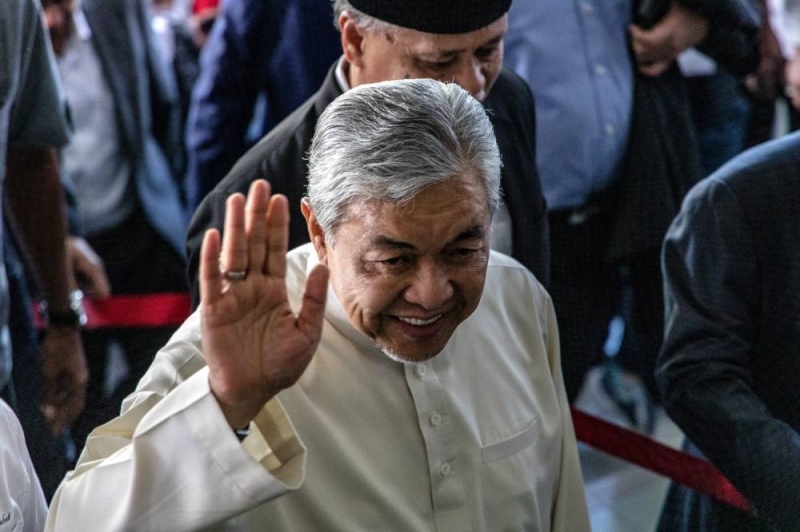
SHAH ALAM, Sept 23 — The High Court today acquitted Datuk Seri Ahmad Zahid Hamidi of taking bribes from Ultra Kirana Sdn Bhd (UKSB), the company awarded a government contract for a foreign visa system (VLN).
However, the Umno president is still on trial for another corruption case where he is accused of 47 criminal breach of trust, corruption and money laundering charges involving tens of millions of ringgit belonging to Yayasan Akalbudi, the charity organisation he founded.
Judge Datuk Mohd Yazid Mustafa said the prosecution failed to successfully prove a prima facie case against Ahmad Zahid, who is also Bagan Datuk MP, on all 40 bribery charges.
In his ruling, Mohd Yazid said the testimonies by three key prosecution witnesses — former UKSB executives Wan Quoris Shah Wan Abdul Ghani and Harry Lee Vui Khiun, and former administrative manager David Tan Siong Sun — were unreliable and untrustworthy.
Mohd Yazid also said the prosecution has failed to prove the main ingredients of the charges framed under Section 165 of the Penal Code and Section 16(a)(B) of the MACC Act leveled against Ahmad Zahid.
"In view of the failure by the prosecution to prove the foremost important element in all the charges leveled against the accused, i.e the receipt of the corrupt monies, upon exercise of the maximum evaluation of the evidence in totality I find the prosecution has failed to make out a prima facie case on all charges," Mohd Yazid said.
The judge also said he took account of the prosecution's failure to call other important witnesses to ascertain the source of the funds allegedly paid to Ahmad Zahid, noting there was existing 'unanswered doubt' as to whether the money even existed and who delivered the monies.
Based on the oral testimonies of key prosecution witnesses, Mohd Yazid said one individual who goes by the name 'Nicole Tan' was not called to testify to provide clarifications on the missing link by explaining the nature of the arrangement between UKSB and the Hong Kong subcontractors of which the monies allegedly paid to Ahmad Zahid was derived from.
"The witness from Hong Kong including Nicole would be able to provide an explanation on the actual source of funds especially given that all three key prosecution witnesses confirmed the source of the monies paid to the accused did not originate from UKSB," he said.
Mohd Yazid also said the prosecution did not produce any sample envelope used for the alleged cash payments, remarking that he found it hard to imagine what kind of envelope could fit the bill stacks amounting to hundreds of thousands at the material time.
Thus, the judge said he was unable to consciously make a finding that the monies were received by Ahmad Zahid as suggested by the prosecution based on transactions recorded in a ledger — which had listed cash payments to various ministers, politicians and civil servants — owned by UKSB.
Furthermore, Mohd Yazid said neither close-circuit television footage nor toll receipts on delivery visits to Ahmad Zahid's house or the deputy prime minister's official residence — where the offences allegedly took place — were produced in court to support the prosecution's case.
As for the key prosecution witnesses being unreliable, Mohd Yazid said Tan had not mentioned he paid a sum of RM3 million to Ahmad Zahid in his witness statement and admitted to saying it was an afterthought under cross-examination.
"This admission of an afterthought by the key prosecution witness is more than sufficient for me to find that he was with zero credibility," he said.
Ahmad Zahid faced 33 charges of receiving bribes amounting to S$13.56 million (RM42 million) from UKSB as inducement for himself in his capacity as a civil servant and the then home minister to extend the contract of the company as the operator of the One Stop Centres in China and the VLN system as well as to maintain the agreement to supply VLN integrated system paraphernalia to the same company by the Home Ministry.
He was also charged with another seven counts as home minister who obtained S$1.15 million, RM3 million, CHF15,000 and US$15,000 in cash from the same company for himself in connection with his official work.
Ahmad Zahid, who was in the dock dressed in a white baju Melayu top and black trousers, appeared calm as the judge read out his two-hour long decision.
The public gallery immediately erupted with cries of Alhamdullilah (Arabic for praise be to God) when the judge made the no prima facie ruling.
Lawyers Hamidi Mohd Noh, Datuk Ahmad Zaidi Zainal and Datuk Hisyam Teh Poh Teik appeared for Ahmad Zahid.
Deputy
public prosecutors Datuk Raja Rozela Raja Toran, Abdul Malik Ayob,
Zander Lim and Thavani Balakrishnan appeared for the prosecution. - Malay Mail, 23/9/2022

RM6 million was a political contribution, not kickbacks for passport chip contract, Zahid says
He says he had no authority to appoint Datasonic Technologies Sdn Bhd as the supplier as such decisions lay with the finance ministry.
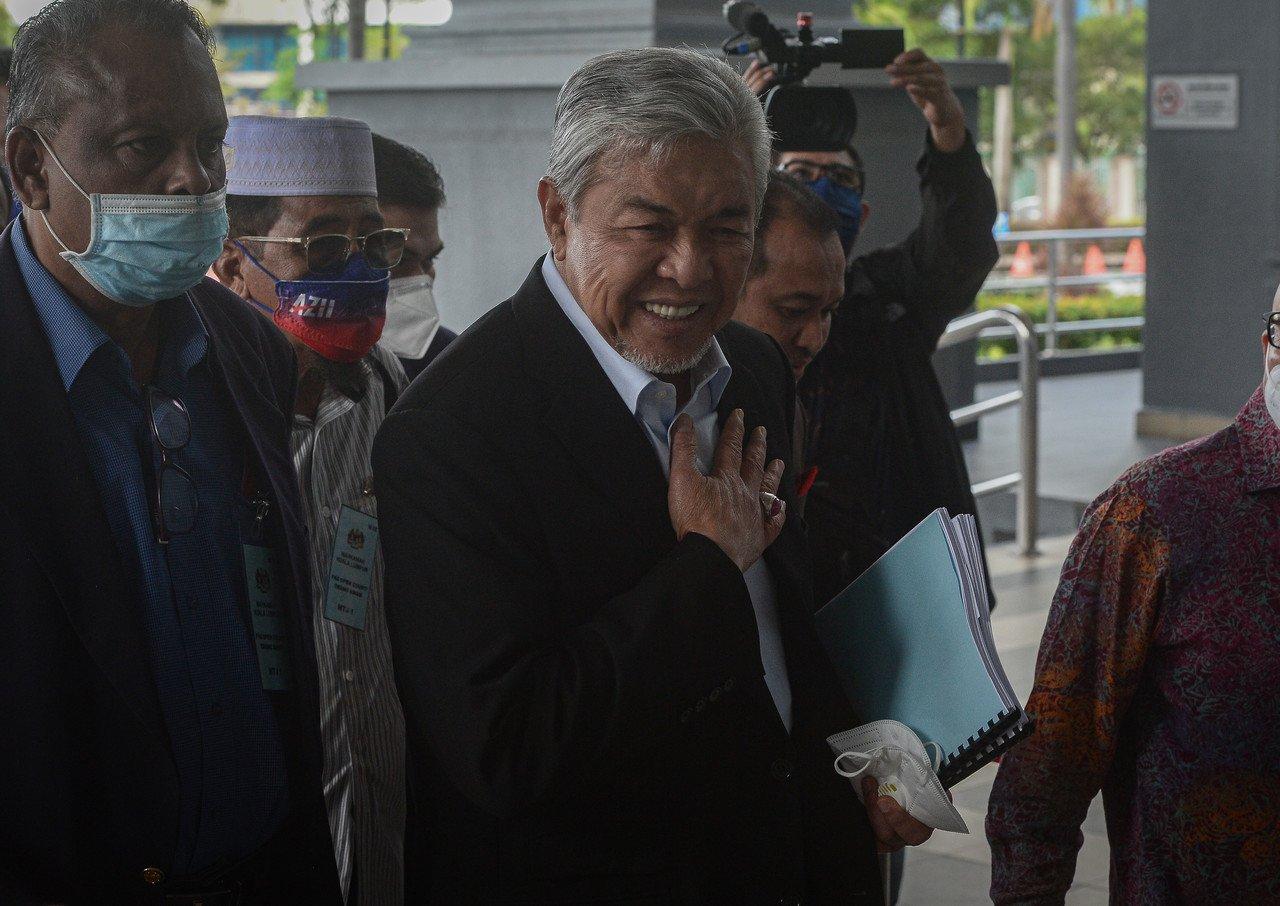
Ahmad Zahid Hamidi told the Kuala Lumpur High Court today that the two cheques amounting to RM6 million received from Syarikat Sarana Kencana Sdn Bhd were political contributions during his time as the deputy prime minister, not bribes.
Zahid, 69, said allegations that the cheques received through former Datasonic Group Bhd deputy managing director Chew Ben Ben were inducements to appoint Datasonic Technologies Sdn Bhd (DTSB) as a supplier of passport chips for five years were untrue and slanderous.
“I wish to stress that the decision to appoint DTSB was not mine. I had no authority to make the final decision as it was under the jurisdiction of the finance ministry.
“The process carried out by the finance ministry, home ministry and immigration department on awarding the polycarbonate contract to DTSB was in order and according to the stipulated procedure.
“All procedures were conducted appropriately by my officers at the home ministry and this was verified by the finance ministry before the contract was awarded to DTSB,” he said when questioned by his lawyer, Ahmad Zaidi Zainal, during his defence against 47 charges involving tens of millions of ringgit in funds belonging to Yayasan Akalbudi.
Twelve of the charges are of criminal breach of trust, eight are of corruption, and 27 are of money laundering.
Zahid said during his time as home minister, former DTSB director Mohamed Hashim Mohd Ali had submitted a letter applying to supply passport chips for five years or 12.5 million chips which would be embedded in the Malaysian passport polycarbonate biodata page via direct negotiation.
“When it involves direct negotiation, it involves directives from the treasury as well as the internal procurement of the home ministry. Furthermore, I stated that the finance ministry determines the award of direct negotiations to any company that has made an application not at the procurement level of the home ministry,” he said.
To Zaidi’s question on how he knew Hashim, Zahid said he met Hashim, who was then the army chief, when he held the position of political secretary to the defence minister.
“He (Hashim) later became the director of several listed companies, including DTSB. I have known him for more than 20 years since I was in the defence ministry, not because of his involvement in business but as an officer of the armed forces,” he said.
He said Sarana Kencana was owned by Hashim and Abu Hanifah Noordin, the former managing director of Datasonic Group Bhd.
The Bagan Datuk MP also said that Abu Hanifah, who is the 32nd prosecution witness, had stated in court that the cheques were given to him as a political fund which was part of a charity.
“Chew Ben Ben (the 34th prosecution witness) also testified during re-examination by the prosecution that based on his understanding, political money is also included as charity.
“Abu Hanifah and Chew also stated that the issuance of these two cheques had nothing to do with the appointment of DTSB to execute the polycarbonate contract. In fact, the cheques that were credited into the customer account of Messrs Lewis & Co were a political contribution to me,” he said.
According to the 14th and 15th charges, Zahid is alleged to have received bribes amounting to RM6 million from Chew as a reward for appointing DTSB to implement a passport chip project for a period of five years or for a total of 12.5 million chips to be included in the polycarbonate biodata page of Malaysia’s international passport by the immigration department through direct negotiations under the home ministry.
The trial is being conducted before judge Collin Lawrence Sequerah. - Malaysia Now, 26/5/2022
Zahid says never used RM6 million political donation for personal benefit
He says he never deposited the money into his accounts but instead handed it over to legal firm Messrs Lewis & Co, the trustee of his charity outfit Yayasan Akalbudi.
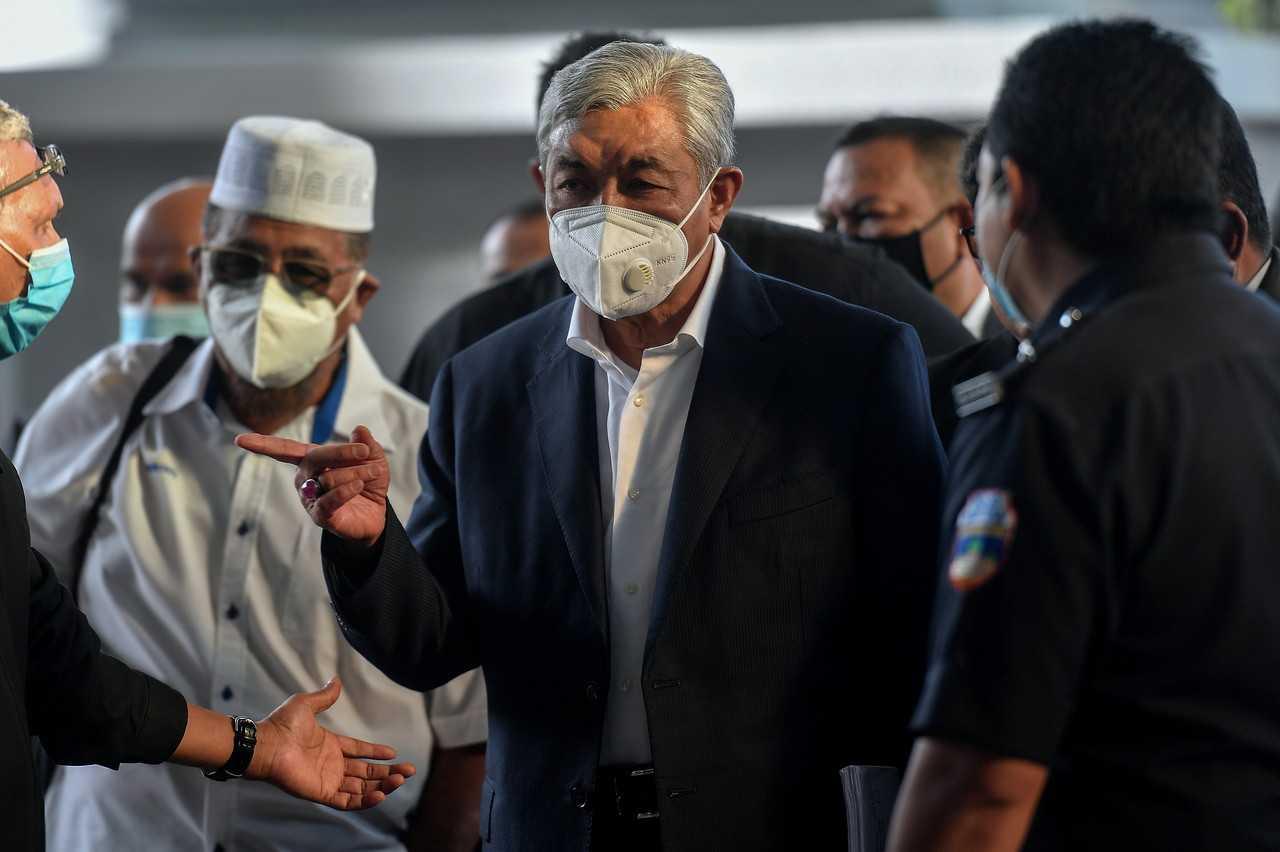
Ahmad Zahid Hamidi told the High Court today that he had never used the RM6 million allegedly received as a political donation from the deputy managing director of Datasonic Group Berhad (DGB), Chew Ben Ben, for personal benefit.
Zahid, 69, also said he had never deposited the money received through two cheques into his personal accounts but that he instead handed over the money to legal firm Messrs Lewis & Co, the trustee of his charity outfit Yayasan Akalbudi.
The Bagan Datuk MP repeatedly stressed that he chose not to deposit the money into his accounts or use it for his personal benefit.
"Even though at that time I was holding the post of deputy president (of Umno) and that money could be used for political purposes, I chose to use it neither for politics nor for personal purposes, but instead to channel it for charity, waqf and religious activities," he said during cross-examination by deputy public prosecutor Abdul Malik Ayob.
Zahid is on trial for 47 charges: 12 of criminal breach of trust, eight of corruption, and 27 of money laundering involving tens of millions of ringgit belonging to Yayasan Akalbudi.
When asked by Malik why the RM6 million he claimed was a political donation was not deposited into the accounts of Umno or Barisan Nasional, Zahid said it was "not necessarily (so)".
"If a politician receives a political donation, the money doesn’t necessarily need to be deposited into his party’s account as nowhere on the cheque were the words ‘donation for political party’ written.
"If money is given to a politician, he has the discretion to deposit it into his own account or any other account he deems fit," he said.
Zahid also disagreed with Malik’s suggestion that the RM6 million he received from Chew was a bribe.
In the 14th and 15th charges, Zahid is accused of receiving bribes amounting to RM6 million from Chew as a reward for appointing DTSB to implement a passport chip project for a period of five years or for a total of 12.5 million chips to be included in the polycarbonate biodata page of Malaysia's international passport by the immigration department through direct negotiations under the home ministry.
The trial before judge Collin Lawrence Sequerah continues. - Malaysia Now, 22/8/2022



 Posts
Posts