Sunday, March 05, 2023

Respect People’s Right to Privacy, Freedom of Expression - Repeal Section 233 and other rights violating provisions in the Communications and Multimedia Act 1998(CMA)...- MADPET

Media Statement – 4/3/2023

Respect People’s Right to Privacy, Freedom of Expression - Repeal Section 233 and other rights violating provisions in the Communications and Multimedia Act 1998(CMA)

Suspect’s right to be informed and to be heard must be respected before online services are 'blocked' by State

The continued use of the draconian Section 233 Communications and Multimedia Act 1998(CMA) by Malaysian government under Prime Minister Anwar Ibrahim is appalling. News that the government will review this section is welcomed, but MADPET (Malaysians Against Death Penalty and Torture) calls for the repeal of Section 233 and all anti-human rights provisions in CMA.

Despite the long-standing call of the Malaysian Bar (also vide a Bar Resolution passed at the AGM in 2016 attended by over 1,000 lawyers), SUHAKAM (Malaysian Human Rights Commission), civil society groups and others for the repeal of this law, this PH-led government is still using this law.

The Bar in a statement December 2015 said, amongst others that ‘…Section 233(1)(a) of the CMA is a serious encroachment on the freedom of speech and expression guaranteed by Article 10(1)(a) of our Federal Constitution. …Section 233(1)(a) of the CMA is also repugnant to the rule of law, as it is broad in scope, vague and ambiguous, with entirely subjective terms such as “offensive” and “annoy”.  It can easily be misused to stifle speech and expression, to shut out contrary views, to quash dissent, to deny democratic space, and to suppress Malaysians.  It is this imprecision that gives rise to the perception that the provision is yet another dressed–up political weapon in the armoury of the Government…’

Section 233 criminalizes the publication and dissemination online of communication that is ‘…obscene, indecent, false, menacing or offensive in character with intent to annoy, abuse, threaten or harass another person…’ It is just too broad and vague, and is open to abuse. For example, the highlighting of violation of human rights or laws, or facts connected to alleged violations of rights/laws, would likely ‘annoy’ or even ‘harass’ the wrongdoer, and for the alleged wrongdoer, it could also be said to be ‘menacing and offensive’. This should never be considered an offence.

As such, this section deters even the highlighting of human rights abuses, breaches of law and even possible government wrongdoing. A criticism of a statement of a Minister or anyone that is in the wrong can also be alleged to be false, menacing, annoying or even harassment.

In 2022, the Centre for Independent Journalism documented 114 cases where Section 233 of the Communications and Multimedia Act was used to investigate netizens and human rights defenders.

CMA has also infringed press freedom, and this also can violate people’s right to information. Two national newspapers are being investigated by police for publishing news reports insinuating that Chinese vernacular school students in the country are reluctant to learn Bahasa Malaysia. This maybe just an opinion of some, so why the investigation at all.

Blocking access without owner-user knowing – section 263

Another draconian provision is Section 263, whereby Section 263(2) states, ‘(2) A licensee shall, upon written request by the Commission[Malaysian Communications and Multimedia Commission(MCMC)] or any other authority, assist the Commission or other authority as far as reasonably necessary in preventing the commission or attempted commission of an offence under any written law of Malaysia or otherwise in enforcing the laws of Malaysia, including, but not limited to, the protection of the public revenue and preservation of national security.’ A ‘.."licensee" means a person who either holds an individual licence, or undertakes activities which are subject to a class licence, granted under this Act;..’.

This means access to your blog, website, Facebook, email, etc can be blocked by the licensee or service providers on the request of the MCMC, who simply have to send a written request.

What is worse is that you may not know WHY this happened, and who is responsible for this ‘censorship’ and deprivation of your right to communicate with others? Worse, this ‘censorship’, interference, blocking of access and even closure of account of your online facilities of communication can even happen before any alleged crime is committed. One may end up wrongly blaming service providers and social media applications, when the truth may be that it was the government that is responsible.

If blog/website or any social media facility access is to be blocked, the suspect of the alleged crime must be immediately informed by MCMC or the relevant authorities, and accorded the right to challenge that decision.

Note that all the police or MCMC can do is allege or suspect that a crime has been committed, for it is only the court, after a fair trial, that determines whether an offence has been committed or not. Hence, premature punishment by blocking access to internet facilities must end, as punishment ought to come after the court decides on the guilt.

Spying on us – Section 252, 265 …

How many people’s communication online are being intercepted and listened to using CMA? The people’s right to privacy must be respected and acknowledged.   

Section 252 CMA ‘…. authorise the officer to intercept or to listen to any communication transmitted or received by any communications….’ .  CMA says, "interception capability" means the capability of any network facilities or network service or applications service to intercept communications under section 265;

All that is needed now is the authorization of the Public Prosecutor, and MADPET believes that it is better that the requirement be a Court order made by a Judge, who will have to consider our right to privacy before allowing for any such ‘spying’.

Section 265(1) states, ‘The Minister may determine that a licensee or class of licensees shall implement the capability to allow authorised interception of communications…’

CMA needs a total review, and all draconian provisions that violates our human rights must be forthwith repealed

MADPET (Malaysians Against Death Penalty and Torture) calls for the immediate repeal of section 233, 263, 252, 265 and other draconian provisions in the Communications and Multimedia Act 1998(CMA);

MADPET calls for an immediate stay in the usage of Section 233 and all draconian provisions of the CMA pending repeal;

MADPET calls for respect and acknowledgement of a persons right to privacy, and to insert this right in the Constitution or relevant laws;

MADPET calls for press freedom, and for the government to ‘end’ trying to scare or ‘control’ journalists and media outlets from reporting and/or delivering information, including critical opinions, to the Malaysian public.

Freedom of speech, expression and opinion must be respected. If there is some ‘fake’ or ‘misleading’ information online, the government should speedily correct or clarify rather than prosecuting the author and those who shared it online. The government must acknowledge the right of people to express opinions different from that of the government of the day, the police or MCMC.

Charles Hector

For and on behalf of MADPET (Malaysians Against Death Penalty and Torture)

see:-

TM blocks access to Malaysian Insider? Based on Multimedia Commission's request based on an alleged offence? Unjust and draconian?

Resolution on Internet Censorship, The Malaysian Insider, and Freedom of Expression and Opinion

Whereas:

1. The access to the website of alternative online media, The Malaysian Insider, have been denied to Malaysians by the Malaysian Communications and Multimedia Commission (“MCMC”).

2. A visit to the said website will disclose, amongst others, the following statement: “Access to this site has been denied under Section 263(2) Communications And Multimedia Act 1998 as it violates the following Malaysian law: … Breached provision section 233 Communications and Multimedia Act 1998.”

3. In the case of the Malaysian Chronicle website, another alternative media outlet, all that one sees is ‘This website is not available in Malaysia as it violate(s) the National law(s).’ – there is no mention of even what laws have been breached and under what provision is the site blocked.

4. A statement in Bahasa Malaysia dated 25/2/2016, which did not even indicate the name of the person who issued the statement, in the Malaysian Communications and Multimedia Commission (MCMC) website, confirms that it is the MCMC that blocked the The Malaysian Insider website.

MCMC SEKAT LAMAN THE MALAYSIAN INSIDER

CYBERJAYA, 25 Februari 2016 --- Suruhanjaya Komunikasi dan Multimedia Malaysia (MCMC) telah menyekat laman The Malaysian Insider ekoran tindakan portal berkenaan yang telah mengeluarkan kandungan-kandungan yang menjurus kepada kesalahan di bawah Seksyen 233, Akta Komunikasi dan Multimedia 1998.

Sekatan tersebut juga dilakukan oleh MCMC berdasarkan aduan-aduan dan maklumat yang diterima daripada orang ramai.

Sehubungan itu, MCMC memperingatkan portal-portal berita agar tidak menyebarkan atau menyiarkan artikel-artikel yang tidak ditentukan kesahihannya. Ini kerana, tindakan sedemikian boleh mengundang kekeliruan dan mencetuskan situasi yang tidak diingini.

SEKIAN

5. The reason seems that the said The Malaysian Insider had published contents that amount to a violation of Section 233 Communications and Multimedia Act 1998. There are, however, no details whatsoever, as to what the alleged violation was – no mention of date and time, no mention of which particular report, and no mention of the particulars of the statements that allegedly were in breach of section 233. Section 233(1) and (2), which contains the offence is as follows:

233  Improper use of network facilities or network service, etc

(1) A person who-

(a) by means of any network facilities or network service or applications service knowingly-

(ii) initiates the transmission of,

any comment, request, suggestion or other communication which is obscene, indecent, false, menacing or offensive in character with intent to annoy, abuse, threaten or harass another person; or

(b) initiates a communication using any applications service, whether continuously, repeatedly or otherwise, during which communication may or may not ensue, with or without disclosing his identity and with intent to annoy, abuse, threaten or harass any person at any number or electronic address,
commits an offence.

(2) A person who knowingly-

(a) by means of a network service or applications service provides any obscene communication for commercial purposes to any person; or

(b) permits a network service or applications service under the person's control to be used for an activity described in paragraph (a),
commits an offence.

6. A perusal of section 233(1) will see that it is just too broad and vague, and is open to abuse. For example, the highlighting of violation of human rights or laws, or facts connected to alleged violations of rights/laws, would likely ‘annoy’ or even ‘harass’ the wrongdoer, and for the alleged wrongdoer, it could also be said to be ‘menacing and offensive’. This should never be considered an offence.

7. As such, this section deters even the highlighting of human rights abuses, breaches of law and even possible government wrongdoing. This section even deters the sharing of such relevant and important facts, and/or opinions over the internet.

8. Section 233(1), together with section 263(2), violates even the very assurance provided for in Section 3(3), which states ‘Nothing in this Act shall be construed as permitting the censorship of the Internet.’ The blocking of access to websites like The Malaysian Insider, could hardly be said to be not ‘censoring the internet’.

9. Section 263(2) states, ‘(2) A licensee shall, upon written request by the Commission or any other authority, assist the Commission or other authority as far as reasonably necessary in preventing the commission or attempted commission of an offence under any written law of Malaysia or otherwise in enforcing the laws of Malaysia, including, but not limited to, the protection of the public revenue and preservation of national security.’ 

10. The wordings of section 263(2) suggest the ability to block website/s or website access (and/or ‘censor) for the purpose of preventing a possible offence or an attempt to commit an offence – as such, it is akin to a ‘preventive detention’ law like our former Internal Security Act (ISA). This means websites blogs and other social media can be pre-maturely blocked even before any crime has been committed. Was the The Malaysian Insider website access blocked because there was some ‘suspicion’ that The Malaysian Insider may breach some law in the future?

11. We remind ourselves of the legal principle that is the ‘presumption of innocence until proven guilty. No one can be said to have breached any law until the court, after a trial, determines whether one is guilty or not. No administrative authority and/or executive body can arbitrarily determine whether one has breached the law or not – all they can do is allege for it is the courts that determine whether a law is breached or not.

12. The other use of section 263(2) is for the enforcing of the laws in Malaysia – and, the question is which law is it enforcing, and does the said law allow the blocking of access to the internet or any particular website, remembering the guarantee that there will be no ‘censoring of the internet’.

13. What makes it even more dangerous is that, unlike the draconian ISA and Detention Without Trial laws, which requires a Minister’s order, here all that is required is not even an order but merely a ‘written request by the Commission or any other authority’ – this is unacceptable.

14. An ISA detention order by a Minister could be subject to judicial review, but here under section 263(2), we only have a ‘written request’, that too directed to the licensee, which seems to be the internet service providers, not even the affected website like The Malaysian Insider, making it even more difficult to appeal. Hence, the victim may be deeply prejudiced – not having the ability to appeal to higher authorities, let alone proceed with a judicial review.

15. In Malaysia, when a person is deprived of his rights or freedoms, like in an arrest, the enforcement authority only can hold him/her for 24 hours, and for further detention a court remand order is required. 

16. However, in this case of ‘blocking access to internet websites’, which we now know can last indefinitely, there is no requirement for any court order, and as such this is grossly unjust. 

17. In the case of The Malaysian Insider, there were also no material particulars as to which the ‘offending’ article was, and what was wrong with it. 

18. Even if there was some offending report, reasonable would have been blocking access to the particular report/article – not the blocking of the entire media website.

19. In Parliament, the Deputy Communications and Multimedia Minister Datuk Jailani Johari ‘…said the government had on January 19 formed a special committee to monitor the use of the internet and social media platforms, with the panel chaired by minister Datuk Seri Salleh Said Keruak and comprising representatives from his ministry, the Malaysian Communications and Multimedia Commission (MCMC), the police and the Attorney-General Chambers….to ensure stern action on those using social media to plant hate against government institutions and prevent social media from becoming the cause of the incitement of discord through the propagation of lies, hatred and religious extremism…’(Malay Mail, 8/3/2016)

20. In the said report, it also disclosed that since January 19 until February, ‘the MCMC has probed 22 cases of internet misuse and blocked a total of 399 websites.’ The law does not give the MCMC the specific power to block access to websites. 

21. No material particulars were given as to which websites have been blocked and for what specific reason they were blocked. One could not find even on the Malaysian Communications and Multimedia Commission (MCMC) website a listing of the websites blocked, and the reasons for the blocking of access. Hence, not only are the owner/s of the said websites deeply prejudiced, but also we who do not want internet censorship.

22. Even if was a pornographic or gambling website, there must be a requirement for a court order for the blocking of access. It should be noted that now many local and foreign media websites, websites/blogs of individuals and civil society organisations are also being blocked arbitrarily. In all cases, the owners of the website must be given due notice and the opportunity to be heard.

23. The Malaysian Bar, in its 1/3/2016 statement, amongst others, said: ‘…The right to information, or the right to know, is implicit in the guarantee of freedom of speech and expression that belongs to every citizen, as enshrined in Article 10(1)(a) of the Federal Constitution. Indeed, a true democracy envisages a meaningful right to know…. The blocking of access to websites is a serious curtailment of the right to know, as it thwarts the flow or dissemination of information, thoughts and ideas.  This renders the constitutional guarantee in Article 10(1)(a) vacuous or meaningless… Further, a critical and complementary aspect of the fundamental right to freedom of speech and expression is contained in Article 19 of the Universal Declaration of Human Rights, which states: “Everyone has the right to freedom of opinion and expression; this right includes freedom to hold opinions without interference and to seek, receive and impart information and ideas through any media and regardless of frontiers.”
 
THEREFORE, it is hereby resolved that:

A. That we, the Members of the Malaysian Bar, and the Malaysian Bar, call on the Malaysian government to stop censorship of the internet.

B. That we, the Members of the Malaysian Bar, and the Malaysian Bar, call for immediate unblocking and restoring internet access to The Malaysian Insider, Malaysian Chronicle and all such media sites and blogs that publish information, opinions and views. 

C. That we, the Malaysian Bar calls for the repeal of section 263, section 233 and such vague provisions in the Communications and Multimedia Act 1998.

D. That the Malaysian Bar calls for the repeal of all such laws that allow for the deprivation of human rights and freedoms by executive and/or administrative authorities, without the necessary requirement of a court order.

E. That the Malaysian Bar review Malaysian laws, and highlight laws and/or provisions therein that is contrary to international human rights standards. 

F. That the Malaysian Bar uphold the rule of law, including the right to be heard and a fair trial. 

##Malaysian Bar’s 70th Annual General Meeting (“AGM”), held on 19 Mar 2016 at Renaissance Kuala Lumpur Hotel, which saw the attendance of a  total of 1,110 Members, adopted the following Resolution
 
Press Release | Section 233(1)(a) of the Communications and Multimedia Act 1998 Creates a Chilling Effect on Freedom of Speech and Expression, and Should be Repealed 21 Dec 2015 5:06 pm

The Malaysian Bar is deeply concerned over the use of Section 233(1)(a) of the Communications and Multimedia Act 1998 (“CMA”) which, among others, criminalises the use of network facilities or network services by a person to transmit any communication that is deemed to be offensive and could cause annoyance to another person. 

Section 233(3) of the CMA stipulates, upon conviction, the imposition of a maximum fine of RM50,000 or a maximum one–year jail term or both, as well as a further fine of RM1,000 for every day the offence is continued after conviction. 

Section 233(1)(a) has been frequently used, and recently against the following persons and entities:

(1) Radio journalist Aisyah Tajuddin and two of her colleagues were investigated on 23 March 2015 for her alleged appearance in a video posted online, entitled “Hudud Isi Periuk Nasi? (Kupas)”;

(2) The Malaysian Insider (“TMI”) managing editor Lionel Morais, Bahasa Malaysia news editor Amin Shah Iskandar, and features and analysis editor Zulkifli Sulong were arrested on 30 March 2015; and chief executive Jahabar Sadiq and group CEO of The Edge Media Group (which owns TMI) Ho Kay Tat were arrested on 31 March 2015, for allegedly publishing a news report that claimed the royal institution had opposed the amendment of the Federal Constitution to enable hudud laws to be implemented; 

(3) Whistleblower website Sarawak Report was investigated, and access to it blocked, in July 2015 for allegedly publishing unverified information relating to the Prime Minister and 1MDB;

(4) Political analyst Shahbudin Husin was investigated on 29 September 2015 for allegedly posting a comment piece entitled “Kenapa lawatan rasmi Zahid ke Indonesia sama tarikh dengan majlis sanding anaknya di Jakarta?”;

(5) Former Chief Minister of Malacca Tan Sri Abdul Rahim Thamby Chik was charged on 5 October 2015 for allegedly posting an item on his Facebook account concerning the Selangor Raja Muda;

(6) Parti Sosialis Malaysia Secretary–General S Arutchelvan was charged on 23 November 2015 for allegedly criticising the Court of Appeal's decision against then–Opposition leader Anwar Ibrahim, in a Facebook post;

(7) Activist Khalid Mohd Ismath was charged on 13 November 2015 for making allegedly seditious online posts regarding the Johor royalty; 

(8) Former Minister in the Prime Minister’s Department Dato’ Zaid Ibrahim was charged on 3 December 2015 for the alleged offence of publishing the transcript of a speech that he delivered at the Royal Selangor Club on his blog.  The blog post, entitled “Rally Behind Tun Dr Mahathir Mohammad”, called for the removal of the Prime Minister; and

(9) “Letak Jawatan” Facebook page administrator Joe Haidy Sulaiman was investigated on 4 December 2015 for allegedly defaming the Prime Minister in a Facebook post.

Section 233(1)(a) of the CMA is a serious encroachment on the freedom of speech and expression guaranteed by Article 10(1)(a) of our Federal Constitution.  While Parliament may impose restrictions on this fundamental constitutional liberty, such restrictions must be reasonable and proportionate.  The extremely wide and draconian effect of Section 233(1)(a) renders it an impermissible restriction, inasmuch as it unduly negates the exercise of the right to speech and expression. 

Section 233(1)(a) of the CMA is also repugnant to the rule of law, as it is broad in scope, vague and ambiguous, with entirely subjective terms such as “offensive” and “annoy”.  It can easily be misused to stifle speech and expression, to shut out contrary views, to quash dissent, to deny democratic space, and to suppress Malaysians.  It is this imprecision that gives rise to the perception that the provision is yet another dressed–up political weapon in the armoury of the Government.

In any event, there can certainly be no basis for Section 233(1)(a) to be invoked against any person who calls for the Prime Minister to step down.  It is absurd to criminalise the exercise of such a legitimate democratic right.  Peaceful change to the executive leadership of a nation is part and parcel of democracy.  The Prime Minister must accept that the price for being in office includes constant scrutiny and criticism, and this could include calls for him to resign. 

The continuous use of Section 233(1)(a) of the CMA to clamp down on views, discourse and expression, and to restrict democratic space, creates a climate of fear that threatens to silence Malaysians.  Section 233 (1)(a) suffocates not only freedom of expression and freedom of speech in Malaysia, but more critically, freedom of thought.  In this age of connectivity, where the exchange of ideas and information is rife, no nation that aspires to be recognised and accepted as a world leader in ideas and intellectualism can afford to raise an unquestioning and non–discerning population. 

The Malaysian Bar therefore calls upon the Government to cease its use of Section 233(1)(a) of the CMA, and to repeal Section 233 of the CMA.  The chilling effect on the freedom of speech and expression that is created by its use must be eliminated. 

Steven Thiru
President
Malaysian Bar

21 December 2015 - Malaysian Bar Website


Malaysia: Hasten reform of Section 233 of the Communications and Multimedia Act

Activist Heidy Quah, 7 September 2022. https://www.facebook.com/heidy.quah

In 2022, the Centre for Independent Journalism documented 114 cases where Section 233 of the Communications and Multimedia Act was used to investigate netizens and human rights defenders.

This statement was originally published on cijmalaysia.net on 15 February 2023.

1. We are glad that the new government decided not to pursue the case against Heidy Quah. It was reported yesterday that human rights activist, Heidy Quah, was to be charged under Section 233 of the Communications and Multimedia Act (CMA). The government however made a sharp u-turn at the last minute and decided not to pursue the case.

2. This decision, we hope, foretells the government’s commitment in not weaponising repressive laws to silence critics and curtail our freedom of expression and speech. Human rights activists, such as Heidy Quah, should not have been investigated and intimidated for speaking out and critiquing government action.

3. The broad scope of Section 233 of the CMA allows it to be widely used against human rights defenders and has become a tool of intimidation and harassment by State apparatus in the recent years. Last year alone we documented 114 cases where Section 233 of the CMA was used to investigate netizens and human rights defenders for various reasons. FOE Report 2022 can be accessed here

4. The government must always be open to scrutiny and constructive criticism in fulfilling its mandate. In this regard, we call upon Fahmi Fadzil as the new minister of Communications and Digital to hasten reforms with regards to the CMA, and other laws which are used to silence critics, specifically human rights defenders.

5. We need a State that lives up to the hopes of the Rakyat for an unencumbered freedom of expression and speech, especially when it comes to holding the government accountable.

15 February 2023
Wathshlah Naidu
CIJ Executive Director - Ifex Website


Govt to review Section 233 of Communications and Multimedia Act 1998 [NSTTV]

KUALA LUMPUR: The government plans to review the amendment of Section 233 of the Communications and Multimedia Act 1998 to ensure a smooth investigation process for those charged for political purposes under the Act.

Deputy Communications and Digital Minister Teo Nie Ching said the review would also allow better data traffic maintenance for the Malaysian Communications and Multimedia Commission (MCMC).

"Only 67 per cent of the complaints we receive contain threatening content and another 58 per cent are obscene content.

"However, we are mulling the effort to review the Act to ensure that the investigation aspect will be smooth and better data traffic maintenance for MCMC.- NST, 1/3/2023

Police confirm NSTP dailies under investigation for claiming SJKC students not keen to learn BM


Sentul police chief Assistant Commissioner Beh Eng Lai confirmed that police reports on the matter had been filed on January 21. ― Picture by Ahmad Zamzahuri

By Zarrah Morden
Wednesday, 01 Feb 2023 3:07 PM MYT

KUALA LUMPUR, Feb 1 — Two national newspapers are being investigated by police for publishing news reports insinuating that Chinese vernacular school students in the country are reluctant to learn Bahasa Malaysia.

The English-language New Straits Times (NST) and the Malay-language Berita Harian, both published by the New Straits Times Press Berhad (NSTP), sparked uproar with Chinese Malaysian education groups accusing the two dailies of sedition in their January 18 articles titled “SJKC pupils not keen to learn BM” and “Murid SJKC tak minat subjek Bahasa Melayu?” respectively.

Sentul police chief Assistant Commissioner Beh Eng Lai confirmed that police reports on the matter had been filed on January 21.

“We are investigating under Section 505(b) of the Penal Code and Section 233 of the Communications and Multimedia Act (CMA) 1998,” he told Malay Mail today when contacted.

Section 505(b) of the Penal Code deals with the publication of statements with the intent to cause, or which are likely to cause, fear or alarm to the public whereby a person may be induced to commit a crime against the State or public peace.

If found guilty, punishment includes a jail term of up to two years, an unspecified fine, or both.

Section 233 of the CMA 1998 criminalises the use of network facilities or network services by a person to transmit communication deemed offensive.

Those found guilty of this offence can be punished with a maximum fine of RM50,000, or a jail term of up to one year, or both.

Malaysian Chinese Language Council (MCLC) president Datuk Eddie Heng Hong Chai held a news conference here yesterday accusing the NST reporter of misleading the public by making sweeping generalisations in the published article about BM in vernacular schools nationwide.

He claimed that the reporter had only interviewed two teachers who were only sharing the difficulties their vernacular school students faced in learning the national language, news portal Malaysiakini reported.

Heng clarified that the vernacular school students were improving their BM scores in recent years, with the average marks topping 90 per cent.

He added that MCLC had written to the news outlets but had yet to receive a response, Malaysiakini reported.- Malay Mail, 1/2/2023


SUHAKAM has expressed concern at the actions of police using specific laws against activists, politicians, journalists and human rights defenders.

The Human Rights Commission of Malaysia (SUHAKAM) wishes to express its concerns on the actions by the police using specific laws against activists, politicians, journalists and human rights defenders for exercising their freedom of expression.

SUHAKAM is of the view that the enjoyment of freedom of expression should only be restricted as provided by the law to the extent necessary and proportionate to achieve legitimate aims such as national security and public order.


Anyone exercising their right to freedom of speech and expression should not be made to suffer or be fearful of retaliation or intimidation.

Human Rights Commission of Malaysia

Restrictive laws which are essential for political stability, racial harmony, and economic prosperity cannot be used as tools to restrict any political contestation and people's mobilisation against it.

SUHAKAM notes that Section 233 of the Communications and Multimedia Act (CMA) and laws such as the Sedition Act 1948, the Peaceful Assembly Act 2012 and Section 504 and 505 of the Penal Code and The Security Offences (Special Measures) Act 2012 (Sosma) are being used to censor, intimidate, silence critics and curtail freedom of expression and speech.

SUHAKAM is concerned with the ongoing use of restrictive laws, which are not in line with human rights principles as expounded in Article 19 of the Universal Declaration of Human Rights (UDHR) and Article 10 of the Federal Constitution of Malaysia on freedom of opinion and expression. Anyone exercising their right to freedom of speech and expression should not be made to suffer or be fearful of retaliation or intimidation.

Therefore, SUHAKAM calls for the Government to:

  • Repeal the Sedition Act 1948 without further delay and address the disproportionality in the presumption of "seditious tendency".
  • Address "hate speech" only as an exception to freedom of speech based on the objective criteria rooted in Article 19 of the UDHR and Article 10(1) Federal Constitution. Only "hate speech" defined and determined as incitement to race, religious or national hatred and war should be prohibited. At the same time, freedom of speech should be restricted only to the extent necessary and proportionate to fulfil the legitimate aims of respect for the reputation of others and for protection of national security, public order, public morality, as prescribed in the law.
  • End the suppression of dissent now being mounted against critical voices or the need to haul them up for questioning.

SUHAKAM wishes to remind the Government on its duty and responsibility to protect the people's right to free speech, in line with Article 10 of the Federal Constitution of Malaysia which guarantees Malaysian citizens the right to freedom of speech, freedom of assembly and freedom of association, as a democratic nation should be.

Source: Human Rights Commission of Malaysia

Date: 23 June 2020


Wednesday, March 01, 2023

Racist, Divisive and Discriminatory elements in Budget? Indian Malaysians? 'Divide and Rule' continues under Anwar's PH-led 'UNITY" government?

No need for special Budget allocations to specific Malaysian ethnic groups - Indian Malaysians, Chinese Malaysians, Indonesian Malaysians, Thai Malaysians, Brunei Malaysians, Filipino Malaysians... allocations must be ethnic-free for ALL Malaysians, and disbursed/utilized through the Ministry not any ethnic based entity or NGO. Why? The risk of discriminatory disbursements by reason of class, religious, sub-ethnic groups, political party affiliations...During BN era, this was done by the ethnic based parties(MIC/MCA/UMNO) - but the problem was that it may have not reached ALL because of disbursing groups in-built discrimination... So, best that all be managed and disbursed through government Ministries/Departments..

Chinese Malaysians - NOT just 'Chinese' - that is how we refer to Malaysians of Chinese heritage whose forefathers may have come from China, etc. Indian Malaysians... [In Indonesia, I believe all are Indonesians > there is no 'continuous re-enforcement', as in Malaysia, that some of us are different by the always insistence that we identify as Chinese or Indians even in government forms/documents> Is it not time, that Malaysia changes and stop emphasizing ethnic differences to 'divide' the Malaysian people.

The allocation for Indian Malaysians, etc in the recent BUDGET is simply 'RACIST', in my opinion, - it ignores the fact that there as so many different ethnics whose forefathers were from different countries like Sri Lanka, Pakistan, Thailand, Indonesia >> why no allocations for these minority groups? 

True, the Chinese Malaysians and the Indian Malaysians are the biggest group after Malays in Semenanjung > why ignore other minor ethnic groups? So, ALL Malaysians must be treated equally - and budget allocations must be for ALL maybe for targeted groups like the poor, the marginalized, young people, etc

Malaysia achieved independence in 1957, and was united with Sabah and Sarawak in 1963 - but to date, we are still being treated based on ethnicity, based on where our fore fathers came from, religion - when really all of us in Malaysia ought to be treated equally. It is OK for special preferences for the groups listed in Article 153 - but for the rest it should not be ethnic or religious based.

Allocation for Indian Malaysians no need? Just a common allocation, where all including Malaysian Indians can get assistance...

Now, let us look at the PM Anwar Ibrahim's Pakatan Harapan led-government, and we see budget allocations for particular ethnic groups...why is that? It could have been allocations to help B40 or M40, without reference to any particular groups. It could be allocations to poorer Malaysians for the development of business, etc

Sivakumar also shared that RM100 million had been allocated to the Malaysian Indian Transformation Unit (Mitra) while another RM30 million was provided through the Usaha Niaga Group Economic Fund (Tekun) for the Indian Micro-Entrepreneur Financing Scheme.

But, here there is in the Budget allocation specific to Indian Malaysians - are the Sri Lankan Malaysians, the Pakistani Malaysians, the Indonesian Malaysians, the Thai Malaysians and many other ethnic groups forgotten?

V. Sivakumar(DAP) - the spokesperson just because he is Indian Malaysian and Hindu? ABSURD. Responsibility for Indian Malaysian citizens rest on the PM and government in Malaysia...

Why did Human Resource Minister V. Sivakumar talk about this, and meeting the Finance Minister about such issues and about non-Muslim places of worship? Are the non-Malaysian Indian and Muslim Ministers/Deputy Ministers and MPs not concerned about this issue simply because it concerns Malaysians not from his/her ethnic group?

If the government was still under the Alliance(later renamed Barisan Nasional), then maybe there will be some justification as the main component parties were ethnic based political parties - UMNO(United Malay National Organisation), MCA(Malaysian Chinese Association) and MIC(Malaysian Indian Congress) - because in that scenario the Indian Malaysian party will want to SHOW that it is concerned about Indian Malaysian  - who is the said party's members.

But here, we have V. Sivakumar >> from Pakatan Harapan, and DAP(Democratic Action Party)? Now, is DAP the new 'representative' of Malaysian Indians, and non-Muslims in Malaysia? Why is there no one from PKR - a 'so-called multi-ethnic multi-religious' party? Remember DAP also is a multi-ethnic multi-religious' party. Even Parti Amanah Negara, the 3rd member of PH, is a multi-ethnic multi-religious party where anyone irrespective of ethnicity or religion can become a member.

4.1 Keahlian Parti adalah terbuka kepada semua rakyat Malaysia tanpa mengira bangsa, kepercayaan atau
jantina

Now, in the BUDGET, if special allocation is made specifically for  Malays and natives of any of the States of Sabah and Sarawak, as per Article 153 of the Federal Constitution, then it is reasonable and justifiable. But all other allocations, it must be for all Malaysians, irrespective of  where their grandfathers or great grandfathers came from. There could be targeted allocation based on poverty(B40 or M40), youth and women.

153  Reservation of quotas in respect of services, permits, etc., for Malays and natives of any of the States of Sabah and Sarawak...

REMOVE RACIST ELEMENTS FROM THE BUDGET - and remember that all Malaysians voted for all the MPs, and the government of the day. The government of the day must use MONIES and power to help/assist ALL irrespective of party affiliation, religion, ethnicity, etc - only criteria of preference may be things like poverty

There is NO WAY how you can say who vote for PH based on ethnicity - as our votes are 'SECRET' - Even the different channels at voting centers are based on AGE-groups, not ethnicity. You may be able to analyze how older and younger citizens - but there is really no way to find out how many Malays voted for any party >> only a guess. In any constituent, one may vote because of who the candidate is - not because of who the party is. 

Remember that the recent education and public service issue - did not the government take the position is that there is NO DISCRIMINATION based on ethnicity/religion in Malaysia? 


Budget 2023: Sivakumar to discuss allocations for non-Muslim houses of worship with Finance Ministry


BATU GAJAH: Human Resources Minister V. Sivakumar will meet the Finance Ministry to discuss the details of allocations for non-Muslim houses of worship in the 2023 Budget.

Sivakumar, who is also the sole Hindu minister in the cabinet, said this was because it was the first time Hindu temples (as part of non-Muslim houses of worship) had received allocations from the government in a national budget.

"Yesterday, Prime Minister (Datuk Seri Anwar Ibrahim) announced an allocation of RM50 million for the maintenance and repairs of non-Muslim houses of worship.

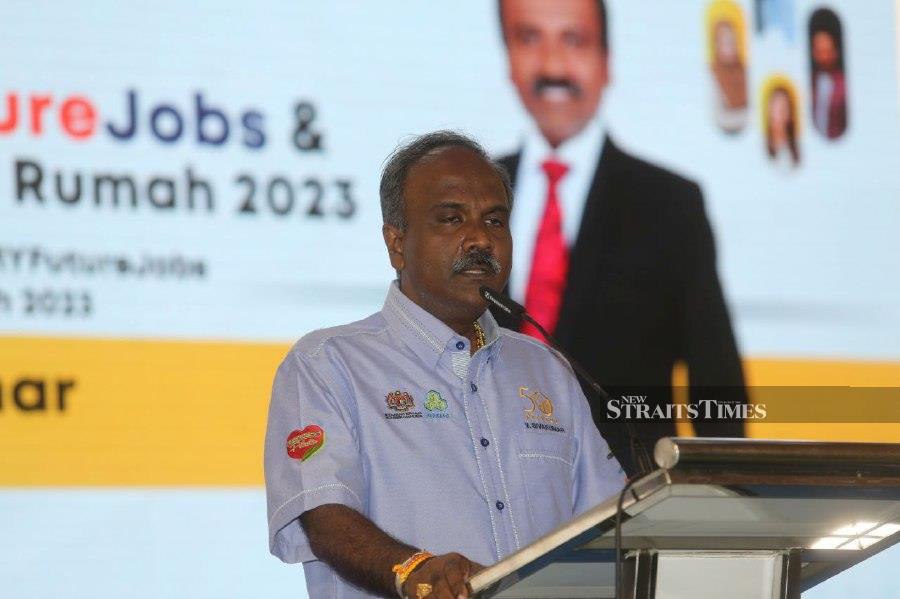
"This includes houses of worship for Hindus, Buddhists and Christians. The move will benefit all the communities," he said after officiating the MYFuture Jobs Career Carnival and Housewives' Social Security Scheme 2023 at the Silverlakes Village Outlet here today.

Sivakumar also shared that RM100 million had been allocated to the Malaysian Indian Transformation Unit (Mitra) while another RM30 million was provided through the Usaha Niaga Group Economic Fund (Tekun) for the Indian Micro-Entrepreneur Financing Scheme.

Anwar, who is also finance minister, announced RM50 million for the maintenance and overhaul of non-Muslim houses of worship throughout the country, and RM900 million for the maintenance of all schools, including Tamil schools, when he presented the 2023 Budget in Parliament yesterday. — BERNAMA