GREAT NEWS when the Court of Appeal allowed the Malaysian Bar's application for a Judicial Review of the Public Prosecutor's decision that led to the DNAA of Zahid Hamidi. It was a decision to discontinue prosecution of the accused in a criminal trial.
In Malaysia now, the Attorney General is also the Public Prosecutor - and their POWERS are as stated in the Federal Constitution and also the Criminal Procedure Code, amongst others.
Federal Constitution - Article 145(3) The Attorney General shall have power, exercisable at his discretion, to institute, conduct or discontinue any proceedings for an offence, other than proceedings before a Syariah court, a native court or a court-martial.
Sec. 254 Criminal Procedure Code - Public Prosecutor may decline to prosecute further at any stage
(1) At any stage of any trial, before the delivery of judgment, the Public Prosecutor may, if he thinks fit, inform the Court that he will not further prosecute the accused upon the charge and thereupon all proceedings on the charge against the accused shall be stayed and the accused shall be discharged of and from the same.
(2) At any stage of any trial before a Sessions Court or a Magistrates Court before the delivery of judgment, the officer conducting the prosecution may, if he thinks fit, inform the Court that he does not propose further to prosecute the accused upon the charge, and thereupon all proceedings on the charge against the accused may be stayed by leave of the Court and, if so stayed, the accused shall be discharged of and from the same.
(3) Such discharge shall not amount to an acquittal unless the Court so directs.
In Zahid Hamidi's case, the decision to discontinue proceedings(that led to the DNAA) was ODD - because it was done after the High Court determined that the Prosecution has successfully proven a PRIMA FACIE case against Zahid > this is the MOST difficult task in a criminal trial - the proving of ALL elements of the CRIME to the satisfaction of the Judge. NOW, this means that Zahid has a final chance during the Defence case, to raise REASONABLE doubt in COURT, that will lead to his ACQUITTAL - and, if he failed to do so, he will be CONVICTED and sentenced. Thus, it was VERY DIFFICULT to avoid conviction.
However, when the Attorney General/Public Prosecutor decides to 'DISCONTINUE' criminal prosecution - the Court/Judge have no choice but to DISCHARGE the accused simply because the Public Prosecutor does not want to continue prosecuting. Malaysian law still does not provide for any other - including the victim or some other to step in and continue prosecuting.
By discontinuing the criminal proceedings, more so after PRIMA FACIE case have been proven, allows for a GUILTY person to walk free and the Court/Judge although knowing that until that stage, the accused is still GUILTY beyond reasonable doubt. In my opinion, if the accused has any evidence or argument for his innocence, it must be presented in COURT and only the JUDGE will decide whether one is GUILTY or NOT.
DANGER - What if the Public Prosecutor is CORRUPT or abused his/her POWER? What if the Public Prosecutor did as Prime Minister Anwar Ibrahim or some others wanted?
NOTE the Attorney General/Public Prosecutor is CHOSEN by the Prime Minister, and who also have the power to remove at any time? No need for REASONS - that is why Public Prosecutors must be INDEPENDENTLY appointed with SECURITY of TENURE..to prevent 'wrongful dismissal' for bad reasons like you went against what the PM wanted.
Too many NOT charging of persons, too many decisions not to prosecute and discontinuation of criminal proceedings
Like Ministers, decision of the Public Prosecutor must be subjected to JUDICIAL REVIEW to determine whether the decisions were correct???
For JUDICIAL REVIEW of Public Prosecutor's decision - it must be open to all persons - because crime is a public matter - and Malaysians expect those who break the law to be charged and tried...NOT COMPOUNDED or just 'swept under the carpet"
That was over the deputy prime minister’s 47 corruption charges involving Yayasan Akalbudi funds, where he obtained a discharge not amounting to an acquittal (DNAA) three years ago.
In a unanimous decision this morning, the panel of three judges led by Faizah Jamaludin said they found the Bar’s judicial review application “appropriate” and not frivolous.
They said the lawyers’ professional body raised arguable issues that warrant a full judicial review and remitted the matter back to the High Court for hearing.
The panel also said the challenge by the Bar was not a collateral attack on the criminal court presiding over the case; instead, it challenged the legality and rationality of the AG’s decision that led to Zahid’s DNAA.
“The criminal court cannot compel the AG in his role as public prosecutor to proceed with the prosecution once he (has) decided to discontinue it (as) such (a) decision remains with his constitutional responsibility under Article 145(3) of the Federal Constitution.

“Since the criminal court’s DNAA order was a procedural consequence of the AG’s decision, the appellant is not attacking the criminal court’s order granting a DNAA.
“(But) what it challenges is the executive root of that order, namely the AG’s decision to discontinue the prosecution in respect of the charges against Zahid and to seek a DNAA.
“Therefore, we find that the appellant’s application for judicial review was not a collateral attack on the criminal court’s order of a DNAA in respect of all 47 charges against Zahid.
“We (also) respectfully disagree with the High Court’s refusal of leave, as in our view, the High Court applied an unduly (high) standard at the leave stage and went too far into matters properly reserved for the substantive hearing,” Faizah said, in reading the panel’s judgment.
The panel also made no order to costs. Presiding with Faizah were Lim Hock Leng and Nadzarin Wok Nordin.
Zahid’s DNAA
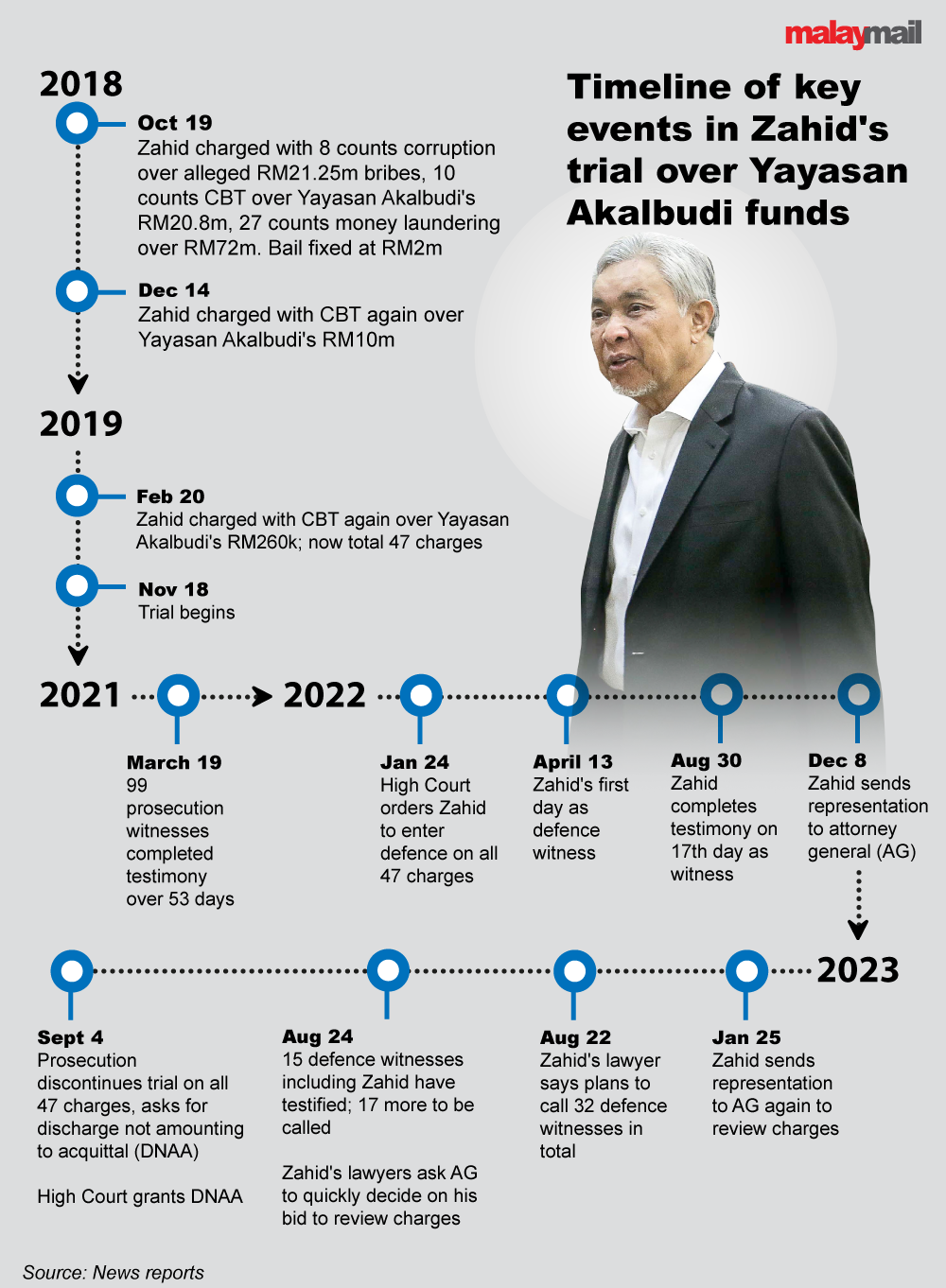
The Kuala Lumpur High Court, on Sept 4, 2023, granted the prosecution’s application for DNAA on Zahid’s corruption case.
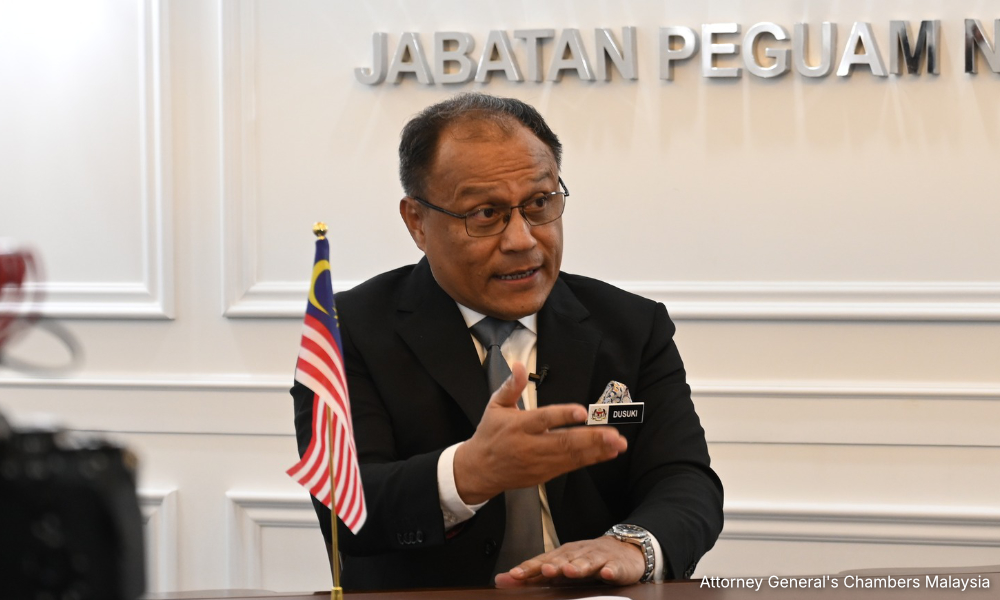
The lead prosecutor, Dusuki Mokhtar, who is the current AG, had laid out 11 reasons for the application, including to allow the prosecution a more comprehensive and complete investigation into Zahid’s case.
The DNAA was granted while the case was at the defence stage.
Following this, the Bar filed their judicial review application on Dec 4, the same year, in challenging the AG’s decision.
However, they failed to obtain leave to proceed with the judicial review in 2024, resulting in the present appeal before the panel. - Malaysiakini, 7/5/2026
Court grants Malaysian Bar green light to challenge DNAA in Zahid’s Yayasan Akalbudi case

- The Court of Appeal unanimously ruled that the Malaysian Bar can proceed with its challenge against the AG’s 2023 decision to seek a discharge not amounting to an acquittal (DNAA) for Datuk Seri Ahmad Zahid Hamidi in his Yayasan Akalbudi trial.
- The court found that Zahid’s DNAA was an “appropriate, rare and exceptional” case for the challenge to proceed, given several factors, including that 99 prosecution witnesses and 15 defence witnesses had already testified.
- The Malaysian Bar’s judicial review will now be heard by the High Court.
- The Malaysian Bar will ask the High Court to defer its decision on Zahid’s acquittal application until the judicial review has been heard.
PUTRAJAYA, May 7 — The Malaysian Bar today won its appeal to begin its court challenge against the Attorney General’s 2023 decision to apply for a discharge not amounting to an acquittal (DNAA) against Datuk Seri Ahmad Zahid Hamidi’s 47 charges in the Yayasan Akalbudi corruption trial.
Datuk Faizah Jamaludin, who chaired a three-judge panel at the Court of Appeal, said the panel unanimously decided that the Malaysian Bar’s court challenge could proceed to be heard by the High Court.
“Leave is granted to the Appellant to commence judicial review against the Attorney General’s impugned decision. The matter is remitted to the High Court for substantive hearing of the judicial review,” she said, referring to the Malaysian Bar as the appellant.
The other two judges on the panel were Datuk Lim Hock Leng and Datuk Nadzarin Wok Nordin.
The Malaysian Bar had on December 2, 2023 filed its court challenge via a judicial review application, but the High Court on June 27, 2024 decided not to grant leave for the case to be heard.
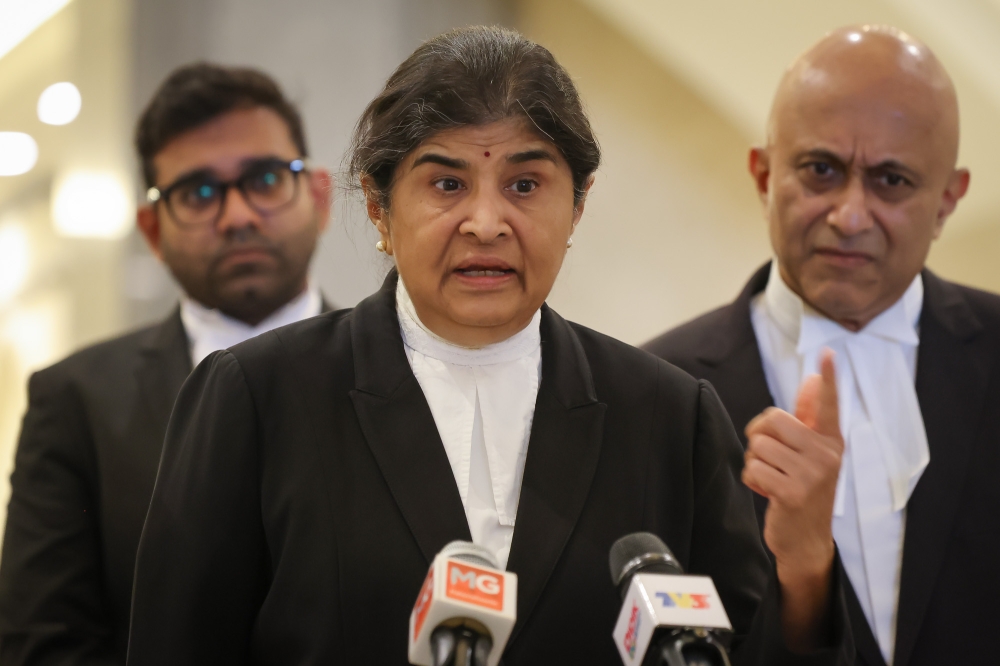

 Lawyer
Datuk Ambiga Sreenevasan, who represented the Malaysian Bar, speaks to
reporters at the Palace of Justice in Putrajaya, May 7, 2026. — Picture
by Yusof Isa
Lawyer
Datuk Ambiga Sreenevasan, who represented the Malaysian Bar, speaks to
reporters at the Palace of Justice in Putrajaya, May 7, 2026. — Picture
by Yusof IsaInstead, she said the only question is whether the Malaysian Bar has met the threshold for leave to start its court challenge against the AG’s September 2023 decision to ask for a DNAA in Zahid’s case.
She made it clear that a DNAA is “not a finding of innocence or guilt”, but a “procedural order” that the courts make in criminal proceedings.
Faizah listed five legal issues that the Court of Appeal had examined in coming to its decision today, including whether the Malaysian Bar had fulfilled the test to be able to start its court challenge.
She said the Federal Court’s 2021 decision in the Sundra Rajoo case had clarified that the AG’s prosecutorial discretion under Article 145(3) is wide but is not “absolute or unfettered”, and that it had ruled that the AG’s prosecutorial discretion could be subjected to judicial review in “appropriate, rare and exceptional” situations.
She noted the Federal Court had made it clear that all public powers have legal limits and that the AG’s constitutional status does not mean that the courts could not review his prosecutorial discretion, although a higher standard of scrutiny would apply.
The Court of Appeal today decided that the test to get leave for a judicial review against the AG’s prosecutorial discretion is the same test that applies to other judicial review cases.
This test is whether there is an arguable case that is not frivolous.
But when the judicial review is about how the AG exercised his prosecutorial discretion, the Court of Appeal said the test for getting leave must also be applied with “discipline, caution and restraint” with considerations of four factors.
These four factors are the AG’s constitutional status; the presumption that the AG’s exercise of his prosecutorial discretion was legal; the doctrine of separation of powers; and the principle that judicial review over prosecutorial discretion is limited to “appropriate, rare and exceptional” cases.
Faizah said the presumption of legality of the AG’s prosecutorial discretion cannot be an “absolute bar” or completely shut out leave for judicial review, if such a court challenge is supported by identifiable and serious matters.
Unlike the AG’s decision to charge an individual which can be challenged within the court process and trials, she noted that the decision to discontinue or drop a prosecution “may have a final practical effect” and remove it from the courts.
“In such a case, a judicial review may be the only practical means by which the legality or rationality of the AG’s decision-making process can be examined,” she said.
She said the Malaysian Bar’s court challenge is focused on whether the AG’s decision-making process when deciding to discontinue the prosecution against Zahid was legal and rational, including whether relevant or irrelevant factors were considered, and whether the AG’s decision at such a “late stage” in the trial was justified.
She said the Court of Appeal concluded that the Malaysian Bar has crossed the threshold or fulfilled the test to get leave for judicial review of the AG’s prosecutorial discretion, and that the Bar has an arguable case that is not “frivolous”.
“This case is appropriate, rare and exceptional, because several factors converge: the seriousness of the charges, the public interest in corruption prosecutions, the prima facie finding after a maximum evaluation, the calling of the defence, the extent of proceedings already undertaken, including 99 prosecution witnesses over 53 days of trial, and 15 defence witnesses, the timing and number of representations and the practical finality of the discontinuance,” the judge said, referring to Zahid’s Yayasan Akalbudi case.
“Accordingly, this is our findings for issue III, we therefore held the application is not frivolous and discloses serious public law issues that should be heard at the substantive stage,” she said.
For the fifth and final legal issue, the Court of Appeal ruled that the Malaysian Bar’s judicial review bid is not a “collateral attack” on the criminal courts’ order to grant a DNAA for all 47 charges against Zahid, as the Bar is instead focused on the AG’s decision to seek a DNAA.
Faizah explained that when the AG discontinues a prosecution, the default result would be a DNAA, unless the court decides to acquit the accused person.
This is based on the Criminal Procedure Code’s Section 254.
Citing Section 254, she said the criminal court cannot compel the AG to continue a criminal trial once the AG has decided to discontinue the prosecution, and that means the decision to continue or discontinue the prosecution would still be the AG’s constitutional responsibility under Article 145(3).
In the Yayasan Akalbudi case, she said the High Court in September 2023 had considered the choice of whether to grant a DNAA as sought by the prosecution or an acquittal as sought by Zahid, and that it did not make a finding on whether the AG’s decision to discontinue the prosecution was legal, rational or reasonable.
Ultimately, the Court of Appeal concluded that the Malaysian Bar should be given leave to have its court challenge heard.
Zahid’s acquittal application in courts next week
The Court of Appeal’s decision today is important as it could potentially affect when the High Court decides on Zahid’s separate application for acquittal in the Yayasan Akalbudi case.
Zahid had on January 28 applied to be acquitted and the Attorney General’s Chambers has said it has no objections to this application.
The High Court had on February 24 said it would wait for the Court of Appeal’s decision to prevent the Malaysian Bar’s appeal from becoming academic, but had also later scheduled May 14 (next Thursday) to decide on Zahid’s acquittal application.
Unlike a DNAA which temporarily frees an accused from charges and the same charges can be brought again, an acquittal would mean the prosecution cannot file the same charges in the future.
Lawyer Datuk Ambiga Sreenevasan, who represented the Malaysian Bar, told reporters that the Bar also has a separate court challenge against the AG’s January 8, 2026 decision to classify Zahid’s Yayasan Akalbudi case as “NFA” (No Further Action).
As for the High Court’s scheduled decision next week on Zahid’s acquittal bid, Ambiga said the Malaysian Bar would ask for the decision to be deferred until the courts hear the Malaysian Bar’s two separate judicial review applications against the AG’s DNAA and NFA decisions: “We will be asking for it to either be adjourned or stayed pending the hearing of our substantive application for judicial review.”
Zahid’s lawyer Datuk Hisyam Teh Poh Teik said the legal team would seek his client’s instructions about next week’s acquittal matter, which he confirmed is scheduled for decision at the High Court: “We will take further instructions on that as well and will discuss among ourselves as to what do on the 14th of May.”
Hisyam said the legal team would study the judgment today in greater detail and move on to the next stage of the judicial review hearing at the High Court.
He noted that the Court of Appeal today did not rule on whether anyone was guilty or not: “In other words, this is only at the leave stage, and what is important is the court emphasises that as far as the leave stage is concerned, the threshold is low, so long as the grounds canvassed are not frivolous or vexatious, leave will be heard.”
When asked if an appeal would be filed against the court’s decision today, Hisyam said this would have to be discussed with the AG: “We will discuss among ourselves, the legal team, we will take further instructions again, and we will also liaise with the Chamber’s of the AG.”


 Posts
Posts




No comments:
Post a Comment