Wednesday, April 23, 2008

Lenggeng riot: 'A disaster waiting to happen'

State police chief Osman Abdullah had earlier stated that ""We are still investigating the cause, but at this point in time all I can say is that they were unhappy because they heard that their application to a third country had been rejected,"

Now that reason about unhappiness because application to third country denied is found to be baseless.

SO - what did happen and WHY? We deserve to know this and a thorough investigation needs to be done maybe by SUHAKAM(Human Rights Commission).

It is also shocking that Malaysia has given over the management of detention centres to the Volunteer Corp RELA - and this detention centres were previously under the professionals - the Prisons Department.

RELA should be abolished - and that has been the call of the Malaysian Bar, ALIRAN and other groups but the government is turning a deaf ear to the call that law enforcement, including management of detention centres should be undertaken by full-time professionals. If there is a shortage of man-power - then HIRE and TRAIN -- not resort to volunteers.

Until shown otherwise, blame must rest with the body responsible - the RELA.

Lenggeng riot: 'A disaster waiting to happen'
Fauwaz Abdul Aziz | Apr 23, 08 10:44am (Malaysiakini)

It was only a matter of time before trouble broke out at the 14 immigration detention centres taken over earlier this year by voluntary corps Rela - as the Lenggeng incident in Negri Sembilan has proved.

alex ong“We anticipated it to happen sooner or later. Lenggeng is only the beginning of worse things to come,” said Migrant Care coordinator Alex Ong when contacted yesterday.

Ong was commenting on the riot on Monday in which about 60 Burmese detainees reportedly tried to pull down the perimeter fence and afterwards torched an administration building.

More than 100 Rela members, riot police, civil defence department and fire and rescue service personnel had to be called in to contain the riot.

According to state police chief Osman Salleh, the detainees had vented their anger against the authorities after their application for resettlement to a third country had been denied.

lenggeng detention camp myanmar burmese detainees incarcerated 220408Ong, however, questioned this version of the story and said the more likely reasons involve the poor living conditions and treatment that migrants receive in such detention centres.

Many human rights and migrant groups have long decried the harsh treatment, overcrowding, poor sanitation, and inadequate food and medical facilities.

Since Jan 15 when Rela took over the running of Lenggeng from the prison department, the plight of those detained has gotten from bad to worse, Ong claimed.

“We have always opposed Rela taking over because we expected the move to be accompanied by complaints of more human rights abuses and abusive treatment,” he said.

Rela is already saddled with a poor track record in relation to treatment of migrants, given its previous role in rounding up undocumented foreigners in Malaysia and the number of complaints this attracted.

‘Detainee beaten’

Lending strength to Ong’s contention that the riot was not over the issue of resettlement, the United Nations High Commissioner for Refugees (UNHCR) said that no refugees in Lenggeng have been told that their resettlement request had been denied.

“Our records indicate that their cases are still being actively processed by our office,” said spokesperson Yante Ismail when contacted.

There are 75 refugees and asylum-seekers known to UNHCR in Lenggeng, of whom seven are non-Burmese and 68 are mostly Chin Burmese. It is still unclear whether and how many of these were involved in the riot, said Yante.

rela 290507 women being checkedAll-Burma Democratic Force vice-chairperson Mohammad Sadek pointed out that it is not usually the Chin - who are predominantly Christian - whose applications for resettlement in Western countries are denied.

“It is the Burmese Rohingyas who have complained that their applications for resettlement have been turned down,” said Mohammad.

A social worker who had visited the centre a few weeks ago said a day-long hunger strike had been held on April 3 by a large number of refugees, to protest the severe beating of a Burmese detainee by Rela officers.

“It took a senior immigration officer to come to the detention centre to persuade them to call off their hunger strike,” said the worker, who declined to be identified.

“I think things only got worse after that, which is why the riot happened.”

Osman said 14 foreigners - six Burmese, six Indonesians, one Vietnamese and one Cambodian - have been called in for questioning over the riot.

He said they were arrested under Sections 148 (possession of dangerous weapons) and 438 (committing mischief by fire or use of explosive substance) of the Penal Code.


*****************************************
Burmese detainees torch Lenggeng detention centre
Apr 21, 08 5:41pm

At least 60 Burmese immigrants rioted in the Lenggeng detention centre in Negri Sembilan today, torching a building after failing to win asylum to a third country.

lenggeng detention camp myanmar burmese detainees incarcerated 220408The group initially gathered outside their block at the detention and tried to bring down the perimeter fence, local state police chief Osman Abdullah was quoted as saying by the daily Star newspaper website.

"The authorities tried talking to them but a short while later, they turned violent and then gained entry into the office and set it ablaze," he added.

Osman said about 200 police and security personnel were deployed to bring the situation under control.

The Lenggeng detention facility houses 820 illegal immigrants, of which 218 are from Burma, he said.

"We are still investigating the cause, but at this point in time all I can say is that they were unhappy because they heard that their application to a third country had been rejected," Osman added.

Officials at the detention centre could not be reached for comment.


Tuesday, April 22, 2008

Myanmar detainees riot, set fire at Malaysian camp

Myanmar detainees riot, set fire at Malaysian camp

Reuters
April 21, 2008

Detainees from Myanmar rioted at a Malaysian holding camp on Monday,
torching a building, after hearing they had been denied asylum in a third
country, the authorities said.

Some 72 Myanmarese, who were being held at a camp just outside the capital
Kuala Lumpur, forced their way into an administrative block and set it
ablaze, the Immigration Department's head of enforcement, Ishak Mohammad,
said.

"They were disappointed on hearing the UNHCR (the U.N. Nations High
Commissioner for Refugees) couldn't get a placement for them in a third
country," he told Reuters. Malaysia considers them to be illegal
immigrants.

Police said the rioters, who were unarmed, would be charged with arson. No
one was injured.

"They set fire at the ground floor causing damage to office furniture and
computers," the local Star newspaper quoted Osman Abdullah, the police
chief in the southwestern Negeri Sembilan state, as saying in its online
edition. The camp is located at Lenggeng in the state.

The camp, housing some 800 illegal immigrants including Bangladeshis and
Indonesians, would be closed temporarily, the immigration department said.

Malaysia is home to around 3 million foreign workers, 1 million of whom
are working illegally, Home Minister Syed Albar said at the weekend.

The country currently has about 39,000 refugees registered with the UNHCR,
the body said.

Of the total, about 13,000 are members of Myanmar's Rohingya Muslim
minority and another 12,000 are members of other Myanmar minority ethnic
groups.

The Rohingyas came in the 1990s from Myanmar, but the government there
disputes their origin and refuses to let them return.

(Reporting by Jalil Hamid, Editing by Alex Richardson)

Time's up, but will Suhakam chief go? (Malaysiakini)

Time's up, but will Suhakam chief go?
Beh Lih Yi | Apr 22, 08 12:33pm
All eyes are on Human Rights Commission of Malaysia (Suhakam) chairperson Abu Talib Othman, as his tenure - alongside that of 11 commissioners - expires tomorrow.

Indications so far point to the likelihood of the former attorney-general being re-appointed for a fourth term, but there is no official confirmation of this as yet.

It is learnt that some Suhakam officers were told two months ago that Abu Talib would have his contract renewed for another two years, to helm the government-backed commission.

zaid ibrahimMalaysiakini also learnt that de facto law minister Zaid Ibrahim (photo) has been asked to recommend fresh faces to Deputy Prime Minister Najib Abdul Razak, to fill the posts of those commissioners whose tenure ends tomorrow.

suhakam commissioner expiry 220408A well-placed Suhakam source said Zaid’s office contacted the commission last week to ask for details of the commissioners to be furnished on an urgent basis.

Confirming this, a spokesperson for Zaid’s office said the final decision on the line-up lies with Najib, whose portfolio includes supervision of Suhakam’s operations.

“The names have yet to be given to (Najib) based on what I understand,” the source said.

Najib’s aide Tengku Sarifuddin Tengku Ahmad, when contacted, declined comment apart from saying that an announcement will be made soon.

A check with a number of commissioners revealed that they too are in the dark as to whether their contract will be renewed.

“There might be some changes perhaps,” one commissioner said.

They said they do not know when the announcement will be made, although one commissioner said it could take place next week.

simon sipaun 02denison jayasooriaThose affected include vice-chief Simon Sipaun (left), commissioners Dr Chiam Heng Keng, Dr Mohammad Hirman Ritom Abdullah, Asiah Abu Samah, Dr Raj Abdul Karim, Dr Abdul Monir Yaacob, KC Vohrah, Dr Denison Jayasooria (right), Dr Michael Yeoh, Muhammad Uthman El-Muhammady and Zaitoon Othman.

Commissioner Choo Siew Kioh’s term will expire on April 29, followed by Tunku Nazihah Tunku Mohamed Rus (May 31), Prof Dr Khoo Kay Kim, Muhammad Shafee Abdullah and N Siva Subramaniam (all on July 19) and Khalid Ibrahim (Nov 30).

This is not the first time that commissioners have waited on such announcements. In 2006, the new batch of the commissioners was only announced 10 days after their term expired.

abu talib othman from ag to suhakam 230807There is a strong concern over the possible re-appointment of Abu Talib, whose initial appointment in 2002 had been boycotted by 32 NGOs for 100 days.

This was due to his defence of the 1987 mass crackdown dubbed Operasi Lalang and actions during his tenure as AG, when he played an instrumental role in the sacking of Lord President Salleh Abas.

Human rights watchdog Suaram director Dr Kua Kia Soong stressed that only personalities with credibility and human rights credentials should be appointed.

“No, not Abu Talib. He is the person who said during my habeas corpus application that solitary confinement is like (staying) in a hotel room,” Kua said, referring to his legal challenge against his detention under the Internal Security Act during Operasi Lalang.

Frustration of officers

Some Suhakam officers also argue for a pressing need to overhaul the line-up. They would like to see eight commissioners who have held the post for three terms (six years) - in particular, Abu Talib - being dropped.

The eight are Simon, Chiam and Mohammad Hirman - all of whom were appointed at Suhakam’s inception in 1999 - and Abu Talib, Asiah, Raj, Abdul Monir and Vohrah who were appointed in 2002.

“In countries like Australia and New Zealand, the human rights commission makes it clear that a commissioner should not stay for more than five years,” said an officer.

Another high-ranking officer echoed the sentiment, saying it is a common feeling among the 70-odd officers that they want a “complete change”.

“If I had my way, I would not mind seeing all of them replaced, especially those who will soon entering their 10th year at Suhakam. Even Parliament has changed half of faces but we’re still getting old faces here,” she said.

“We really need new blood in Suhakam and I hope the decision-maker knows this is coming from us - the officers.”

kc vohrahFormer Court of Appeal judge Vohrah - who heads Suhakam’s law reform and international treaties working group - has indicated his wish not to be re-appointed, sources said.

Another personality who may be excluded is Denison, who heads the MIC-linked Yayasan Strategik Sosial. This follows the party’s request to Denison to focus on the foundation’s work after the March 8 general election, which saw severe losses for its candidates.

Two officers said they hope to see constitutional expert Prof Dr Shad Saleem Faruqi in the new line-up.

param cumaraswamyraja aziz addruseOther names suggested by them and Kua include former United Nations special rapporteur on the independence of judges and lawyers Param Cumaraswamy (left), human rights group Hakam ex-president Ramdas Tikamdas and prominent lawyer Raja Aziz Addruse (right).

“It could be a good idea to bring back Prof Hamdan Adnan too,” said a Suhakam officer. The vocal ex-commissioner was dropped in 2006.

According to sources, some ex-politicians have lobbied to be appointed as commissioners.

Suhakam has a chequered history in defending human rights, with NGOs frequently complaining about its ineffectiveness.

Most of the commission’s recommendations over the past nine years have been ignored by the government, while repeated attempts to get the Suhakam annual report to be debated in Parliament have proved futile.

The government has previously stated that it has no intention of giving the commission any ‘teeth’, in terms of enforcement of recommendations. Suhakam only acts as an advisory body to government at present.

Monday, April 21, 2008

Rela may be upgraded to an enforcement agency


Monday April 21, 2008

Rela may be upgraded to an enforcement agency

By JASON LIOH

MALACCA: The Home Ministry is mulling over whether to upgrade Rela to an enforcement agency in a move to enhance its enforcement and public order operations.

Minister Datuk Seri Syed Hamid Albar said a draft of the proposal was being finalised for consideration by the Government.

“The role and responsibility of Rela has increased and become even more challenging,” he told reporters after attending a get-together between its officers and leaders at the Rela Southern Zone Training Camp in Sungai Udang yesterday.

“So it is appropriate that the organisation is upgraded to an enforcement agency under the ministry.”

Syed Hamid said the move would allow for better logistical support and funding for facilities, equipment, and uniforms for its personnel.

“We need to give the 508,000 volunteers sufficient training, not only to enhance the capability of Rela but also to further assist the police and immigration. To date, Rela has caught 73,938 illegal immigrants,” he added.

Under the 9th Malaysia Plan, three more Rela training camps would be set up – in Negri Sembilan, Pahang and Perak – to complement the existing camps at Sungai Udang in Malacca, Sungai Petani in Kedah and Tuaran in Sabah.

On Makkai Osai, Syed Hamid reiterated that the decision not to renew the vernacular paper’s licence was taken after thorough consideration.

The Government did not restrict the publication of newspapers as the media had a role to play in society, he said, but cautioned news publications to not create conflict or disharmony among the people,

“Freedom comes with responsibilities. The Government allows ample freedom of speech and practices democracy with fairness and integrity,” he said.


***************

Sunday April 20, 2008

Proposal to upgrade Rela to enforcement agency

By JASON LIOH


MALACCA: The Home Ministry is proposing that Rela be upgraded to full departmental status as an enforcement agency under the ministry.

This would enhance the organisation's enforcement and public order operations, said Home Minister Datuk Seri Syed Hamid Albar, adding that a draft of the proposal was being finalised before being tabled to the Government for approval.

“The role and responsibility of Rela has increased and become even more challenging.

“As such it is appropriate that the organisation be upgraded to an enforcement agency under the ministry,” he told reporters after attending Rela's get-together between officers and leaders at the Rela Southern Zone Training Camp in Sungai Udang Sunday. He said that the move would allow for better logistical support and funding for facilities, equipment, and uniforms for its personnel.

“We need to give the 508,000 volunteers sufficient training, not only to enhance Rela’s capability but also to further assist police and the Immigration Department -- as of today, it has nabbed 73,938 illegal immigrants," he added.

Under the 9th Malaysian Plan, three more Rela training camps would be set up in Negri Sembilan, Pahang and Perak to complement the existing camps at Sungai Udang in Malacca, Sungai Petani in Kedah and Tuaran in Sabah.

Saturday, April 19, 2008

ISA detainee gets to visit sick daughter

ISA detainee gets to visit sick daughter
Azreen Madzlan | Apr 19, 08 3:24pm

Four-year old V Vishaleny refused to eat ever since she was warded for severe viral fever at the Cheras Pantai Medical Centre on Tuesday.

But when her father came to visit and fed her a slice of bread, she began to eat. But this was no ordinary hospital visit.

hospital visit 180408 familyVishaleny is the youngest daughter of K.Vasantha Kumar, Hindu Rights Action Force (Hindraf)
coordinator who is currently being held under the ISA in Kamunting.

Yesterday, her wish to see her father came true. After her mother appealed to Home Minister, Syed Hamid Albar to allow Vasantha Kumar to visit her was approved, Vishaleny has been waiting impatiently.

A big group of police and Special Branch officers were stationed at the hospital from noon until Vasantha Kumar arrived at 5 pm. About 50 of them were patrolling outside and inside the hospital building and another 25 went in to the pediatric ward with Vasantha Kumar.

Vasantha Kumar went in to see her daughter at 5.35 pm. However, Vishaleny was asleep and too tired to respond when her father arrived.

The detainee spent about 40 minutes with his sick daughter before being whisked away at the back exit, to avoid Hindraf supporters and the press. Reporters were not permitted into the ward.

Meanwhile, about 20 Hindraf supporters gathered at the paediatric ward in the hospital to catch a glimpse of the Hindraf leader.

Children psychologically affected

In an interview with Malaysiakini, Vasantha Kumar's wife, K Vickneswary said her two daughters, aged six and four are psychologically and physically affected by their father's detention.


"I dragged them along to Kamunting every weekend because they want to see their father. They're in school five days a week and because of the weekly trip, they did not get enough rest." she said.

Four year old V.Vishaleny, who is being warded for severe viral fever, has gotten sick since Sunday. She was warded after her school teacher called Vickneswary that she has been vomiting at school.

Vickneswary expressed her disappointment when the court postponed the hearing for the Hindraf Five ISA detainees for another month.

hindraf p uthayakumar taiping hospital 170408 03"Today is my daughter (who has gotten sick). We don't know whether others (ISA detainees’ children) will follow. They (ISA detainees) also have babies and small children. The children can't bear this anymore." she said.

Vickneswary expressed her gratitude to Prime Minister Abdullah Ahmad Badawi and Home Minister Syed Hamid Albar for allowing Vasantha Kumar to visit her daughter.

The five Hindraf leaders have been detained under the draconian law since December following the massive rally of Hindraf supporters in Kuala Lumpur.

Hindraf 5 remain united

Meanwhile, according to Hindraf supporter S Sivalingam, Vasantha Kumar had asked him to inform the public that the five Hindraf leaders are still together, quashing rumours that they are disunited.

Sivalingam also revealed that Vasantha Kumar had applied for permission to visit her daughter for the second time next Saturday but has not received a reply yet.

Hindraf leader Uthayakumar, according to Sivalingam, is now in better health after receiving proper medication and food for his diabetes following his hospitalisation.

Why appointment - not elections of Local Council members? Why appointment of PR members not appointment irrespective of party affliations..

What happened to the election of local council members.... so they, the DAP-led government also follows the BN way and appoints its own political party members as local councillors..

Just get on with the elections - and if you cannot have local council election by reason of some provision in a Federal Law --- then you still can go for a "referendum" or a "poll" to enable the rakyat to choose their own local council members.

Pakatan Rakyat local council members: "Of the 43 appointed councilors, DAP has 19, PKR 15 and PAS two" ...is this not how the BN does it in the states they control. Even if there was to be an appointment of temporary council members pending local council elections, it should never be based on political party affiliations at all..

The Malaysian people voted for CHANGE - REAL CHANGE... and even Penang led by Lim Guan Eng is already disappointing us... just like George Orwell's 'Animal Farm".

MORE DEMOCRACY please - elections of local council members, election of Penghulus, election of the JKKK and the JKKKT, the later being the leaders at the Kampung and the Taman levels...


Penang groups unhappy with new Pakatan councillors
Athi Veeranggan | Apr 19, 08 2:10pm

The Penang Pakatan Rakyat government's populist agenda to appoint representatives from non-governmental organisation as councillors in local authorities seems to have backfired.

The DAP-led government came under fire from a group of NGOs for not fulfilling its promise to appoint at least 10 municipal councillors from the civil society.

By appointing only seven councillors from the NGOs, the group spokesperson BK Ong said the DAP-led government had squandered the public trust by making a blatant mistake.

"The state government promised 10 but only appointed seven and that too, not on merit.

"The NGO appointments were dominated by business groups which had caused imbalanced appointment," said Ong.

He criticised the Pakatan Rakyat government of continuing the previous Barisan Nasional administration by giving councillor jobs to "boys" rather than giving the posts on merit.

penang transportation 191206 ong boon keong organicOng blasted the state government for emulating a failed BN method which he claimed would subsequently produce weak councillors and give rise to longkang (drainage) assemblypersons and members of Parliament.

Too many business people

On Wednesday, the Penang government appointed four councillors from the civil society groups in the Penang Island Municipal Council (MPPP) and three in the Seberang Perai Municipal Council (MPSP).

The MPPP four are Women's Centre for Change (WCC) lawyer Lim Kah Cheng, Universiti Sains Malaysia professor Dr Francis Loh Kok Wah, Penang Malay Chamber of Commerce president Rizal Faris Mohideen Abdul Kader and Penang Chinese Chamber of Commerce representative Choong Khuat Seng.

The three in MPSP are Chinese Chamber's Liu Ting Ling, Indian Chamber of Commerce's R Gunasegaran and Federation of Malaysian Manufacturers' Muhammad Ismail.

MPPP has 22 appointed councillors while MPSP has 21.

Of the 43 appointed councillors, DAP has 19, PKR 15 and PAS two.

Ong lamented over the "over-representation" of businessmen could cause an unbalanced council and conflict of interests since members of chambers were often involved in applying for business operational licences and building permits.

"This could cause injustice to the laymen," said Ong, speaking on the behalf of the NGOs, including Save Ourselves, Bus Users Group, Malaysian Voters Union, Penang Watch, Mafrel, Suaram, Jim, United Hindu Religious Council, Tanjung Bungah Residential Association and Tanjung Workers Service Centre.

In contrast, he said there was lack of representation, or none, from house buyers, residents associations, consumer groups, workers' union and petty traders.

"Even women were under-represented in appointments," said Ong, suggesting that the representation should have been as high as one per three ratio.

Ong also blasted the state government's lack of transparency in the selection process, saying that it mirrored the previous BN government.

DAP members left out

He said the state government should have adopted an open selection system such as open invitation, open criteria, open process and open list of candidates even when local government elections could not been held straight away.

chow kon yeowOng's open criticism is the last that State Executive Councillor and Penang DAP chairperson Chow Kon Yeow, who is in charge of Local Government portfolio, would want as the state government was already under fire from DAP members on the appointment of councillors from NGOs and "strangers" under the party quota.

Disgruntled DAP members have informed Malaysiakini that they had been against the appointment of NGO councillors from the beginning as many of them would not work in the interests of the Pakatan Rakyat state government.

Several short messages service (SMS) were already sent out since Wednesday night criticising the state government leaders for overlooking loyal party workers for council appointments.

Several assemblypersons have also been singled out by the powerful Makkal Sakti lobbyists in Penang for appointing their "cronies" as councillors at the expense of loyal party members, who had worked hard to secure the party's victory in the recent general election.

"Several of the appointed councillors from NGO were known BN supporters.

"Even the Indian councillors appointed under the DAP quota were strangers to DAP," said Makkal Sakti group spokesperson MN Anbalagan.

Another Makkal Sakti supporter, R Kumaran, said he learnt that the decision to appoint NGO councillors was made without consulting the party state committee and general members.

"There is a saying that `loyalty pays.'

"But it seems staunch Indian DAP grassroots leaders and members are irrelevant today," he said.

IBA's letter to the Malaysian Prime Minister on ISA detainees

IBA's letter to the Malaysian Prime Minister on ISA detainees

Saturday, 19 April 2008 11:47am

IBADear Prime Minister Abdullah Ahmad Badawi,
Re: Concern over detention of five men under the Internal Security Act (ISA) in Malaysia

We are writing on behalf of the International Bar Association Human Rights Institute (IBAHRI) to express our concern about the detention of five lawyers under the Internal Security Act (ISA) in Malaysia.

In its role as a dual membership organisation, comprising 30,000 individual lawyers and over 195 Bar Associations and Law Societies, the IBA influences the development of international law reform and shapes the future of the legal profession. Its Member Organisations cover all continents.

The Human Rights Institute works across the association, helping to promote, protect and enforce human rights under a just rule of law, and to preserve the independence of the judiciary and the legal profession worldwide.

We understand that P. Uthayakumar, M. Manoharan, V. Ganabatirau, R. Kenghadharan, and T. Vasanthakumar, reportedly the leaders and legal advisors of Malaysia’s Hindu Rights Action Force (HINDRAF), were detained on 13 December 2007 under a detention order issued by the Minister of Home Affairs. We understand that these men were detained following a peaceful HINDRAF demonstration on 25 November 2007 protesting discriminatory government policies against the ethnic Indian population in Malaysia. Reports indicate that the charges against the five men include undermining national security and public order by threatening racial and religious harmony amongst Malaysia’s Malay, Indian and Chinese communities.

The IBAHRI has also learnt that on 26 February 2008, a habeas corpus application filed on behalf of the detainees was rejected by the Kuala Lumpur High Court Judicial Commissioner Zainal Azman Ab Aziz, thus confirming that the detention order was valid under the law.

However, reports received by the IBAHRI suggest that the charges brought against the five detained men under the ISA, namely breaching national security and public order, may not be based in fact and do not reflect the alleged actions of the five men. Therefore, the IBAHRI is concerned that their detention under the ISA may be arbitrary and unlawful. Furthermore, we understand that the five detainees have been linked without evidence to a terrorist organisation and we are concerned that the use of the Act in this way could indicate an abuse of process.

In addition to our specific concerns about the application of the ISA as it relates to the five arrests detailed above, we would also like to highlight a number of broader issues relating to the Act and its application in the context of peaceful demonstrations in Malaysia. We understand that the Act gives power to the Minister of Home Affairs to issue detention orders against any member of civil society. Furthermore, detainees can be held up to 60 days without warrant, trial or access to legal counsel on suspicion that they have ‘acted or are about to act or are likely to act in any manner prejudicial to the security of Malaysia or any part thereof or to maintenance of essential services therein or to the economic life thereof’. Further, we understand that after 60 days, the Minister of Home Affairs can extend the period of detention without trial for up to two years, without submitting any evidence for review by the courts, by issuing a detention order, which is renewable indefinitely.

The ISA therefore establishes the conditions for long term and arbitrary detention without trial and contravenes the right to legal counsel, the right to defend oneself in an open court and the right to be presumed innocent until proven guilty; principles which are protected and guaranteed under international law. The IBAHRI would also like to point out that the prohibition of unlawful detention and the right to habeas corpus are recognised as key principles of customary international law and are therefore applicable to all states, even those that have yet to sign any international human rights treaties.

In this context, the IBAHRI would like to remind you that Malaysia is a founding member of the Association of South Asian Nations (ASEAN). Under the ASEAN Charter signed by Malaysia in 2007, and as a member of the United Nations Human Rights Council, Malaysia is required to ‘promote and protect’ human rights. Malaysia’s Constitution also contains a number of human rights provisions including the right to freedom of expression, the right to free assembly and the right to form associations (Article 10).

We would also like to remind you of the United Nations Basic Principles on the Role of Lawyers which provides standards by which lawyers worldwide should be treated. Principle 23 upholds that ‘lawyers like other citizens are entitled to freedom of expression, belief and association and assembly’. Further, Principle 18 states that ‘lawyers shall not be identified with their client or their clients’ causes as a result of discharging their functions’. The IBAHRI is concerned that the detention of the five lawyers under the ISA may be in breach of the above provisions.

Finally, the IBAHRI has received reports that the health of the detainees has deteriorated during the course of their detention and that urgent medical attention may be required. In particular, reports have been received suggesting that P. Uthayakumar has been denied diabetes medication essential for regulating his condition and maintaining his health. Article 22 of the UN Standard Minimum Rules for the Treatment of Prisoners stipulates that ‘sick prisoners who require specialist treatment shall be transferred to specialised institutions or to civil hospitals. Where hospital facilities are provided in an institution, their equipment, furnishings and pharmaceutical supplies shall be proper for the medical care and treatment of sick prisoners, and there shall be a staff of suitable trained officers’. We request that urgent medical attention should be made immediately available to all detainees if required.

The IBAHRI would like to receive your assurances that the issues raised above relating to what might constitute unlawful detention of the five men be promptly investigated and that, if the detention is found to be arbitrary, the detainees be immediately released. Furthermore, in light of the concerns relating to the broader application of the ISA as detailed above, we call upon the Malaysian Government to bring to trial all those currently detained under the Act. All those charged must be tried in accordance with international standards and, if not found guilty of any criminal offence, promptly released. We further request that urgent medical attention is provided to P. Uthayakumar and to all other detainees who may require it.

Yours sincerely,

Ambassador Emilio Cárdenas
Co-Chair, Human Rights Institute

Justice Richard J. Goldstone
Co-Chair, Human Rights Institute

CC: Tan Sri Abu Talib Othman
Chairman, Human Rights Commission of Malaysia

Another reason for RELA to be abolished...

2008/04/18 (NST)
Spotlight: Indian nationals' holiday trip that turned into a nightmare
By : Suganthi Suparmaniam


Indian nationals (from left) P. Murugesan,  Sheikh Rajendran and K. Meenakshi with the police reports they lodged over their  arrest by Rela and Immigration officers even though they claimed they had valid travel papers.
Indian nationals (from left) P. Murugesan, Sheikh Rajendran and K. Meenakshi with the police reports they lodged over their arrest by Rela and Immigration officers even though they claimed they had valid travel papers.

KUALA LUMPUR: All that they wanted to do was to see what Malaysia is all about.

Instead, the three Indian nationals on their first visit to Malaysia, ended up being arrested and detained at the Semenyih camp for 18 days despite having valid travel documents, they said.

Farmer K. Meenakshi, 52, tailor Sheikh Rajendran, 40, and carpenter P. Murugesan, 24, had been saving up for a long time to visit Malaysia, a country that they had heard so much about from friends who had been here.

All three were at the Selangor Mansion block of flats in Jalan Masjid India when Rela conducted a raid on March 15.

"I was sleeping in a room when they came at 1.30am. I had a copy of the passport in my pocket and showed it to them. I kept telling them that the original was inside my bag which was in the same room. But they did not understand me," Meenakshi told the New Straits Times.
Sheikh was together with him in the room when he was also arrested.

Murugesan said he had just finished eating and had gone downstairs to throw away the paper used to pack food when he was stopped by a Rela member.

"I told him my passport was upstairs but he refused to let me get it or come with me to take it. He told me to wait with others and later took us to the camp in a lorry," said Murugesan.

They spent 18 days in the Semenyih camp which they described as the worst place that they had ever been.

"The conditions in the camp were bad. The food was terrible and I was so afraid to eat. I spent days not touching the food at all. It was not fit for human consumption," said Sheikh.

They were "rescued" when a Malaysian businessman, T. Kamalanathan, came to the camp and negotiated for their release.

"I was at my shop when a few Indian nationals approached me and told me to help bring out their friends from the camp," Kamalanathan said.

He added that the Indian nationals should have been produced in court within 24 hours or even after the 14 days' remand. He claimed that the Immigration officers had also been unhelpful.

A bigger shock awaited the three men when they went back to the apartment on April 3 and found their belongings missing.

"I had about RM2,500 inside the bag. The money and my return flight ticket were also missing," said Meenakshi, adding that the other two also lost their money and belongings.

Sheikh said his friends found his torn passport in a nearby dustbin.

Friday, April 18, 2008

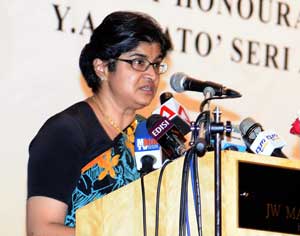
Text of the Malaysian Bar President Bar's speech....

"....In this process of positive change, we have not forgotten, and we believe, credit should be given to you, Mr. Prime Minister that since 2004, it was you who loosened the tight grip on our fundamental freedoms, you who created more democratic space and you who encouraged dialogue and difference of opinion. It is only in such an environment that a nation can come of age and grow in strength...." - Ambiga Sreenevasan, Malaysian Bar President

I really do not know where the President of the Malaysian Bar has been hyanging out -

- for she has forgotten the suppression of public protest have become worst during Abdullah's premiership when they started using 'tear gas' - before it was just the water-cannons.

- the arrest and detention of 4 lawyers and 1 other, associated with HINDRAF, under the ISA , with an immediate issuance of detention order by Abdullah Ahmad Badawi, even without waiting for the 60-day period of investigation.

- the breaking down of numerous temples, places of worship..

- the rejection of the Bar Council's application to have their customary Human Rights Day march..

- the banning of the daily in Tamil language - the "Makkal Osai"

- the action being currently taken against the Pakatan Rakyat leaders over the holding of their function in Kampung Baru..

- the media "black-outs" or 'minimal coverage' of even fuel-hike and price-hike protests by the RAKYAT

- the agreement to set up the IPCMC and this we do not even have that commission. (The government had the audacity of rejecting the recommendation of 2 Royal Commissions, the Bar and civil society by coming out by trying to come out with some other body who will NOT be able to fulfil the reason for the IPCMC)

- and recently again the issuance of further 2-year detention orders to some arrested under the ISA for 6 years...

- the refusal to even disclose information about executions about to be done, being done, etc...

- the renewed suppression of people of other faiths using the word "ALLAH"

- the seizing of religious books of faiths other than Islam that contain caricatures/drawing/images of the prophet other that prophet Muhammad

and the list goes on and on...

HENCE - no credit should be given to this Prime Minister - whose disappointing performance was clearly reflected in the outcome of the recent General Elections..

And that is why, I ask where the Bar President have been -- for her to openly and publicly credit this PM..

After the event...I hope that this PM has again made some new promises -- but judging from his past record, I would not be out there celebrating anything yet until I see something concrete ...

Ambiga Sreenevasan is a good person BUT she must be more cautious not to be seen to be giving credit where credit is not due ---


Text of the Malaysian Bar President Bar's speech
at that Dinner funded by the government, hosted jointly by the Bar Council and the Malaysian Government


Contributed by Ambiga Sreenevasan
Friday, 18 April 2008 09:45am

Ambiga Sreenevasan


1. In 1988, when Tan Sri Wan Hamzah, Tan Sri Azmi and the late Tan Sri Eusoffe Abdoolcader were suspended and Tun Salleh, the late Tan Sri Wan Suleiman and Dato’ George Seah were dismissed, it seemed as if a seismic shift had broken the equilibrium of power between the Executive and the Judiciary. The removal of three of the most senior Judges of the High Court left us with the sense that the Judiciary had been bent to the will of the Executive.

2. To the Bar, these Judges who had been removed are heroes in the battle to uphold the dignity, integrity and independence of the judiciary. Heroes who paid a heavy price.

3. But there ought never to have been a battle. There ought never to have been a price to pay. We had a Judiciary that was painstakingly nurtured and developed by all those that came before. For the first time these Honourable Judges faced the challenge of their lives. And they lived up to that challenge. I am reminded of a saying, “It is the hour of trial that makes men great, not the hour of triumph.”

4. In 1988, the Bar recognised the greatness of what these Judges did by numerous Resolutions and other declarations of admiration. Now, 20 years later, we hope for due recognition of their brave acts by the nation, so that the public conscience may be assuaged by the righting of a wrong.

5. It is therefore only proper that on your behalf, I acknowledge these judges who withstood their hour of trial with fortitude and dignity. In that battle, they are the victors - Tun Salleh, Dato’ George Seah, Tan Sri Wan Hamzah, Tan Sri Azmi, Tan Sri Wan Sulaiman and Tan Sri Eusoffe Abdoolcader.

6. We are pleased to acknowledge the presence of Tun Salleh and his family, the family of Tan Sri Wan Sulaiman and Tan Sri Eusoffe, Tan Sri Azmi. Unfortunately Tan Sri Wan Hamzah was unable to be present.

7. The highlight of tonight’s dinner is the Keynote Address by the Prime Minister entitled “Delivering Justice, Renewing Trust”. Such a speech to be delivered in the presence of these judges has much meaning. The promise of judicial reform ushers in a new era for the administration of justice. These moves are in step with the worldwide shift towards strengthening institutions and in particular the critical institution of the Judiciary. They are in step with the greater call for transparency and accountability. Most of all, they are in step with the wishes and aspirations of the people of Malaysia.

8. In this process of positive change, we have not forgotten, and we believe, credit should be given to you, Mr. Prime Minister that since 2004, it was you who loosened the tight grip on our fundamental freedoms, you who created more democratic space and you who encouraged dialogue and difference of opinion. It is only in such an environment that a nation can come of age and grow in strength. That credit is yours. We have also not forgotten that last year at the Malaysian Law Conference you promised to meet us, the Bar and you kept your promise when you indeed met us subsequently to address our concerns. Now you and your administration are being responsive to the views of the people, and demonstrating the resolve, courage and vision to bring in much needed reform in the administration of justice. All this augurs well for a Malaysia that is poised to take its rightful place amongst the developed and functioning democracies of this world.

9. In this connection we are pleased that one of our members has been appointed a Cabinet Minister in charge of legal matters namely Datuk Zaid Ibrahim who has stepped up to the plate in the national interests. He has wasted no time in moving forward the promised changes. We say to him that so far, we like what we are hearing from him.

10. The Judicial Appointments Commission may not attract universal acceptance. This is understandable and all concerns should be addressed. Recent events have taught us that the current system does not work, and is no longer acceptable to the Malaysian public. Those objecting to it must therefore suborn their fears of a new system to the larger interests of the nation.

11. The concept of consultation with the Bar in the judicial appointments process is not new. It existed before but was done on an informal basis. The role of the Bar was always given weight in this process as they were the views of the professionals who appeared before the courts on a daily basis.

12. The question of being beholden to any appointing authority, whether under the proposed Judicial Appointments Commission or the present system, does not arise as Judges know that they discharge their responsibilities impartially, independent of who the appointing authority is, guided only by their oath of office, and their conscience.

13. In this quest for reform, the legal profession must and will play its part. We continually endeavour to strengthen the profession from within to improve our standards and our professionalism. We will never shy away from criticism and are sensitive to the public’s views.

14. Another proposed reform is the restoration of Article 121(1) of the Federal Constitution to its original wording. The amendment in 1988 was seen by many as an attempt to negate the doctrine of separation of powers and to limit the jurisdiction and power of the Judiciary. We welcome the proposal to restore the original wording of Article 121(1). It will be an expression of the Legislature’s and the Executive’s understanding that judicial power vests, and must vest, in the Judiciary.

15. We are delighted to have with us tonight the leader of Pakatan Rakyat Yang Berhormat Datin Seri Wan Azizah Wan Ismail, leaders of the Barisan Nasional component parties and leaders of the Pakatan Rakyat component parties as well as so many civil society groups, all of whom are here at short notice. This demonstrates that we are a nation united when there is a move towards positive change in the public interest, a move towards correcting an injustice and when we do something simply because it is the right thing to do.

16. We have other issues of course that we would like to engage your administration on Mr. Prime Minister. One of them is that of the ISA detainees, and here we appeal to you, Mr. Prime Minister, to please look at their cases again, and revisit the decision made. We hope Dato’ Seri will be open to discussing this issue further with us.

17. I conclude by saying that the time for change is now. Evidently, you see that Mr. Prime Minister. The Bar supports this move. In any event, we would like to see our Minister in charge of law kept busy. Ladies and gentlemen, have a pleasant evening.

PM's "Judicial Reform' speech -17/4/2008

Abdullah Ahmad Badawi is just doing the same thing all over again - making promises and this time about the Judiciary. Remember that 'Police Misconduct Commission" which he said he will implement -- we are still waiting. Ah yes - then there was that statement about moving against corruption, and we had Vincent Tan (an old businessman) and one Senator who was charged -- and what really happened...

So now he says...
"... that the Government is proposing the setting up of a Judicial Appointments Commission to identify and recommend candidates for the judiciary to the Prime Minister...", and I say WHEN.....and how. Maybe several years down the road, we will still be wondering about when this would come about..

Then, he said that he "....will initiate a review of the judiciary’s terms of service and remuneration...", and this I believe they have been doing and will do. -- Nothing NEW here.

And then we have the 1988 Judicial Crisis - and there was NO APOLOGY - only that "...
In recognition of the contributions of the six outstanding judges, the Government has decided to make goodwill ex gratia payments to them...." Again no mention of any sum... and totally inadequate...

It would have been better if the PM said that these judges (or their living spouses) will be paid pensions from now on , and that they will receive in lump-sum all pension payments that they should have been receiving since their removal until this date. This would have been so much more better - and would amount to an unspoken apology - an unspoken admission that their removal was wrong....BUT NO...

And again, we may have been conned by this "MR CLEAN" PM --- and somehow the results of the General Elections has not conveyed the message to this PM..

And now, when there is call for his removal from within his own party - and also a certain amount of dissatisfaction amongst the component BN parties, to whom he is still showing little respect... (MIC, MCA and GERAKAN have openly called for the HINDRAF 5 but this PM is not even listening to them ...let alone releasing the HINDRAF 5)

Has Badawi changed? NO - he has not. Was not "Makkal Osai'', the Tamil daily with the 2nd highest circulation been banned...

We will not be taken for a RIDE again by this PM, who should be on the way out himself or with that BN government...


Full text of speech by Prime Minister Datuk Seri Abdullah Ahmad Badawi delivered at the Malaysian Bar Council dinner at the JW Marriott Hotel, Kuala Lumpur.

Esteemed friends and colleagues
Ladies and gentlemen

A very good evening to all of you. It is an honour and a pleasure for me to be here tonight. I would like to thank the Bar Council for giving me the privilege of addressing this illustrious gathering. This is my first opportunity to speak directly to the legal community and related members of civil society since the recent General Election. As such, it is an important occasion and I thank you for taking time out from your busy schedules to be here tonight.

This occasion is particularly meaningful to all of us because of the presence of a few special guests. It is heartening to see in this gathering Tun Salleh Abas, Tan Sri Azmi Kamaruddin and Dato George Seah. Tan Sri Wan Hamzah had wanted to join us tonight but was not able to.

Sadly, Tan Sri Eusoffe Abdolcadeer and Tan Sri Wan Suleiman are no longer with us. But they are represented by their respective families: representing Tan Sri Wan Suleiman are Puan Sri Siti Nurhayati and his son Wan Noor Azli; representing Tan Sri Eusoffe are his granddaughter Brenda Lim and her husband.

For me and for many other Malaysians, these towering judicial personalities represent a very different era for the nations judiciary. Many felt that the judiciary then was a venerable institution which could be trusted to deliver justice. Some even hailed Malaysia’s judiciary as a model for other countries independent and credible.

This level of trust and respect for the judiciary, we must all admit, is simply not as strong as it was before. Although efforts are being made now by the present Chief Judge, still there are concerns related to capacity and efficiency, stemming from long case backlogs, delays and the outdated manner of court administration. There are concerns which are less tangible but are nonetheless prevalent such as perceived corruption and perceived decline in quality. The business community, in particular, have voiced concerns about the fairness and capacity of Malaysia’s judiciary in settling disputes. This has directly affected perceptions of our country’s economic competitiveness.

No nation can call itself fair and just without an efficient and trusted judiciary. By trusted, I mean a judiciary that delivers justice and is seen to deliver justice. In Malaysia’s case, debates and arguments on the state of our judiciary have been heated and protracted. Some of the Malay Rulers have openly voiced their disquiet on what they see as a decline, requiring nothing short of a judicial renaissance. Some retired judges have related troubling tales of impropriety. Politicians on both sides of the aisle have called for reform of this most august institution. Even the Bar Council, true to form, has marched en masse outside my office.

To a large extent, the events of 1988 have fuelled much of the disagreement on how to move on. When I took office in 2003, I promised a credible, effective and independent judiciary. I recommended judicial appointments in consultation with the senior judges before bringing the names to DYMM Seri Paduka Baginda Yang Di Pertuan Agong as required by the Federal Constitution. I pledged material and fiscal support for the judicial service in order to reduce the backlog of cases. I even took a political leap of faith by appointing an outspoken maverick as my new de facto Law Minister. I can say with a clear conscience that I abided and will continue to abide by the principle of separation of powers, leaving the matter of justice to the judiciary. And yet the legacy of 1988 haunts us until today.

Ladies and gentlemen,

Let us move on. The judiciary must be revitalised to enable it to serve the people in pursuit of justice. The judiciary must be fortified to be an institution that serves the democratic principle of separation of powers. The judiciary must be the guardian of the Constitution and the sentinel of the people’s rights.

This government gives its commitment to the Malaysian public that it will begin a process of judicial reform. We recognise that this process must be undertaken with the spirit and belief that no one, not even those entrusted to govern or to make laws, must assume to be above the law. This government continues to guard against abuse of its power, and is now proposing measures to further solidify and entrench the doctrines of good governance and the rule of law.

Ladies and Gentlemen,
As a result of many events, which culminated in the inquiry undertaken by the Royal Commission into the so-called V.K. Lingam Tape, I am aware that the public considers the present way of appointing and promoting judges as inadequate. The absence of a system in nominating candidates has led some to believe that the process is characterised by abuse, even where there is none. As is often the case, perception can lead reality.

On the other hand, some may argue that the present system does not require improvement if people in the system are inherently honest and fair. The same system has produced its share of outstanding judges after all.

I do not dispute this, but the fact is, we can no longer leave such an important institution to hope and chance. The system must have built-in safeguards to prevent potential abuse and it must have a process that will convincingly identify the best legal minds in the country to join the judiciary. This is a necessary part of ensuring that our nation’s judiciary is robust and trusted by the people.

Moreover, the demands on the judiciary today are greater than ever before. An increasing number of cases are being brought before the courts. There is a growing body of law particularly in relation to specialised areas such as Corporate Law, Information Technology, Maritime Law and Islamic Finance. With these pressures comes the need for expert and speedy decision-making.

Therefore, the Government proposes a change to make the process of nominating, appointing and promoting judges more transparent and representative.

I am pleased to announce to you tonight that the Government is proposing the setting up of a Judicial Appointments Commission to identify and recommend candidates for the judiciary to the Prime Minister. While the constitutional prerogative of the Prime Minister to put forward names to DYMM Seri Paduka Baginda Yang Di Pertuan Agong will remain, the Commission will help to evaluate and vet candidates in a systematic and credible manner for the Prime Minister, based on clearly defined criteria.

The process to bring about this change will begin now and I assure all of you here today, that consultation on the workings and the structure of the Commission will involve primary stakeholders. All will have a chance to provide their input to the Government.

In addition, the Government will initiate a review of the judiciary’s terms of service and remuneration. There is a pressing need to set salaries and compensation to the right levels to ensure that the bench can attract and retain the very best of the nation’s talent. This, and other measures which will be announced in due course, will form a comprehensive package of reform to strengthen the capacity and credibility of the judiciary.

Ladies and Gentlemen,

For many, the events of 1988 were an upheaval of the nation’s judicial system. Rightly or wrongly, many disputed both the legality and morality of the related proceedings. For me, personally, I feel it was a time of crisis from which the nation never fully recovered.

Again, ladies and gentlemen, let us move on. I do not think it wise or helpful to revisit past decisions as it would only serve to prolong the sense of crisis, something our nation can do without. The rakyat wants movement and progress, not continuing strife.

Therefore, the Government would like to recognise the contributions of these six judges to the nation, their commitment towards upholding justice and to acknowledge the pain and loss they have endured. For Tan Sri Eusoffe and Tan Sri Wan Suleiman and their families, I know this sentiment is made too late. For Tun Salleh Abas, Tan Sri Azmi Kamaruddin, Tan Sri Wan Hamzah and Dato George Seah, although this acknowledgement is 20 years too late, it is made with much hope that a measure of the pain and loss may yet be healed.

In recognition of the contributions of the six outstanding judges, the Government has decided to make goodwill ex gratia payments to them. Gentlemen, I do not presume to equate your contributions, pain and loss with mere currency, but I hope that you could accept this as a heartfelt and sincere gesture to mend what has been.

Ladies and gentlemen,

There is still much to do to renew the publics trust in the nations judiciary and to ensure that justice is consistently delivered. What I have announced here tonight is a beginning of a longer process towards reform. I humbly seek your support for these measures because the need for reform may not be entirely clear to all.

The government has set the ball rolling. We have put forward initial, but vital, steps. Now it is for all parties concerned - the judiciary, the Bar, civil society and the public at large - to also play their respective roles in facilitating these reforms. Whatever our differences, we share the same idealism for our nations judiciary. Let us work through our differences.

With this, it is my sincere hope that we may begin a new chapter for the Malaysian judiciary. It is my hope that this becomes part of a bigger process to further strengthen our democratic institutions, step-by-step resolving intractable problems that have stood in the way of genuine nation-building. Let us write this proud and new chapter together.

Thank you.