Tuesday, May 15, 2012

Malaysian Bar : Reactionary attack on independence of the Bar is fundamentally flawed


Press Release


Reactionary attack on independence of the Bar is fundamentally flawed


The Malaysian Bar is flabbergasted at Minister in the Prime Minister’s Department Dato’ Seri Mohamed Nazri Abdul Aziz’s reported announcement that a proposed law academy “can be an alternative” to the Bar, and that the Bar Council “should dissolve itself”.

The Malaysian Bar is opposed to this suggestion, which appears similar to the proposal that the Government had mooted, and subsequently withdrawn, twice in the past.[1]  Regrettably, this third occurrence appears to have come about purely as a reaction to the Bar’s strong message, contained in the Bar’s final report on the BERSIH 3.0 public assembly on 28 April 2012 (“Bar’s final report”) and the resolution adopted at the Bar’s Extraordinary General Meeting (“EGM”) on 11 May 2012 (“EGM resolution”), of grave concern and condemnation of the use of excessive force by the police during the public assembly.

The announcement lends itself to the perception that the proposal is revived from time to time when the Government feels threatened by an independent Bar that does not countenance the abuse of power by the institutions of the state (the police, in this case), and speaks up in defence of the public at large.  The Bar, in doing so, is fulfilling its duty under section 42(1)(a) of the Legal Profession Act 1976 (“LPA”), namely, “to uphold the cause of justice . . . uninfluenced by fear and favour”.  

The Malaysian Bar welcomes any move to encourage legal excellence, promote high academic standards and encourage social interaction and discourse by all those interested in the law. However, under the LPA, only the Bar Council is empowered to set standards for the legal profession, issue Practising Certificates, and regulate Members of the Bar.  The creation of any “alternative” institution empowered to control the conduct of the legal profession, would usurp the functions and powers of the Bar Council under the LPA and ignore its powers and duty to regulate its own affairs, and would be an intolerable assault on the independence of the Malaysian Bar.

If any Member of the Bar wishes to set up an association of lawyers, that Member is entitled to do so, as our Federal Constitution guarantees the right to freedom of association.  Such initiatives have resulted in the founding of, for example, the Malaysian Muslim Lawyers Association, Catholic Lawyers Society, and Association of Women Lawyers.  
The 36 members of the Bar Council are elected — not appointed — as leaders by Members of the Bar annually, in a transparent process.  If there is any dissatisfaction about the leadership of the Bar, Members can propose motions of no confidence against the Council members, as they have done, unsuccessfully, in the past.

The test of a mature and democratic society is the manner in which it treats the weakest amongst it.  On 28 April 2012, when the mighty weight of the police was unleashed without restraint onto the streets of Kuala Lumpur, many innocent participants were undeservedly harmed.  This is in contrast to the restraint exercised by the police in Ipoh, Johor Bahru, Kuantan and Malacca.  The Malaysian Bar will continue to speak out and seek justice for the affected participants, and to require transparency and accountability from our law enforcement agencies, which continue to commit the same transgressions already highlighted in four previous SUHAKAM public inquiries.

The Malaysian Bar urges the Government not to attack the messenger, but to act on the message contained in the Bar’s final report and the EGM resolution instead.

Lim Chee Wee
President
Malaysian Bar
15 May 2012  
_____________________________________

[1] See resolutions adopted at the EGMs of the Malaysian Bar held on 21 September 1996 and 31 May 2002.

Sunday, May 13, 2012

BERSIH 3.0 - Must be an INDEPENDENT inquiry - certainly not one led by former police chief

Now, when it come to BERSIH 3.0 and an INDEPENDENT investigation or inquiry, we have to acknowledge that the allegation of violation of rights is, amongst others, against the police, the government of Malaysia - Minister of Home Affairs, Minister of Information, Communications, and Culture Minister, etc, and also the DBKL (i.e. the Kuala Lumpur mayor and KL's Local Authority which is not a democratically elected entity but one that is appointed by the Federal Government), and as given these facts, any independent panel or inquiry must be independent of the Federal government. 

The suggestion of an independent inquiry headed by the former Inspector General of Police, as such, is absurd more so since the alleged violators of rights is also the police, prior to the event and on the day itself.

Malaysia has its own Human Rights Commission (SUHAKAM), and that would have been the natural choice for the independent investigation and inquiry - and they, in fact, had also done previous similar inquiries involving the exercise of the freedom of peaceful assembly and protest - but sadly the government choose to instead set up some other panel. [It must be pointed out that the Human Rights Commission is made up of  government appointed HR Commissioners - and also the fact that even when they do come up with their report and/or recommendations in the past, this Malaysian government have failed to act on them. The same is also the respond of this BN government when it comes to findings and recommendations of even other Royal Commissions of Inquiry.]    

As such, when the United Nations Special Rapporteur on the Promotion and Protection of the Right to Freedom of Opinion and Expression Frank La Rue offered to be involved in the independent inquiry, it would be best for the Malaysian government to seize this opportunity and allow them to lead and conduct this inquiry. Malaysian lawyers also takes the same position.

Hopefully, our Malaysian government, currently the BN government led by Prime Minister Najib Tun Razak, will without FEAR allow such a body to conduct this independent inquiry...

More importantly, the BN government must commit to implementing the recommendations made by such independent inquiries... [History has shown that this BN government have generally not followed all recommendations of such bodies - even one's that have been appointed by the King...Let's hope that there will be changes...]


Bar Council to boycott panel, wants UN rapporteur instead
  • Hafiz Yatim
  • 8:02PM May 11, 2012
 
The Bar Council will not participate in the independent panel formed by the government to probe last month’s violence at the Bersih 3.0 rally.

The powerful body representing 14,000 lawyers nationwide wants a United Nations special rapporteur to head the independent panel instead of former inspector-general of police Mohd Hanif Omar.

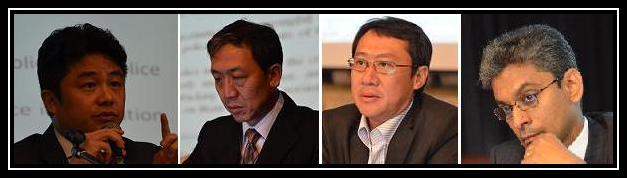
NONE“Otherwise, the Bar Council will not participate in it,” said council chairperson Lim Chee Wee (right) at a press conference following an extraordinary general meeting of the Bar, called to discuss the police crackdown on the mammoth Bersih 3.0 rally on April 28.
“The Bar prefers a UN special rapporteur to oversee the running of the panel and if this is complied with, then the Bar Council will reconsider its participation.”

He said the independent panel formed lacks any legal framework as it is ordinarily found in a royal commission of inquiry or the Malaysian Human Rights Commission of Inquiry (Suhakam).

“It does not have such features as legal immunity for itself or any participating persons involved in the proceeding. By immunity I mean immunity against defamation,” he said.

“Secondly it lacks the legal power to call or subpoena witnesses or call for the production of documents. Under these constraints, the panel has limited utility.”

1,300 lawyers at EGM

A total of 1,270 members attended the EGM to condemn the police’s heavy-handed use of force on Bersih protesters and without giving them ample time to disperse.

A total of 939 voted for the resolution while 16 voted against.

Lim also pointed out that the existing panel does not have any legal standing as it has no powers to summon witnesses to testify before the panel, unlike a royal commission of inquiry.

He said Hanif had also made adverse comments on the Bersih 3.0 rally, describing some of the protesters as communists seeking to overthrow the government.

According to Lim, it was not proper for the government to appoint Hanif to chair the panel as he had espoused such biased views.

“We do not even think Hanif is appropriate to chair the panel. We think the most appropriate person to chair it would be the retired Chief Judge of Sabah and Sarawak Steve Shim,” said the Bar Council president. 

On Sunday, United Nations Special Rapporteur on the Promotion and Protection of the Right to Freedom of Opinion and Expression Frank La Rue offered to be part of the independent panel. - Malaysiakini, 11/5/2012, Bar Council to boycott panel, wants UN rapporteur instead
 

Saturday, May 12, 2012

Resolution condemning actions of police at BERSIH 3.0, and demanding apology passed (11/5/2012)


Extraordinary General Meeting of the Malaysian Bar (11 May 2012)
Friday, 11 May 2012 10:05pm
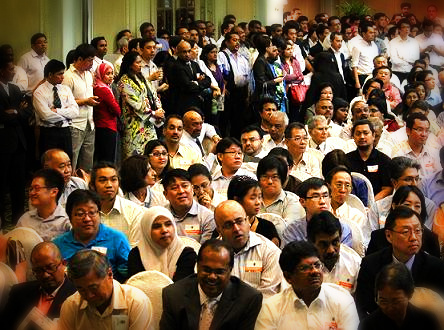
Contributed by Chin Oy Sim, Deputy CEO, and photos by Md Faizal Mahat, Administrative Assistant, Bar Council


  • 1,270 Members of the Bar attended the Malaysian Bar’s Extraordinary General Meeting (“EGM”) held at Sunway Putra Hotel on 11 May 2012.
  • The EGM was scheduled to begin at 3:00 pm.  By 2:20 pm, 143 Members had already signed in, and the figure rose quickly to 214 Members within the next 11 minutes.  The quorum of 500 Members was achieved by 2:55 pm, but the meeting did not commence until almost 3:30 pm, while the crowd waited for hundreds of additional Members to be registered.  By 3:32 pm, 1,101 Members had signed in, and there was standing room only in the hall.

  • One motion had been proposed for consideration at the EGM: “Motion in relation to the events of and surrounding the BERSIH 3.0 public assembly on 28 April 2012, and matters in connection therewith, proposed by Lim Chee Wee (Chairman, Bar Council), on behalf of the Bar Council, dated 4 May 2012”.
  • Although a few Members spoke fervently against the motion and the convening of the EGM, the vast majority of Members present were strongly supportive of both, and were vocal in expressing their viewpoints. 
  • After a number of amendments had been made to the motion, it was put to a vote and carried by a majority, with 939 votes in favour, 16 against, with no abstentions.
  • The EGM was adjourned at approximately 5:40 pm.
  • (Full report to come)
    Image


    Resolution adopted at the Extraordinary General Meeting of the Malaysian Bar held at Sunway Putra Hotel, Kuala Lumpur (Friday, 11 May 2012)

    Resolution in relation to the events of and surrounding the BERSIH 3.0 public assembly on 28 April 2012, and matters in connection therewith

    Motion proposed by Lim Chee Wee (Chairman, Bar Council), on behalf of the Bar Council, dated 4 May 2012

    (As amended)

    Whereas:

    (A)  A public assembly was called for and organised by BERSIH 2.0, a coalition of 84 NGOs, on 28 April 2012 for electoral reforms.  The public assembly was commonly known as BERSIH 3.0;

    (B)  Dewan Bandaraya Kuala Lumpur refused to allow the assembly at Dataran Merdeka, as chosen by the organisers, and insisted on the use of alternative venues;

    (C)  Despite the Minister of Home Affairs having twice asserted that the BERSIH 3.0 assembly was not a security threat, the police obtained an ex parte order from the Magistrates’ Court on the evening of 26 April 2012 restraining Dato’ Ambiga Sreenevasan, the organisers of the BERSIH assembly and members of the public from gathering at Dataran Merdeka;

    (D)  The police announced, after obtaining the court order, that participants were permitted to gather at various points in Kuala Lumpur, except Dataran Merdeka;

    (E)  It has been reported by various news agencies that there were between approximately 30,000 to 250,000 people gathered for the assembly in Kuala Lumpur on 28 April 2012.  The Malaysian Bar monitoring team estimated the crowd to be at least 100,000 people;

    (F)  The crowd that gathered that day reflected a broad cross-section of Malaysian society, and was peaceful;

    (G)  There were police barriers set up at every point/road leading to Dataran Merdeka, most of which consisted of metal gates, water-filled dividers and razor wire;

    (H) There was massive police presence: approximately 14,000 personnel were reportedly deployed (including personnel from the Federal Reserve Unit) together with water cannons.  It was observed that a substantial number of police personnel did not display their police identification numbers on their uniforms; 

    (I)  At approximately 2:35 pm the organisers of the assembly, through its Co-Chairperson Dato’ Ambiga Sreenevasan, announced that the assembly had concluded and requested that the crowd disperse;

    (J)  The police were initially restrained.  However, this changed at approximately 3:00 pm, when there was a reported breach of the perimeter barriers set up at the junction of Jalan Tun Perak and Jalan Raja;

    (K)  The police then responded by unleashing water cannon and firing successive volleys of tear gas directly into the crowd gathered at that junction, and along Jalan Tun Perak, Jalan Tuanku Abdul Rahman and Jalan Raja Laut.  Similar police action was reported at other points where crowds had gathered;

    (L)  The Malaysian Bar’s monitoring teams reported witnessing the use of heavy-handed tactics by the police, including the indiscriminate discharging of multiple rounds of tear gas directly into the crowds, without any obvious provocation, and the arbitrary use of water cannons;

    (M)  The police also directed their use of water cannon and firing of tear gas to box in participants rather than allowing them to disperse quickly.  As participants retreated, the police should have re-established their barriers and given sufficient time to the crowd to disperse in an orderly and safe manner, instead of chasing participants and persistently shooting water cannon and firing tear gas on them.  It appeared that the purpose of the police was not to disperse, but to attack, the crowd;

    (N)  Random, widespread and wanton physical assault and brutality by the police on members of the public and media professionals have been reported.  It has further been reported that there was confiscation and/or destruction of photographs and video recordings made by members of the public and media professionals, and damage caused to their recording equipment;

    (O)  There were unwarranted arrests of members of the public and media professionals.  The police also arrested Members of the Bar who had participated in the public assembly.  Whilst in the care and custody of the police, at least three of these Members were physically assaulted and beaten, and suffered serious injuries;

    (P)  In response to the use of force by the police, sections of the crowd resorted to retaliatory acts, including the throwing of stones and bottles.  The police responded like for like.  These skirmishes between the police and sections of the crowd carried on until approximately 7:00 pm;

    (Q)  The police have failed to display the maturity, discipline and restraint required of a professional force.  Instead of acting to calm the situation, they aggravated it and contributed to its escalation;

    (QA) The findings and recommendations of the previous four SUHAKAM public inquiries, regarding the incidents at Kesas Highway (2001), KLCC (2007), Bandar Mahkota Cheras (2008) and the BERSIH 2.0 public assembly (2012), do not appear to have been put into consistent practice by the police;

    (R)  It has been reported that the organisers of the BERSIH 3.0 assembly had not made sufficient efforts to manage the crowds or to resolve the impasse between the police and the crowds;

    (S)  It has been reported that between 388 and 513 persons were arrested and taken to Pusat Latihan Polis (“PULAPOL”), Jalan Semarak, Kuala Lumpur.  The Malaysian Bar’s urgent arrest team, comprising members of the Bar Council Legal Aid Centre (Kuala Lumpur) and volunteer lawyers, were present at PULAPOL to assist and represent the arrested persons.  However, the police refused to allow them access to the arrested persons despite repeated requests by both the lawyers present and the arrested persons.  This denial of access to legal representation is a violation of Article 5 of the Federal Constitution and section 28A of the Criminal Procedure Code;

    (T)  The right of every citizen to freedom of speech and expression, and to assemble peaceably, is enshrined in Article 10 of the Federal Constitution as well as Articles 19 and 20 of the Universal Declaration of Human Rights;

    (U)  The right of every person to life and liberty, including the right not to be assaulted or harmed, is enshrined in Article 5 of the Federal Constitution as well as Article 5 of the Universal Declaration of Human Rights; and

    (V)  The Malaysian Government, as a member of UNESCO, is aware of the Medellin Declaration on Securing the Safety of Journalists and Combating Impunity, adopted at the UNESCO Conference on Press Freedom, Safety of Journalists and Impunity on World Press Freedom Day 2007;


    Now it is hereby resolved that with respect to the events of and surrounding the BERSIH 3.0 public assembly on 28 April 2012 in Kuala Lumpur:  

    (1)    The Malaysian Bar views with grave concern, and condemns:

    (a)    the excessive, indiscriminate and wrongful use of water cannons and tear gas by the police on participants of the assembly;

    (b)    the action of the police in not allowing the crowd sufficient time to disperse in an orderly and safe manner, and instead chasing the participants and attacking them by persistently shooting water cannon and tear gas on them;

    (c)    the tactics of the police in trapping and attacking the participants with water cannon and tear gas instead of permitting them to disperse;
           
    (d)    the random, widespread and wanton physical assault and brutality by the police on members of the public and media professionals;

    (e)    the unwarranted arrests of members of the public, media professionals and Members of the Bar, and the physical assault and beating of at least three arrested Members;

    (f)    the unjustifiable and unlawful confiscation and/or destruction of photographs and video recordings made by members of the public and media professionals, and damage caused to their recording equipment; and

    (g)    the lack of discipline and professionalism of the police;

    (2)    The Malaysian Bar calls for the police to identify their personnel involved in the misconduct and unlawful acts and surrender all the wrongdoers, in particular those who assaulted members of the public, media professionals and lawyers, for prosecution;

    (3)    The Malaysian Bar renews our call on the Government to give effect to the recommendation of the Royal Commission to Enhance the Operation and Management of the Royal Malaysia Police to set up the Independent Police Complaints and Misconduct Commission recommended therein, without further delay;

    (4)    The Malaysian Bar calls for the Minister of Home Affairs and the Inspector General of Police to issue a public apology for the actions and conduct of the police, including the excessive, indiscriminate and wrongful use of water cannons and tear gas;

    (5)    The Malaysian Bar calls for the Minister of Home Affairs and the Inspector General of Police to issue a public apology to members of the public, media professionals and lawyers who were assaulted or beaten by the police;

    (6)    The Malaysian Bar calls for the setting up of an independent commission to recommend and formulate proper guidelines or operating procedures governing conduct of police in the control and management of public assemblies, and the use of non-lethal and lethal weapons, which would be in accordance with internationally-accepted standards, in particular the Code of Conduct for Law Enforcement Officials (adopted by United Nations General Assembly resolution 34/169 of 17 December 1979) and the Basic Principles on the Use of Force and Firearms by Law Enforcement Officials 1990;

    (7)    The Malaysian Bar calls on the Government to pay just and proper compensation to members of the public, media professionals and lawyers who were assaulted;

    (8)    The Malaysian Bar condemns the police for denying lawyers access to arrested persons and calls upon the police to abide by and give effect to Article 5 of the Federal Constitution and section 28A of the Criminal Procedure Code;

    (9)    The Bar Council will look into how it can assist those denied their constitutional rights and those who were assaulted to pursue claims against the relevant parties for just and proper compensation;

    (10)    The Malaysian Bar calls on the Government, in line with the Medellin Declaration, to:

    (a)    prevent crimes against media professionals, investigate and penalise such crimes, provide witness protection for those testifying about them and ensure that the perpetrators do not go unpunished;

    (b)    promote awareness and train Malaysian law enforcement agencies to respect and promote the safety of media professionals, and ensure that they are able to work in full security and independence; and

    (c)    take resolute action for the safety of media professionals and ensure respect for their professional independence;

    (11)    The Malaysian Bar calls on Dewan Bandaraya Kuala Lumpur to uphold freedom of assembly and the right of all to utilise Dataran Merdeka for public assemblies; and

    (12)    The Malaysian Bar reaffirms the right of individuals to participate in public assemblies.  The Malaysian Bar is however concerned by, and does not countenance, any acts of violence in a public rally.  Such action by participants is not an appropriate response to the police.  Such right of public assembly must be exercised in a peaceful and responsible manner.  The Malaysian Bar reminds organisers of public assemblies of their responsibility to take all reasonable action to ensure a peaceful assembly.  The Malaysian Bar is equally concerned by reports that certain persons had crossed through the police perimeter barriers at the relevant location when the said organisers had at about 2:35 pm called for a dispersal of the assembly.

    The motion, as amended, was put to a vote and carried by a majority (939 votes in favour, 16 against, with no abstentions).

    Saturday, May 05, 2012

    Joint Statement of 90 Groups sent to Prime Minister

    The joint statement has been sent by post (with certificate of posting) to the Prime Minister of Malaysia, Minister of Human Resources and the National Human Rights Commission on 4/5/2012...The letter to the Prime Minister is as follows:-

    Open Letter

    4th May, 2012

    Dato' Sri Mohd Najib Bin Tun Haji Abdul Razak,
    Prime Minister of Malaysia,
    Prime Minister's Office,
    Main Block, Perdana Putra Building,
    Federal Government Administrative Centre,
    62502 Putrajaya, MALAYSIA

    Dear Sir,

    Please find enclosed the Joint Statement of 90 trade unions, organizations and groups, from all over the world, dated 28/10/2011, entitled “Abolish the ‘Contractor for Labour’ system - Withdraw the 2012 amendments to Employment Act 1955’ and the Bahasa Malaysia version entitled, “Mansuhkan Sistem ‘Contractor for Labour’ - Tarikbalik pindaan 2012 kepada Akta Kerja 1955”

    The said statement speaks for itself, and we urge you to ensure the continuity of the 2-party direct employment relationship between principals and the workers that work for them to the exclusion of any 3rd party ‘contractor for labour’.

    If there is need for further information and clarification, feel free to write to us or contact me [Charles Hector at 019-2371100 (chef@tm.net.my or easytocall@yahoo.com )

    Kindly acknowledge receipt. A written response acknowledging receipt, and your response to the stated demands in the statement is expected, which we shall communicate to all parties that have jointly issued this statement.

    Thank you.

    In solidarity,


    Charles Hector                                
    For and on behalf of the said 90 Trade Unions, Organisations and Groups 

    -
    Joint Statement – 3/5/2012

    Abolish the ‘Contractor for Labour’ system
    Withdraw the 2012 amendments to Employment Act 1955.

    We, the undersigned 90 trade unions, civil society groups and organizations object to the actions of the government of Malaysia in destroying direct employment relationship between the principal, as employer, and their workers, as employees, with the latest amendments to the Employment Act 1955.

    The Malaysian Trade Union Congress (MTUC) , which not only represents the about 800,000 unionized workers but also the over 12 million workers in Malaysia,  have strongly and consistently opposed the proposed amendments since it was first tabled in Parliament vide Bill No: D.R.25/2010 in July 2010, which the government later withdrew. The government re-introduced the Bill with minor changes in June 2011 vide Bill No: D.R.15/2011. MTUC came out even more strongly and also picketed at the Parliament House on 3rd October 2011 and in spite of strong resistance from many quarters, including on the Dewan Rakyat  floor, the controversial Bill was passed on  6th October 201, did finally come into effect on April 1st 2012. 

    We would like to address just one of several aspects of the new amendments that is the main bone of contention, i.e. the introduction of the new provision for the definition of “contractor for labour”.

    With the amendment, the contractor for labour will be the third party (or the middleman) who will come in between the now direct employment relationship between the owner-operator of trade or business (defined as the “principal”) and their worker-employee. 

    BACKGROUND

    The Employment Act 1955 was introduced before independence (Merdeka) by the British Administration effectively abolishing indentured labour, bonded labour and the “kanggani” system in Malaya. (collectively then known as the “contract system”). The Act also did establish two very important principles of law which are considered sacrosanct to this day. They are, security of tenure – ensuring permanence of employment, and proprietary right to the job – where termination of worker, shall be only with just cause and excuse and by due process.
    The employment scenario in the country began to change in the early 1990s. In 1992 the government allowed migrant workers for the construction and plantation sector. In 2000, it was extended to manufacturing and service (hotel and restaurants) sectors and in 2002, it was extended to all sectors.

    Originally migrant workers were employed directly by the principal employer but this started to change in 2005, when the Cabinet Committee on Foreign Workers in its meeting on 5-July 2005 agreed to the recruitment of foreign workers through outsourcing companies (now known as ‘Contractor for Labour’ in the amended Act). The issuance of these outsourcing licenses was strangely done by the Ministry of Home Affairs, not the Ministry of Human Resources. There are today about 277 registered labour outsourcing companies in the country today. (The Star, 23-Feb 2010).  

    This establishment of the outsourcing companies allowed for the re-emergence of the old ‘contract system’. It opened doors resulting in a direct assault on the basic foundation of labour rights, the undermining dignity of labour, perpetuating the establishment and operation of dehumanized and bonded labour. The practice, which started with migrant workers, was then extended to local workers.

    These outsourcing companies recruited local workers and migrant workers, some on fix term contracts, with terms and conditions usually less favourable than that of workers directly employed by principals. 

    The incidence of principals using workers supplied by outsourcing companies is growing. The principal company pays the outsource company an agreed sum of money for the number of workers supplied, whether they be local or migrant workers. The principal company effectively is able to avoid the employer’s duty and obligation to ensure their workers’ rights and welfare are protected. This practice also saved principal company money that would have ordinarily been expended for workers like medical cost, insurance, bonus, wage increments, retirement benefits, transportation and accommodation, service awards, and several other benefits. It also allows them to evade statutory contributions to the Employees Provident Fund and for social security schemes. The principal company also evades all obligations and safeguards in law when workers are hired or terminated, including domestic inquiries and lay-off and termination benefits. If the principal wants to now get rid of workers, it now merely have to inform the outsource company. 

    To convert the workforce from permanent employees to short-term contract employees, and now outsourced workers, most principals either retrenched their workers, used “voluntary separation schemes” or other methods, or simply terminated their employees substituting them now with workers supplied by the outsourcing companies.

    REASON FOR THE AMENDMENT

    These outsourcing companies have been allowed to operate outside the law with no law regulating them. Even though they were manpower/labour suppliers, they were not created under and/or regulated by the Private Employment Agencies Act 1981, which would have also ensured these manpower/labour suppliers would only provide workers and not become employers of workers supplied.  

    The recent amendment to the Employment Act is to give these outsourcing companies statutory recognition under the Employment Act, and at the same time institutionalize and legitimize employment through the outsourcing companies, which  now legally will be legally known as the “contractor for labour”.  

    A primary reason for the creation of the ‘contractor for labour’ and the introduction of labour outsourcing is to stifle workers and trade unions capacity to demand and negotiate for better rights and benefits. The MTUC Memorandum to the HR Minister dated October 7, 2008 refers to an interview with Datuk Ishak Mohamed, the Enforcement Director of the Immigration Department that was published in New Straits Time, July 20, 2008, where he, amongst others, said, ‘…outsourcing is good as it will attract foreign direct investment. Investors do not want unions to be formed in their establishments. Through outsourcing, it would be difficult for unions to be formed as outsourcing company, and not the factory, would be the employer…’ is indicative of the intention of the government.

    SUB-CLASS OF WORKERS. 

    The creation of this new sub-class of workers, who are not considered employees of the principal, also jeopardizes existing employment relationship between the principal and their current worker-employees, likewise the relationship with their trade unions. Today, these new sub-class of workers, made up of both local and migrant workers, are found in most workplaces, including even government-linked companies, whereby in some factories they currently make up about  50% of the total workforce. Trade unions are being weakened, and their bargaining powers for better rights and benefits for workers are slowly eroding by the increasing presence of workers who are not employees of the principal, and also by the loss of security of tenure created by short-term contracts.

    ‘Contractor for labour’ is actually outsourcing of labour which is very different from outsourcing of work. Outsourcing of work is when principal employer outsources some specified work or operations which are not their core operation, to another company who carries out the work for the principal using their own employees under their own control and supervision. For example, in several manufacturing companies, cleaning, turf/gardening, canteen and security services are examples of outsourced work. This outsourcing of work is legal, and the workers of those who are doing outsourced work are protected by the Employment Act.

    Contrary to the principle that workers doing core operation work should be employees of the principal, this amendment to the Act now allows the ‘contractor for labour’ to supply workers to perform the core operation under the control and supervision of the principal’s supervisory staff and managers. The ‘contractor for labour’ merely collects the salary of the labour supplied and apportions a part to himself  and pays his workers, usually less than the workers who are under the direct employment of the principal, though they do the same work. The principle of equal pay for equal work is thus breached. 

    The principal, who is considered not the employer of the workers supplied, absolves himself of all liabilities and employer’s obligations with regard these workers supplied by ‘contractor for labour’ who are working for the principal’s benefit,

    EMPLOYMENT (EXEMPTION) ORDER 2012

    The MOHR Minister, in an attempt to placate the MTUC, trade unions, civil society groups and workers issued an exemption order, effective April 1st 2012, which, amongst others, stated:-

     “…Any person who enters into contract for service with a principal to supply employees required by the principal for the execution of the whole or any part of any work for the principal in any industry, establishment or undertakings other than the agriculture undertakings, is exempted from sections 31, 33A, 69 and 73 of the Act...”

    However, the words used in the said exemption order, which by the way also did not include the amendment in section 2, which was the very amendment that gave statutory recognition to the ‘contractor for labour’ and its practices, only further affirms the contractor for labour and their practices. The exempted sections referred to in the said Order merely dealt with ancillary matters like registration of employees when supplied to principal and priority of debt. The exemption order also would deny access to justice for workers now being supplied by these ‘contractor for labour’ in all the exempted sectors. 

    MTUC and all groups that opposed the amendments were not appeased by this exemption order, and continue their objections to the ‘contractor for labour’.

    PROTEST

    We strongly object to the ‘contractor of labour’ system. All workers that work under the control and supervision of the principal must be the employees of the said principal not some third party. The Malaysian government’s action is in breach of article 8 of the Federal Constitution. In 1998, Malaysia also ratified the ILO Declarations on Fundamental Principles and Rights at Work but this amendment is in  contravention of the said Declaration. Further, it also is in contravention of the ILO’s Decent Work Agenda which Malaysia has committed to. 

    The International Trade Union Confederation (ITUC), many trade unions and civil society groups, also opposed, and still oppose this amendment. The Malaysian Bar also recently passed unanimously a resolution on March 10th 2012, amongst others, calling for the maintenance of existing 2-party employment relationships, and also that labour suppliers and/or contractors of labour should never be or continue to be employers of workers after they are supplied, accepted and start working at the workplaces of principals.

    The contractor for labour and their practices should not be allowed in any sectors including the plantation and agricultural sector.

    DEMAND

    We, therefore, demand for the repeal of all amendments to the Employment Act 1955, in particular the amendments to section 2, 31, 33A, 69, 73 brought about by Employment (Amendment) Act 2012 [ACT A1419] relating to the ‘contractor for labour’ and their practices,  and pending repeal for an immediate stopping operation of the said amendments.

    We call for the abolition of the contractor for labour and their practices and that all workers, currently supplied by these 3rd party manpower/labour suppliers (contractor for labour) who are still not direct employees of the principal employer be immediately made employees of the said principal and be accorded same benefits and treatment as accorded to all other employees without discrimination, including the right to form/join trade unions or afford protection and entitlement to the benefits accorded through their respective Collective Agreements.

    We call for the abolition of precarious employment, and for retention of a just 2-party employment relationship between principals and workers, and for the respect of worker and trade union rights.

    Charles Hector
    Pranom Somwong
    Bruno Pereira

    For and on behalf,

    ALIRAN (Aliran Kesedaran Negara), Malaysia
    Amalgamated Union of Employees in Government Clerical and Allied Services(AUEGCAS )
    Amalgamated Union Employees Tenaga Nasional Berhad (AUETNB )
    Anak Muda Sarawak (AMS)
    Asian  Migrants Center (AMC)
    Asia Monitor Resource Centre(AMRC)
    Asia  Pacific  Forum on Women , Law and Development  (APWLD)
    Asian Network for the Rights of Occupational and Environmental Victims (ANROEV)
    Association for Community Development -ACD, Bangladesh
    BASF Asia Pacific Network

    BASF-PETRONAS Malaysia
    Burma Campaign Malaysia (BCM)
    Burma Partnership
    Centre For Reflection And Action On Labour Rights (Cereal Guadalajara), Mexico
    Center for Indonesian Migrant Workers-CIMW
    Center for Migrant Advocacy, Philippines (CMA-Phils)
    Centre des travailleurs et travailleurs immigrants / Immigrant Workers' Centre (Montréal, Québec)
    Centre d'appui aux Philippines - Centre for Philippine Concerns (Montréal, Québec)
    Christian Development Alternative (CDA)-Bangladesh
    Clean Clothes Campaign

    Communication Workers Union Victoria,Australia
    Community Action Network (CAN), Malaysia
    Democratic Party for a New Society (DPNS), Burma
    Dignity International
    Ecumenical Institute for Labor Education and Research (EILER), Philippines
    Electronic Industry Employees Union Western Region Peninsular Malaysia (EIEUWRPM)
    FAIR (Italy)
    Families Against Corporate Killers, UK
    Federation Independent of Trade Union (GSBI) Indonesia
    FSPMI ( Federasi Serikat Pekerja Metal Indonesia)

    Future In Our Hands, Norway
    Garment and Allied Workers Union, India
    Hsinchu Catholic Diocese Migrants and Immigrants Service Center (HMISC), Taiwan
    Institute for Occupational Health and Safety Development (IOHSAD),
    International Metalworkers' Federation (IMF)
    International Union of Food, Agricultural, Hotel, Restaurant, Catering, Tobacco and Allied Workers' Associations (IUF)
    Jaringan Rakyat Tertindas (JERIT), Malaysia
    Kesatuan Pekerja-Pekerja Polyplastics Asia Pacific (KPPAP)
    Kesatuan Sekerja Industri Elektronik Wilayah Selatan
    Kesatuan Sekerja NUTEAIW Isuzu Hicom (M) Sdn Bhd, Pekan, Pahang, Malaysia

    Kesatuan Industri Elektronik Wilayah Timur Semenanjung Malaysia
    Konfederasi Serikat Nasional (National Union Confederation)[KSN] , Indonesia.
    Labour Behind the Label, UK
    Lal Zenda Coal Mines Majdoor Union (LZCMMU), India
    Lembaga Informasi Perburuhan Sedane-Sedane Labour Resource Centre Bogor-Indonesia
    LHRLA - Lawyers for Human Rights & Legal Aid (Pakistan)
    MADPET (Malaysians Against Death Penalty and Torture)
    Malayan Nurses Union(MNU)
    MTUC (Malaysian Trade Union Congress)
    Migrant CARE, Indonesia

    Migrant Forum in Asia(MFA)
    Migrante International
    National Domestic Workers Movement- AP Region
    National Hazards Campaign of UK
    NLD-LA (National League for Democracy-Liberated Areas), Malaysia
    National Union of Banking Employees (NUBE)
    National Union of Petroleum & Chemicals Industrial Workers (NUPCIW), Malaysia
    National Union of Transport Equipment and Allied Industries Workers (NUTEAIW), Malaysia
    Network of Action for Migrants in Malaysia (NAMM)
    Occupational and Environmental Health Network of India (OEHNI)

    Pakistan Rural Workers Social Welfare Organization (PRWSWO)
    Paper & Paper Products Manufacturing Employees Union(Reg No 444), Malaysia
    Parti Rakyat Malaysia (PRM)
    Perak Women for Women Society (PWW)
    Persatuan Masyarakat Selangor dan Wilayah Persekutuan (PERMAS)
    Persatuan Sahabat Wanita, Selangor (PSWS)
    PINAY - The Filipino Women's Organization in Quebec
    Public Services International, Malaysian Affiliates National Coordinating Committee
    Pusat Komunikasi Masyarakat (KOMAS)
    RightOnCanada.ca, Canada

    Sarawak Medical Services Union (SMSU)
    Solidarity of Cavite Workers, Philippines
    Tenaga National  Berhad Junior Officers Union (TNBJOU)
    Tenaganita, Malaysia
    Thai Committee for Refugees Foundation (TCR)
    Thai Labour Campaign, Thailand
    The Live And Livelihood Foundation, Bangladesh
    The Women's Caucus (Southeast Asia Women's Caucus on ASEAN)
    Think Centre – Singapore
    United Filipinos In Hong Kong (UNIFIL-MIGRANTE-HK)

    United Students Against Sweatshops,  US
    University of Malaya General Staff Union (UMGSU)
    WARBE Development Foundation, Bangladesh
    Women's Legal and Human Rights Bureau, Inc.(WLB),Philippines
    WOREC Nepal
    Workers Assistance Center, Inc., Philippines
    Workers Hub For Change (WH4C)
    Yayasan LINTAS NUSA Batam-Indonesia
    Yokohama Action Research (Japan)
    Clean Clothes Campaign, the Netherlands