Showing posts with label HR Violations. Show all posts

Thursday, July 20, 2017

ADPAN and HR groups shocked that Adilur Rahman Khan was detained at KLIA?

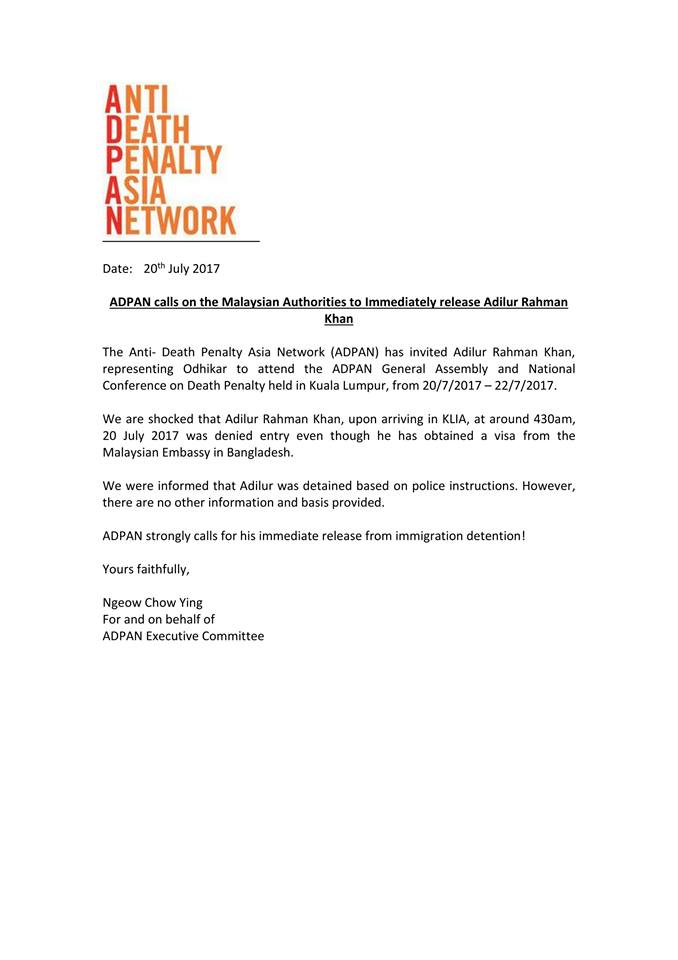
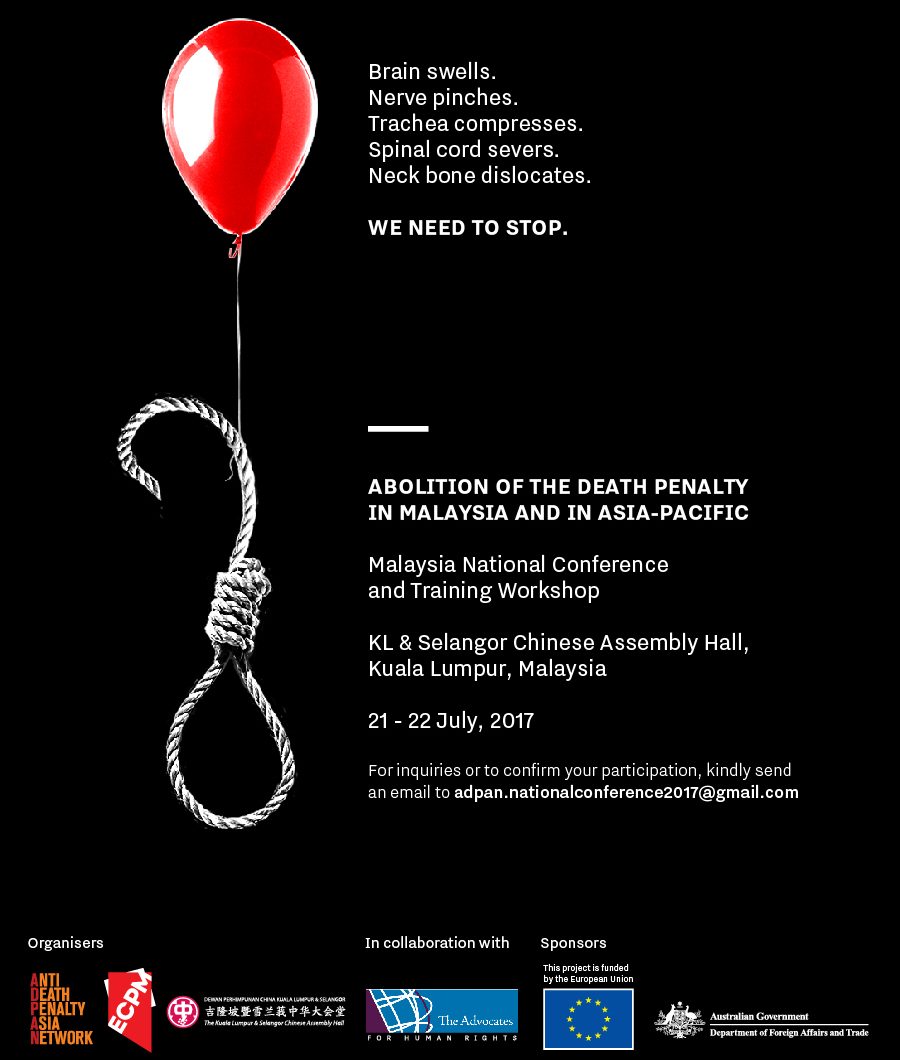
Adilur Rahman Khan from Odhikar, a member of the ADPAN, was detained at the Kuala Lumpur Internationbal Airport(KLIA) by the Malaysian Immigration and prevented entry (he is still being detained at this time). He was supposed to be attending the General Assembly of ADPAN today(20/7/2017), and Malaysian National Conference on 21-22 July. At the ADPAN General Assembly today, Adilur Rahman Khan, was one of 8 who were succesfully voted into the Executive Committee of ADPAN for the 2017-2019 term.

After Malaysian embassy in Bangladesh, had issued the required visa, it is absurd for Adilur Rahman Khan then to be detained at the KLIA International airport, and denied entry.
adpan adilur statementcropped-adpan-national-conference-poster1.jpg


Malaysia: Arbitrary arrest of Mr. Adilur Rahman Khan

20/07/2017
Urgent Appeal
Human Rights Defenders
  • Malaysia
MYS 001 / 0717 / OBS 083
Arbitrary arrest /Harassment
Malaysia

July 20, 2017

The Observatory for the Protection of Human Rights Defenders, a partnership of the World Organisation Against Torture (OMCT) and FIDH, requests your URGENT intervention in the following situation in Malaysia.

Brief description of the information:

The Observatory has been informed with great concern about the arbitrary arrest in Kuala Lumpur of Mr. Adilur Rahman Khan, Secretary of the human rights non-governmental organisation [1], also a member of OMCT General Assembly and FIDH Vice-President.

According to the information received, on July 20, 2017, at about 4.00 am, Mr. Adilur Rahman Khan was detained by immigration officers upon his arrival at Kuala Lumpur International Airport. No reason was given for his detention.

Mr. Rahman Khan was travelling to Malaysia to attend the National Conference on Death Penalty organised by the Anti-Death Penalty Asia Network (ADPAN) from July 21 to 22, 2017 in Kuala Lumpur.

The Observatory strongly condemns Mr. Adilur Rahman Khan’s arbitrary arrest, and calls upon the Malaysian authorities to release him immediately and unconditionally, as well as to guarantee in all circumstances his physical and psychological integrity.

Actions requested:

Please write to the authorities in Malaysia, urging them to:

i. Guarantee, in all circumstances, the physical and psychological integrity of Mr. Adilur Rahman Khan, as well as of all human rights defenders in Malaysia;

ii. Release Mr. Adilur Rahman Khan immediately and unconditionally as his detention is arbitrary since it only aims at sanctioning his human rights activities;

iii. Put an end to any kind of harassment - including at the judicial level - against Mr. Adilur Rahman Khan as well as all human rights defenders in Malaysia;

iv. Ensure in all circumstances that all human rights defenders in Malaysia are able to carry out their legitimate activities without any hindrance and fear of reprisals;

v. Conform with the provisions of the UN Declaration on Human Rights Defenders, adopted by the General Assembly of the United Nations on December 9, 1998, especially its Articles 1 and 12.2;

vi. Ensure in all circumstances respect for human rights and fundamental freedoms in accordance with international human rights standards and international instruments ratified by Malaysia.

Addresses:
· Dato’ Sri Mohd Najib bin Tun Abdul Razak, Prime Minister of Malaysia, Fax: +60 3 8888 3444, Email: ppm@pmo.gov.my

· Mr. Ahmad Zahid Hamidi, Minister of Home Affairs of Malaysia, Fax: +60 3 8889 1613 / +60 3 8889 1610, Email: ahmadzahid@moha.gov.my
 

· Attorney General of Malaysia, Tan Sri Mohamed Apandi Ali, Fax: +603 8890 5670 Email: pro@agc.gov.my
 

· Tan Sri Razali Bin Ismail, Chairman of the Human Rights Commission of Malaysia (SUHAKAM), Fax: +60 3 2612 5620, Email: humanrights@suhakam.org.my;

· H.E. Mr. Amran Mohamed Zin, Ambassador, Permanent Representative of Malaysia to the United Nations in Geneva, Switzerland. Fax: +41 22 710 75 01, Email: malgeneva@kln.gov.my

· Embassy of Malaysia in Brussels, Belgium, Fax: +32 2 762 50 49, Email: malbrussels@kln.gov.my

Please also write to the diplomatic missions or embassies of Malaysia in your respective country as well as to the EU diplomatic missions or embassies in Malaysia.
***
Geneva-Paris, July 20, 2017


The Observatory for the Protection of Human Rights Defenders (the Observatory) was created in 1997 by the World Organisation Against Torture (OMCT) and FIDH. The objective of this programme is to intervene to prevent or remedy situations of repression against human rights defenders. OMCT and FIDH are both members of ProtectDefenders.eu, the European Union Human Rights Defenders Mechanism implemented by international civil society.


Bangladesh human rights activist detained at KLIA

 | July 20, 2017

Suaram condemns arrest of Adilur Rahman Khan who arrived this morning to attend a conference in Kuala Lumpur on the abolition of the death penalty.

PETALING JAYA: The arrest of a Bangladeshi human rights activist at the Kuala Lumpur International Airport (KLIA) this morning has been condemned by a local rights group.
Adilur Rahman Khan was detained by immigration officers at KLIA at about 4am today. Khan is the secretary of Odhikar, a human rights NGO based in Bangladesh.
He had travelled to Malaysia to attend a conference on the topic of “Abolition of the death penalty”.
“Suara Rakyat Malaysia (Suaram) condemns the detention of Adilur Rahman Khan.
"As of 10am, no reason has been given by immigration officers as to why he was detained. However, Suaram was informed that Khan has now been moved to the immigration lock-up,” Suaram executive director Sevan Doraisamy said in a statement.
The NGO urged the authority to release Khan and called for an end to the “persistent harassment against human rights defenders visiting Malaysia”.
This is the latest action taken against foreign human rights activists by the Malaysian government.
Earlier this month, Amnesty International (AI) said it was concerned over the barring of Singapore human rights defender Han Hui Hui from entering Malaysia last month.
Han had been blocked from entering the country after having been labelled an “undesirable immigrant” by the home minister.
“AI notes that this is not the first time the government has barred peaceful activists from entering Malaysia.
“In recent years, Hong Kong political activist Joshua Wong and Indonesian human rights defender Mugiyanto Sipin have been prevented from visiting the country, as well”. - FMT News, 20/7/2017FMT News, 20/7/2017

Immigration detained activist from Bangladesh, claims Suaram
  •    Published     Updated

The human rights group Suaram has condemned the Immigration Department for supposedly detaining a human rights activist from Bangladesh.
"Suaram calls for his immediate release and demand that the Immigration Department stop its persistent harassment against human rights defenders visiting Malaysia," it said in a statement today.
Suaram claimed that Odhikar secretary Adilur Rahman Khan was detained at about 4am today at the Kuala Lumpur International Airport, and as of 10am, he was not told the reason for his detention.
He was supposed to attend a conference on the abolition of the death penalty that would take place in Kuala Lumpur this evening until Saturday.
Malaysiakini has contacted the Immigration director-general Mustafar Ali and is waiting for a response. - Malaysiakini, 20/7/2017


Malaysia detains prominent Bangladeshi rights activist Adilur Rahman Khan

KUALA LUMPUR (AFP) - Malaysia has detained a prominent Bangladesh activist, civil groups said on Thursday (July 20), describing the government action as "harassment" against human rights defenders.
Adilur Rahman Khan, secretary of the rights group Odhikar, was detained after arriving at Kuala Lumpur International Airport early Thursday, activists said.
He was due to speak at a two-day conference organised by the Anti-Death Penalty Asia Network
Rights group Voice of the Malaysian People (Suaram) said Khan was being kept incommunicado at the airport's immigration lock-up and appealed for his release.
"Suaram calls for his immediate release and demand that the immigration department stop its persistent harassment against human rights defenders visiting Malaysia," it said in a statement.
Immigration authorities could not be reached for comment.
Malaysia often denies foreign pro-democracy activists entry into the country without giving explanation.

The Asian Human Rights Commission urged the international human rights community "to immediately intervene in this case, and secure Khan's release from arbitrary detention".
The commission said it was worried that the detention of Khan, his country's former deputy attorney general, "is the result of collusion between governments in Bangladesh and Malaysia".
In the past, Khan's group has been critical of human rights violations allegedly committed by Bangladeshi security forces, including torture and extra judicial killings.
Malaysia has also denied Khan a lawyer and the right to speak to anyone, the group said.
In 2015, student activist Joshua Wong, who helped organise the 2014 Hong Kong protests, was denied entry by immigration authorities. - The Straits Times, 20/7/2017


Malaysia sends back Odhikar Secretary Adilur

Malaysia sends back Odhikar Secretary Adilur
File photo of Adilur RahmanDhaka Tribune

The high commission will take steps to resolve the matter as soon as possible, says Bangladesh high commissioner to Malaysia

Immigration police at a Malaysia airport on early Thursday barred Bangladesh-based human rights organisation Odhikar’s Secretary Adilur Rahman Khan from entering the country and sent him back to Bangladesh.

On Thursday evening,  Odhikar Director Nasiruddin Elan said that Adilur is expected to land at Hazrat Shahjalal International Airport at 10pm.

“We barred him over immigration issues. We are checking his documents. Adilur will not be allowed to enter Malaysia. He will be deported,” Malaysian immigration officer Shely had said as quoted by the Bangla Tribune.

Earlier in the morning, an official of Odhikar, asking to remain anonymous, told the Dhaka Tribune that Adilur had travelled to Malaysia to join a conference on the death penalty, organised by the Anti-Death Penalty Asia Network (ADPAN), scheduled to be held from July 21-22.

“He [Adilur] was not detained. He was barred from entering the country,” said the official.
Odhikar Director Nasiruddin told Bangla Tribune: “Malaysia has been accused of violating human rights and Adilur might have been barred from entering the country for this reason.”

Also Read- ASK protests Malaysia’s barring of Adilur

Md Shahidul Islam, Bangladesh high commissioner to Malaysia, told the Dhaka Tribune that he was not aware of the incident.

“Immigration police can bar anyone from entering the country. If he is obstructed by the immigration police without a valid reason, the high commission will take steps to resolve the matter as soon as possible,” he said.

Condemning the incident, Malaysian rights group Suara Rakyat Malaysia (Suaram) demanded the immediate release of Adilur and called for an end to the harassment of human rights activists in Malaysia.
Bangla Tribune has contributed to this story - Dhaka Tribune, 20/7/2017

Sunday, May 13, 2012

BERSIH 3.0 - Must be an INDEPENDENT inquiry - certainly not one led by former police chief

Now, when it come to BERSIH 3.0 and an INDEPENDENT investigation or inquiry, we have to acknowledge that the allegation of violation of rights is, amongst others, against the police, the government of Malaysia - Minister of Home Affairs, Minister of Information, Communications, and Culture Minister, etc, and also the DBKL (i.e. the Kuala Lumpur mayor and KL's Local Authority which is not a democratically elected entity but one that is appointed by the Federal Government), and as given these facts, any independent panel or inquiry must be independent of the Federal government. 

The suggestion of an independent inquiry headed by the former Inspector General of Police, as such, is absurd more so since the alleged violators of rights is also the police, prior to the event and on the day itself.

Malaysia has its own Human Rights Commission (SUHAKAM), and that would have been the natural choice for the independent investigation and inquiry - and they, in fact, had also done previous similar inquiries involving the exercise of the freedom of peaceful assembly and protest - but sadly the government choose to instead set up some other panel. [It must be pointed out that the Human Rights Commission is made up of  government appointed HR Commissioners - and also the fact that even when they do come up with their report and/or recommendations in the past, this Malaysian government have failed to act on them. The same is also the respond of this BN government when it comes to findings and recommendations of even other Royal Commissions of Inquiry.]    

As such, when the United Nations Special Rapporteur on the Promotion and Protection of the Right to Freedom of Opinion and Expression Frank La Rue offered to be involved in the independent inquiry, it would be best for the Malaysian government to seize this opportunity and allow them to lead and conduct this inquiry. Malaysian lawyers also takes the same position.

Hopefully, our Malaysian government, currently the BN government led by Prime Minister Najib Tun Razak, will without FEAR allow such a body to conduct this independent inquiry...

More importantly, the BN government must commit to implementing the recommendations made by such independent inquiries... [History has shown that this BN government have generally not followed all recommendations of such bodies - even one's that have been appointed by the King...Let's hope that there will be changes...]


Bar Council to boycott panel, wants UN rapporteur instead
  • Hafiz Yatim
  • 8:02PM May 11, 2012
 
The Bar Council will not participate in the independent panel formed by the government to probe last month’s violence at the Bersih 3.0 rally.

The powerful body representing 14,000 lawyers nationwide wants a United Nations special rapporteur to head the independent panel instead of former inspector-general of police Mohd Hanif Omar.

NONE“Otherwise, the Bar Council will not participate in it,” said council chairperson Lim Chee Wee (right) at a press conference following an extraordinary general meeting of the Bar, called to discuss the police crackdown on the mammoth Bersih 3.0 rally on April 28.

“The Bar prefers a UN special rapporteur to oversee the running of the panel and if this is complied with, then the Bar Council will reconsider its participation.”

He said the independent panel formed lacks any legal framework as it is ordinarily found in a royal commission of inquiry or the Malaysian Human Rights Commission of Inquiry (Suhakam).

“It does not have such features as legal immunity for itself or any participating persons involved in the proceeding. By immunity I mean immunity against defamation,” he said.

“Secondly it lacks the legal power to call or subpoena witnesses or call for the production of documents. Under these constraints, the panel has limited utility.”

1,300 lawyers at EGM

A total of 1,270 members attended the EGM to condemn the police’s heavy-handed use of force on Bersih protesters and without giving them ample time to disperse.

A total of 939 voted for the resolution while 16 voted against.

Lim also pointed out that the existing panel does not have any legal standing as it has no powers to summon witnesses to testify before the panel, unlike a royal commission of inquiry.

He said Hanif had also made adverse comments on the Bersih 3.0 rally, describing some of the protesters as communists seeking to overthrow the government.

According to Lim, it was not proper for the government to appoint Hanif to chair the panel as he had espoused such biased views.

“We do not even think Hanif is appropriate to chair the panel. We think the most appropriate person to chair it would be the retired Chief Judge of Sabah and Sarawak Steve Shim,” said the Bar Council president. 

On Sunday, United Nations Special Rapporteur on the Promotion and Protection of the Right to Freedom of Opinion and Expression Frank La Rue offered to be part of the independent panel. - Malaysiakini, 11/5/2012, Bar Council to boycott panel, wants UN rapporteur instead
 

Tuesday, May 24, 2011

Consumers, Shareholders, People have a right to know about HR violations in companies

When made aware of information about human rights and/or worker rights violations, what should one do? Just assist the victims to lodge police reports, lodge complaints at SUHAKAM, lodge complaints at the Labour Department and/or Industrial Relations Department, or other relevant government agencies? Or should one also highlight it to the public as well? I am of the position that knowledge of human rights violations (or alleged human rights violations) should be highlighted to the public  - and this right, duty and obligation is clearly also stated in the UN Declaration on Human Rights Defenders.


"...Everyone has the right, individually and in association with others, to promote and to strive for the protection and realization of human rights and fundamental freedoms at the national and international levels....
 
"....freely to publish, impart or disseminate to others views, information and knowledge on all human rights and fundamental freedoms;

(
c) To study, discuss, form and hold opinions on the observance, both in law and in practice, of all human rights and fundamental freedoms and, through these and other appropriate means, to draw public attention to those matters ..."
Do consumers have an interest in knowing about human rights violations that may be happening to workers involved in the production of products?

YES, they certainly do as this would affect their choices when it comes to products that they do purchase. It is not just the quality of substance used that concerns the consumer - but also the question of whether the said products have been made in a situation where human rights, worker rights, environment rights, etc have been respected and protected. If in the production, there have been violation of worker rights - like the use of slave or forced or child labour, then many consumers may elect not to support such violations of rights by not buying such products until and unless these violations are rectified...

Do investors have an interest in knowing about human rights violations that may be happening to workers involved in the production of products?

YES. Today, directly and indirectly individual persons invest in companies - by buying and owning shares, by buying unit trusts (which choose and buy shares in companies), through the employees provident fund (which also buys shares, bonds, etc...) - and whilst at one time the consideration was purely how much profits/revenue would one earn was the only consideration, today there is also concern about other aspects including human rights, worker rights, environment rights,...
It is because of this trend amongst consumers and investors that has resulted in the emergence of 'corporate social responsibility', something that most companies now advocate - and this not only cover the quality of products used in production but also a commitment to ensuring that worker rights, human rights and environment rights are not only recognized but also protected by these companies.

Some companies have progressed to not only tying themselves to these higher rights protecting standards but have also bound their suppliers and all companies/individuals in their supply chain right from the mining/harvesting of metals/products used in their production. Some have even developed comprehensive Code of Conducts themselves, or have bound themselves to Code of Conducts that covers sectors of production, like the Electronic Industry Code of Conduct. 

Today, even at the UN - we have a Special Representative of the Secretary General on the issue of human rights and transnational corporations and other business enterprises

What about people generally?
In a democratic society, where it is people that elect their government, as in Malaysia, certainly people have a legitimate right to know - because ultimately the very existence (and continued existence) of companies/businesses, including conditions relating to their existence in a country which today includes also how they respect human rights, environment and how they treat their workers are matters that are all aspects that any good government consider as important. If governments ignore human rights violations, then people would chose some other that will ensure that these rights are not only respected but also protected. Lynas, for example is a current case, where there is general dissatisfaction of the people about the earlier government approval for this rare earth company to operate in Malaysia, and there is much public outcry - and this, mind you, is an issue of future posibble risk to health and environment. 

What about the Federal Government, State government and Local Councils?
For any factory and business to operate, they need to get the permission and approval of not just the Federal Government but also the State government and the relevant Local Council. It is absurd for State governments and/or Local Council to even allege that they do not have any say in the matter...

Friday, July 10, 2009

Will Najib, Anwar, Lim Kit Siang, Hadi, Syed Husin Ali...protest this killing of (about 440) innocents by the US in Pakistan using un-manned drones?

Why are we not seeing reports of the US-unmanned drones killing people in Pakistan? It is also not reported in the Malaysian main-stream papers...

The 'shoot to kill' by Malaysian police personnel was bad - but many were allegedly situations where the people shot (or some of them) had allegedly started firing at the police....but in this cases, US drones are un-manned. There are no 'firing at' happening. Innocents are being killed....and the whole world choses to ignore this - not demanding even an answer from the US under Obama.

Rule of Law - right to defend oneself ...right to a fair trial??

Amnesty International is also silent....why? Are Pakistanis lesser humans - and so we are not at all concerned.

At least six missile attacks from suspected US drones have killed eight people and wounded five others in the Pakistani province of South Waziristan near the Afghan border. - Al-jazeera, 8/7/2009, Deadly missiles strike Pakistan
Reuters...have a report on this, and we note that there only 7 (and that too 'suspected' ) al-Qaeda/Taliban persons have been killed so far, from almost 430 persons killed by reason of these un-manned US drones. How many men? How many women? How many children? What were their names? Is this not murder? But, why is the UN....the EU...the World...the OIC...Malaysia not protesting this ongoing killing of innocents? Pakistan's protest have also been wanting...

Suspected U.S. drones fired six missiles into a Pakistani Taliban training camp near the Afghan border on Wednesday, killing six militants, government and intelligence agency officials said.

The pre-dawn attack was in the South Waziristan region, in a stronghold of Pakistani Taliban leader Baitullah Mehsud, they said.

Here are some facts about the U.S. missile attacks, the controversy they have caused, and a list of some of the more prominent militants killed, according to Pakistani officials.

WHY DOES THE UNITED STATES ATTACK?

Many al Qaeda members and Taliban fled to northwestern Pakistan's ungoverned ethnic Pashtun belt after U.S.-led soldiers ousted Afghanistan's Taliban government in 2001. From their sanctuaries there the militants have orchestrated insurgencies in Afghanistan and Pakistan. The United States and Afghanistan have pressed Pakistan to eliminate the sanctuaries. Apparently frustrated by Pakistan's inability to do so, the United States is hitting the militants itself.

HOW MANY ATTACKS?

The United States has carried out about 46 drone air strikes since the beginning of last year, most since September, killing about 430 people, including many foreign militants, according to a tally of reports from Pakistani intelligence agents, district government officials and residents.

SOME OF THE PEOPLE REPORTED KILLED

January 28, 2008 - A senior al Qaeda member, Abu Laith al-Libi, was killed in a strike in North Waziristan.

July 28 - An al Qaeda chemical and biological weapons expert, Abu Khabab al-Masri, was killed in South Waziristan.

November 22 - Rashid Rauf, a Briton with al Qaeda links and the suspected ringleader of a 2006 plot to blow up airliners over the Atlantic, was killed in an attack in North Waziristan. An Egyptian named as Abu Zubair al-Masri was said to be among the dead in the same attack.

January 1, 2009 - A U.S. drone killed three foreign fighters in South Waziristan, Pakistani agents said. A week later, a U.S. counter-terrorism official said al Qaeda's operational chief Usama al-Kini and an aide had been killed in South Waziristan. The U.S. official declined to say how or when they died.

WHERE ARE THE DRONES LAUNCHED FROM?

A senior U.S. lawmaker, Senator Dianne Feinstein, told a U.S. Senate hearing in February that drones were being operated and flown from an air base inside Pakistan. Pakistan denied that, saying there was no permission for the strikes, nor had there ever been.

U.S. POSITION

The United States has shrugged off Pakistani protests. It says the missile strikes are carried out under an agreement with Islamabad which allows Pakistani leaders to decry the attacks in public.

U.S. officials said last month the United States had given Pakistan data on militants in the Afghan border area gathered by surveillance drones in Pakistani airspace under an agreement with Pakistan.

PAKISTAN'S POSITION

Pakistan says the drone strikes violate its sovereignty and undermine efforts to deal with militancy because they inflame public anger and bolster support for the militants. Pakistan has pressed the United States to provide it with drones to allow it to conduct its own anti-militant operations.

(Compiled by Islamabad Newsroom; Editing by Robert Birsel and Jerry Norton) - Reuters, 8/7/2009, FACTBOX: U.S. drone strikes in Pakistan

Will Najib, Anwar, Lim Kit Siang, Hadi, Syed Husin Ali...protest this killing of innocents by the US in Pakistan? Or will they too turn a blind eye when it comes to US's violations of human rights?

Remember also that all is presumed innocent until proven guilty...

See also earlier posts:-

We must protest US indiscriminate extra-judicial kiiling of at least 440 persons since August 2008..

Obama's un-manned drones kills at least 45 people attending a funeral service in Pakistan...- some reports say 80 were killed during this funeral service bombing

Obama 'murders' another 22 in Pakistan

Saturday, May 30, 2009

Suspension in UMNO will go against presumption of innocence until proven guilty..

What has happened to presumption of innocence until proven guilty.

UMNO has got it wrong again...no member should be suspended until he/she has been proven guilty.

If Najib is charged with corruption(or murder) - then it would he so very unfair to suspend him until the court finds him not guilty (or the charge is dropped) - and the months and maybe years of waiting for the the case to0 start and for one to be cleared of the false charges would have been sufficient time to completely kill one's political career, would it not. [It would be worse for the 'smaller' members who may not have the influence to expedite trials in court...].

Let us consider Pakatan Rakyat - if we are suspend all those that have been charged, this would include Anwar (facing a sodomy charge again), Tian Chua and many others (who are all facing some charge of 'illegal assembly' or something like that. See how long it takes for the trials to start...and end (and, mind you it is even so much more slower if you are a 'small' person - some have been waiting for their trial in remand prisons for periods longer than the prison sentence that they will get if they are found guilty - and this is why many innocent poor persons elect to plead guilty and carry out their sentence - rather than claim trial)

In Malaysia, so easily do they arrest, detain, charge persons...and little worry is placed on the infliction of unnecessary suffering on the lives, family...of them who in truth may be innocent. Sometimes, we are shocked at how flimsy and inadequate prosecution evidence is at the end of the day. The powerful also seems to be above the law...

Why should an innocent person be punished? Suspension of party membership...or suspension from holding political office...or suspension from university (studies)...or suspension from one's job before one is proven guilty and convicted by a court of law is unacceptable...
Umno will suspend the position of members who have been charged in court, Datuk Seri Najib Tun Razak said.

However, the suspension would be lifted and the position restored once the member succeeded in fighting the court charges, said the Prime Minister, who is also Umno president.

“We have agreed in principle with the management committee’s suggestion to suspend a member’s position if he is charged in court,” he said after chairing a supreme council meeting yesterday. - Star, 30/5/2009, Umno to suspend those charged in court

Remember, news that one is being investigated or even have been charged is already bad for a person, and would have in the past affected one's political career, employment, business,... even without any suspension.

I sometimes think that we have to really think about compensating persons who have at the end of the day found to be not guilty. Compensate them for the expenses they incurred, for the suffering they went to,...Compensate them even more for the number of days that they had to languish in the remand prisons (this is for the many poor who just would not have been able to post bail, and for those who were charged for offences where there was no bail..)

I recall also them students, who were suspended some years back - Their studies were definitely affected, and they were not found guilty at the end...Sorry alone is really not enough.


rafzan (4K)
Rafzan Ramli and the six other students should be considered as Human Rights Defenders.

Two and a half years have passed, and Rafzan Ramli and his six other student friends are still wondering when they can get back to campus to continue their studies and graduate with degrees or diploma.

The Universities and University Colleges Act 1971 (UUCA) provides that when a student is charged with a criminal offence, he shall immediately be “suspended from being a student”. Thus these students who have been charged in court for the offence of illegal assembly are unable to continue their studies.

These seven students, after having been charged and pleaded not guilty, were subsequently suspended from their universities under the provisions of the UUCA or Educational Institutions (Discipline) Act 1976.

Rafzan and his friends are still suspended and cannot continue their studies and get their degrees or diplomas - even though the alleged criminal offence occurred more than two years ago. Their peers would have all graduated by now and moved on with their lives, possibly now working and earning decent wages. But these students are still in limbo, unsure as to whether they will ever graduate.

The so-called “illegal assembly” took place on 8 June 2001, when about 500 undergraduate students from several universities and institutions of higher learning in Malaysia came together in Kuala Lumpur to protest the Internal Security Act 1960 (a draconian piece of legislation that allows for detention without trial). They called for the repeal of this Act and for the immediate and unconditional release of all those currently detained or restricted under this repressive law. Malaysians and others around the world have been calling for the repeal of these anti-liberty laws for a long time.

Out of the 500-odd students who gathered peacefully to express their protest, Rafzan and his six student friends were arrested. On 19 July 2001, they were charged in court for participating in an illegal assembly, an offence under the Police Act, 1967. All of them pleaded not guilty and claimed trial. Today, almost two and a half years later, their trial is still not over and they remain suspended from university/college.

Absolute Discretion

According to the UUCA or Educational Institutions (Discipline) Act 1976, the Education Minister has the power to at any time, in any particular case, in his ‘absolute discretion’, to grant exemption to any person from the application of the provisions of section 15D (1) and/or (2), amongst others. This exemption can come with conditions or otherwise.

start_quote (1K) Now, even though these seven students are not prominent human rights activists, politicians or public personalities, the plight of these young human rights defenders should be a cause for concern among all justice-loving persons. end_quote (1K)
But alas, the Minister has so far not yet considered the matter, let alone exercised his discretion. In this case, Rafzan is still awaiting a reply to his letters of appeal to the Minister.

The students are not being charged for murder, assault, battery, robbery, theft, drug trafficking or any other offences against persons or property. They are being charged for participating in an assembly to express their opinion about a preventive detention law, the Internal Security Act.

More Restrictions

It is disturbing that students in Malaysian universities and institutions of higher learning suffer more limitations on their freedom and liberty than most other Malaysians. Instead of nurturing creative and critical thinking, the authorities have restricted the space for students to attain wider social concern.

Over and above the various laws and legislation that suppress freedoms and human rights in Malaysia, these students are also governed by the UUCA or Educational Institutions (Discipline) Act 1976. The shackles are many, including restrictions on freedom of association with persons or groups outside the campuses.

Of concern in this case is the unjustified additional deprivation of rights imposed on students charged with a criminal offence even before any conviction by a court of law.

Under the UUCA or the Educational Institutions (Discipline) Act 1976, students in universities or other educational Institutions who are charged with criminal offences will be suspended and, if later found guilty, they will be expelled.

Section 15D (1) of the UUCA provides that:
“where a student of the University is charged with a criminal offence he shall immediately thereupon be suspended from being a student of the University and shall not during the pendency of the criminal proceedings, remain in or enter the Campus of that or any other University.”

Section 15D (2) of the UUCA provides that the said student shall immediately cease to be a student if found guilty. By implication, if the student is found not guilty, then he or she would presumably be able to continue studying.

Where Is The Equality?

The established legal principle of “presumption of innocence until proven guilty” seems to have been overlooked when it comes to university students. Normally, when people are charged in court, they can claim trial and be released on bail. They can then go back to work and resume normal life. They would only be required to serve the sentence upon conviction and sentencing.

But when it comes to university students, they are immediately suspended. If they are later found guilty, they would not only be expected to serve the sentence imposed by the court but would also be expelled.

Where then is the equality under the law guaranteed to all persons by our Federal Constitution? Where then is the promise that there shall be no discrimination as stipulated in the Federal Constitution? Those who fail to enter local universities and educational institutions enjoy so much more freedom and liberty than the students in these institutions. They can associate with whomever they want. They can join political parties, contest general elections and even have the chance to become Prime Minister.

We must realize that we are talking about students here, the hopes of their parents and the nation. To deprive them of higher education at the diploma and degree levels is a gross injustice. We are talking here about the right to education and their future. To suspend them indefinitely merely because they have been charged with an offence is very sad.

Human Rights Defenders

Rafzan Ramli and the six other students should be considered as Human Rights Defenders. It must not be forgotten that Malaysia is part of the United Nations. The UN General Assembly on 9 December 1998 through resolution 53/144 adopted the Declaration on the Right and Responsibility of Individuals, Groups and Organs of Society to Promote and Protect Universally Recognised Human Rights and Fundamental Freedoms (now commonly referred to as the Human Rights Defenders’ Declaration).

I believe that the ‘suspensions’ of Rafzan and his six friends go against the principles and the very essence of this Declaration. Now, even though these seven students are not prominent human rights activists, politicians or public personalities, the plight of these young human rights defenders should be a cause for concern among all justice-loving persons.

I am not asking for their charges to be dropped, although that too will be good as they have suffered enough. What I am asking is for their suspension to be immediately revoked so that they can go back to their universities or educational institutions and finish their degree and diploma courses. In fact, in the worse case scenario, even if they are found guilty and sentenced to prison, their sentence should be suspended until they have completed their studies.

A note to the Education Minister:

Think of these students as your children, dear Minister, and allow them to immediately continue their studies in their respective universities and academic institutions so that they can get their degrees or diplomas. In an employment market that places high regard on paper qualifications, their continued suspension is manifestedly unfair. As the Education Minister, you should be projecting more care and compassion for Rafzan and his six friends. To ignore the students’ letters of appeal and to allow them to suffer indefinitely doesn’t reflect well on you.

I am sure that all concerned and justice-loving people would also want the Education Minister to immediately exercise his discretion, as provided by law, and lift the suspension of these seven students. Repealing the UUCA and the Educational Institutions (Discipline) Act 1976 would contribute to the growth of well-rounded citizens and, in this spirit, we hope the government will seriously consider this.- Aliran Monthly, Unheralded human rights defenders still deprived of education Suspended from campus even before the courts can find them guilty, by Charles Hector [Aliran Monthly 2003:11]

In Malaysia, public servants also get suspended when they get charged in court, and the suspension is usually with half-pay, and there will also be a freeze of entitlements and other benefits. DBKL also practices something similar. For the poorer persons, suspension with HALF pay is really torture. [Even, if there is to be suspension, it must be with full pay].

Remember that all this 'suspension' are happening to persons who have not pleaded guilty...or have not been found guilty by a court. In Malaysia, all things are possible - including maybe getting someone to be charged falsely, and keeping him in that state for as long as possible...

All of us must be bound by the principle of presumption of innocence until proven guilty

We have to repeal all laws that go against this
principle of presumption of innocence until proven guilty.

No one should be suspended if he is arrested, charged or being tried of an offence. If there is going to be any suspension from your political party, jobs...

The State should also compensate those who have been found not guilty, especially those who had been detained.

Thursday, May 14, 2009

What is the position of Pakatan Rakyat on jobs and ...??

What is the position of Pakatan Rakyat on jobs and on the other real issues?

For so long people of Malaysia have been distracted by one by-election after the other, plans of large numbers of BN MPs hopping over to PR, the Perak issue...but sadly, there has been little discussion let alone expression of positions on many real issues. The phrase, 'We want greater JUSTICE' means so very little, if we do not state what exactly we will do to bring about this greater justice. It would be good, if PR (and even maybe the BN) can really state their position and policy (and their intended actions) on the many...real issues that affect person's lives - like Job, Healthcare, etc... Let's start with jobs and some of the related concerns...

JOBS FOR EVERYONE
- Every person in Malaysia shall have employment (i.e. the policy would be to provide every person in Malaysia with employment and income every month) - So what is the position, policy and practice of PR on this issue?

PERMANENT JOBS NOT SHORT-TERM CONTRACTS
DIRECT EMPLOYMENT BY THE BIG EMPLOYERS
- Well, the present trend with many employers is not to employ permanent employees. The practice today is:-

a) Short Fixed Term Employment Contracts :- Many employers now offer 6-month, 1-year contracts...The problem with this is that there is no more job-security for workers. Even retrenchment-benefits and lay-off benefits are lost to these workers. It is OK to be on short-term employment contracts but as one becomes older, it is more and more difficult. This practice also 'cripples' workers' union and struggle... What is sad that this method of employment is also being practiced by government, GLCs, ...TNB, Telekom Malaysia, CELCOM, etc...So what is the position, policy and practice of PR on this issue?

b) Outsourcing - this is a new 'trick' of many employers, including our banks - In this way, what should be the employers are now free of the traditional and usual obligations of employers to workers - i.e. job security, social security, work benefits, working conditions, right to unionize, etc... You work at ABC Berhad - but you really are the employee of some small contractor, or outsourcing company. These 'outside' workers really would have the interest or the 'right' to complain...to struggle for better working conditions at the workplace... So what is the position, policy and practice of PR on this issue?

c) Automation. At one time, governments were concerned about getting its people jobs and regular income, and hence there was a resistance to automation, which results in loss of jobs for the people. Remember, before in a bus, there were 2 workers - the driver and the conductor, and today there is one - the driver. In banks, there were previously many counter staff - but now they have been replaced by ATM machines, and usually at hand to assist consumers is the security guard - so soon Banks will again VSS or retrench more workers...So what is the position, policy and practice of PR on this issue?

MINIMUM WAGES FOR WORKERS - There really should be minimum wages that are set, and this should realistically take into consideration cost of living. What is this minimum? State government...and even Local Councils do have the requisite power to impose Minimum Wage requirements... So what is the position, policy and practice of PR on this issue?

Wednesday, May 06, 2009

Malaysian Bar: Equal rights now for people with disabilities

Press Release: Equal rights now for people with disabilities


The Malaysian Bar is disappointed that persons with disabilities continue to battle discrimination in almost every aspect of their daily lives, including routine matters that we take for granted, such as safe access to buildings and to public transport. Existing laws that are intended to protect the rights of the disabled and to improve their quality of life, such as those mandating access to public buildings, ring hollow as they still lack enforcement.

These shortcomings were illustrated only too well when Karpal Singh reportedly fell from his wheelchair in the Kuantan High Court building while being carried up two flights of stairs to attend a hearing recently. If even lawyers face such problems in accessing courtrooms, it requires no feat of the imagination to believe that persons with disabilities face unacceptable barriers in their daily mobility due to the lack of proper infrastructure to cater to their basic needs.

The Malaysian Government signed the United Nations Convention on the Rights of Persons with Disabilities (“Convention”) on 8 April 2008. However, it has yet to ratify the Convention, which means that the Government is not yet bound to comply with the provisions of the Convention.

Pursuant to signing the Convention, the Government introduced new legislation by way of the Persons With Disabilities Act 2008 (“PWD Act”), which came into force on 7 July 2008. The Act represents a small but significant step forward, but it is not comprehensive nor inclusive enough. It only incorporates selected objectives from the Convention, and its relatively narrow language does not adopt the full spirit and intent of the Convention, which calls for governments to take steps to “ensure and promote the full realization of all human rights and fundamental freedoms for all persons with disabilities without discrimination of any kind on the basis of disability”.

In addition, there are some major omissions and gaps in the PWD Act. One glaring example is the lack of penalties for any party who fails to comply with its obligations, with the Federal Government enjoying an express exclusion from any wrongdoing. This exemption casts serious doubt on the Government’s commitment to the rights of persons with disabilities. Furthermore, disabled individuals have little or no recourse to legal remedies if they face discrimination in areas such as public transport, housing, education, employment and health care.

Other laws that address the needs of persons with disabilities also exist. One example is the Uniform Building By-Laws 1984, which stipulate that all public buildings must have adequate facilities to ensure that persons with disabilities can enter, move around within and exit such buildings. These by-laws have been gazetted in all 11 states in Peninsular Malaysia, but full compliance is needed.

Without doubt, there is a cost element involved in redesigning public areas and buildings, and generally with undertaking obligations under international treaties. The Convention therefore calls for the “progressive realization” of most of its provisions.

We urge the Government to spare no cost in dismantling, without delay, all obstacles that hinder the full and effective participation of disabled persons in society on an equal basis with others. Furthermore, any costs incurred will be more than offset by the greater contributions that persons with disabilities can then make to society.

The Malaysian Bar strongly urges the Government to immediately ratify the Convention, sign and ratify the Optional Protocol, and take measures to implement its obligations under these instruments. We also call on the authorities to take a pro-active stance in improving and enforcing the existing laws that pertain to the rights of disabled persons, with the goal of ensuring full inclusion and equality of opportunity for them. These are crucial steps in promoting respect for their inherent dignity and in moving from a charity-based approach to a rights-based approach.


Ragunath Kesavan
President
Malaysian Bar
5 May 2009

Wednesday, March 18, 2009

Malaysian Bar Resolution on deaths in custody ...Kugan Ananthan,...

Malaysian Bar Resolution on deaths in custody , passed on 14th March 2009 at the 63rd Annual General Meeting of the Malaysian Bar held at the Grand Ballroom, Legend Hotel, Kuala Lumpur

The Malaysian Bar,

recalling Article 6 of the International Covenant on Civil and Political Rights 1966, which states that:
Every human being has the inherent right to life. This right shall be protected by law. No one shall be arbitrarily deprived of his life.

recalling Article 7 of the International Covenant on Civil and Political Rights 1966, which states that:

No one shall be subjected to torture or to cruel, inhuman or degrading treatment or punishment.
noting that on 8 July 2008, the Ministry Of Home Affairs reported in Parliament that, based on the Prison Department’s statistics from 2003 to 2007, 1535 persons died in prisons, rehabilitation centres and immigration detention camps;

noting that based on the Royal Malaysia Police’s statistics from 2003 to 2007, 85 persons died in police custody, while 600 persons died in remand centres for drug addicts;

noting that the victims of custodial deaths are from various ethnic groups;

distressed that on 20 January 2009, Kugan Ananthan, a 22-year old reportedly detained for investigations into car thefts died in police custody;

shocked that the relevant authorities, at first instance, appeared to certify that Kugan Ananthan’s death was not caused by any person criminally concerned;

noting
that the nature of Kugan Ananthan’s death once again raises concerns regarding the treatment of detainees in the custody of law enforcement personnel and the interrogation methods used on detainees;

deeply concerned that custodial deaths continue to occur and erode public confidence in and perception of the Royal Malaysia Police;

1. Strongly calls upon all law enforcement agencies and their personnel to respect, protect and promote the rights of detainees.


2. Strongly calls upon the Government to immediately sign and ratify the International Covenant on Civil and Political Rights 1966, and implement it as domestic legislation.


3. Strongly calls upon the Royal Malaysia Police, the Attorney-General and the Judiciary to cause all custodial deaths to be investigated by inquiries conducted pursuant to Chapter XXXII of the Criminal Procedure Code, and ensuring that all inquiries are conducted expeditiously, transparently and in a meaningful manner.


4. Strongly calls upon the Government to immediately advise the King to establish a Royal Commission of Inquiry to investigate the issue of custodial deaths including, but not limited to, Kugan Ananthan’s case.


5. Strongly calls upon the Government to immediately establish the Independent Police Complaints and Misconduct Commission and implement all the recommendations of the Royal Commission to Enhance the Operation and Management of the Royal Malaysia Police.


The motion was unanimously carried.

Malaysian Bar Resolution on deaths in custody ...Kugan Ananthan,...

Malaysian Bar Resolution on deaths in custody , passed on 14th March 2009 at the 63rd Annual General Meeting of the Malaysian Bar held at the Grand Ballroom, Legend Hotel, Kuala Lumpur

The Malaysian Bar,

recalling Article 6 of the International Covenant on Civil and Political Rights 1966, which states that:
Every human being has the inherent right to life. This right shall be protected by law. No one shall be arbitrarily deprived of his life.

recalling Article 7 of the International Covenant on Civil and Political Rights 1966, which states that:

No one shall be subjected to torture or to cruel, inhuman or degrading treatment or punishment.
noting that on 8 July 2008, the Ministry Of Home Affairs reported in Parliament that, based on the Prison Department’s statistics from 2003 to 2007, 1535 persons died in prisons, rehabilitation centres and immigration detention camps;

noting that based on the Royal Malaysia Police’s statistics from 2003 to 2007, 85 persons died in police custody, while 600 persons died in remand centres for drug addicts;

noting that the victims of custodial deaths are from various ethnic groups;

distressed that on 20 January 2009, Kugan Ananthan, a 22-year old reportedly detained for investigations into car thefts died in police custody;

shocked that the relevant authorities, at first instance, appeared to certify that Kugan Ananthan’s death was not caused by any person criminally concerned;

noting
that the nature of Kugan Ananthan’s death once again raises concerns regarding the treatment of detainees in the custody of law enforcement personnel and the interrogation methods used on detainees;

deeply concerned that custodial deaths continue to occur and erode public confidence in and perception of the Royal Malaysia Police;

1. Strongly calls upon all law enforcement agencies and their personnel to respect, protect and promote the rights of detainees.


2. Strongly calls upon the Government to immediately sign and ratify the International Covenant on Civil and Political Rights 1966, and implement it as domestic legislation.
3. Strongly calls upon the Royal Malaysia Police, the Attorney-General and the Judiciary to cause all custodial deaths to be investigated by inquiries conducted pursuant to Chapter XXXII of the Criminal Procedure Code, and ensuring that all inquiries are conducted expeditiously, transparently and in a meaningful manner.
4. Strongly calls upon the Government to immediately advise the King to establish a Royal Commission of Inquiry to investigate the issue of custodial deaths including, but not limited to, Kugan Ananthan’s case.


5. Strongly calls upon the Government to immediately establish the Independent Police Complaints and Misconduct Commission and implement all the recommendations of the Royal Commission to Enhance the Operation and Management of the Royal Malaysia Police.


The motion was unanimously carried.

Malaysian Bar Resolution on Detention of P Uthayakumar, M Manoharan, ...

Malaysian Bar Resolution on Detention of P Uthayakumar, M Manoharan, R Kengatharan and V Ganabatirau under the ISA , passed on 14th March 2009 at the 63rd Annual General Meeting of the Malaysian Bar held at the Grand Ballroom, Legend Hotel, Kuala Lumpur


(1) Whereas Article 5 of the Federal Constitution guarantees that no person shall be deprived of his life or personal liberty save in accordance with law.
(2) And whereas Article 8 of the Federal Constitution guarantees that all persons are equal before the law and entitled to the equal protection of the law.
(3) And whereas Article 8(2) of the Federal Constitution guarantees that except as expressly authorized by this Constitution there shall be no discrimination against citizens on the ground only of religion, race or descent or place of birth
(4) And whereas Article 10 of the Federal Constitution guarantees freedom of speech, assembly and association.
(5) And whereas Article 11 of the Federal Constitution guarantees freedom of religion.
(6) And whereas Article 12 of the Federal Constitution provides that there shall be no discrimination against any citizen on the grounds of religion, race, descent or place of birth:-
(a) in the administration of any educational institution, maintained by a public authority and in particular the admission of pupils or students or the payment of fees or; and
(b) in providing out of the funds of a public authority financial aid for the maintenance or education of pupils or students in any educational, institution (whether or not maintained by a public authority and whether within or outside the Federation)
(7) And whereas Article 153(1) of the Federal Constitution provides that it shall be the responsibility of the Yang Di Pertuan Agong to safeguard the special position of the Malays and natives of any of the states of Sabah and Sarawak and the legitimate interest of the other communities in accordance with the provision of this Article.
(8) And whereas Article 153(2) provides that the Yang Di Pertuan Agong is to ensure the reservation for Malays and natives of any of the States of Sabah and Sarawak of such proportion as he may deem reasonable of positions in the public service and of scholarships, exhibitions and other similar educational or training privileges or special facilities given or accorded by the Federal Government and when any permit or license for the operation of any trade or business is required by Federal law
(9) And whereas Section 42 of the Legal Profession Act 1976 empowers Advocates and Solicitor to represent their client’s interest without fear or favour.
(10) And whereas Article 1 of the Universal Declaration on Human Rights stipulates that “All human beings are born free and equal in dignity and rights”. The Universal Declaration of Human Rights is the most widely subscribed body of principles that establishes Universal Human Rights norms and standards.
(11) And whereas the Declaration on the right and responsibility of individuals, groups and organs of society to promote and protect Universally Recognised Human Rights and fundamental freedoms, adopted by consensus by the United Nations General Assembly on the 9th of December 1998 recognises the legitimacy of the activities of human rights defenders their rights to freedom of association and to carry out their activities without fear of reprisals.
(12) In the Harare Commonwealth Declaration 1991, the Heads of Government of the countries of the Commonwealth had reaffirmed the pledge that were set out in a Declaration of Commonwealth Principles agreed to by their predecessors at their meeting in Singapore in 1971 among them being that, they believe in the liberty of the individual under the law in equal rights for all citizens regardless of gender, race, colour, creed or political belief and in the individual’s inalienable right to participate by means of free and democratic political processes in framing the society in which he or she lives. They recognize racial prejudice and intolerance as a dangerous sickness and a threat to health development and racial discrimination as an unmitigated evil. They oppose all forms of racial oppression and they are committed to the principles of human dignity and equality.
(13) And whereas the United Nations International Covenant on Economic, Social and Cultural Rights states in it’s preamble that it developed out of recognition of the fact that “in accordance with the Universal Declaration of Human Rights the ideals of free human beings enjoying freedom from fear and want can only be achieved if conditions are created whereby everyone especially the minority may enjoy his economic, social and cultural rights as well as his civil and political rights”.
(14) And whereas Articles 3, 10 and 11(1) of the Universal Declaration of Human Rights 1948 provides for no detention without trial, right to personal liberty and a fair trial and the presumption of innocence until proven guilty.
(15) And whereas the United Nations Convention on the elimination of all forms of racial discrimination, the term racial discrimination shall mean any on race, colour, descent or national or ethnic origin which has the purpose or effect of nullifying or impairing the recognition, enjoyment or exercise on an equal footing of human rights and fundamental and any other field or public life.
(16) At the world conference on human rights held in Vienna, Austria in June 1993, Malaysia along with 170 other countries reiterated the universality, indivisibility and interdependence of human rights and commitment to the Universal Declaration of Human Rights.
(17) And whereas the preamble to the Internal Security Act 1960 starts of by stating “An act to provide for the Internal Security of Malaysia preventive detention, the prevention of subversion, the suppression of organized violence against persons and property in specified areas of Malaysia, and for matters incidental thereto.

“Whereas action has been taken and further action is threatened by a substantial body of persons both inside and outside Malaysia:-

(a)

To cause and to cause a substantial number of citizens to fear organized violence against persons and properly; and
(b)

To procure the alteration otherwise than by lawful means the lawful Government of Malaysia by law established.
(18) And whereas even the drafter of the ISA, the late Professor R.H. Hickling had said that the Internal Security Act (ISA) was only intended against communist insurgents and those bent on armed struggle. In an interview with the New Straits Times (on the 30th day of July 2006) Hickling said the ISA was being used against people for whom it was not intended “it was designed to be more limited in its scope than it is at the moment”. Organised violence is the key to this preamble but a lot of people who had nothing to do with organized violence at all were arrested (and detained under the ISA). “I would want Judicial review at all times”.
(19) And whereas Advocates and Solicitors P. Uthayakumar, M. Manoharan, R.Kengatharan and V.Ganabatirau had at all material times been discharging their duties pursuant to Section 42 of the Legal Profession Act and further to the aforesaid Malaysian Constitution, Laws of Malaysia Commonwealth, United Nations and International laws and obligations in particular in championing the minority, human rights and dignity of the Malaysian Indian community who are suffering from about the worst forms of violations of minority and human rights.
(20) And whereas when P.Uthayakumar had filed a RM100 Million Civil Suit against the aforesaid parties, they had speedily and without even filing their statement of defence filed an application to strike out the Writ of Summons and Statement of claim now denying that they were referring the said terrorist link to P.Uthayakumar. They had further stated that they were merely referring to Hindraf leaders knowing fully well that P.Uthayakumar was the main Hindraf leader.
(21) And whereas these Advocates and Solicitors are still languishing in Malaysia’s very own “Guantanamo Bay” the Kemta Prison without trial and against the rules of natural justice and the rule of law for about one year and three months as at the date hereof despite having pursued their struggle only through legal and peaceful means.
(22) And it is now hereby resolved by the Malaysian Bar that :-
(a) Advocates and Solicitors and activists P. Uthayakumar, M. Manoharan, R.Kengatharan and V.Ganabatirau were at all material times acting without fear or favour through peaceful legal and legitimate means further to the Federal Constitution, Laws of Malaysia, the Commonwealth, United Nations and the International laws, conventions and obligations as aforesaid.
(b) The arrest and detention of Advocates and Socilitors P.Uthayakumar,M.Manoharan, R.Kengatharan and V.Ganabatirau is against the letter and spirit of Article 5 of the Federal Constitution the Internal Security Act 1960, Laws of Malaysia, the Commonwealth, United Nations the International Laws, Conventious and Obligations, rules of natural justice and the rule of law.
(c) Justice has not been done for Advocates and Solicitors P.Uthayakumar, M.Manoharan, R.Kengatharan and V.Ganabatirau who have now been detained and imprisoned without trial for one year and three months now since the 13th day of December 2007 and for an indefinite period of time thereafter.
(d) The Malaysian Bar hereby calls upon the Prime Minister, Deputy Prime Minister, Home Minister and the Government of Malaysia to forthwith set free and release from ISA detention the aforesaid P. Uthayakumar, M. Manoharan, R.Kengatharan and V.Ganabatirau.
(e) That all the remaining 43 detainees currently detained under the Internal Security Act 1960 also be forthwith released.
(f) The Malaysian Bar calls for the abolishment of the Internal Security Act 1960 which provides for detention without trial and all other such laws providing for detention without trial with immediate effect.
The amended motion was unanimously carried.