Sunday, December 09, 2007

Human Rights March(A Chronological Insight) Sunday, 9 December 2007

Human Rights March

(A Chronological Insight)

Sunday, 9 December 2007

Pics by Colin Nicholas

(Timeline obtained from the digital camera’s metadata.)


Your browser may not support display of this image.
8:00:18AM

March proceeds along Jalan Tuanku Abdul Rahman.

Your browser may not support display of this image.
8:00:32AM

March proceeds.

Your browser may not support display of this image.
8:01:01AM

March proceeds in front of SOGO shopping complex.

Your browser may not support display of this image.
8:01:34AM
Your browser may not support display of this image.
8.01.51AM
Your browser may not support display of this image.
8:02:26AM
Your browser may not support display of this image.
8:02:59AM
Your browser may not support display of this image.
8:03:51AM

March still proceeding peacefully.

Your browser may not support display of this image.
8:05.24AM

Three police officers stand in the path of the marchers.

Your browser may not support display of this image.
8:06:08AM

Police officer declares the march an illegal assembly. Latheefa and other lawyers negotiate.

Your browser may not support display of this image.
8:06:19AM

Police officer gives 10 minutes to disperse. Latheefa and lawyers immediately agree without further negotiation.

[This makes the deadline to disperse to be 8:16:19AM]

Your browser may not support display of this image.
8:06:30AM

March continues.

Your browser may not support display of this image.
8:07:20AM
Your browser may not support display of this image.
8:08:32AM
Your browser may not support display of this image.
8:09:12AM

March remains peaceful.

Your browser may not support display of this image.
8:11:07AM

Marchers enter into Jalan Tun Perak.

Your browser may not support display of this image.
8:11:27AM

Police officers apparently given orders to move in.

Your browser may not support display of this image.
8:11:47AM

Group of women police officers begin to run to the head of the march as it reaches the Masjid India LRT station.

Your browser may not support display of this image.
8:11:49AM

Charging women police personnel, uniformed and in plains-clothes, nearing the head of the march.

Your browser may not support display of this image.
8:12:10AM

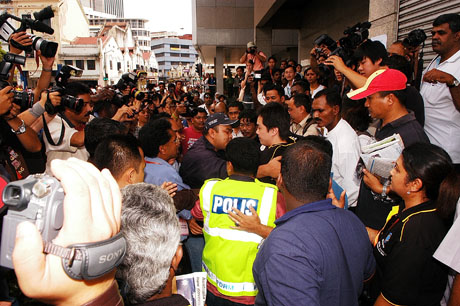
Police officers stop the march. Police personnel and photographers make it impossible for the group to move forward.

Your browser may not support display of this image.
8:12:16AM

Lawyers at the head ask that they be allowed to continue to walk to the Bar Council premises. Police officers reject their request.

Your browser may not support display of this image.
8:12:22AM

Senior police officer engages the lawyers, while the group’s path is still blocked by police.

Your browser may not support display of this image.
8:12:30AM

The group is still prevented from moving further.

Your browser may not support display of this image.
8:12:48AM

Lawyers ask that they be allowed to continue their march.

Your browser may not support display of this image.
8:14:00AM

Senior police officer agrees.

Your browser may not support display of this image.
8:14:15AM

Latheefa asks the crowd to move forward and continue the march towards the Bar Council premises behind Central Market.

Your browser may not support display of this image.
8:14:21AM

However their path is blocked by the same police personnel who stopped their march earlier.

Your browser may not support display of this image.
8:15:45AM

Lawyers Latheefa, Surendran, Eric and Sivrarasa consult the senior police officer on the blocked passage.
Latheefa asks, “Are you arresting me?” Police officer initially says “No”, but answers “Yes” after being asked again.

Your browser may not support display of this image.
8:15:52AM

Latheefa asks who else is to be arrested. Police officer points to the nearby lawyers (Sivarasa, Eric, Surendran)..

Your browser may not support display of this image.
[Original deadline to disperse expires, at 8:16:19AM]

8:16:50AM

Policed officers move in to arrest the lawyers.

Your browser may not support display of this image.
8:17:56AM

Latheefa is packed into the police van.

Your browser may not support display of this image.
8:18:07AM

Eric Paulsen is packed into the van.

Your browser may not support display of this image.
8:18:20AM

Sivarasa arrested.

Your browser may not support display of this image.
8:18:33AM

Surendran is packed into the police van.

Your browser may not support display of this image.
8:18:47AM

Amer is packed into the police van.

Your browser may not support display of this image.
8:20:35AM

Activist Nooraza arrested.

Your browser may not support display of this image.
8:28:09AM

The group continues the march to the Bar Council premises. Police do not interrupt, except the loud whirring of their helicopter.

Your browser may not support display of this image.
8:38:55AM

But the Bar Council premises looks like it is under siege.

Your browser may not support display of this image.
8:46:54AM

The police siege widens to the car park beside the premises (where stalls have been set up for the festival).

Your browser may not support display of this image.
8:51:27AM

Edmond and Rajen of the Bar Council negotiate with the senior police officer to remove his officers from the Bar’s rented space in the car park, and also to move out the police car parked there.

Your browser may not support display of this image.
8:52:02AM

The police officer agrees. The police personnel leave the rented space.

Your browser may not support display of this image.
8:52:09AM

Followed by the police car.

Your browser may not support display of this image.
8:54:27AM

Rajen of the Bar Council announces that the Bar’s Human Rights Festival is about to start and asks the people to move into the auditorium.

Your browser may not support display of this image.
9:44:09AM

The Human Rights Festival proceeds as scheduled and ends before lunch.

About 11.30am: Edmond is arrested after trying to prevent DBKL from taking down posters and banners in front of the Bar Council’s premises.

Conclusion: A simple march would have ended peacefully if our country recognizes fundamental human rights, especially on an occasion to celebrate World Human Rights Day.

Ambiga said "this is outrageous and I am in a state of utter disbelief at what has happened."

Ambiga (The Malaysian Bar President) said "this is outrageous and I am in a state of utter disbelief at what has happened.".

The Malaysian Bar Human Rights march was an annual affair - and the Malaysian Bar DID NOT STAND UP FOR THEIR RIGHTS - and canceled their March, that was to be from Sogo to the Central Market, and said that the remaining of Human Rights Day celebration will carry on in Central Market...

Then again the Bar backed off and cancelled their program in Central Market - and said that they would do their program indoors in their Bar Council auditorium...

But did the authorities let off - no they send the DBKL OFFICERS (the local authority enforcement personel) - not even the POLICE to come take down all posters from around the Bar building - and they took away the banners...

After that the human rights chairman (possibly feeling rather safe at the entrance of the Bar building) allegedly said
"Itu adalah hak kita" (this is our rights), Bon said. Bon was also heard inviting the senior police officer who was standing there, "Come, don't do that. Come and celebrate with us. There is nasi lemak and mee goreng inside." - and that he is when they arrested Mr Bon.

Now, what will be the response of the Malaysian Bar ? Will it stop at
"this is outrageous and I am in a state of utter disbelief at what has happened." ? Will it stop with a press statement? Will it stop with some meeting the IGP, PM and some memorandum of protest?

If the Prime Minister, the government, the police and the DBKL officers can get away with treating the Malaysian Bar and lawyers the way that they have done today - what hope is there for the ordinary person?


"This is outrageous!", Bar screams over arrest of Edmund Bon

Contributed by Web Reporter
Sunday, 09 December 2007, 01:25pm

Edmund Bon arrested
Edmund Bon arrested

KUALA LUMPUR, Sun: The Chairman of the Bar Council's Human Rights Committee, Edmund Bon was arrested after stopping some officers from the Kuala Lumpur City Council (DBKL) from removing banners and placards hung on the premises of the Bar Council Secretariat about 12.15 this afternoon.

Earlier, the Bar Council had decided to cancel the walk from SOGO to the Bar Council Secretariat in conjunction with the International Human Rights Day which falls tomorrow. The Council then decided to hold the celebration indoor at the Bar Council Secretariat. Banners and placards were also hung outside the building as well at the perimeter of the car park next to the building which was rented for this purpose. Some of these banners were carried by members during the September 26 Walk for Justice.

Then about 12.05pm, a team of officers from DBKL led by one Kulasegaram arrived and said the banners and placards had to be removed because they were put up without any permit. Edmund was then seen trying to explain to him that these banners and placards were hung on private property and asked whether Kulasegaram had any warrant to enter the premises.

Bar Councillor Roger Tan who had also just arrived then tried to persuade Kulasegaram to exercise restraint and to allow the celebrations to continue as these banners and placards would be removed by 3pm. Tan also said the Council had already cancelled the walk in good faith, and there was no need to mar the celebrations and aggravate the situation by resorting to this means.

However, the unreasonable Kulasegaram and his officers nevertheless went ahead to forcibly remove the banners and placards. Other members of Bon's committee together with the Executive Officer, Rajen tried stopping them shouting, "This is private property, and we reserve our rights against DBKL and each of you". One of the banners removed was totally harmless advertising Masakan Warisan

The DBKL officers then took the banners and placards away. It was at this time that the indignant Bon went back to the steps of the Secretariat shouting in the presence of the press that DBKL had no right to enter our premises as it is private property. "Itu adalah hak kita", Bon said. Bon was also heard inviting the senior police officer who was standing there, "Come, don't do that. Come and celebrate with us. There is nasi lemak and mee goreng inside."

Shortly thereafter, a police officer walked towards Bon and wrapped his arms over Bon and said, "You are under arrest".

A visibly shaken Bon's mother who was in the Auditorium located on the 1st floor then rushed down but Bon was already whisked away in a police car with a huge crowd of pressmen and lawyers running behind. The patrol car followed by another 2 unmarked police vehicles sped away with sirens screening.

Bon was sent to IPK, Pudu and there the Web Reporter understands he was met by the President of the Malaysian Bar, Ambiga Sreenevasan who was there visiting those lawyers who were arrested earlier in the morning for taking part in the walk from SOGO to the Bar Council Secretariat.

When contacted, Ambiga said "this is outrageous and I am in a state of utter disbelief at what has happened."

Human rights march: 5 lawyers arrested ( 3 other people who care also arrested)

As of 4.00pm, they are apparently still being held at the Ibu Pejabat Kontijen Polis (the big building beside the old Pudu Jail - as to whether they will be charged for illegal assembly, attempted murder or detained further under the Internal Security Act for having links with some terrorist groups is still a question mark - nowadays as it was also the case before anything is possible.

Call on the Prime Minister and the government of Malaysia for their immediate release
N Surendran, Amer Hamzah, Latheefa Koya and the 5 others, and for them not to be charged for exercising their right to assemble peacefully..

(The Bar Council had earlier that week ,having succumbed to fears and threats, canceled the Human Rights Day March - and interestingly their Human Rights Chairman, Edmund Bon, was also got arrested much later for apparently preventing DBKL officers removing banners outside the Bar Building.....


The put pressure - the Bar Council called off the Human Rights walk

They put pressure - the Bar then moved the Human Rights festival from Central Market back into their own building

They put pressure again to take out banners in the Bar Building ...and when they resisted finally - their Human Rights Chairman gets arrested

The lesson:- The more you succumb to government threats and pressures, the more the government will push until at the end there is no more human rights and democratic space - it never ends until people overcome their fears and take a stand

After all it seems that our Malaysian government wants a docile citizenry, one who will loyally say "All is right - government is good - no other regime can rule Malaysia - Malaysia boleh...boleh UNITY)


Human rights march: 5 lawyers arrested


Sunday, 09 December 2007, 08:21am

Human rights march: 5 lawyers arrested©Malaysiakini
by Syed Jaymal Zahiid | Dec 9, 07 8:16am

The police have arrested eight people, including five lawyers, for proceeding with a march to mark International Human Rights Day from the Sogo department store to Central Market in Kuala Lumpur early this morning.

The arrests came after a failed attempt by the organisers of the march to negotiate with the police to allow them to finish their march at their intended spot.

The 100-odd crowd was already halfway to their destination when the police give the marchers a 10-minute warning to disperse.

The organisers, who believed that they could complete their march within the time limit, wanted to press on. According to an eyewitness, the police however cordoned off the area, moved in and made the arrests even before the stipulated deadline expired.

Those arrested included five lawyers - N Surendran, Latheefa Koya, R Sivarasa, Eric Paulsen and Amer Hamzah. Others were Anthony Andu, Norazah Othman and an unidentified activist.

They were arrested near the Jalan Tun Perak LRT station and were immediately taken to the Kuala Lumpur police headquarters.

The eight were arrested under the Police Act for illegal assembly, said Dang Wangi's acting Superintendent Che Hamzah Che Ismail.

The remainder of the marchers dispersed following the arrests.

"Authorities seem to be upset by any visible signs of protest and I think this is a problem with the country," said Sivarasa, who is also a leader of PKR.

"They don't seem to be able to deal with peaceful dissent," he told AFP before he was arrested.

Organiser Latheefa said that Malaysians needed to continue to exercise their constitutional right to public assembly.

Willing to cooperate

Earlier today, at about 8am, the small group of about 100 gathered at the Sogo departmental store under the watchful eyes of the police. There were however no signs of the dreaded Federal Reserve Unit and their water cannon trucks.

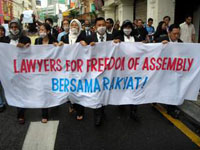
The marchers had carried banners that read "Lawyers for the freedom of assembly" and "Government that abuses human rights is terrorist."

Eyewitnesses said that one of the persons arrested was dragged into the waiting police truck and the arrests were done despite the marchers’ willingness to cooperate with the police.

This small group of marchers have undertaken this march after the Bar Council had dropped its annual march in conjunction with the International Human Rights Day celebration - which falls on Dec 10 - due to pressure to obtain a police permit.

Yesterday the police had warned the public not to participate in the march given that no permit had been issued for the gathering.

"As no permit has been issued for the gathering, those who take part in it can be charged under Section 27(5) of the Police Act 1967 for participating in an illegal assembly," warned Che Hamzah in a Bernama report.

Upon the decision of the Bar Council to call off the march, at least 15 lawyers decided to proceed with the walk to make a statement that citizens have a right to assemble peacefully and without prior requirement of a police permit.

Venue changed

Two days ago, Surendran had said that the march was purely initiated by a group of concerned lawyers, adding that the organisers will not be applying for a police permit.

“We think that applying for a permit is a negation of our fundamental right to freedom of assembly as enshrined in Article 10 of the Federal Constitution,” he had explained.

“We feel the (Bar Council) march was called of due to undue pressure from the authorities. We want to send a message that the people of Malaysia have the right to a peaceful assembly,” Surendran said.

Bar Council chairperson Ambiga Sreenevasan meanwhile had explained that the decision to call off the march was made after “anxious consideration to the present circumstances that surround the event, particularly the interests of the public and the Malaysian Bar."

The Bar Council also moved its “Festival of Rights” event today to its own building located near Central Market after police insisted that organisers apply for a permit to hold the event at Central Market.

In a related development, Ambiga today expressed disappointed over not being allowed to see the arrested people.

Ambiga said that the march was peaceful and slammed the arrests as "totally unnecessary and unfortunate."

"The Bar holds the view that requirement of police permit is unconstitutional," she told reporters.

Meanwhile the police continued to exert pressure on the Bar Council over their ‘Festival of Rights’ by arresting the council’s human rights committee chairperson Edmund Bon, allegedly for preventing the authorities from performing their duty.

Eyewitnesses said that Edmund was arrested at about 12.45pm for blocking Kuala Lumpur City Hall (DBKL) officials from removing human rights banners outside the Malaysian Bar building in Leboh Pasar Besar in Kuala Lumpur.

Friday, December 07, 2007

JOINT STATEMENT ON RELA TAKING OVER IMMIGRATION DETENTION CENTRES

Joint Statement
Ikatan Relawan Rakyat Taking
Over Immigration Detention Centres
Ikatan Relawan Rakyat (RELA) Taking Over Immigration Detention Centres
7 December 2007

Presented to the

Human Rights Commission of Malaysia (SUHAKAM)

Prepared in collaboration with

Non Governmental Organisations within the Migration Working Group (MWG) Network

JOINT STATEMENT ON RELA TAKING OVER
IMMIGRATION DETENTION CENTRES

We, the undersigned civil society organisations, are greatly alarmed at the recent Cabinet decision to have RELA (Ikatan Relawan Rakyat) take over the management of Immigration Detention Centres/ Depots.

According to newspaper reports, the Cabinet has relieved the Prisons Department of its jurisdiction over Immigration Detention Centres, and will place them under the control of RELA by the end of the year. This is a temporary measure until the Immigration Department has the resources to take over, which may take up to two years.

This move suggests that RELA will have greater control over the entire process, starting from arrest and detention to the deportation of migrants and refugees.

We are concerned that:

  • RELA volunteers do not have the specialized skills, experience, and training required to handle the detention of people according to international guidelines. They also do not have the organizational infrastructure (in terms of full-time staff, standard operational procedures and accountability mechanisms) required for the task of this magnitude.

The detention of human beings is a deprivation of liberty. In civilized countries, and in accordance with international laws, there are rules and regulations concerning detention. These include:

    • the prohibition of arbitrary detention,
    • limits to provisional or preventative detention,
    • minimum material conditions of detention (which include the separation of different categories of detainees, accommodation conditions that are decent, living conditions that ensure the self-respect of detainees, basic standards for medical services, as well as regulated procedures for discipline and punishment),
    • special conditions of detention for vulnerable groups (including children, mentally or physically ill persons and pregnant women)

Although there have been assertions that RELA will be trained on “policing” and “handling of riots”, we do not think that this is sufficient for the competent administration of large numbers of migrants in detention facilities.

The issue of the competent management of detention centres is not new. In 2003, SUHAKAM reported on seven detention centres, highlighting issues such as unhygienic living conditions, detainees languishing without assistance, prolonged and indefinite detention, severe overcrowding, deplorable conditions of buildings, skin diseases, an outbreak of meningitis, as well as the detention of trafficked persons, asylum seekers, and refugees. SUHAKAM’s recommendation then was for Prisons to take over the management of detention centres. Reports from detainees indicate that conditions of detention have improved markedly under the administration of the Prisons Department.

We strongly recommend that:

  • Immigration Detention Centres remain under the jurisdiction of the Prisons Department, who are better trained and equipped to handle detention facilities
  • The Prisons Department be allocated greater resources to address existing deficiencies in the detention system, such as the insufficient provision of basic facilities and services necessary for different categories of detainees
  • SUHAKAM be vigilant in fulfilling its mandate to monitor detention conditions, safeguarding, in particular, the rights of women and children in detention in accordance with recommendations by the Committee on the Elimination of Discrimination Against Women and the Committee on the Rights of the Child in their concluding observations on Malaysia dated 31 May 2006 and 2 February 2007 respectively
  • Immigration policies and practices concerning migrants and refugees be reviewed to eliminate unnecessary and unjust detention of migrants and refugees, which contributes to overcrowding and concomitant strain in resources. These include the detention of: documented migrant workers, migrant workers awaiting the outcome of court judgments, asylum seekers and refugees, infants, children, pregnant women, trafficked persons, the physically and mentally ill, and other vulnerable migrants.

  • If RELA is to take over Immigration Detention Centres, there is potential for abuse that has not been given sufficient consideration by government authorities.

Civil society groups have, on numerous occasions, voiced concerns about mistreatment, violence and wrongful arrests committed by RELA volunteers during operations to arrest migrants. We have highlighted cases of valid documents being torn up, migrants being beaten, sexual violence against women, shelters being burnt down, monies and possessions being stolen, and documented migrant workers and refugees being arrested.

However, the response of government officials has ranged from denial to justification to excuses. Instead of taking firm action against RELA, there have, instead, been recommendations to increase their powers under a proposed RELA Bill. We are concerned that these abuses, already occurring outside, will continue to occur within places of detention.

Under the existing Essential (Ikatan Relawan Rakyat) (Amendment) Regulations 2005, RELA has very wide and discretionary powers. This includes powers to stop any person by the standard of reasonable belief that the person is a terrorist, undesirable person, illegal immigrant or an occupier in order to make inquiries and to arrest these persons without warrant. They also have powers to enter and search premises without a warrant and to carry arms. Recent incidents have shown that RELA officers have arrested and detained persons on their own, without an oversight mechanism involving a competent authority.

Law enforcement work that involves powers to arrest, search and detain must only be given to competent and specially trained full-time authorities coupled with clear provisions in terms of powers and accountability, as these powers affect fundamental liberties and freedoms. These powers should not be extended to a volunteer civilian body with partially trained part-time members; they should be limited to Police and Immigration officials with clear guidelines and accountability mechanisms.

The use of RELA is not a durable solution to the issue of undocumented migrants; neither is the repeated use of arrest, detention and deportation. These are short-term, crisis-handling approaches of dealing with long-term, structural issues. We hold that the solution lies in a realistic and comprehensive review of immigration policies.

We strongly recommend that:

  • The existing enforcement powers of RELA over migrants and refugees be revoked
  • The proposed RELA Bill be open for public discussion and scrutiny in consultation with civil society groups

  • If RELA is to take over Immigration Detention Centres, they lack the capacity to deal with the health concerns of detainees that are linked inextricably to the right to life.

In addition, to general health problems, there have been a diverse range of emergency health problems amongst detainees in Immigration Detention Centres such as stroke, epilepsy, complicated hernia, obstetric complications, and ante-natal problems and abdominal problems requiring emergency care. These depend on competent response by authorities to detect and ensure that urgent medical assistance is provided, including timely access to ancillary services and to patient care beyond emergency care.

In relation to mental health, studies indicate that conditions of detention cause and/or perpetuate severe mental health problems, including depression, severe and chronic post-traumatic stress disorder, anxiety disorder and suicidal ideation. This is especially serious in the light of the life experiences of refugees and asylum seekers who have survived torture, persecution, human rights abuses, and witnessed various forms of violence perpetrated on their family and others.

During raids, RELA has already demonstrated insensitivity to the needs of women and children. RELA volunteers do not allow them time to pack necessary supplies such as milk, diapers, and sanitary napkins. The lack of these provisions seriously compromise the health of children and infants, as well as creates vulnerabilities for women detainees, who have been subject to sexual abuse, violence and exposure to sexually-transmitted diseases in exchange for necessary hygiene supplies.

We are also concerned about the possible termination of the contract of the private company that was brought in by the Prisons Department to provide health services to Immigration Detention Centres as this will further jeopardize health service provision to detainees.

We strongly recommend that:

  • SUHAKAM strengthen the monitoring of Immigration Detention Centres, in particular in relation to the right to health, in line with internationally agreed ethical principles and human rights standards, and with its reports and recommendations tabled and debated by Parliament
  • SUHAKAM verify information regarding the termination of services of the private company that provides medical care to detainees, assessing the potential impact this will have on health service provision to detainees
  • SUHAKAM seeks clarification from the Malaysian Government regarding how it plans to meet the health needs of detainees, as well as the process and mechanisms for medical and health referrals from Immigration Detention Centres
  • The Malaysian Government ensures the continuation of the existing constructive cooperation between the Prisons Department and civil society groups and United Nations agencies, especially in the area of provision of health services in Immigration Detention Centres

  • There is a strong emphasis on the speedy arrest, detention, imprisonment, sentencing and deportation of migrants and refugees, which may further contribute to the miscarriage of justice and the refoulement of refugees

One of the main reasons cited by newspaper reports for the handover is the facilitation of admission into detention centres as well as faster deportation.

Some civil society groups have already highlighted the miscarriage of justice that occurs as a result of the fast processing of cases through the Special Immigration Courts set up in Immigration Detention Centres. These include the inability of some detainees to understand court proceedings, the lack of translators, the difficulty of obtaining legal assistance while detained, and the pressure to plead guilty, as detainees are not allowed to post bail and wish to avoid prolonged detention required when claiming trial.

We are also concerned that existing checks and balances afforded by the Prisons Department in the processing of detainees will be removed. We are concerned that existing cooperation afforded to the United Nations High Commissioner for Refugees (UNHCR) in their interventions for asylum seekers and refugees will be jeopardized, leading to the continued detention of vulnerable refugees and a higher incidence of refoulement (the return of a refugee against his/her will to a territory where his/her life or freedom can the threatened on account of his/her race, religion, nationality, membership of a particular social group or political opinion). Similarly, we are concerned that the basic services given to detainees by civil society groups in order to address existing gaps in the system will also be jeopardized.

We strongly recommend that:

  • The Malaysian Government ensures that cooperation between UNHCR and law enforcement agencies with regard to detained asylum seekers and refugees remains
  • The Malaysian Government ensures that cooperation between civil society groups and law enforcement agencies in the provision of basic services to detainees remains
  • The Malaysian Government releases all documented asylum seekers and refugees and ensures that none are refouled, in order to meet their international obligations under international customary law

We draw the attention of the Malaysian Government to the following international guidelines:

  • 1955 UN Standard Minimum Rules for the Treatment of Prisoners (UN Economic and Social Council Resolution 2076)
  • 1985 UN Standard Minimum Rules for the Administration of Juvenile Justice (‘The Beijing Rules’, UN General Assembly Resolution 40/33, of 29 November 1985)
  • 1988 Body of Principles for the Protection of All Persons under Any Form of Detention or Imprisonment (UN General Assembly Resolution 43/173, of December 9, 1988)
  • 1990 Basic Principles for the Treatment of Prisoners (UN General Assembly Resolution 45/111, of 14 December 1990)
  • 1990 UN Rules for the Protection of Juveniles Deprived of their Liberty (‘The Havana Rules’, UN General Assembly Resolution 45/113, of 14 December 1990)

We, the undersigned civil society organisations:

1. Malaysian Trade Union Congress (MTUC)
2. Kumpulan ACTS Bhd.
3. Coordination of Action Research on AIDS and Mobility, Asia (CARAM Asia)
4. Aliran Kesedaran Negara (ALIRAN)
5. Amnesty International Malaysia (AI)
6. Suara Rakyat Malaysia (SUARAM)
7. All Women’s Action Society (AWAM)
8. Building & Wood Workers International (BWINT)
9. Women’s Aid Organisation (WAO)
10. Health Equity Initiatives
11. National Human Rights Society (HAKAM)
12. Labour Resource Centre (LRC)
13. Migrant Desk, Melaka-Johor Diocese
14. Penang Office for Human Development (POHD)
15. Civil Rights Committee of the Kuala Lumpur Selangor Chinese Assembly Hall
16. Writers Alliance for Media Independence (WAMI)
17. Education and Research Association for Consumers, Malaysia (ERA Consumer)

Thursday, December 06, 2007

POLL RESULTS: Has the BN government FAILED? - income disparity

POLL RESULTS

253 persons voted in this poll and the result is as follows

(Voters were only allowed one choice)

Malaysia has one of the worst income disparity in Asia. Richest 10% earn 22 times more than poorest 10% (controls 38.4 % of country’s economic income) - Has the BN government FAILED?

YES

65 (25%)

NO

8 (3%)

YES - but I still will vote for BN in coming elections

3 (1%)

YES - I will reject the BN in the coming elections

177 (69%)

Get Malaysia to support UN Resolution for moratorium on executions pending abolition of death penalty - URGENT Action needed

Support must be drummed-up for this RESOLUTION of the UN General Assembly which will be voted on very soon on or about 10/12/2007. At the committee stage, Malaysia opposed it, and so Malaysians groups and government should lobby for our Malaysian government to support this resolution at the General Assembly stage.


United Nations A/C.3/62/L.29
General Assembly
Distr.: Limited
1 November 2007
Original: English
07-57706 (E) 021107
*0757706*

Sixty-second session
Third Committee
Agenda item 70 (b)

Promotion and protection of human rights: human
rights questions, including alternative approaches
for improving the effective enjoyment of human rights
and fundamental freedoms

Albania, Andorra, Angola, Argentina, Armenia, Australia, Austria, Belgium,
Benin, Bolivia, Bosnia and Herzegovina, Brazil, Bulgaria, Cape Verde, Chile,
Colombia, Costa Rica, Croatia, Cyprus, Czech Republic, Denmark, Ecuador,
Estonia, Finland, France, Gabon, Georgia, Germany, Greece, Guinea-Bissau,
Honduras, Hungary, Iceland, Ireland, Israel, Italy, Latvia, Liechtenstein,
Lithuania, Luxembourg, Malta, Marshall Islands, Mexico, Micronesia
(Federated States of), Moldova, Monaco, Montenegro, Netherlands, New
Zealand, Nicaragua, Norway, Panama, Paraguay, Philippines, Poland, Portugal,
Romania, Samoa, San Marino, Serbia, Slovakia, Slovenia, Spain, Sweden,
Switzerland, the former Yugoslav Republic of Macedonia, Timor-Leste, Turkey,
Tuvalu, Ukraine, United Kingdom of Great Britain and Northern Ireland,
Uruguay, Vanuatu and Venezuela (Bolivarian Republic of): draft resolution
Moratorium on the use of the death penalty

The General Assembly,


Guided by the purposes and principles contained in the Charter of the United
Nations,

Recalling the Universal Declaration of Human Rights,1 the International
Covenant on Civil and Political Rights2 and the Convention on the Rights of the
Child,3

Recalling also the resolutions on the question of the death penalty adopted
over the past decade by the Commission on Human Rights in all consecutive
sessions, the last being its resolution 2005/59,4 in which the Commission called
upon States that still maintain the death penalty to abolish it completely and, in the meantime, to establish a moratorium on executions,

Recalling further the important results accomplished by the former
Commission on Human Rights on the question of the death penalty, and envisaging that the Human Rights Council could continue to work on this issue,

Considering that the use of the death penalty undermines human dignity, and
convinced that a moratorium on the use of the death penalty contributes to the
enhancement and progressive development of human rights, that there is no
conclusive evidence of the death penalty’s deterrent value and that any miscarriage or failure of justice in the death penalty’s implementation is irreversible and irreparable,

Welcoming the decisions taken by an increasing number of States to apply a
moratorium on executions, followed in many cases by the abolition of the death
penalty,

1. Expresses its deep concern about the continued application of the death
penalty;

2. Calls upon all States that still maintain the death penalty to:

(a) Respect international standards that provide safeguards guaranteeing the
protection of the rights of those facing the death penalty, in particular the minimum standards, as set out in the annex to Economic and Social Council resolution 1984/50 of 25 May 1984;

(b) Provide the Secretary-General with information relating to the use of
capital punishment and the observance of the safeguards guaranteeing the protection of the rights of those facing the death penalty;

(c) Progressively restrict the use of the death penalty and reduce the number
of offences for which it may be imposed;

(d) Establish a moratorium on executions with a view to abolishing the death penalty;

3. Calls upon States which have abolished the death penalty not to
reintroduce it;

4. Requests the Secretary-General to report to the General Assembly at its
sixty-third session on the implementation of the present resolution;

5. Decides to continue consideration of the matter at its sixty-third session
under the same agenda item.


__________________
1 Resolution 217 A (III).
2 See resolution 2200 A (XXI), annex.
3 United Nations, Treaty Series, vol. 1577, No. 27531.
4 See Official Records of the Economic and Social Council, 2005, Supplement No. 3 and
corrigenda (E/2005/23 and Corr.1 and 2), chap. II, sect. A.
A/C.3/62/L.29
2 07-57706

For the good of Malaysian Judiciary, Zaki Azmi MUST Resign

3 months ago a lawyer - suddenly in an unprecedented move elevated straight to a Federal Court judge - and now appointed as Judiciary's N0. 2. Oh yes - he was UMNO's lawyer & sat also in several other UMNO committees ....it is these facts that makes his appointment as the Court of Appeal President not at all good for the public perception of a fair and independent Judiciary.

ZAKI AZMI, should do Malaysia, especially the Malaysian Judiciary, and immediately tender his resignation as the President of the Court of Appeal.


Abdul Hamid is new CJ, Zaki is judiciary's No 2
Dec 5, 07 5:29pm

Court of Appeal president Abdul Hamid Mohamad has been today appointed as the new chief justice, which is the judiciary's most powerful post.

Meanwhile Zaki Azmi - who has parachuted into the Federal Court three months ago - has been appointed Court of Appeal president, taking over Abdul Hamid’s former post.

Zaki's lightning-fast promotion to the judiciary's No 2 post is unprecedented and is expected to raise eyebrows.

The King, Tuanku Mizan Zainal Abidin, has consented to the appointment of the duo on the advice of the prime minister and after consultation with the Conference of Rulers, said Prime Minister Abdullah Ahmad Badawi in a statement.

Abdullah said that Abdul Hamid's appointment took effect on Nov 1 while Zaki's would be decided later.

The premier added that the Federal Court is in discussion with Istana Negara as to when the instruments of appointment will be handed over to the two judges.

Abdul Hamid, 65, (left) was made acting CJ when Ahmad Fairuz Sheikh Abdul Halim (right) retired on Nov 1 under a cloud of controversy linked to the Lingam tape despite an indirect denial of involvement.

Abdul Hamid is expected to serve for no more than one year before he too retires from judicial service.

Born in Penang, Abdul Hamid was appointed head of the appellate court on Sept 5. He joined the legal service in 1969 and has served in Perlis, Perak, Kedah, Selangor and Kelantan.

He was made judicial commissioner of the High Court of Malaya in 1990 and two years later, became a High Court judge.

After being appointed to the Court of Appeal in September 2000, he was elevated to the Federal Court in August 2003. He has a year of service left before reaching the age of compulsory retirement.

Another blow?

The unconventional elevation of Zaki, 62, could pose another blow to the ailing reputation of the judiciary. Exactly three months ago, he became the first lawyer to be directly appointed into the Federal Court.

Before this, only lawyer Gopal Sri Ram had bypassed serving in the High Court when he was appointed to the Court of Appeal in 1994.

Zaki previously served as Umno’s legal adviser and disciplinary committee chairperson. He was also the party’s selection committee secretary and deputy chairperson of the disciplinary board appeal panel.

He stepped down from these posts in 2005 following his divorce from his second wife, Nor Hayati Yahaya, who was almost half his age.

With Abdul Hamid due for retirement next year, Zaki is the frontrunner for the judiciary's No 1 post.

Bar surprised over appointment

Meanwhile in an immediate response, the Malaysian Bar expressed surprise over the appointment of Zaki as the Court of Appeal president “given that there were other suitable candidates in terms of seniority and service in the judiciary”.

The Bar’s president Ambiga Sreenevasan said in a statement that Zaki was also only recently elevated to the Federal Court.

“There are the added concerns of his previous business interests and involvement in Umno,” she added.

However she said that the Bar, representing some 13,000 lawyers in Peninsular Malaysia, hoped that these concerns will be dispelled by Zaki’s display of integrity and exemplary performance on the bench.

While congratulating both Abdul Hamid and Zaki on their appointment, Ambiga also said that the Bar was looking forward to a new era of co-operation with the judiciary.