Monday, March 26, 2018

Evaluating UMNO-BN - Low Wages, Losing Employment Security, Large Debts, Future Insecurity...?

UMNO-BN government failure was to ensure that the income earned by each and every Malaysians increased....If we all had a higher income, then cost of living would not be a problem, would it?

For a long time, Malaysia kept wages low to ATTRACT the foreign investor to come set up factories and businesses in Malaysia. They also weakened workers' capacity to fight for better worker rights and working conditions...

As long as the government kept the cost of living down, and affordable, most Malaysians were not bothered and allowed this. But, then there was allegations of 'kleptocracy', corruption, abuses, bad management/governing - which includes a sudden drastic increase of government borrowing, especially in the past decade, seeing our debt skyrocketing, expose of the loss of Billions of ringgit...which followed the slow removal of subsidies, increased taxation, etc ...all of which has increased the cost of living drastically...making life difficult.

NOW, Malaysians are feeling the effect of our indifference to the way the UMNO-BN government was governing the country...The BLAME is also ours - we failed to keep an eye on our government to make sure that they did the right thing to keep us all safe and financially secure now and for the future...We allowed 'wastage of money', ...and maybe even kleptocracy...so some have become very rich...and the rest of Malaysians are stuck with the problems...and also the DEBT.

Over the years, the Malaysian government

- Invaded our 'Savings for Old Age', in particular our Employees Provident Fund(EPF/KWSP) - they allowed contributors to take out from this 'savings' to spend now to buy houses, etc ...they wanted people to spend more to help our economy NOW - not so bothered about how we will survive our old age...Well, this did not affect the public servants(who will still enjoy their pensions until death) but the workers in the private sector and self employed.

- Encouraged people to buy with money that they did not have - Credit Cards were given freely to people who would never even have qualified before. Hence, many Malaysians ended up in debt - many too became bankrupt.

- Encouraged people to buy HOUSES - Well, even if the house cost RM150,000, and there was no interest charged, and the loan had to be repaid in 30 years - it would mean coming out with RM417 per month. But, the reality is that Banks charge interest, so even if the interest was 5%(of course, it is much more usually), which makes the annual interest for a loan of RM150,000 = RM7,500( RM625 a month). Now, the big problem is that UMNO-BN has failed to preserve EMPLOYMENT SECURITY - the government could have insisted on REGULAR EMPLOYMENT(employment until retirement, which will ensure financial security, wage increments, etc) - but UMNO-BN simply allowed unhindered the use of short-term contracts and 'contractor for labour', meaning that employment security is not there for many of Malaysian workers will only have a guarantee of employment for a year or 2, and then the quest to find a 'new' job - but loan-paying obligations is monthly, and default can result in you losing your house. What use is a House in one town - when your next employment in a year or so may be is some far away location? HOW MANY OF YOU REALLY OWN YOUR OWN HOUSE...or the reality is that you will only be the real owner after the loan is paid up in 10-30 years to come?

Note:- 
* Reality is that every one need Homes to stay, and it must be close to where one works and lives. Most Malaysians, because of low or uncertain long-term income at the same locality, really cannot afford houses of their own...not yet.

* Public Servants - Well, they tend to be transferred all over Malaysia - as such, what is needed is for the availability of government housing when they move to a different town.

* Other than public servants - especially those that are not earning sufficiently to afford own houses, and noting because of current employment insecurity, they too need to move from place to place as well - Well, then maybe the government should be providing low rent housing especially for those who earn less than RM2,000 - RM3,000. [Remember, one will not be able to buy houses everywhere they have to move to for employment or for other important reasons]

* Government need to ensure that affordable houses (not low cost small apartment in high rise buildings) is available for everyone. Maybe, even government loans for the first home, where unlike banks and/or financial institutions, will be open to flexibilities especially when there is a loss of employment, etc...


HOW MUCH DO MALAYSIANS EARN?

* The TRUTH is hidden when the government do not provide income statistics for individuals, let alone families(husband, wife, non-working children, dependents). Household Income is misleading for it simply tells us how much households are earning, and this could be workers 'forced' to share a house because they cannot afford their own homes, this would include working children who have to stay at home because they cannot afford their own accommodation... 

According to Shahril[CEO of EPF], more than 75% of its 14 million EPF contributors earn less than RM2,000 a month. About 15% earn between RM2,000 and RM5,000 a month, while those earning more than RM5,000 are in the top 10%.

* One effect of low or inadequate income is crime - to survive some are driven to crime...but then, UMNO-BN has also stopped giving us detailed crime statistics. It is important to know the number of thefts, robbery, purse snatching, etc. Today, we get the CRIME INDEX...but not details.


EPF says 80% of workers have savings below poverty line as they turn 55

13 March 2015 Print page BY SHERIDAN MAHAVERA
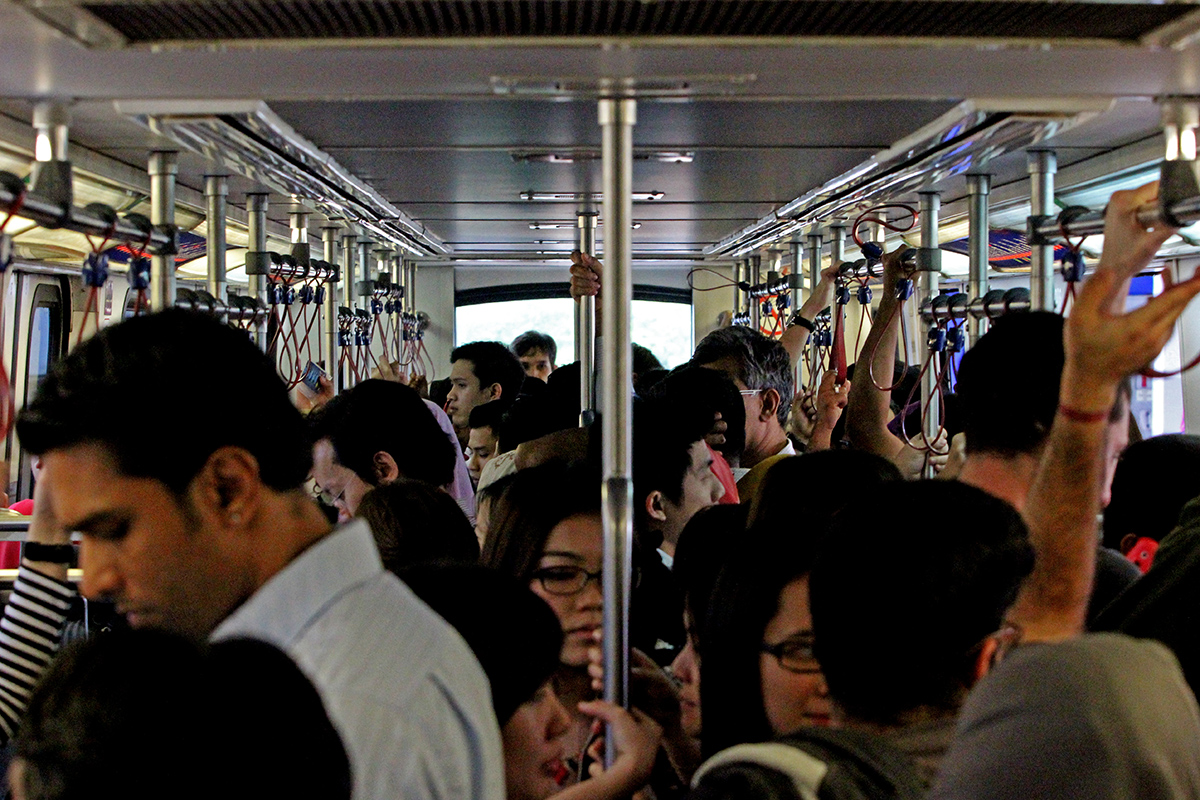
Malaysian workers during morning rush hour on their way to work. EFP says most Malaysians have not enough savings in their pensions fund as they reach 55, forcing many people to work into their 70s, reflecting latest global trends. – The Malaysian Insider file pic, March 13, 2015.

Nearly 80% of workers who will turn 55 this year will not have enough savings in their Employees Provident Fund (EPF) to live above the poverty line, according to figures released by the fund’s chief executive officer.

Datuk Shahril Ridza Ridzuan said for the next 20 years, the workers would not have enough in total EPF savings to enable them to live on RM800 a month, which is close to Malaysia’s average poverty line income of RM830.

This is because most of them had low wages when they started contributing to the fund in 1980s, and continued earning relatively low salaries till they turned 55, said Shahril, who did not provide a number for this batch of retirees.

The revelation shines the spotlight on the problem of low incomes among a majority of Malaysian workers, even as Putrajaya said it aims to make Malaysia a high income nation in five years’ time.

According to Shahril, more than 75% of its 14 million EPF contributors earn less than RM2,000 a month. About 15% earn between RM2,000 and RM5,000 a month, while those earning more than RM5,000 are in the top 10%.

The EPF has set RM196,800 as a savings threshold that would allow a contributor to spend at least RM800 a month for the next 20 years.

The threshold is revised every three years to take into account inflation.

Only about 20% of its contributors who turn 55 this year are expected to have RM196,800 in total savings. 

That percentage is likely to stay about the same in the coming years, said Shahril.

“Historically, we have a low wage environment, so that percentage has inched up only a little.

“This is why we tell contributors not to take out their savings till they are 60, when they really retire.

Datuk Shahril Ridza Ridzuan“That extra five years can earn them an extra 40% through compound interest,” Shahril (pic, right) said when met after a talk organised by the Chevening Alumni Association in Kuala Lumpur last night.

These figures, he said, reflect the new reality of working life in Malaysia, as people will have to work beyond 55 in order to save enough to live out the rest of their lives.

“This is the trend in developed countries and we are getting there. The reality is that you cannot retire and enjoy yourself at 55 any longer.”

That age was set in the 1950s and has not been changed to take into account longer life expectancies, he said, adding that these days, people expect to live through their 70s.

This trend is compounded by the fact that Malaysia is a rapidly ageing nation. In 2030, 17% of the population will be aged above 65, he said. In 2040, people aged 65 will outnumber younger individuals.

“So we need policies to deal with this, such as financial literacy training so that young people are aware of the need to save for retirement and how to integrate old workers into the market.

“These are issues that advanced economies have to deal with and we are getting there,” said Shahril. – March 13, 2015.


*


Friday, March 23, 2018

GST - Abolition alone cannot bring justice for most victims?

GST - Abolishing it now will really not bring justice to those already victimized - especially the small business people who had to shut down their businesses because of GST policy. SO many shops and businesses have closed down because of the GST policy and implementation...So many shop spaces available now in many towns...

IF YOU ARE JUST CONCERNED ABOUT WHAT YOU AND YOUR FAMILY WILL GET, AND IS NOT CONCERNED ABOUT THE WELL BEING OF ALL PERSONS AND FAMILIES IN MALAYSIA, THEN THERE IS A PROBLEM. AN INCREASE IN POVERTY AND A LACK OF EMPLOYMENT(OR INCOME GENERATION ACTIVITIES) WILL AFFECT THE ENTIRE COMMUNITY...

Why did the GST cause great suffering to the smaller businesses?

1 - The GST policy required the shopkeeper to pay the GST as soon as he received the good in his premises NOT after he sold it to consumers. [This pre-pay GST system killed many small businesses}

2 - The UMNO-BN government failed to realize that many small businesses/shops - Many do not pay immediately the suppliers/producers that send the product to their shops/places of businesses. If they manage to sell to consumers, then they pay the suppliers/producers. But, the UMNO-BN policy required them to pay the GST immediately when it arrives.

3 -  The suppliers(or middle man) who had to pay GST when they took products from the producers(or major suppliers) also now will control themselves and take less - and they may not want to sent the supply to smaller shops and those in smaller towns, where the rate of sale is slow...so, even the community suffers.

4 - Local producers of products(not the famous brands) also find that less and less shops will want to take their products and 'try to sell' - because if you take the products you have to pay GST first - not sure whether any consumer may want to buy these new local products usually. And guess what the government officers are always dropping by and checking...

5 - The UMNO-BN GST also forced people to have to buy computer,program and equipment - also need to submit accounts...(so had to hire an additional worker for this) so, a lot of the old time people running businesses suffered...and could not afford the extra cost..

6 - When the shops suffer, i.e. the amount they need to spend increases, then consumers also will suffer....After all, now they had already paid the GST (and also in some cases, they had to pay their suppliers when products arrived at the shop) - so their cost of operation thanks to the way the GST was implemented ...caused some to go out of business(and some had to charge consumers more ...or pay now...'no more hutang')

TAX - Most products had before had Sales Tax - and it was in the Price of the Product(so, we never realized this). It was 6% also - but that was based on the price the factory sold...Now, GST increases tax collected because now it is based on the final price - the price the consumer pays. The UMNO-BN government could have simply forced producers - to pay tax on the final price the consumer pays. Then, no need for suppliers to pay GST, shops to pay GST, and consumers to pay GST...

The way the UMNO-BN implemented the GST, in short made the small person suffer - from the middle-man, suppliers, small shops, etc ... and the consumer. 

What the UMNO-BN could have done was:-
* Collect the sales tax as it did before but charge it at the point of production. The change would be that tax will be based of price the good is sold to the end-consumer, from the price sold by the factory to the supplier. 
* The payment of the tax would be after the goods are sold to the consumer, and after the factory has received the monies for the good. No 'pre-pay' of taxes before you earn.
* The government should also maybe control the prices the supplier sells to the final retailer, ensuring both enjoy reasonable profits.


**  One major problem for smaller shops is that the company(or supplier) do not want to supply them the products - so many shops are forced to rely on hypermarkets or supermarkets to get their products, which they buy and take to their shops and sell to customers ...[Of course, one needs to make a 'profit' and need cover all 'additional cost' in transport/time, etc...] - So, even the fixed price of product should be allowed to be sold at a higher price by such shops...


BUT the problem in Malaysia - is the low income of Malaysians - Our Minimum wages is RM1,000 - it should be really at least RM2,000 - because cause of products will rise but Malaysian's income is not rising...[Last time a low cost house cost you RM40K - now the government says it cost RM100-150K - so have the wages of Malaysians risen at the same rate?]

Some cost increase - is because of the removal of subsidies ...

One major factor is drop in the value of the Malaysian Ringgit ...even against Thailand and Indonesia...not just US and Europe...that is linked to maybe 1MDB, the state of Malaysian Courts and Judiciary, the administration of justice, etc ...kleptocracy and how Malaysia dealt with it?

See earlier related posts:-

People killing themselves because of GST? Government admit GST caused closure of businesses..?


Is GST responsible for rising prices?

Published on  |  Modified on

A QUESTION OF BUSINESS | Is the Goods and Services Tax (GST) responsible for higher prices now? Can one reverse the price increases by scrapping the GST or zero-rating items in the GST? Will the poor see a significant drop in living costs if we removed the GST?

Unfortunately, the answer to all three questions above, as we shall see, is a resounding “no!” Which begs the question why the opposition is using these old, false assertion to whip the rakyat into a frenzy.

That’s probably because their surveys show that the rise in living costs is a major election issue. So, their spin doctors - yes, the opposition has theirs too - probably decided that demonising GST will resonate with the rakyat. Never mind-lah that it is not quite accurate! Easy to message, ma.

That GST ploy appeared to backfire some when Penang Chief Minister and DAP supremo Lim Guan Eng was criticised heavily for encouraging, singing and dancing to a heavily political GST singalong with children.
Lim’s defence was rather pathetic, saying that BN was practising double standards when the Federal Territory minister and Umno secretary-general did worse at a government school. Does that imply that it is okay for Lim to descend to the kind of behaviour that BN politicians practise? By now he should know that the public wants a higher standard of behaviour from him than that.

But the truth may actually resonate better with the rakyat in this case. There is a good story to tell. In any case, should anyone who wants to be more moral and honest than BN try and win the election by putting up half-truths? No.


What is closer to the truth is that the cycle of price increases is more related to the depreciated currency - now around RM3.9 to the US dollar, which has come down steadily from around RM3 around post the 2009 world financial crisis when money flowed into developed countries. And the other problem is that incomes have not risen sufficiently to keep up with rising prices.

But first, is the GST responsible for higher prices now? No. Because it was implemented on April 1, 2015. In fact, the full-year effect on prices as a result of GST was 2016. Most of the price increase would have occurred in 2015 because GST was already in place for nine months. It is an indisputable fact that GST is no longer responsible for rising prices.

For 2017, therefore, price increases and the rising relative cost of living - incomes staying stagnant while prices increased - that people are experiencing is not at all due to the GST. On top of that, a long list of goods and services are exempt from GST, which means price increases for these cannot be attributed to GST. This includes almost all food consumed by most people, transports costs, many services, education and so on.

Why set the clock back?

In fact, GST is a good tax in the sense that it taxes consumption - those who consume pay more, with essential goods and services exempted. It catches too those who evade income tax by taxing consumption because it is the rich who consume more and therefore spares the poor for whom many essential items are exempted anyway.

Not only are the opposition’s assertions false, it appears that they don’t even want to help the poor by raising taxes from those who can afford it to help the development process. Who are the opposition helping by cutting GST? The poor? Certainly not. 


Will abolishing GST bring down prices for the poor? Highly unlikely because the poor consume essential goods more which will not move even a little bit down because there is no GST on them. What will happen is that although the price of consumer goods may, I repeat may, go down prices are more likely to be slow to adjust and will not drop by as much - sticky downwards.

Where the prices will go down is for items where the prices are clearly marked - such as cars or restaurant food prices. But even then, what many of them would do is to simply increase their prices and say that costs have gone up. Thus, GST removal is likely to have an extremely limited impact in terms of prices coming down, and certainly not for the ordinary man.

So will the poor see a significant reduction in the costs of living if GST is removed? Of course not. The opposition is campaigning strongly on an issue which is not – yes, rising costs are an issue but not GST because that is not what is causing costs to rise anymore.

The groundwork has been set and the GST is being collected. Difficulties have already been ironed out. Some 160 countries around the world implement it. Why set the clock back and abolish it? There is so much more the opposition could be doing.

If GST is not the cause of rising prices now, what is then? Now we come to the real story. Currency depreciation is the main one. When BN under Najib Razak was re-elected in May 2013, the ringgit was RM3 to one US dollar. Today it is RM3.90 - in effect a depreciation by about nearly a quarter or some 25%. That exerts a lot of cost pressures because on average prices of imports are going up by an average of 5% a year, adding up over the years.

Yes, some money is moving back to the US but the Malaysian currency depreciated more than most despite the economy showing good relative growth and performance. Why? Most probably because of reduced confidence in Malaysia caused by 1MDB, the biggest case of kleptocracy in the world. Investors and speculators, and many Malaysians have imputed a negative premium on the ringgit.

The other reason is that successive BN governments, including Najib’s have not done enough to increase the incomes of ordinary people, which means price increases exceed income increases. These are the two main reasons why people are suffering from the higher cost of living.

Is that not a sexy enough story to tell voters instead of resorting to half-truths, economically unsound measures like abolishing GST and asking children to participate in misleading singalongs? Imagine what will happen if GST is removed and prices remained high and increased anyway as it is most likely to. Then what? 

How does the opposition fill that hole in revenue?

For me, the main reason this government should go is that it has allowed kleptocracy - theft of unimaginable proportions, circa RM40 billion - to go uninvestigated and unpunished. That’s good enough reason instead of conjecturing falsehoods and descending to the low level of the incumbents.

When your hands are clean, truth is the best defence - and offence. Keep the dirt off your hands and fight, then you stand a better chance of converting people to your side to win the war.


P GUNASEGARAM believes that if enough people know the truth about BN and the government, it will topple. E-mail: t.p.guna@gmail.com.

No jail or fine for Datin for voluntarily causing grievous hurt by dangerous weapons? Special treatment for Datins and Rich?

Press Release

Abuse of Domestic Workers is Unacceptable and Must be Punished Accordingly

The Malaysian Bar supports the Attorney General’s decision to file a notice of appeal against the manifestly inadequate sentence imposed on Datin Rozita Mohamad Ali, who was let off with merely a good behaviour bond for five years with one surety of RM20,000 by the Petaling Jaya Sessions Court on 15 March 2018.  She had pled guilty to a charge of voluntarily causing grievous hurt by dangerous weapons or means, under Section 326 of the Penal Code. 

Datin Rozita Mohamad Ali had used a kitchen knife, a clothes hanger, a steel mop and an umbrella to cause multiple injuries to migrant domestic worker Suyanti Sutrinso’s head, hands, legs and internal organs.

The blatantly light sentence meted upon the accused is shocking and inappropriate, especially in light of the extreme and appalling nature of the injuries inflicted upon Suyanti Sutrinso.

The light sentence has drawn significant negative publicity within and outside Malaysia, particularly in the Indonesian press..  It has also lent to the public perception — evidenced by the 48,000 persons who have signed the online public petition to date, calling for “equal justice for the rich and poor” — that the accused received preferential treatment due to her perceived financial and social status.  Such perception does not augur well for the administration of justice in our country.

As Lord Denning said in Metropolitan Properties Co (FGC) Ltd v. Lannon [1969] 1 QB 577: “Justice must be rooted in confidence: and confidence is destroyed when right-minded people go away thinking: ‘The judge is biased.’”

The courts ought to impose a more appropriate sentence in accordance with the law, commensurate with the grievous nature of the crime that was committed.  A deterrent sentence is warranted in this case, to convey clearly the strong message that all persons are equal before the law; and that the abuse of any person in Malaysia — and migrant workers are no exception — is not condoned by the State, and offenders will be subject to severe punishment.


George Varughese  
President
Malaysian Bar

22 March 2018

Monday, March 19, 2018

Dilemma of the Malaysian Voter - Which Opposition Candidate shall I choose?

For many Malaysians, there seems to be an urgent belief that we now need to have a NEW government - no more the UMNO-led coalition government that has governed Malaysia since Independence - today the Barisan National. Unlike most democracies, Malaysians have never experienced the rule of another government...In power for so long is unhealthy - it could lead to greater corruption, abuses, kleptocracy too...

Remember that saying 'a new broom sweeps cleaner' - Well, that is true, is it not? Anyway, we elect people into government once every 5 years(usually lesser) - So, if the new government fails to do a better job - then we can always change come next elections.

In Malaysia, by allowing just the UMNO-led BN to continue on is very dangerous - it gives the message that we are 'HAPPY" with the manner in which the country is being governed...

Are we OK with a government that has caused our debt to be increased -  The debt increased significantly after the Mahathir era, especially during the Najib era - now about
RM883.4bil (US$215.5bil). Remember every Malaysian is liable for a government debt (or a government guarantee for the debt of some other company)


Malaysia's external debt rose to RM883.4bil (US$215.5bil) or 65.3% of GDP as at end-December 2017
Read more at https://www.thestar.com.my/business/business-news/2018/02/14/malaysia-external-debt-higher-at-rm883pt4b-end-dec-but-manageable/#vqEztc4DAPsYDfyi.99

In the past, the Malaysian government was more transparent - but today, even in the face of allegations, there is a 'lot of secrets' or simply no answers. When the issue about billions in the PMs personal account came up, it was most distressing that Najib did not quickly come out and personally explain to the people. In the 1MDB matter, where there are numerous legal action in US and other countries, which certainly severely impacted on  reputation of this wholly owned government company and the government who is responsible(on behalf of all Malaysians) - the government has yet to provide a clear explanation or a denial to the people. There is no action against foreign governments that has done this...? Why? 

1MDB paid billions wrongly to a company - and then later had to come out with the money to pay the correct recipient...This alone is a major issue, but to date we have not heard about legal actions being taken against those responsible - and also not much news about what action is being taken to recover the wrong paid billions. How does anyone make such a mistake - more so when it involves paying out Millions or Billions of ringgit?

Malaysians would generally not be too bothered - but when it started affecting the people directly - then, we are bothered. Removal of subsidies, increasing cost of living, reduction of personal savings and wages(when the ringgit becomes weaker - the real value of the money we have also shrinks). 

Malaysia seem to have lost assets and control even in what was previously companies owned(more than 50%) and controlled by government and government agencies. DRB Hicom (so even Pos Malaysia maybe), Proton, etc... Of course, the fact that Malaysia has not been very transparent as to shares/stock held, profits made annually(losses), etc...and the fact that law does not allow the Auditor General to also audit these companies(now as of right, only government(Ministries/Departments/Agencies) are being audited and reports made available to the public. So, the people are kept in the dark with regard to what is happening to our monies and business, etc..  [1MDB also was not subject to Auditor General's annual audit and report, and the audit was done on government specific request, and then it was kept secret using the OSA).


NO ONE CAN GOVERN MALAYSIA EXCEPT THE UMNO LED BN? Proven Not to be true

That was the concern of many Malaysians but it is no longer a concern ever since the Opposition have been winning States and forming State governments - and proof has been shown that the Opposition has the capacity to govern. [Either way, any party coming in as the winner at the next General Elections really has nothing to worry about because - the daily running of government is no problem as it will go on smoothly as the public servants always will do it. The politicians and the new Prime Minister that come into power generally are concerned with 'policy' changes...so even if a Minister, is not so educated in healthcare - he can still be Minister of Health, and all will go on as usual] 


PROBLEMS AND WORRIES NOW??? 

It would have been most easy if we had to choose between ONE Opposition Coalition and the current UMNO-BN government - like what happened in past General Elections. In the past elections, generally we found a working relationship between the primary Opposition parties being PAS and DAP, or they were part of one pact - Now, they are in different Opposition pacts - and, if one looks at the media, way too much time is being spend attacking and discrediting amongst Opposition parties - so much so, that sometimes the focus on the incumbent UMNO-BN failures diminishes. The dilemma for many may be what will I do if I have to decide between UMNO-BN and 2 of the Opposition pacts(one led by PAS and another that includes DAP) - will the split of support favour the UMNO BN?

Many other Opposition political parties generally stayed out from the past few General Elections simply to allow for a success of the existing Opposition pacts(PR) - to enable a 1 to 1 contest. But, come this General Elections, many of these parties will no longer step aside, including parties like PRM and PSM...who have already announced intention to contest, some even have identified candidates.

The exclusion of other Opposition parties, by the then Pakatan Rakyat(PR) and now Pakatan Harapan(PH) was a mistake - they should have been working to get all(if not many more) Opposition parties not just in Semenanjung but also Sabah and Sarawak into one Opposition coalition. They should have spend time working out COMMON policies and positions...but alas they did not manage to do. YES - it is a difficult exercise, because different political parties come into being with different ideas, principles, values, ideologies or even for different purposes...(including to represent certain ethnic or religious groupings)...But, to finally help Malaysians get an alternative government - other than UMNO-BN, maybe more effort could have been undertaken.

SO, which Opposition party should I cast my vote for? That is the question - that is the dilemma of Malaysians today...

One solution is that these 2 Opposition coalition sit down and try to work it out to ensure that we will be faced with the simple choice of choosing between an UMNO-BN candidate and an Opposition alternative...

The other Opposition parties should also be part of this discussion...That will be best.

The choosing of the candidates will also be crucial - we prefer candidates who have an history of struggling for justice and human rights...Someone who has not been 'bothered' about this issue may not be the best choice for a people's representative - because after being elected, he/she may continue maybe just attending the Parliament/DUN - and not even speak up there...or worse still absent himself/herself during important votes...A MP/ADUN is best a full-time MP/ADUN - not someone who is still very involved in his/her personal business and/or profession. 

A person elected as an MP/ADUN has got so much work - he will be expected to study about a lot of new things so that he can be actively involved in the debates in Parliament/DUN - he will be able to explain to his/her constituents what is happening, and why is taking that position or taking an opposing view ...his/her answer should not be simply because the political leaders told him to take a particular position. We complained about UMNO-BN MPs not having regular consultations/discussions with their constituents - not making them available to answer questions...Not sharing the answers he/she received as a written response, etc ...but sadly even today many of our Opposition MP/ADUNs behave the same - not even a FB Page, Website or Blog to be able to continuously communicate with the people...Many are not even fighting for issues and causes - not even present at people's protest .. 

SO, maybe we need a new coalition or group that will help us evaluate and tell us who be the best candidate to support in particular constituencies as the best Opposition choice, from amongst all that are standing including independents...The political parties cannot resolve this, so maybe we need Independent persons/groups to help us in the choices we make...

WORRIES after the next GE - if BN fails to get majority at the Federal level or the State level?  

Biggest worry is the 'katak'(frog) - well money, promised rewards and/or threats could make an Opposition MP/ADUN change affliation..

A worry that even an Opposition party, in the Opposition coalition may suddenly return to UMNO (or maybe join BN as a new coalition partner). Semangat 46 did this before...and like Semangat, we have a few parties led by former UMNO(or BN) personalities - their desire may simply to get rid of Najib...and, if that happens, they may return...

What about agreements with all candidates to ensure that they will resign as MP/ADUN before they jump parties? {Our election laws is bad because it now does not allow a MP/ADUN to stand in the by-election that follows that resignation - this should be changed - the resigning MP/ADUN should be allowed to also stand for the said by-elections...then, the people will still have the choice to show that they still want the resigned MP/ADUN ...It is useful especially when false allegations arise for any MP/ADUN to go back to the people in another elections, to strengthen his claim that the people still choose him/her despite allegations of corruption or some crime...?


UMNO-BN attitude, lack of action and 'cover-up'? Bar demands more of government...

One problem that is emerging is the public perception that government seems to be not interested in investigating allegations of crimes committed by possible persons working in government and even 'members of the administration'(Prime Minister and Cabinet), and persecuting the alleged suspects.Officials and police involved in wrongdoing seem to not end up being prosecuted in court. The lack of a proper transparent explanation by the government is also a problem. 

The Malaysian Bar, at its recent AGM, highlights the the discovery of mass graves and “death camps” - whereby about 150 graves were discovered. It highlighted also the contention by New Straits Times that 'there had been a “massive, coordinated cover-up” of the mass graves and “death camps” and the investigations surrounding it'. Read the Resolurion which contains more details.


Resolution Regarding the Discovery of ‘Death Camps’ in Perlis

WHEREAS the Malaysian Bar:

(1) Is outraged by the unprecedented discovery of mass graves and “death camps” within our borders. The more than 150 graves at “death camps” spread across various remote sites in the state of Perlis, near the border with Thailand, as reported by the New Straits Times on 26 May 2015 (Appendix 1) are widely believed to have contained human remains of victims of trafficking or smuggled migrants who died whilst in the custody of traffickers or smugglers.

(2) Is deeply troubled by an article in the New Straits Times on 20 December 2017 (Appendix 2) stating that there had been a “massive, coordinated cover-up” of the mass graves and “death camps” and the investigations surrounding it. The article details various allegations as regards the way in which the discovery was handled as follows:
(a) Two conflicting reports submitted by the police on the events that unfolded on 19 January 2015;

(b) A coordinated cover up involving complicity, collusion, and corruption of law enforcement agencies with syndicates which perpetuate these acts;

(c) That “… there had been some “serious redacting” in reports and papers filed in the course of investigations.”; and

(d) That “… the local middleman, who had been taken into custody had admitted to greasing the palms of personnel in border security agencies to ensure that his operation could continue unmolested.”

(3) Finds that the two New Straits Times articles have resulted in conflicting accounts of the events and raises the following queries:

(a) When exactly were the sites discovered?

(b) When were the graves found?

(c) Why the destruction of the sites was ordered before relevant forensic evidence was extracted?

(d) How long had the sites been in operation?

(4) Notes that several Thai nationals, including politicians and an army general, have been found guilty in Thailand pursuant to investigations initiated by the Thai authorities and sentenced to long periods of imprisonment.1

(5) Is not aware of any reports of any Malaysians charged for these heinous crimes in Malaysia, save for the foreigners already charged and sentenced in court for immigration offences,2 with victims predominantly repatriated. These are crimes that are perpetrated not just by foreigners but in collusion with Malaysian counterparts who have yet to be held to account.3

(6) Notes that Malaysia is obliged to uphold the underlying values of international human rights laws and norms set out in, inter alia, the United Nations Convention Against Transnational Organized Crime (November 2000), the Protocol to Prevent, Suppress and Punish Trafficking in Persons, Especially Women and Children (December 2000), the Protocol Against the Smuggling of Migrants by Land, Sea and Air (December 2000), and the United Nations Against Corruption (October 2003); and regional obligations, namely the ASEAN Convention Against Trafficking in Persons, Especially Women and Children (November 2015), all of which the Malaysian Government has voted in favour and/or signed.

(7) Recognises the Government of Malaysia’s commitment to eradicate human trafficking with the implementation of international obligations in the Anti-Trafficking in Persons and Anti-Smuggling of Migrants Act 2007 and the Pelan Tindakan Kebangsaan Antipemerdagangan Orang (2016-2020) by the Majlis Antipemerdagangan Orang (MAPO”).

(8) Reiterates that no stone should be left unturned in cleaning up our backyard as our international reputation is at stake and this incident remains a stain on the fabric of Malaysia. In light of this, as a nation we need to acknowledge and come to terms with these atrocities that have occurred within our borders and ensure that justice is served.

Therefore it is hereby resolved that:

(A) The Malaysian Bar call upon the Government of Malaysia to take all necessary steps to ensure that such tragedies never recur within our borders, including:
(i) To abide by and uphold the principles of justice, good governance and the rule of law, and to respect, promote and protect the human rights of trafficked persons within Malaysia’s borders;

(ii) To establish a Royal Commission of Inquiry (“RCI”) to investigate the existence of the mass graves and “death camps”, and the allegations of, among others, a cover-up, complicity, collusion, and corruption of law enforcement agencies, and to identify the perpetrators concerned; and

(iii) To adhere to its obligations under international law and thereafter take steps for legal, policy and institutional reform in compliance with the same.

(B) The Malaysian Bar call on the Government of Malaysia, and specifically the Ministry of Home Affairs, to better resource the implementation of the provisions of the Anti-Trafficking in Persons and Anti-Smuggling of Migrants Act 2007 and the MAPO Pelan Tindakan Kebangsaan Antipemerdagangan Orang (2016-2020), by increasing investigative teams and developing them to become specialist teams dedicated to the identification, apprehension and prosecution of human traffickers and those abetting them, and to work closely at all levels of policy formulation, administration and implementation, with civil society organisations an other stakeholders to improve public awareness of and eradicate human trafficking.

(C) The Malaysian Bar call on the Royal Malaysia Police to fully disclose the extent of these crimes and the various personalities involved and to all take necessary steps to thoroughly investigate and bring those responsible for these heinous atrocities to task.

(D) The Malaysian Bar call on the Human Rights Commission of Malaysia (“SUHAKAM”) to exercise its functions and powers pursuant to sections 4(1)(d), 4(2)(d) and 4(2)(f), read with section 12(1), of the Human Rights Commission of Malaysia Act 1999, to carry out an inquiry in respect of the alleged human rights infringements, and produce a report of its investigations, findings and conclusions.

--------------------------------------------------------------

1 “General among dozens found guilty in Thailand's largest human trafficking trial”, Sydney Morning Herald, 20 July 2017.
2 “Thai man gets five years jail for Wang Kelian human-trafficking”, New Straits Times, 15 December 2016.
3 “12 cops arrested over Perlis migrant mass graves”, Malay Mail Online, 27 May 2015.


Note:-

One may want to look again at the:-

[EXCLUSIVE] The secrets of Wang Kelian exposed - New Straits Times

https://www.nst.com.my/news/exclusive/2017/.../exclusive-secrets-wang-kelian-expose...
Dec 20, 2017 - KUALA LUMPUR: An exhaustive, two-year investigation by the New Straits Times Special Probes Team into the mass killings in Wang Kelian in 2015 that shook the world, has revealed startling new evidence, which suggests a massive, coordinated cover-up.

Friday, March 16, 2018

Group against death penalty warns amended Drug Act still has flaws(Malay Mail 15/3/2018)

MADPET and others have been drawing attention to this unjust delay through Media Statements, which were all carried by the Media, since 19/1/2018. MADPET issued a statement on 19/1/2018, and another on 25/1/2018. A joint statement by 45 Groups was issued on 14/2/2018. Now, allegedly there are also about 2 Motions on this issue tabled for discussion in the upcoming Malaysian Bar AGM on 17/2/2018. 
Thursday March 15, 2018
09:32 PM GMT+8
Charles said that the amended Act also did not address the more than 800 convicts in the country currently on death row for drug trafficking. — AFP picCharles said that the amended Act also did not address the more than 800 convicts in the country currently on death row for drug trafficking. — AFP pic KUALA LUMPUR, March 15 ― The removal of the mandatory death penalty for drug offences under the Dangerous Drugs Act 2017 starts today, however, Malaysians Against Death Penalty and Torture (Madpet) said there were still major flaws in the Act.

With the amendment to the Act, judges are now given the discretion to sentence convicted drug traffickers with a life sentence alternative with no less than 15 strokes of the whip.

In a statement today, Madpet said the new law will only benefit those who have yet to be convicted by the High Court.

“If one has already been convicted and sentenced to death prior to the amendment then even the Appellate Courts will not have the power to review the death sentence, and impose an alternative sentence for drug trafficking.”

“The only way that those already sentenced to death can escape the death penalty is if the Appellate Courts set aside the conviction for drug trafficking,” it said.

Madpet’s coordinator Charles Hector said the implementation delay resulted in injustice for 10 individuals who have been sentenced to death as reported by the media.

“This is because judges still had no discretion to consider and impose any other sentence other than death penalty until the Act came into operation,” he said.

Charles added that despite the amendment, limitations were still evident when considering the factors by which a judge can review a case before sentencing a convict.

He added that the amended Act also did not address the more than 800 convicts in the country currently on death row for drug trafficking.

“Madpet calls for the immediate amendment of the law to ensure full unfettered discretion be given to judges when it comes to sentencing those convicted of drug trafficking.”

He also urged for judges to be allowed the discretion to impose sentences fitting for the crime, especially for first time offenders.

Madpet in the statement also called for the abolition of the mandatory death sentence in Malaysia conclusively and reiterated its call for a moratorium on executions pending abolition following the amendment to the Act.

The amendment of the Act was first passed on November 30 via a majority voice on the last day of the Dewan Rakyat meeting.

Minister in the Prime Minister’s Department Datuk Seri Azalina Othman tabled the alteration to the bill to give full discretion to judges in sentencing drug convicts.

The previous version of the amendment bill states that judges could only exercise their discretion if the Public Prosecutor issued a certificate declaring that the convict had cooperated with authorities.

The relevant section 39B of the amendment bill was altered to remove the requirement of the certificate.
The amendment bill however does not apply in retrospective for previous convictions.- Malay Mail, 15/3/2018

See full statement:-

At Last, Mandatory Death Penalty For Drug Trafficking Abolished With Coming Into Force Amendment Act On 15 March 2018


See earlier relevant post

No reason to delay commencement of DDAA 2017(Malaysiakini) - says 45 groups(14/2/2018 - Joint Statement - 45 Groups)

Minister’s Delay Resulted in Judge Having No Choice but to Sentence A. Sargunan and 4 others to Death(19/1/2018 - MADPET Media Statement)

Malaysian is 6th victim because Minister's delay bringing into force law that abolishes mandatory death penalty for drug trafficking?(25/1/2018 MADPET Media Statement)

Judges forced to sentence at least 7 to death because Dangerous Drugs Amendment Act 2017 not in force yet? 

MALAYSIA’S CABINET’S DELAY IN TABLING LAWS ABOLISHING THE DEATH PENALTY RISKS UNNECESSARY LOSS OF LIFE -Immediate Moratorium On ALL Executions -

Minister’s Delay Resulted in Judge Having No Choice but to Sentence A. Sargunan and 4 others to Death

Don’t let delay in applying new dangerous drugs law take more lives(FMT)

Thursday, March 15, 2018

At Last, Mandatory Death Penalty For Drug Trafficking Abolished With Coming Into Force Amendment Act On 15 March 2018


Media Statement – 15/3/2018


At Last,  Mandatory Death Penalty For Drug Trafficking Abolished With Coming Into Force Amendment Act On 15 March 2018


MADPET(Malaysians Against Death Penalty and Torture) is pleased that the Dangerous Drugs Amendment Act 2017, which received royal assent on 27/12/2017, has finally, after much delay, has come into force as of 15 March 2018.


The gazette notification appointing the date this new law comes into operation, that will abolish the mandatory death penalty for drug trafficking, giving judge’s discretion to be able to sentence those convicted of drug trafficking to an alternate sentence of life imprisonment with not less than 15 strokes of the whip, dated 8/3/2018 was signed by the Minister of Health. It was odd that it was not the Minister in the Prime Minister's Department Datuk Seri Azalina Othman, the facto Law Minister or the Home Minister.


It must be pointed out that this still unexplained delay has resulted in grave injustice to at least 10 persons, who had been sentenced to the mandatory death penalty this year until 15/3/3018, because judges still had no discretion to consider and impose any other sentence other than death penalty until the date the Act comes into operation. It must be noted that not all persons convicted and sentenced to death for drug trafficking would have been reported by the media. This 10 media reported cases included 5 Malaysians and 5 foreign nationals, being:-


-          S. Pragasam(30) – Ipoh High Court(Malay Mail, 9/2/2018)

-          Ong Cheng Yaw(33) and San Kim Huat(38) – Kuala Lumpur High  Court (Malaysian Insight, 8/2/2018)

-          Jonas Chihurumnanya(Nigerian) – Kuching High Court (The Borneo Post, 30/1/2018)

-          S. Gopi Kumar(33) – KL High Court( (The Sun Daily, 24/1/2018)

-          A. Sargunan(42), and four Indian nationals, namely Sumesh Sudhakaran(30), Alex Aby Jacob Alexander(37), Renjith Raveendran(28), and Sajith Sadanandan(29) – Shah Alam High Court (The Sun Daily, 22/1/2018)


This new law, when it comes into force, will only benefit persons who have yet to be convicted by the High Court. If already convicted and sentenced to death before the law came into force, then even the Appellate Courts will not have the power to review the death sentence, and impose an alternative sentence for drug trafficking. The only way, that those already sentenced to death can escape the death penalty is if the Appellate Courts set aside the conviction for drug trafficking.


Even after the amending Act comes into force, there are still serious flaws, including limitation on the factors that Judges could consider when imposing the appropriate just sentence after conviction. The law now states, that judges ‘…may have regard only to the following circumstances…’ being a limited list of  four matters. In criminal trials generally, judge will consider all relevant factors and circumstances of the case and/or the relevant convicted persons, including also age, whether he/she is a first time offender, etc.. before imposing a just and appropriate sentence.


At present, there is also mandatory requirement ‘…that the person convicted has assisted an enforcement agency in disrupting drug trafficking activities within or outside Malaysia…’ before a judge can impose a sentence other than death. This is unjust for it impacts of an individual’s right to a fair trial, for an innocent person, when convicted at the High Court may be forced to incriminate himself truthfully and/or falsely simply to avoid the death penalty. This ‘admission’ will also impact on his right of appeal against conviction and sentence to the Appellate Courts, be it the Court of Appeal and/or the Federal Court.


The new amendments also failed to deal with the 800 plus persons currently on death row for drug trafficking, including also others who have already been convicted before the Amending Act came into force.


MADPET calls for the immediate amendment of the law to ensure full, unfetterered discretion be given to judges  when it comes to sentencing those convicted of drug trafficking.


We also urge that judge’s discretion when it comes to the imposition of imprisonment not be simply limited to life imprisonment, but is extended  possibly by setting a more just and reasonable minimum sentence of not more than 5 -10 years especially for first time offenders;


MADPET also calls for the abolition of the mandatory death penalty for the about 11 remaining offences in Malaysia, and for the total abolition of the death penalty; and


MADPET also reiterates the call for a moratorium on executions pending abolition of the death penalty in Malaysia.


Charles Hector

For and on behalf of MADPET(Malaysians Against Death Penalty and Torture)


Tuesday, March 13, 2018

DEMOCRACY - feared by UMNO-BN and Opposition? Restore democracy at all levels to the Rakyat?

DEMOCRACY is feared by both the UMNO-BN and some of the Opposition in Malaysia. A disturbing trend causing injustice to all Malaysians at all levels.


 Image result for local council elections

In most democracies, the people will elect their Federal Government representatives(MPs and Senators), their State Government representatives(the ADUNS - State Legislative Assemblypersons) and their Local Government(Local Councils/Majlis Perbandaran) - In Malaysia, we now only elect MPs and ADUNs. We had local government elections - but the UMNO-BN government stopped it - and decided to appoint Local Councillors - people had no choice. 


The Pakatan Rakyat, since 2008 made democratic Local Council elections a priority...but then, the Opposition seem to have quietly dropped (or reduced priority of this call)...

According to the Royal Commission of Enquiry into the Workings of Local Authorities in West Malaysia led by Senator Datuk Athi Nahappan, if a local government is not elected, it is non-representative.If we hold fast to the time-honoured concept of "no taxation without representation", nominated local government undermines the legitimacy of local authorities to collect assessment rates which are the most important source of income of the local authorities.That is why the Royal Commission Report concluded that the merits of elected local government with all its inherent weaknesses outweigh those of the nominated ones.It is only right that Malaysia reintroduces local government elections. In a democratic society people elect their representatives.


DEMOCRACY demands that the governments are continuously in consultation with the people - more so when it comes to development projects an/or decisions affecting the towns/districts and area that people are actually living and working in. 

A big shopping mall, a new taman, a building, a supermarket or hypermarket, a road enlargement, etc - all of which really need the people living in the area to be consulted - without democratic structure in place to enable people to be consulted means consulting tens of thousands of people. Not so, if we had democratically elected kampung leaders/committees, taman leaders/committees, kampung baru leaders/committees - whereby then the government will have to consult the people through these democratically elected people's representatives - who then will consult their electorate - they will fear making decisions by themselves, without consulting the people in their kampungs, kampung baru, taman, kampung orang asli, etc ...

UMNO BN government strategy to by-pass the need to consult the ordinary people was simply to just pick and appoint the Local Councils, the kampung/taman/kampung baru  leaders - they created the JKKKK

Now, these 'APPOINTED' Local Councillors and the JKKKKs,... are people chosen by the government - and they are less likely to cause 'trouble' or 'difficulties' to the government's that appointed them - so they will easily approve or oppose decisions being desired by the government/s - and most times, the people may be unaware of these 'decisions made on behalf of them, the local people'...If later, people start making noise or protesting something, the answer may be that 'Yes, the people were consulted...and they agreed - evidenced maybe by the meetings or even the agreement of these 'government appointed
people's representatives - not democratically elected representatives' ? 

Jawatankuasa Kemajuan dan Keselamatan Kampung (JKKK) adalah jawatankuasa yang ditubuhkan oleh Kerajaan Negeri manakala Jawatankuasa Kemajuan dan Keselamatan Kampung Persekutuan (JKKKP) ditubuhkan oleh Kerajaan Persekutuan. Jawatankuasa ini tidak termasuk Jawatankuasa Kemajuan dan Keselamatan Rancangan (JKKR) dan JKKK Perkampungan Orang Asli memandangkan institusi ini diselia oleh jabatan/agensi masing-masing.
Anggota JKKK dan JKKKP terdiri daripada 1 Pengerusi, 1 Setiausaha dan 13  Ahli Jawatankuasa.  Anggota JKKK dan JKKKP adalah individu yang dilantik untuk berkhidmat secara SUKARELA kepada Kerajaan tetapi mereka BUKANLAH penjawat awam.


WELL, these 'appointed' persons sadly are not even known by many in the community - and the people do not see them as 'wakil rakyat'(people's representatives) but rather government's representative.

Fungsi utama JKKK dan JKKKP
  1. Merancang dan melaksanakan pelan transformasi pembangunan kampung dengan penglibatan komuniti setempat menggunakan pendekatan bottom up approach ke arah mewujudkan kampung lestari, berdaya saing dan sejahtera; dan
  2. Melaksanakan transformasi modal insan yang komprehensif untuk melahirkan masyarakat yang bersatu padu, progresif dan mengamalkan nilai-nilai murni serta mendukung dasar-dasar Kerajaan.


DEMOCRACY is difficult - for the people elected leaders at Local Councils, Kampung/Taman/Kampung Baru/Kampung Orang Asli may not be 'YES Men/Women' who will simply do what the government/s want them to do - they may have a different opinion - oh yes, they may even people from 'Opposition' parties...So, to avoid all 'problems' that democracy brings - simply appoint 'our' 'YES Men/Women', maybe even our party people - and less resistance...no problems. Well, sadly, this is not democracy - but really 'dictatorship' of the Federal/State government? And, sadly, some Opposition parties want to simply continue on the way the UMNO-BN has been doing all this time...do Malaysians want this?

To make matters even more difficult for people ...the UMNO-BN government created laws that will prevent the local people from coming together, meeting and acting...well we have our laws on 'Peaceful Assembly' - if we want to meet even at the taman level, we need to inform police...get permission, etc. Same with even the organising of talks/discussions...Malaysians have been denied true democracy for too long(about 60 years now) - and many have accepted it as the way it is...

In Thailand, not only is there local government elections, but every 2 years, there are also 'village elections' - kampung, taman, etc, and there are campaigns, speeches and elections for the head and the committee - The government, including the local government, are in constant consultation...and local community approval and agreement is always sought. 

So, people may vote for people close to another party, not the party controlling the State or Federal Government - but that is the people's choice - RESPECT it and deal with the people through their democratically elected leaders. 

UMNO-BN may have stopped Local Council elections, because persons from Opposition parties were being elected in...as local leaders at the level of Local Council. Looks like our Opposition is just as fearful as UMNO-BN - too afraid to let the people choose their own leaders at the different levels and allow for real democracy..

Furthermore, the scheduled local government elections for the rest of the country in 1965 and 1966 were also suspended. The official reason was "Konfrontasi" (Confrontation) from Indonesia.It is fair to believe that the real reason for withholding elections was the Alliance government's fear of losing more local authorities to the opposition parties.
The solution is to dis-allow partisan politics - i.e. people standing for elections at the Local Council, Kampung/Taman/Kampung Baru/Kampung Orang Asli should stand as individuals - not as a political party candidate. 
Party politics has no place in local government. Candidates should contest these elections under their own banners and symbols randomly drawn from a list. Non-partisan local government is neither unique nor inconceivable. Local government in Malaya before 1960 was conducted without parties. Many cities around the world, including, for example, some of the largest in the United States such as Los Angeles and Chicago, have non-partisan elections for their city councillors.
SENATORS - Why are we,people, still not having elections for Senators? Even the Opposition ruled States like Kelantan, Penang and Selangor did not allow us to choose our own State Senators...They could have done this, but why did they not do this???

GENERAL ELECTIONS - Well, many are blaming Najib and the Federal Government for the delay...but then, Penang, Selangor and even Kelantan, governed by the Opposition could at any time dissolve the State Legislative Assembly and call for State Elections - Why have they not done so. Personally, I would prefer that that Federal and State Elections are done at a different time...Then the people, may consider the outcome of State Elections, and decide how they are going in the Federal Elections? Many consider 'check and balance', so if the Federal Government is governed by UMNO-BN, they may choose to vote in the Opposition for the State Government...Maybe...maybe??

DEMOCRACY - well, we vote in ONE MP - but after elections, that MP will be concerned for all in that constituency and will treat all equally. No favoritism for its supporters or party members...or 'friends'...But, unfortunately UMNO-BN government seems to have failed to do so...maybe also the Opposition government's of Kelantan, Penang and Selangor...Have all the Parliamentary Constitutions and State Assembly Constituents who chose an 'Opposition' MP and/or ADUN received the same attention and focus from the ruling Federal and State government? 

In Temerloh, traffic lights are not working, roads in Tamans/Town are not being maintained - pot holes, dissapearing white lines, etc ...Even in the Mentakab Pusat Kesihatan, the parking lines are barely visible and people end up parking where they should not be parking blocking exits... Why? Is it because we have a PAS MP, and an Amanah ADUN, DAP ADUN and a UMNO ADUN? But, outside Klang Valley, the state of affairs even in UMNO-BN constituencies seem to be same - thanks to the fact that UMNO-BN focussed more on KL and the Klang Valley?

How many of your MPs and ADUNs took the time to have public forums (and Dialogues) with the people in their constituency in the last 5 years? We are not talking about turning up at funerals and weddings, waving, smilling and shaking hands. We are not talking about turning up to hand over government allocations? We are talking about OPEN dialogues - answering questions, etc? When workers lose jobs in large numbers, how many MPs and/or ADUNs drop by and try to assist? How many MPs and/or ADUNs even have their own FB page, Blog and Website where they share their views about issues, tell the people what they are doing, share the questions and answers they got from the government, 'consulted' the people...How many MPs and/or ADUNs even shared their email address and phone contacts with their constituency - even some of the MP addresses at the Malaysian Parliamentary website do not work anymore? Well, we will be electing the 'people's representative' soon, and hopefully people will choose a 'people's representative' - not simply a candidate chosen by some party leaders...who may simply be 'loyal to current party leader', who may not even even have the capacity of having or forming their own views and maybe even not have the needed qualities to be a true people's representatives, who will fight for the best interest of the people...

I believe that some of our MP/ADUNs may just be too scared to have dialogues with people, answer questions of the people, ...because then the people will see that they really are not 'smart' or even not have the values and principles needed to be an effective 'wakil rakyat'...If they cannot even have dialogue and answer questions of their constituents, will they even be able to convince the government(or even their party leaders) about what is needed and should be done for their constituents and the people of Malaysia? We need strong, inteligent,...MPs/ADUNs...

A baby starts to crawl...and then begins to walk(and he/she will stumble and fall)...A good father/mother will do the needful to ensure that the child becomes independent, and be able to survive without any more being dependent on the parent/s....Does the government in Malaysia at all levels do the same to us...OR do they cultivate the idea that you(and I) cannot survive without them - DEPENDENCY? 

'Don't worry...we know what is best for you?' - Just keep quite ...do not question, do not have a different view...LISTEN...LISTEN...WE KNOW WHAT IS BEST...

Well, democracy is different - we encourage independence - we encourage people to express themselves, their different views, their questions... We discuss...we try to convince people of what is right ...we may even change our position after listening to the different points and views...YES it takes time and energy, but that is DEMOCRACY...and both the UMNO-BN and the Opposition need to grow up and say, yes that is what we want - TRUE democracy - no more appointments - but democratic elections at all levels - SENATORS, Local Council, Kampung/Taman/Kampung Orang Asli/ Kampung Baru >> and the Federal Government/State Government will work with the people of Malaysia through their democratically elected representatives. People are free to choose who they want...

LOCAL COUNCIL ELECTIONS could not have been held in Selangor and Penang because of some Federal law - so, if the Opposition is to win and form the Federal Government, one of the first assurance must be that they will have Local Council Elections within six(6) months, and thereafter will have elections at kampungs/taman/kampung baru/Kampung orang asli. They could also make it non-partisan - persons standing as individuals - not as party candidates. But let the people choose our own community leaders/representatives democratically - NO MORE GOVERNMENT APPOINTEES.

State government may be concerned as Local Council at present collect a lot of money - so maybe, laws could be passed, requiring the transmission of a certain percentage collected by Local Councils to the State Government for use for the State development and upliftment of the people.


Elect local leaders

AS a general rule, democratic countries hold elections to elect their leaders, members of parliament, state assemblymen, and local municipal councillors. Malaysians elect only members of parliament and state assemblymen whereas local councillors, including mayors or presidents, are appointed by their state government leaders.

However, there were local government elections in the past. In fact, as early as 1857, a hundred years before Malaya achieved independence, there were elections in Penang Island to elect local councillors.

The ratepayers in George Town elected three of the five municipal commissioners.

But the local government elections in George Town did not last very long. In 1913, elections were abolished and the colonial government in the Straits Settlements reverted to appointing the leaders in local authorities.

In 1950, the Local Authorities Election Ordinance was passed and once again George Town took the lead in local government elections in 1951. Nine out of 15 municipal commissioners were elected.

In the following year, elections were held to elect 12 out of 18 councillors in the Kuala Lumpur Municipal Council.

Similar elections were held for some state capitals in Malaya.

In fact, elections were also held in the new villages that were created to resettle farmers in enclosed settlements as part of the war against communist insurgents.

Winning candidates in local elections ranged across political parties. For example, in the 1952 municipal elections in Kuala Lumpur, nine out of 12 successful candidates were from the Alliance, a coalition of Umno, MCA and MIC. Two other elected councillors were from the multiracial Independence of Malaya Party led by Datuk Onn Jaafar. An independent candidate also won.

In December 1956, George Town Municipal Council became the first local council in Malaya to be fully elected. The president was chosen from among the councillors and the first person in the country to hold the post was Goh Guan Hoe, popularly known as G. H. Goh, of the Alliance.

Although Goh was popularly addressed as "mayor" he was officially the president of the council, as George Town was declared a city only on Jan 1, 1957.

By December 1957, when the head of the George Town City Council was officially designated as mayor, the Alliance had lost its majority and D. S. Ramanathan of the Labour Party was elected the first mayor of George Town. A road in Pulau Tikus has been named after the mayor.

Unfortunately, the progress of democracy in Malaysia was obstructed. In 1959, elections scheduled for Kuala Lumpur were suspended on the grounds that the electoral rolls were not ready. The planned elections were abolished the following year.

Furthermore, the scheduled local government elections for the rest of the country in 1965 and 1966 were also suspended. The official reason was "Konfrontasi" (Confrontation) from Indonesia.

It is fair to believe that the real reason for withholding elections was the Alliance government's fear of losing more local authorities to the opposition parties.

A Royal Commission of Enquiry (1968) led by Senator Datuk Athi Nahapan was set up to investigate the workings of local authorities in West Malaysia. He did a very good job. The report concluded that local authorities have an important role to play in providing essential services to the people and that local council elections should remain.

Unfortunately, the Local Government Act of 1976 provided for only appointed mayors or presidents and councillors. Until today, the leaders of all local councils, irrespective of whether they are city councils, municipal councils or district councils are still appointed.

It is time to bring back elected local authorities after more than 50 years, with political participation of local people for better accountability and transparency. Besides, elected councillors will be more effective in keeping cities or municipalities safe, clean, vibrant and interesting. As they are answerable to their electorate, they will pay more attention to the needs of the people rather.

Appointed mayors or presidents and councillors tend to pay allegiance to those who appointed them. As a result, they tend to take care of the state government's interests. - The Sun Daily, 23/10/2017

Bring back local elections

MALAYSIANS are expected to go to the polls soon to choose their representatives. It is again timely to raise the issue of local government elections. 

Although Malaysia is a democratic country, only members of Parliament and state assemblymen are elected by the people. Local councillors are appointed by mentris besar and chief ministers.

We did have elected local government in the past. In the early 1960s, the City Council of George Town, Municipal Council of Ipoh and Municipal Council of Malacca and all the local councils of new villages were elected.

The last local council elections were in 1963. Local government elections that were supposed to be held in 1964 and 1965 were suspended. The official reason given by the federal government was Indonesia's confrontation with Malaysia.

The suspension, supposed to be temporary, became permanent in 1976, when the Parliament passed the Local Government Act which only provided for appointed councillors, abolishing local government elections altogether.

Even before the 12th general election, the DAP had made calls for elected local councillors. Some consumers' associations, residents' associations, academicians and notable personalities, like retired judge Harun Hashim, also made similar calls.

Elected local government does not necessarily lead to good leadership and good urban governance. In elections, there is no guarantee that the good guys win. Scoundrels and bunglers could also get elected.

Besides, local government elections incur additional costs that can be enormous if held once every three years.

Another negative point is that in a multiracial and multi-religious society, local elections provide opportunities for racists and fanatics to hijack election campaigns to serve their narrow interests at the expense of national unity.

A sound argument for elected local government is that elected representation is the cornerstone of democracy.

Hence, the absence of elected councillors is a denial of democracy and accountability at the grass-root level of government.

Even if scoundrels or bunglers were to be elected, they would be, at least, the choice of the people.

According to the Royal Commission of Enquiry into the Workings of Local Authorities in West Malaysia led by Senator Datuk Athi Nahappan, if a local government is not elected, it is non-representative.

If we hold fast to the time-honoured concept of "no taxation without representation", nominated local government undermines the legitimacy of local authorities to collect assessment rates which are the most important source of income of the local authorities.

That is why the Royal Commission Report concluded that the merits of elected local government with all its inherent weaknesses outweigh those of the nominated ones.

It is only right that Malaysia reintroduces local government elections. In a democratic society people elect their representatives.

While local government should be elected, there should be no partisan politics.

Local issues, such as safety, pleasant neighbourhoods and vibrant downtowns are non-ideological.

Party politics has no place in local government. Candidates should contest these elections under their own banners and symbols randomly drawn from a list.

Non-partisan local government is neither unique nor inconceivable.

Local government in Malaya before 1960 was conducted without parties. Many cities around the world, including, for example, some of the largest in the United States such as Los Angeles and Chicago, have non-partisan elections for their city councillors.

Hopefully in the years to come, race- and religion-based political parties will become insignificant entities.

As such, the workings of the local councils will be rid off over-emphasis on race and religion rather than on the welfare of ratepayers.

Each local council should establish commissions to help and advise on specific issues such as architecture, planning, waste management, traffic and beautification.

Members of the commissions can be appointed from knowledgeable residents and leaders of trade or professional associations.

This not only lightens the work of councillors, but also ensures that many ratepayers have a role in the governance of their towns or cities.

In conclusion, elected local councillors are more accountable to ratepayers than appointed ones.

Conducting non-partisan elections for city councillors enables more democratic representation at all levels of government, and fosters a better sense of civic and community engagement among residents.

It would go a long way towards instilling pride in our towns and cities. - The Sun Daily, 16/1/2018


George Town's first mayor a fiery man

Saturday, 5 Oct 2013 by wong chun wai The educator: Ramanathan in his office in 1963. - Photo courtesy of MBS Heritage Centre
The educator: Ramanathan in his office in 1963. - Photo courtesy of MBS Heritage Centre

PENANG, or more specifically George Town, still does not have a mayor or Datuk Bandar although it has long attained the status of a recognised city.

Many towns in Malaysia are eager to seek city status and have to work hard to meet the requirements and standards.

Ironically, there are also those which have attained city status but in reality, are not functioning as cities, in the eyes of many.

Back in 1956, George Town had become the first municipality in the Federation of Malaya to have a fully elected council, with G.H. Goh from the Alliance comprising Umno, MCA and MIC as its first president.
More importantly, on Jan 1, 1957, George Town became a city by a royal charter granted by Her Majesty Queen Elizabeth II.
George Town, in other words, was the first town in the Federation of Malaya to be elevated to a city, and the only city in Malaya/Malaysia until Kuala Lumpur was granted city status in 1972.

The first mayor of George Town was councillor D.S. Ramanathan from the Labour Party of Malaya.

The former teacher, who began his career in Perak, was the president of the National Union of Teachers from 1959 to 1962 as well as vice-president of the Malayan Teachers National Congress from 1961-1962.

During that period, he was also an active member of the National Joint Council of Teachers.

But it was his involvement in politics that Ramanathan made his mark in the state’s historical landscape.

He was a founder member of the Pan Malayan Labour Party and was its first chairman.
Politics at the local level was very vibrant back then.

The people at that time elected over 3,000 representatives to head 37 town councils, 37 town boards, 289 local councils and seven district councils.

George Town was said to be the richest local council with reserves totalling $6.037mil.

Local elections were suspended in 1964 because of the Indonesian Confrontation.

Ramanathan was popular and was elected the mayor of George Town for two terms – 1958 and 1959.

According to a report in The Star by Neil Khor and Khaldun Malik, after elections were suspended, “Ramanathan accused his local council colleagues of corruption and mismanagement” leading to the formation of the Athi Nahappan Commission to study the alleged corruption and inefficiency of local government in Malaysia.

Despite his socialist inclinations and fiery image, Ramanathan was a dedicated Methodist.

After finishing his term as mayor, he was appointed as the headmaster of the Penang Pykett Methodist School.
The appointment by the Annual Conference of the Malayan Methodists was reported in the Straits Times issue of Dec 15, 1959.

Ramanathan, who passed away in 1973, was married to Ruth Vanniasingham, who now lives in Kuala Lumpur.

But her family members declined The Star’s request for an interview.

Hailing from a prominent Jaffna- Tamil family, her father, Kanagasa-bapathy Vanniasingham founded the Tamil Methodist Church in Penang.

According to reports, Ruth was the first person in Penang to obtain the Licentiate of the Trinity College of Music in 1936.

She initially taught Penang’s renowned pianist Dennis Lee before he went to the United Kingdom.

Scott Road, a small road off Air Rajah Road, has been renamed in honour of Ramanathan.

Scott Road is said to have been named after James Scott, who was a partner of Francis Light.

The land on which the then Scott Road passes through was formerly the Ayer Rajah Estate which belonged to the Brown Family, which has close ties with the Scotts, according to reports.

Although Ramanathan has been described as “an erstwhile socialist challenging the colonial and federal authorities for the most downtrodden people in the country, and stood side by side with Lim Kean Siew and other socialists” the politicking from within the ranks made him quit the socialist platform.

With various allegations hurled against him, Ramanathan resigned from the LPM to become an independent councillor and subsequently an Alliance councillor, representing the MIC.


The principal: Ramanathan (front, third from right) with the other members of the Penang Pykett Methodist School board.
Not surprisingly, the Left has not spoken highly of him, and has refused to accord him the kind of respect given to other socialist comrades.

When Scott Road was renamed in his honour, it sparked off controversy and the road sign was defaced on numerous occasions.

One reader wrote in to The Star, at the height of the controversy, to say that if any road should be renamed in his honour, it should be Pykett Road, since he was the headmaster of the school there.

Some said the residents, who are mostly affluent, did not like being linked to someone with a socialist background.

Others claim the controversy was ignited by his former socialist comrades.

But a compromise seems to have been struck, ending the standoff, with the city authorities putting both the names of Ramanathan and Scott on the roadsign now.

As a student, then in my secondary years, I spent a fair bit of time playing football with my school mates at the open field at the then Scott Road.

Although I lived in Ayer Itam, which was far away from the area, it did not stop me from cycling all the way to Scott Road, where many of my friends were living nearby in Pulau Tikus for our games.

My years as a Boy Scout also led me to spend my time there, carrying out my patrol (or team) activities there.

While his politics were contentious, Ramanathan has surely left his mark as a school principal with many of his former students posting fond memories of him on the Internet.

In fact, he was also credited for his pioneering efforts to set up a university in Penang.

The idea of a university in Penang was first mooted by him in 1959 in the State Assembly and later crystalised when he was nominated chairman of the Penang University Project committee.

The Universiti Sains Malaysia opened in 1969 and is today one of the leading tertiary institutions of learning in Malaysia.

Ramanathan will certainly be remembered for his contributions as a mayor, politician, teacher, unionist and educationist.- Star, 5/10/2013