In September 2024, Trade UNION laws changed removing some HURDLES imposed by the British Colonial powers, and sadly kept in place by governments of independent Malaysia until 2024.. Some KEY Changes:-
@ NO More Unions confined to any particular establishment, trade, occupation or industry. No more members confined to workers of JUST any particular establishment, trade, occupation or industry
@@ NO more do workers lose UNION membership when they lose their jobs - NOW, even if terminated, retrenched, retired too > workers can remain UNION members. In the past, when worker wrongfully dismissed or retrenched, the lost UNION membership and UNIONS could not help workers when they most needed the help of UNIONS [This will be discussed in a later Blog Post in greater depth..]
REFORMS came in - but will UNIONS and workers take advantage of this? If one is subjected to 'injustices' for too long, the workers and Unions begin to accept it as the NORM...the frog will not jump out of a pot that is slowly warmed up till boiling and kills the frog...Has Malaysian workers and UNIONS in the same state now..

Follow the Charles Hector channel on WhatsApp: https://whatsapp.com/channel/0029Vb6UokfB4hdNugYmph1B
Malaysian workers and their Trade Unions were very active in the struggle for the Independence(MERDEKA) in Malaysia, and also defending and promoting human rights and worker rights..and that displeased the British Colonial government - who then targeted to 'weaken' the Malaysian Labour Movement through laws
The state of the labour movement in Malaysia (Part 1)
The origins of the labour movement in M’sia (Part 2 of a series)
How the British suppressed the Malayan labour movement (Part 3)
The last breath of the labour movement?(Part 4)
DIVIDE AND RULE strategy > it broke the 'UNITY' that existed between workers - yes, then there was no division between Private Sector and Public Sector Unions, and workers united in their struggle irrespective of in which sector, industry, occupation and establishment they worked in > they came together to fight for worker rights, human rights and also for the independence of MALAYA..So, by law, the British thereafter allowed ONLY Unions based on sector, industry, occupation and workplace. WORSE, the British prevented the different UNIONS to come together as Federations or 'other' relationship. So, even the Malaysian Trade Union Congress could not be registered as a Federation of Trade Unions - thus it had to be registered as a Society under the Societies Act.
SEE the law before, and after September 2024 > end of DIVIDE and RULE of workers/trade UNIONS > RETURN of the GENERAL LABOUR UNION?
Section 9(1) of the Trade Unions Act with the amended provision that came into force on 15 September 2024.
•Pre-Amendment‘For the purposes of this Act, a trade union is established on the first date on which any workmen or employers agree to become or to create an association or combination within any particular establishment, trade, occupation or industry, and whether temporary or permanent, for the furtherance of any one or more of the objects specified …’Amended Section 9(1): -NO MORE restriction to ONE particular establishment, trade, occupation or industryFor the purposes of this Act, a trade union is established on the first date on which any workmen or employers agree to become or to create an association or combination of such workmen or employers whether temporary or permanent, for the furtherance of any one or more of the objects …
IMPACT - No more will Trade Unions be RESTRICTED to just one particular establishment, trade, occupation or industry. ALSO the Trade Union membership NO longer Unions confined to just workers from one particular establishment, trade, occupation or industry
It was not just the NAME of Trade Union > but it also restricted on who or which worker can be members of Trade Unions.... only those working in the particular establishment, sector, industry, - hence even at a workplace,
Unions could previously unionize only workers who are employees of a particular establishment, sector, industry or occupation BUT even in a particular workplace, it could just unionize workers who are EMPLOYEES of the principal/owner of the workplace within the scope of UNION membership >
NOTE the many other workers at the SAME workplace but NOT all worked for the Principal/Owner of the said Electronic Company - that includes supplied/outsourced workers, who remain employees of labour suppliers(or contractor for labour), and not workers where work has been outsourced to other companies for work like security, cleanliness/maintenance, and even other work like administration - all these 'other' employers are not considered in the Electronic industry > hence the principle of WORKERS UNITED WILL NEVER BE DEFEATED was defeated by LAW made by governments - then Collective Bargaining Agreements between UNIONS was an agreement that only applied to EMPLOYEES of the principal/owner of the workplace > thus not able to INCREASE rights of all them OTHER workers at even the same WORKPLACE... and BLAME lies on our GOVERNMENT who made and maintained these BAD LAWS...
So, the UNION can effectively fight for RIGHTS of just employees of the owner/principal and get better rights through CBAs between Union and Owner/Principal - NON-Employees or Employees of OTHERS cannot benefit. (In any factory/workplace - how many employees of the workplace - how many employees of some other > as time passes, the number of employees of the workplace declines...> hence owner/principal avoids any employer obligations to all these other workers????
With the amendment, the UNION will also be able to fight for OTHER workers too at the same workplace/company too - NOW able to make ALL workers at the workplace UNION members but will still have to enter into many different CBAs with the Labour Suppliers(Contractor for Labour) and other Companies using workers to do work in the same workplace - to enhance rights of supplied workers and the workers of the other companies --- BUT, NOTE how many labour suppliers per workplace > there may be MANY different labour suppliers > again because the Government by law ALLOWED the principal/owner of workplaces to have many agreements with so many different Labour Suppliers. BEST SOLUTION is to make all that work in a particular workplace/company ALL employees of the pricipal/owner - see Sec.2A - all it needs is a Minister's ORDER
Sec. 2A Employment Act 1955 - Minister may prohibit employment other than under contract of service
(1) The Minister may by order prohibit the employment, engagement or contracting of any person or class of persons to carry out work in any occupation in any agricultural or industrial undertaking, constructional work, statutory body, local government authority, trade, business or place of work other than under a contract of service entered into with-
(a) the principal or owner of that agricultural or industrial undertaking, constructional work, trade, business or place of work; or
(b) that statutory body or that authority.
(2) Upon the coming into force of any such order, the person or class of persons employed, engaged or contracted with to carry out the work shall be deemed to be an employee or employees and-
(a) the principal or owner of the agricultural or industrial undertaking, constructional work, trade, business or place of work; or
(b) the statutory body or local government authority,
shall be deemed to be the employer for the purposes of such provisions of this Act and any other written law as may be specified in the order.
If any GOVERNMENT cared for worker and Trade Union - they would have made a Section 2A Order ....
With the amendment, UNION can also be able to organise workers of companies doing outsourced work for the principal/owner of workplace - again having to enter in new CBAs with companies who have outsourced work...
With the amendment, UNION can also organise workers in the SUPPLY CHAIN - being companies that supply products to the principal/owner of the workplace, and also workers in companies that receive products/services from the principal/owner of the workplaces..
THIS new possibilities comes with the new TRADE UNION Act amendments - but still a LOT of work, even if the UNION can now expand its scope of membership > for still there will be a need for numerous CBAs with the many different employers of the different workers, effectively working in the SAME workplace..
The amendment is a SMALL STEP - but there needs to be more amendments that will empower workers and their Unions >>> and so, which POLITICAL PARTY will commit to these amendments for the GOOD of workers and Trade UNIONS - Should workers VOTE for such parties only - not for parties that just talk about minimum wage, and some general rights ,,,
INCREASING RETIREMENT AGE will not help workers, for it only BENEFITS REGULAR WORKERS - and most workers are NOT REGULAR WORKERS - but are precarious short-term contract employees only???
Likewise, increasing MATERNITY and PATERNITY benefits does not benefit MOST workers - who will only be employed as short-term contract employees > who even then may NOT BE EMPLOYED if they may be getting pregnant soon, or will not enjoy maternity/paternity rights because by then, they may no more be EMPLOYEES as their employment contract is OVER..

The last major, legal, nationwide trade union strike in Malaysia took place in 1962, when 9,000 railway workers went on a 22-day strike demanding the conversion of daily wages to monthly salaries, which ultimately succeeded
In 1967, as many as 10,000 teachers in Peninsular Malaysia went on strike to demand better rights and salaries, and after 19 days, a royal commission was formed to address the strike. This eventually resulted in equal pay for teachers of both genders and teachers with the same qualifications, ensuring several benefits like housing, medical, and pension for teachers, and teachers being granted the status of civil servants.
Minister Steven Sim must honourably resign, or be removed from Cabinet because the Court have found him to be BIASED - not just allegations by politicians/public?
Another DAP State Exco member of PERAK looks bad in Sinar Harian report - pro-employer? anti-Union? ANWAR Ibrahim also involved as UEM Agenta is under Khazanah?
AT, the END of the day, it is all up to WORKERS and/or their TRADE UNIONS - if they DO NOT WANT TO FIGHT FOR BETTER RIGHTS - what can we do? If they FIGHT, then others can SUPPORT their struggle...
Malaysian Workers Protest Union-Busting at Apple Supplier
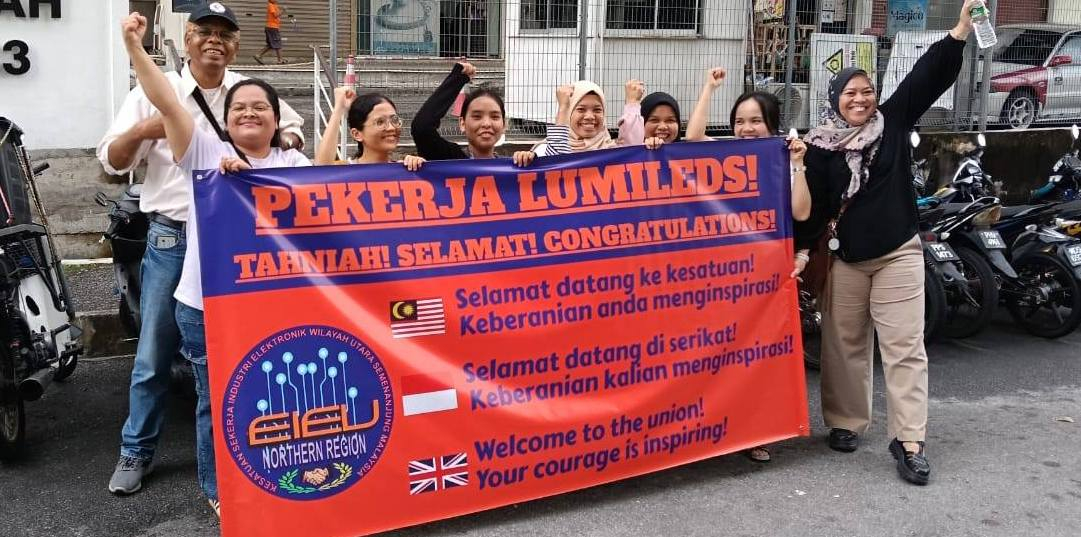
Malaysia has one of the largest electronics manufacturing industries in the world. There are 200,000 electronics workers in the Penang region, on the country’s northwest coast, sometimes referred to as the “Silicon Valley of the East.” Photo: EIEUNR
Workers in Malaysia who make screens like the one you are reading this article on are protesting after union leaders were fired following an organizing victory. The workers make LED screens for companies including Apple.
The Electronics Industry Employees Union Northern Region (EIEUNR) won an election in November to represent workers at the Lumileds factory in Penang. Of the 1,200 eligible voters, 65 percent voted for the union, with 89 percent turnout.
The union won despite company threats to deport migrant workers or evict them from company housing if they supported the union. The employer also excluded 200 union supporters from the voter list, and told workers in captive-audience meetings that they would only get better wages and benefits if they voted against the union.
Now instead of bargaining, EIEUNR says, Lumileds management is continuing to try to bust the union. Sukhairul Bin Khalid, one of the leaders of the organizing effort, was fired on January 6 for stepping in to defend a migrant worker who supported the union from harassment by an anti-union co-worker.
Several migrant workers who supported the union have been deported. And the company opened disciplinary proceedings against union chair Syahnorizal bin Abdul Hamid.
The union is calling for the immediate reinstatement of all fired and deported members with back pay, an end to all disciplinary proceedings against union leaders, and for Lumileds to bargain in good faith with the union.
On January 28, a dozen workers delivered a petition signed by 400 union members to management protesting the firing of Bin Khalid and discipline against bin Abdul Hamid. The company has agreed to drop the case against the union chairman.
‘SILICON VALLEY OF THE EAST’
Malaysia has one of the largest electronics manufacturing industries in the world. There are 200,000 electronics workers in the Penang region, on the country’s northwest coast, sometimes referred to as the “Silicon Valley of the East.”
Overall, more than 600,000 electronics workers in Malaysia play an integral role in the supply chain of companies like Microsoft, Meta, Apple, and Bose. Electronics goods account for nearly 40 percent of the value of Malaysia’s exports.
But few workers in the industry belong to unions. That’s despite the fact that many of the biggest electronics companies have codes of conduct in which they commit to respect workers’ freedom of association throughout their supply chains.
Electronics unions were banned beginning in the 1970s, and then restricted to single enterprises until the late 2000s, dramatically weakening their bargaining power. Only in 2009 did the government finally allow workers to form regional unions in the electronics sector, leading to the formation of EIEUNR and three other Electronics Industry Employees’ Unions in the Western, Southern, and Eastern regions.
While the workers are still banned from forming a national union, the EIEU regions have been operating in coalition. Unions in the EIEU Coalition represented 13,000 workers in 20 companies as of 2024.
In Malaysia, only 6 percent of workers are union members, and most of those are in the public sector.
PERVASIVE UNION-BUSTING
Malaysian labor law requires companies to recognize and bargain with a union that wins a majority vote among eligible workers—not just a majority of those voting, as in the U.S.
Companies have tried shutting down factories on the day of voting to suppress turnout and make it difficult for a union to win a majority. That’s what Flextronics did in July, as part of a broader union-busting campaign to keep out EIEUNR.
At Lumileds, the company is using moves that are all too familiar to U.S. union activists: delay, combined with attacks on worker leaders.
These are also the methods being used by Nexperia, a key supplier of semiconductors to the auto industry owned by the Dutch government, where workers voted to join the Electronics Industry Employees Union Southern Region last summer. Nexperia has refused to bargain and has fired 20 union members since December over minor violations.
Malaysian labor activists say these tactics are commonly deployed to thwart union efforts, taking advantage of the refusal by the Department of Industrial Relations to prosecute employers for union-busting activities.
A group of unions protested outside of Parliament in November to call for a high-level taskforce to investigate union-busting cases, labor law reform to ban employer intimidation and interference in elections, and a mechanism to force employers to start bargaining within 60 days after a union wins an election.
MIGRANT WORKERS
Malaysia’s electronics industry relies heavily on migrant workers from Indonesia, Myanmar, Nepal, Bangladesh, and the Philippines. These workers come on temporary contracts that are renewable every two years. At Lumileds, supporters estimate that 30 percent of the workforce is migrant workers. That figure is even higher in other factories.
Numerous reports have found that migrant workers in Malaysia are routinely subject to forced labor, with recruiters charging them high fees and confiscating their passports, trapping them in low-wage indentured servitude.
In October, the U.S. and Malaysia reached a trade agreement that would lower tariffs on U.S. imports to Malaysia as well as carving out exemptions from Trump’s tariffs for some Malaysian exports to the U.S. As part of the agreement, Malaysia also agreed to “protect internationally recognized labor rights” and to “effectively apply appropriate legal sanctions” for violations of its labor laws.
EIEUNR is appealing for support from unions around the world in the Lumileds fight. “International solidarity matters,” the union said in a statement. “When workers know they are not alone, retaliation becomes harder to justify and harder to sustain.” -Labour Notes, 4/2/2026
The National Union of Bank Employees (Nube) will launch nationwide pickets to protest the “increasingly outrageous” ways bank chief executive officers (CEOs) commit union-busting.
In a statement today, its secretary-general J Solomon said bank CEOs are denying their workers several rights including the right to work-life balance, job security, and freedom from bullying, discrimination, harassment and sexual harassment.
Workers are also being denied the right to fair remuneration, participation in union work, freedom from union-busting, the freedom to attend training on paid leave and the right to have a two percent SST paid for workers’ family medical insurance, he added.... Malaysiakini, 21/7/2026


 Posts
Posts




No comments:
Post a Comment