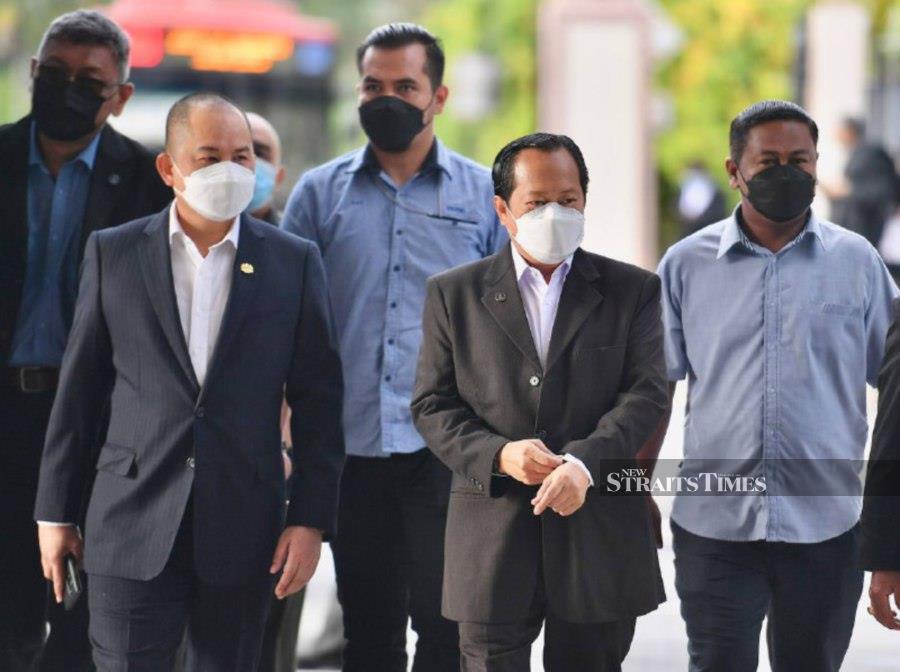
Monday, May 09, 2022

Serba Dinamik - charged for false statement, now a COMPOUND offer > so, no trial, no conviction, no sentence? - Bar > Mere Issuance of Compounds towards Serba Dinamik Sets a Dangerous Precedent

When one breaks the law, one ought to be charged and tried in court....What more here, a company that is public listed who allegedly 'submitted a false statement to Bursa Malaysia'...When one is offered a compound, and it is accepted, then no trial...no conviction...and no criminal records?

The use of COMPOUNDS is getting to be a problem, as the power to offer COMPOUNDS is an administrative power exercise-able by the Executive - not the Judiciary. 

Remember that in some laws, all offences are COMPOUNDABLE - even Anti-Money Laundering, Anti-Terrorism Financing and Proceeds of Unlawful Activities Act 2001

 92  Power of competent authority to compound offences

(1) The competent authority or relevant enforcement agency, as the case may be, may, with the consent of the Public Prosecutor, compound any offence under this Act or under regulations made under this Act, by accepting from the person reasonably suspected of having committed the offence such amount not exceeding fifty per centum of the amount of the maximum fine for that offence,..

See also:-  Ahmad Mazlan and others by reason of 'componds' and 'deals' - undermines the spirit/intention of Art.48(1)(e) on disqualification of MPs?

Same to with CAPITAL MARKETS AND SERVICES ACT 2007, where section 373 Compounding of offences

373 (1) The Chairman of the Commission may, with the consent in writing of the Public Prosecutor, compound any offence committed by any person under Part II, III, VI, VII, X or XII or any regulations made thereunder, by accepting from the person reasonably suspected of having committed such offence a sum of money not exceeding the maximum fine (including the daily fine in the case of a continuing offence, if any) for that offence.

Compounds should really be available for SMALL or smaller offences of speeding, etc ...or not wearing face mask ...BUT it should not be available for SERIOUS offences like money laundering, BURSA offences by public listed companies...

COMPOUNDS - well, it not a conviction or 'finding of guilt' > should it be made into admission of guilt? or recorded as a conviction? Should a person being compounded over and over for speeding - not be expected to be 'penalized' more and more every time he does the offence. NO REASONABLE INNOCENT MAN WILL PAY A COMPOUND - HE/SHE WILL MOST LIKELY WANT TO PROVE HIS/HER INNOCENCE...

The Compound mechanisms removes the Judiciary/Courts, and undermines the administration of criminal justice??

The LAWS also do not set MINIMUM Compounds - only the maximum, so, very easily amount of compound can be minimal...(open to possible corruption/abuse)

If you admit your CRIME, then go to court and 'PLEAD GUILTY" - and when you do so, the courts will take that into account in imposing a just sentence...

Compounds usually are offered before one is CHARGED in court >>> when a person is Charged, the prosecutors/Public Prosecutor MUST BE CONFIDENT that they can prove that you are guilty beyond a reasonable doubt. So, when suddenly, those already charged get the charges withdrawn, because they were offered and paid COMPOUNDS - doubts arise as to the reason for this administrative/executive decision.

Sadly, some judges then go and ACQUIT the accused, meaning ever again can they be charged with the same offence (or other offences based on the same facts). JUDGES should never ACQUIT unless after after a full trial, after they have considered all evidence adduced(or available) - it is always wise to Discharge Not Amounting To An Acquittal, if the courts are yet to evaluate all available evidence and make an independent determination of guilt or innocence of alleged wrongdoers.

EPF sold its shares, but what about other individual Malaysians that purchased shares trusting the BURSA to effectively monitor the public listed company...

At the end of the day, those who broke the law escapes conviction and prison sentence. Is this just?

WHO BROKE THE LAW? All the Directors? Why COMPOUND and not trial?


Press Release | Mere Issuance of Compounds towards Serba Dinamik Sets a Dangerous Precedent 6 May 2022 3:05 pm

The Malaysian Bar refers to the recent news reports concerning Serba Dinamik Holdings Bhd (“Serba Dinamik”).  It was reported that in December 2021, four Serba Dinamik officers were charged in court for submitting a false statement to Bursa Malaysia, which is an offence under section 369(a)(B) of the Capital Markets and Services Act 2007 (“CMSA”).1  Under section 369(a)(B) of CMSA, if convicted, a person faces an imprisonment term not exceeding 10 years and shall also be liable to a fine not exceeding RM3 million.  The imprisonment term demonstrates the severity of such a charge.

However, in April 2022, the Securities Commission Malaysia (“SC”) with the written consent of the Public Prosecutor, and pursuant to its powers under Section 373(1) of CMSA, compounded Serba Dinamik and its accused officers for a sum of RM3 million each.  The Vice President of Accounts & Finance, Muhammad Hafiz Othman, was also compounded an additional RM1 million for falsifying the accounting records of Serba Dinamik’s subsidiary.2  This follows the decision of the Public Prosecutor to accept the representation made to the Attorney-General’s Chambers (“AGC”) by Serba Dinamik and the individuals involved.3  There were no reports whether the SC was informed about the representation letter.

Under section 375 of CMSA, the SC can only institute prosecution proceedings with the written consent of the AGC.  Similarly, under section 373(1) of CMSA, the SC requires the written consent of the AGC to issue a compound.

The Malaysian Bar is mindful of the immense authority wielded by the Attorney General.  Such powers are granted under Article 145(3) of the Federal Constitution, which provides the Attorney General with the discretion to institute any proceedings for an offence.  It is our view that such power must be exercised in a way that would promote and strengthen the rule of law.  With due respect, the AGC should refrain from making a decision that overrides the recommendations made by the regulator — in this case, the SC — as this could potentially erode the function as well as the public perception vested in the regulator.

One of the core objectives of securities regulations is to foster a fair market system, thereby instilling confidence in investors and shielding the market from systemic risks.  To achieve this, regulators who are exercising their statutory duties must be given the liberty to enforce law and regulations against wrongdoers.  The manner in which this matter has been handled and resolved undermines the capital market regulators’ commendable efforts to uphold the integrity of the market.  Such leniency is likely to create a negative perception of selective enforcement by the authorities and that the decision of the regulators can be overruled.  It is our view that the considered opinions of the market regulators — in this case, the SC and Bursa Malaysia — should be preserved and executed accordingly.

The Malaysian Bar is also concerned with the lack of transparency in this matter, given the wider impact that the Serba Dinamik compound has on the integrity of the capital market’s governance and regulatory framework.  At the time of writing this press release, the AGC has yet to provide any statement for its decision not to prosecute Serba Dinamik and the accused officers.  As this is a case of public interest, there is a need for the AGC to provide details of how the decisions in such cases are reached.

The Malaysian Bar therefore implores the AGC to make a full and frank disclosure on the reason, if any, for the issuance of compounds to Serba Dinamik and the accused individuals, instead of proceeding with prosecution.  The AGC should engage in a purposeful consultation process with the regulators to ensure the proper penalties are enforced.  The old adage rings true now more than ever — “Justice must not only be done, but must be seen to be done.”

Mohamad Ezri Abdul Wahab
Vice-President
Malaysian Bar

6 May 2022


1SC Charges Serba Dinamik, Its Director and Officers for False Information in Its Financial Statement”, Media Release, Securities Commission Malaysia, 28 December 2021.

2SC compounds Serba Dinamik, top execs RM3 mil each for submitting false revenue that KPMG flagged”, The Edge Markets, 13 April 2022.

3SC Imposes Maximum Compound against Serba Dinamik, CEO, Director, and Officers for Submitting False Financial Statement to Bursa Malaysia”, Media Release, Securities Commission Malaysia, 13 April 2022.


SC Charges Serba Dinamik, its Director and Officers for False Information in its Financial Statement

- Warrant of Arrest Obtained against CEO/MD Dato’ Mohd Karim Abdullah

28 December 2021 |  Kuala Lumpur 

The Securities Commission Malaysia (SC) today charged Serba Dinamik Holdings Berhad (Serba Dinamik), its director and officers for submitting a false statement to Bursa Malaysia Securities Berhad, an offence under section 369(a)(B) of the Capital Markets and Services Act 2007 (CMSA).

The SC has also secured a warrant of arrest against the company’s Chief Executive Officer/Group Managing Director Dato’ Dr. Ir. Ts. Mohd Abdul Karim Abdullah, who is currently at large.

According to the SC’s charges filed at the Kuala Lumpur Sessions Court, the false statement is in relation to the revenue figure of RM6.014 billion contained in Serba Dinamik’s Quarterly Report on Consolidated Results for the Quarter and Year ended 31 December 2020.

The individuals charged today are the company’s Executive Director Datuk Syed Nazim Syed Faisal, Group Chief Financial Officer Azhan Azmi, and Vice President of Accounts & Finance Muhammad Hafiz Othman.

All three accused claimed trial to the charges filed against them. Sessions Court Judge Sabariah Othman fixed bail at RM300,000 with two sureties each, and ordered the passports of all accused persons to be surrendered to court. Additionally, all three accused are required to report to the SC’s Investigating Officer on a monthly basis.

Independent Non-Executive Director Abu Bakar Uzir who appeared for Serba Dinamik to answer to the charge against Serba Dinamik, also claimed trial.

Under section 369(a)(B) of the CMSA, a person found to have made a false or misleading statement to the SC, the Exchange or approved clearing house, if convicted, faces an imprisonment term not exceeding 10 years and a fine of not less than RM3 million, or both.

The SC’s investigation into Serba Dinamik started in May 2021 following a section 320 CMSA report by KPMG to the SC. Under the CMSA, auditors have a statutory obligation to immediately report to the SC, if they reasonably believe that there are any matters that may constitute a breach or non-performance of any requirement of securities laws, rules of the stock exchange or any matter that may adversely affect to a material extent the financial position of a listed company.

SECURITIES COMMISSION MALAYSIAhttps://www.sc.com.my/resources/media/media-release/sc-charges-serba-dinamik-its-director-and-officers-for-false-information-in-its-financial-statement


Cover Story: What Serba Dinamik didn’t want you to know
This article first appeared in The Edge Malaysia Weekly, on March 28, 2022 - April 03, 2022.
Cover Story: What Serba Dinamik didn’t want you to know
-A +A

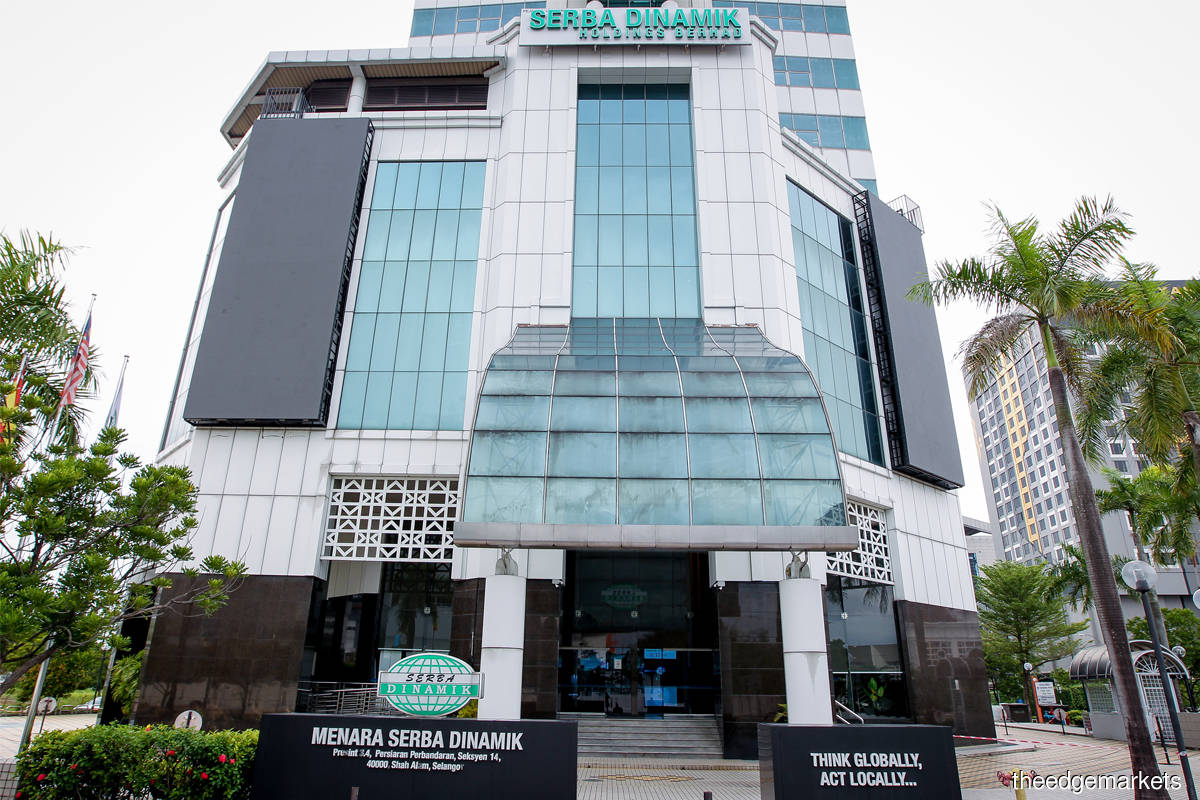
OVER a three-day period in August last year, the Securities Commission Malaysia (SC), which regulates the country’s capital markets, conducted raids on oil and gas outfit Serba Dinamik Holdings Bhd. It carted away 60 boxes of documents from Menara Serba Dinamik in Section 14, Shah Alam, in Selangor.

Market scuttlebutt has it that the SC personnel were forced to take the stairs up and down the 15-storey building as the electricity supply had been cut for some reason.

Nevertheless, the authority found 59 company and personal stamps of external parties in a box, according to court documents. Some of the stamps were from prominent companies such as Malaysia LNG Sdn Bhd, Petronas Gas Bhd, Petronas Carigali Sdn Bhd, Petronas Methanol (Labuan) Sdn Bhd, Petronas Chemicals Methanol Sdn Bhd, Petronas Refinery and Petrochemical Corp Sdn Bhd, Petronas Chemicals Ammonia Sdn Bhd, Sarawak Shell Bhd, Petronas Chemicals LDPE Sdn Bhd, Exxonmobil Exploration and Production Malaysia Inc, Petronas Carigali (Turkmenistan) Sdn Bhd, Petronas Chemicals Derivatives Sdn Bhd, Sabah Shell Petroleum Co Ltd, Shell MDS (Malaysia) Sdn Bhd, PRPC Utilities and Facilities Sdn Bhd and Shell Cyberjaya.

Bursa Malaysia Bhd chief regulatory officer Julian Mahmud Hashim in his affidavit in the case against Serba Dinamik says, “Premised on the above observations, there is a question as to the rationale for Serba Dinamik to have in its possession, company stamps of external parties. Further, depending on the circumstances surrounding the use of these company stamps, then the above could lead to concerns on the veracity of the (company’s) transactions.”

To recap, Bursa Malaysia had sought legal redress against Serba Dinamik for not adhering to its instructions and making public a factual findings update (FFU) after a special independent review (SIR) undertaken by Ernst & Young Consulting Sdn Bhd (EY Consulting). EY Consulting was roped in after former auditors KPMG highlighted irregularities at the oil and gas engineering services company, and was tasked with coming up with a FFU.

KPMG had flagged total sales transactions of RM2.32 billion, a trade receivables balance of RM652 million and materials on site balance of RM569 million, and there were issues with suppliers, with paid-up capital of only RM100,000 and having similar registered addresses, carrying out transactions of between RM60 million and RM96 million. In total, these transactions amount to RM481 million.

Questions were also raised about a customer and supplier in Bahrain whose office address could not be located. Transactions with this outfit totalled US$101 million (RM417.48 million then) and the trade receivables balance was US$24 million (RM99.2 million then).

While Serba Dinamik had sought to dispel all of KPMG’s allegations as trivial, the EY Consulting report, which is more than a thousand pages in total, seems to confirm KPMG’s suspicions and makes it apparent that the issues at Serba Dinamik are not only real but material.

It is also now clear why Serba Dinamik has been trying very hard to prevent the EY Consulting report from being made public.

Many other discoveries, which in the normal course of business would raise red flags, were also seen in the court documents filed last November by frontline regulator Bursa Malaysia.
Other findings include email exchanges between Serba Dinamik’s staff asking for purchase orders to be prepared under the names of Serba Dinamik’s local suppliers.

EY Consulting named four of Serba Dinamik’s local suppliers — Eastgate Dynamics Sdn Bhd, Kekal Jitu Sdn Bhd, NFZ Engineering Sdn Bhd and Naftech Energy Sdn Bhd — as being connected or related directly or indirectly to employees of Serba Dinamik, indicating that Serba Dinamik was in control of these companies. Two other suppliers, Edaran Kejuruteraan Bengkel Sdn Bhd and FRZ Scientific Sdn Bhd, had other issues.

The EY Consulting report stops short of stating that Serba Dinamik was utilising the company stamps and falsifying documents, boosting contracts to raise funds from financial institutions and paying off suppliers (under its control) that issued invoices, purchase orders and delivery orders.

Some of EY Consulting’s findings

In July 2018, national oil company Petronas launched a new vendor development scheme under which 18 organisations — six petroleum arrangement contractors and 12 oil and gas service and equipment companies (Serba Dinamik was one of them) — were slated to replicate Petronas’ vendor development programme (VDP).

Two of Serba Dinamik’s vendors under the VDP — Vibrant Victory Sdn Bhd and Technorette Sdn Bhd — had links either directly or indirectly to Serba Dinamik’s employees.

Editable Microsoft spreadsheet files containing templates of invoices and delivery orders of 10 vendors under Serba Dinamik’s VDP and email communications with a list of suppliers’ company stamps were found in devices and server files of Serba Dinamik employees. The total transactions in these files amounted to RM357.49 million.

According to Julian’s affidavit, EY Consulting’s findings showed that Serba Dinamik had paid for the purchase of furniture in NFZ Engineering’s office.

EY Consulting also found hard copy invoices for incorporation fees of both Naftech Energy and Edaran that bore the words “to pay using EIL” in handwriting believed to be that of Serba Dinamik’s managing director and largest shareholder (21.22%) Datuk Mohd Abdul Karim Abdullah. “EIL” refers to Emirtech International Ltd, in which Karim and Serba Dinamik non-independent non-executive director Datuk Awang Daud Awang Putera are directors as well.

Transactions with Naftech and Edaran listed as trade creditors in FY2020 amounted to RM169.05 million.

EY Consulting also found that Serba Dinamik’s employees had helped in the incorporation of Regen Batt (M) Sdn Bhd and the setting up of its bank account. Regen Batt is linked to Edaran and FRZ.
Similar issues in Bahrain

Serba Dinamik’s IT business in Bahrain, for which KPMG had sought clarification, could also be plagued with issues.

EY Consulting identified six of Serba Dinamik’s customers in Bahrain, namely Najmat Al Maisan Technical Services LLC, Technobyte Computing WLL, Amban Trading & Contracting WLL, Pentatech Ltd, Tecbit Lanka Pvt Ltd and SPRM Techno Infirmiere Pvt Ltd. Two suppliers identified were Litotec and MJ Trading & Contracting.

EY Consulting found company stamps of both Technobyte and Najmat Al Maisan among the items seized by the SC.

Also found were editable Microsoft Excel spreadsheets containing Technobyte’s invoices and delivery orders in excess of US$10 million.

There was also email communication among Serba Dinamik’s employees requesting for the preparation of purchase orders for 12 of Serba Dinamik International Ltd’s customers, amounting to US$66.89 million, among others. Serba Dinamik International Ltd is a wholly owned unit of Serba Dinamik.

As for KPMG’s queries on Serba Dinamik’s business in Bahrain — on the validity of the transactions and balances of a customer, Lata International Trading and Services SPC, and a supplier, Spectrum Oilfield Solution WLL — EY Consulting found that Serba Dinamik could have been managing, processing and paying the salaries of Lata’s employees, with approvals for the payments given by Mohd Abdul Karim via phone text messages.

There were also email communications between Lata and Serba Dinamik which suggest that Serba Dinamik was involved in preparing invoices for Lata. Lata’s company stamp was also found in one of the boxes seized by the SC.

KPMG’s grouse about Lata had been that its commercial registration address was that of workers’ accommodation.

EY Consulting also found Microsoft Excel spreadsheets containing nine invoices and delivery order templates of Sprectum Oilfield amounting to US$12.72 million in a device belonging to one of Serba Dinamik’s employees.

“The cumulative effects of the findings substantiate the concerns of KPMG,” a court document read.

The plight of Serba Dinamik’s minorities

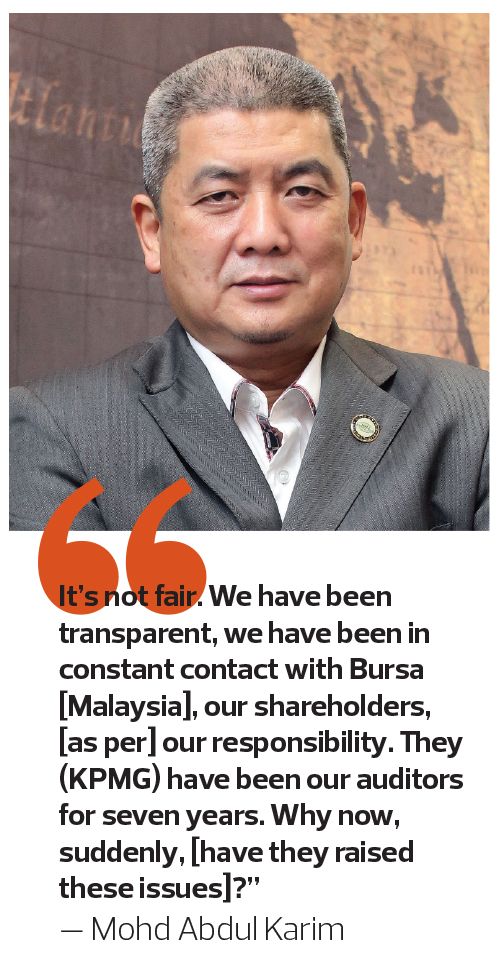
The management of Serba Dinamik has thus far denied any issues at the company. Speaking to The Edge last June when the issues first surfaced, Mohd Abdul Karim claimed that the company had been treated unfairly by KPMG. “It’s not fair. We have been transparent, we have been in constant contact with Bursa [Malaysia], our shareholders, [as per] our responsibility.

“They (KPMG) have been our auditors for seven years. Why now, suddenly, [have they raised these issues]? The company is intact, we have strong fundamentals, we will ride through this,” he said.

“I’m also bound by the legal framework,” he added, explaining that he was not at liberty to elaborate on the issues adversely affecting the company.

With Serba Dinamik’s management refusing to divulge the FFU, Bursa Malaysia suspended the company’s shares from trading in October last year.

Serba Dinamik had sought an injunction to restrain Bursa Malaysia from compelling it to make an announcement pertaining to the FFU by EY Consulting and attempted to declare EY Consulting’s appointment as void ab initio. It even tried to obtain an injunction to restrain EY Consulting from publishing the FFU.
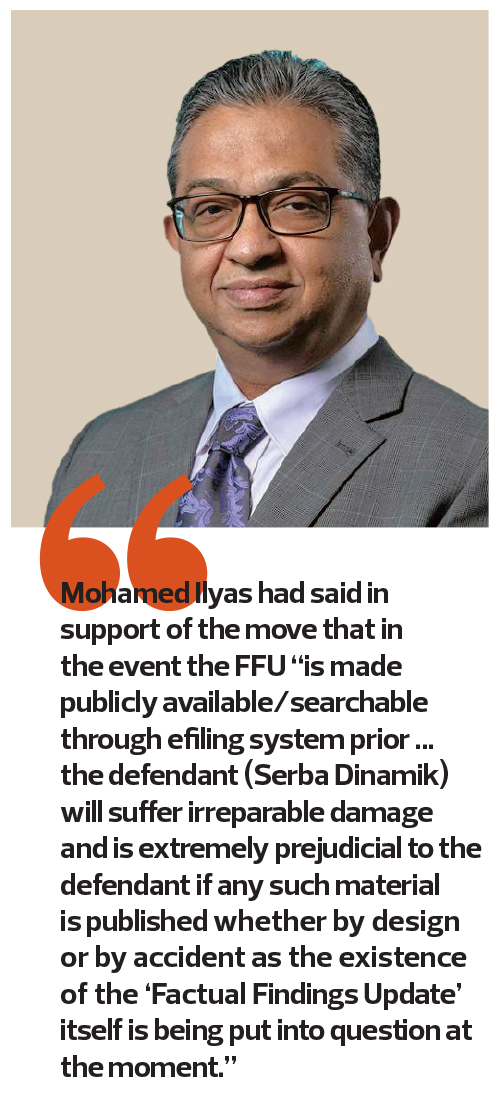
In Serba Dinamik’s failed attempt at obtaining an injunction against the frontline regulator, its then chairman Datuk Mohamed Ilyas Pakeer Mohamed had said in support of the move that in the event the FFU “is made publicly available/searchable through efiling system prior … the defendant (Serba Dinamik) will suffer irreparable damage and is extremely prejudicial to the defendant if any such material is published whether by design or by accident as the existence of the ‘Factual Findings Update’ itself is being put into question at the moment.” The FFU “remains a private and confidential document”, Ilyas contended.

Thus far, all of Serba Dinamik’s attempts to scuttle the court processes have been futile. Nevertheless, the company has not given up and its appeal against a High Court order to comply with Bursa Malaysia’s instruction to make public the FFU has been fixed on April 11.

On March 8, the High Court dismissed an originating summons by the company for an injunction to be imposed on EY Consulting to restrain it from disclosing findings of the SIR to Bursa Malaysia or other parties.

Meanwhile, Serba Dinamik’s legal action against KPMG resulted in the auditor stepping down in June last year, with the void being filled by Nexia SSY PLT a month later. However, it is understood that no suit has been filed against KPMG thus far.

While the wrangling continues, Serba Dinamik has lost more than RM4.7 billion in market capitalisation — from RM6 billion at its peak prior to the issues to RM1.3 billion at present — and could slip more when the suspension is lifted. Serba Dinamik was trading at 35 sen before its suspension.

In early January this year, Serba Dinamik fell into the Practice Note 17 category for cash-strapped companies.

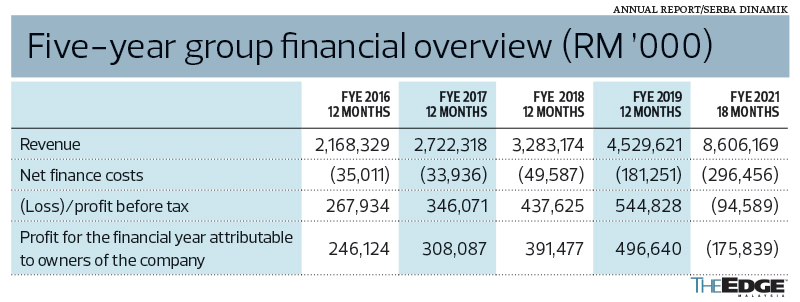
For its six months ended December 2021, it suffered a net loss of RM332.44 million from RM976.49 million in revenue. There are no comparative figures as Serba Dinamik changed its financial year end, just before the issues cropped up, from December 2020 to June 2021.

As at end-December last year, Serba Dinamik had cash and cash equivalents of RM218.94 million. During the period under review, the company had RM2.27 billion in long-term borrowings and RM1.45 billion in current liabilities. Serba Dinamik also had retained earnings of RM724.81 million and other reserves of RM44.99 million.

Serba Dinamik’s finance costs for the six-month period were pegged at RM117.3 million. It is also noteworthy that its cash flow for the six months ended December was negative RM8.77 million.

On its prospects, Serba Dinamik says in its financial report, “Oil prices ended 2021 significantly higher than they did in late-2020, according to major oil futures contracts. However, crude oil futures prices fell for the second consecutive month in December, falling from multi-year highs set in October, owing to persistent market volatility fuelled by rising uncertainty about the impact of the rapidly spreading Omicron variant on the global economy and oil demand.

“However, due to recent geopolitical tensions and resilient oil demand, the consensus has raised their crude oil price forecast from US$75 per barrel to US$80 per barrel, and this re-rating catalyst could benefit the group’s operations.

“Despite the fact that the group has now been classified as a PN17 company, the Board is confident that the restructuring and regularisation plan will benefit shareholders in the long run.

“The Board of Directors anticipates that the group’s operations will remain challenging. On the other hand, the board of directors’ pledges to resolve the ongoing issue, including the restructuring and regularisation plan, in the best interests of stakeholders,” the company says.- Edge Markets, 7/4/2022


Corporate News


Thursday, 01 Jul 2021


The EPF disposed of 96 million shares on Monday, which brought down the fund’s stake in Serba Dinamik to less than 5%, according to a filing with Bursa Malaysia yesterday.

KUALA LUMPUR: The Employees Provident Fund (EPF) has ceased to be a substantial shareholder in Serba Dinamik Holdings Bhd following the recent selldown in the open market, filings with Bursa Malaysia showed.

The EPF disposed of 96 million shares on Monday, which brought down the fund’s stake in Serba Dinamik to less than 5%, according to a filing with Bursa Malaysia yesterday.

The EPF owned 377 million shares, or about 10.2% of the company, about a month ago.

But on May 29, a surprised announcement by Serba Dinamik caught investors off-guard.

The company told Bursa Malaysia that its auditor KPMG had raised concerns over RM3.5bil worth of sales and transactions.

It has rejected these concerns and said it would appoint an independent reviewer to assess and verify these concerns.

On June 22, Serba Dinamik filed a court case against KPMG.

KPMG resigned almost immediately, while at least four of Serba Dinamik independent directors also left the company, citing their disagreement with the board’s decision to sue its external auditors. - Star, 1/7/2021



Saturday, May 07, 2022

“Workplace deaths: Why charge companies alone, not its directors as well?” -FMT & Focus Malaysia

 See full media statement at Is it the Minister or is it the Public Prosecutor that ‘protects’ Directors and/or humans in companies from being charged when OSH laws are breached and worker/s die? - Joint Statement of 15 Groups

Why are directors not charged over workplace accidents, NGOs ask AG

The NGOs said 6,686 workplace accidents were reported last year, resulting in 174 workers being killed and 249 becoming disabled.

PETALING JAYA: The attorney-general (AG) and the human resources minister must explain why directors and officers are not charged when their companies breach the Occupational Safety and Health Act 1994, say rights groups.

In a statement, a group of 15 NGOs asked why those responsible for worker safety and health were not charged when their companies’ breach of the act resulted in deaths or injury of workers.

“Prosecution for offences under this act requires the consent of the public prosecutor.

“One wonders whether it is the public prosecutor or the minister who decides to charge only the company, but not the director, manager, secretary or other such officers, even when workers are killed,” the group said.

Under the Occupational Safety and Health Act 1994, directors, managers, secretaries and other similar officers can be charged in the same legal proceedings as their companies for violations of the act.

According to the group, there were 6,686 workplace accidents last year, resulting in 174 workers being killed and 249 becoming disabled.

They said a state-linked company was recently found guilty of neglecting safety aspects that resulted in a worker’s death, but was only ordered to pay RM15,000 in fines and RM5,000 as compensation to the worker’s next of kin.

“What is of concern is that no decision-maker or owner of these companies was charged for these offences.

“Every time a company is charged for such offences, the persons responsible for the omissions that resulted in the violation of the law must also be charged.”

The group said the current RM50,000 maximum fine for violating the act was to be increased to RM500,000 under the Occupational Safety and Health (Amendment) Act 2022, but this has yet to be enforced. - FMT, 3/5/2022


“Workplace deaths: Why charge companies alone, not its directors as well?”

WE, the 15 undersigned groups, trade unions and organisations are concerned as to why the people responsible for worker’s safety and health are still not being charged in court even when workers are killed or injured despite the fact that the Occupational Safety and Health Act 1994 provides for this.

Prosecution for offences under this Act requires the consent of the public prosecutor, and as such one wonders whether it is the public prosecutor or is it the minister that is deciding to charge only the company but not the director, manager, secretary or officials of the company corporate, even when workers are killed.

It was recently reported that a state-linked company (SLDB Management Sdn Bhd) and a manufacturing firm was found guilty for the offence under Section 15(1) of the Occupational Safety and Health Act 1994 (Act 514), for neglecting safety aspects, which resulted in the deaths of their workers.

If convicted, it provides for a fine of up to RM50,000 or a jail term of up to two years, or both, upon conviction. However, it appears from a media report that no director, manager, secretary or other like officers from the firm was charged.

After state-linked SLDB Management Sdn Bhd pleaded guilty April 8, the company was ordered by the Sessions Court to pay a fine of RM15,000 for the death of Indonesian worker Cahya Abdullah at Ladang Bombong 1, Kampung Bombong in Kota Marudu on May 25, last year.

SLDB Management was also ordered to pay RM5,000 by April 14 to Cahya’s next of kin.

In the other case, Englen Manufacturing Sdn Bhd, after its representative admitted to the charge, was sentenced with a fine of RM20,000 or three months’ jail. The company was accused of failing to ensure the safety of its worker Bonnie Roger, who was involved in a fatal accident at its premises on May 15 last year at the Kota Kinabalu Industrial Park here.

What is of concern is that no decision maker or owner of these companies were charged for these offences despite the fact that Section 52 of the Occupational Safety And Health Act 1994 states “(1) Where a body corporate contravenes any provision of this Act or any regulation made thereunder, every person who at the time of the commission of the offence is a director, manager, secretary or other like officer of the body corporate shall be deemed to have contravened the provision and may be charged jointly in the same proceedings with the body corporate or severally, and every such director, manager, secretary or other like officer of the body corporate shall be deemed to be guilty of the offence.”

Subsection (2) states, “A person may be proceeded against and convicted under the provision of subsection (1) whether or not the corporation has been proceeded against or has been convicted under that provision”.

In a company, all decisions are made by people, including ensuring the safety of workers. It is absurd that only the company is charged in court, and not decision makers or those responsible. With regards to a company, they can only be fined – it obviously cannot be imprisoned.

Concern arises about this practice of not charging directors and officers of the company, more so when it is a Government-linked company (GLC), where directors may be politically appointed persons.

Directors have a great responsibility not just to the shareholders but to all workers, and actions or omissions be it intentionally or negligently done, to avoid making workplaces safe to protect workers and their health should no longer be tolerated.

Even in the recent two cases in Sabah, we find that the companies immediately admitted guilt, and as such there will also not be any grounds of judgment that can be educational to other employers to ensure that they do not ignore safety and health of workers.

The cases were dealt at the Sessions Court, even when death was a result of the fault of the employer, and this may also lead to non-dissemination and/or reporting of the grounds of judgment in law journals.

We are of the view that when a worker dies, or is injured by reason of an employer’s failure to ensure the safety and health of a worker, this matter should be dealt by the High Court, and a higher penalty ought to be imposed on the guilty employer company and its director, manager, secretary or other like officer of the body corporate.

Blacklisting of such convicted companies and its directors may also be needed to ensure employer’s place the highest regard to complying with the law concerning occupational health and safety.

Statistics from the Department of Occupational Safety and Health (DOSH) showed that there were 6,686 workplace accidents reported as of December 2021, of which 174 were fatal. Another 249 victims became disabled. This shows that this issue is a very serious issue for the protection of workers.

Who decided not to charge errant directors?

Section 61 of Act 514 states that “Prosecutions in respect of offences committed under this Act or any regulation made thereunder may, with the prior written consent of the Public Prosecutor, be instituted and conducted by an occupational safety and health officer or by an officer specially authorised in writing by the Director General subject to the provisions of the Criminal Procedure Code.

By reason of the written consent requirement, the public prosecutor may be the person refusing to give the required consent if and when the ministry wants to charge certain corporate officials.

Alternatively, it may the officers of the ministry, being the “…occupational safety and health officer or by an officer specially authorized in writing by the Director General…” who chooses not to charge any corporate members.

This matter needs to be clarified and the reasons for not charging these people in the companies need to be investigated. We hope that there is no corruption or abuse of power involved.

The maximum fine from RM50,000 will be increased to RM500,000, by virtue of the Occupational Safety And Health (Amendment) Act 2022, which was gazetted on  March 16 this year but is yet put into force by the minister. Why the delay?

The public prosecutor and the minister must explain why corporate officials are not being charged and jailed more so in cases when the breach of law resulted in injury or death of workers.

Every time that a company is charged for such offences, the persons who are responsible for the acts/omissions that resulted in the violation of the law reasonably must also be charged too.

It is odd if just the company is charged, and not the people responsible.  – May 3, 2022

The statement is endorsed by 16 NGOs, including North South Initiative Aliran and Labour Law Reform Coalition (LLRC). - Focus Malaysia, 3/5/2022


Wednesday, May 04, 2022

Ahmad Mazlan and others by reason of 'componds' and 'deals' - undermines the spirit/intention of Art.48(1)(e) on disqualification of MPs?

Repeal Article 48(1)(e) and Article 48(3) and allow the voters to choose who they want as their Parliamentarian, irrespective of whether he has been convicted and serving a sentence. 

A Member of Parliament, according to the Federal Constitution in Article 48(1) '...a person is disqualified for being a member of either House of Parliament if - ...(e) he has been convicted of an offence by a court of law in the Federation (or, before Malaysia Day, in the territories comprised in the State of Sabah or Sarawak or in Singapore) and sentenced to imprisonment for a term of not less than one year or to a fine of not less than two thousand ringgit and has not received a free pardon; or...'

Now, the problem that has arisen of late, is the use of COMPOUND and even other agreements, that lead a person who have committed an offence not being charged, and/or if already charged, charge being withdrawn and then even 'ACQUITTED'..

COMPOUND - a payment of a compound must be taken as an admission of a crime > and this must be recorded, and for serious crimes like money laundering, corruption, etc > it must lead to automatic disqualification. No innocent person will take up the compound offer and pay it - if innocent, he will insist on a trial and prove his/her innocence.

If not payment of compounds to avoid trial/conviction, makes Article 48(e) a 'JOKE' defeating the intention of our Constitution drafters.. If the 'guilty' can avoid conviction simply by paying compounds, 'deals with prosecution', etc - this is not right.

Compounds maybe for minor offences like speeding, breach of Covid-19 SOP like social distancing/wearing mask - but then ALL offences of the Anti-Money Laundering, Anti-Terrorism Financing and Proceeds of Unlawful Activities Act 2001 can be compounded....(see s.92)

Worse, when it comes to a compound, who decides on the sum - the Act stipulates the maximum so the public officers decide, and it could have been RM100 too > maybe the compound amount should be determined by the Judiciary, or the minimum set at not less than 25% the total fine. 

As an example, for discussion purpose, let us consider the Pontian MPs case...

In the case of the Pontian Member of Parliament,  he was charged for an offence under Section 113(1)(a) of the Income Tax Act 1967, which '....on conviction, be liable to a fine of not less than one thousand ringgit and not more than ten thousand ringgit and shall pay a special penalty of double the amount of tax which has been undercharged in consequence of the incorrect return or incorrect information or which would have been undercharged if the return or information had been accepted as correct...'

Section 4(1)(a) of Anti-Money Laundering, Anti-Terrorism Financing and Proceeds of Unlawful Activities Act 2001shall on conviction be liable to imprisonment for a term not exceeding fifteen years and shall also be liable to a fine of not less than five times the sum or value of the proceeds of an unlawful activity or instrumentalities of an offence at the time the offence was committed or five million ringgit, whichever is the higher.

For giving false statements to the Malaysian Anti-Corruption Commission (MACC) when questioned by MACC, he was charged under Section 32(8)c) of the Anti-Money Laundering, Anti-Terrorism Financing and Proceeds of Unlawful Activities Act 2001, Section 32 (8) Any person who-....(c) furnishes to an investigating officer any information or statement that is false or misleading in any material particular,...commits an offence and shall on conviction be liable to a fine not exceeding three million ringgit or to imprisonment for a term not exceeding five years or to both, and, in the case of a continuing offence, shall in addition be liable to a fine not exceeding three thousand ringgit for each day or part thereof during which the offence continues to be committed.

 92  Power of competent authority to compound offences

(1) The competent authority or relevant enforcement agency, as the case may be, may, with the consent of the Public Prosecutor, compound any offence under this Act or under regulations made under this Act, by accepting from the person reasonably suspected of having committed the offence such amount not exceeding fifty per centum of the amount of the maximum fine for that offence,

....(3) An offer under subsection (1) may be made at any time after the offence has been committed, and where the amount specified in the offer is not paid within the time specified in the offer, or such extended time as the competent authority or relevant enforcement agency may grant, prosecution for the offence may be instituted at any time after that against the person to whom the offer was made.

(4) Where an offence has been compounded under subsection (1), no prosecution shall be instituted in respect of the offence against the person to whom the offer to compound was made.

Normally, an offer of compound is made before one is CHARGED in court, and if paid, then no prosecution will be instituted.

In the case of the Pontian Member of Parliament Datuk Seri Ahmad Maslan, he was already charged in court >>> and note that the Public Prosecutor reasonably will not charge anyone unless they believe that they can prove beyond reasonable doubt that a person is guilty...

'...the prosecution had withdrawn the charges against the accused as he had paid a RM1.1 million compound...'  

Noting that if he had paid a compound of RM1.1 million, and the law states that compound amount shall be 'such amount not exceeding fifty per centum of the amount of the maximum fine' - this means that if he was tried and found guilty, reasonably he would have ended up paying a fine of most likely more that RM2,000 > which means, he would have immediately been disqualified as a Member of Parliament, and not be able to contest in GE15.

Settlements and agreements, including payment of compounds, after one is charged can thus undermine the Federal Constitution section 48(1)(e) disqualification provision. 

Should there be an additional DISQUALIFICATION inserted in Article 48, that will result disqualification if payment of COMPOUND of more than RM2,000? 

OR ALTERNATIVELY, should we just REPEAL Article 481(e)  - that means no more disqualification if a parliamentarian is convicted of a crime. LEAVE IT TO THE VOTERS, and if they choose a MP or Senator that had been convicted and sentenced, that is the voters' choice and he/she is the duly elected peoples' representative...Full Stop.

Article 48(3)  (3) The disqualification of a person under paragraph (d) or paragraph (e) of Clause (1) may be removed by the Yang di-Pertuan Agong and shall, if not so removed, cease at the end of the period of five years beginning with the date on which the return mentioned in the said paragraph (d) was required to be lodged, or, as the case may be, the date on which the person convicted as mentioned in the said paragraph (e) was released from custody or the date on which the fine mentioned in the said paragraph (e) was imposed on such person and a person shall not be disqualified under paragraph (f) of Clause (1) by reason only of anything done by him before he became a citizen. - REPEAL THIS ARTICLE, as it creates an inequality - disqualification should end when sentenced served - no need for an additional 5 years disqualification. 

Some people, with political connections, can move the government to get them PARDON to remove this additional 5 years disqualification like what happened to Anwar Ibrahim, and may again happen after GE15 if the BN return to power >> how many of them convicted BN leaders may get 'pardoned'...

So, it is my opinion, that Article 48(1)(e), Article 48(3) be repealed - leave it to the VOTERS to choose anyone to their MPs and/or Senators - and if they choose a MP who is in prison, so be it - this is DEMOCRACY.

For COMPOUNDS - acceptance and payments of compounds will be henceforth be taken as admission to CRIMES, and be recorded. It is absurd that a person can be caught even violating traffic laws so many times - and not be penalized simply because he paid the compounds - hence not tried and convicted. He/she is a danger to other road users, and he can continue putting people at risk without having his license revoked or sentenced to jail - just pay and pay that compound. Likewise Covid SOP breach - because of money, the richer can continue breaking the law with no consequence save for paying some money, which is nothing much for the rich.  

Ahmad Maslan allegedly paid a RM1.1 million compound - but for which offence, it is uncertain. Was it for all offences - if so, how much for each of the offence? Did he settle his 'unpaid taxes'? Making 'false statement' is an even more serious offence for a peoples' representative...and certainly a bad example >>> Not convicted but acquitted? Innocent or guilty is uncertain...

So, REPEAL Art.48(1) (e) and no more added disqualification period after sentence served by repealing Article 48(3)

COMPOUND laws - make acceptance of and payment of compounds an admission of guilt, and set minimum amounts of compound for offences, with an increase in compound sums for repeated/subsequent offences under a particular Act. Consider giving the judiciary to set the compound amount - and no more let it be an arbitrary power exerciseable by public officers/Ministers.. See, for Covid SOP violations, compound amounts was influenced by government...

An innocent person ought to prove his/her innocence in court - and will not simply pay a compound to avoid a TRIAL. For small offences like speeding, not wearing mask - one pays compound as its saves monies/times going to court > but compound for serious offences ought to be abolished. A person when charged in court can always plead guilty, and it will MITIGATE the sentence that courts will impose. 

Ahmad Maslan too could have simply pleaded guilty, and may have got a just sentence > but he chose to pay the COMPOUND of RM1.1 million and avoided the trial, a prison sentence, or a fine that may lead to him being disqualified as a MP - without the possibility of being a Parliamentarian for 5 more years --- so, repeal Art.48(1) (e)


Ahmad Maslan’s money laundering, false statement case transferred to High Court

Umno secretary-general Datuk Seri Ahmad Maslan is pictured at the Kuala Lumpur High Court March 11, 2021. — Picture by Yusof Mat isa


KUALA LUMPUR, July 13 — Pontian Member of Parliament Datuk Seri Ahmad Maslan, who is charged for failing to declare RM2 million received from Datuk Seri Najib Tun Razak to the Inland Revenue Board (IRB) and giving false statements to the Malaysian Anti-Corruption Commission (MACC), will have his trial heard in the High Court here.

This followed a decision by Judge Collin Lawrence Sequerah today in allowing Ahmad’s application to have his case transferred from the Sessions Court to the High Court.

Ahmad’s lawyer, Hamidi Mohd Noh when contacted today via the WhatsApp application, said the decision was made because there were serious legal issues that arose, especially in the charges faced by his client under Section 32 of the Anti-Money Laundering, Anti-Terrorism Financing and Proceeds of Unlawful Activities Act 2001.

On the charge of money laundering, Ahmad was alleged to have violated Section 113(1)(a) of the Income Tax Act 1967 by not stating his real income on the RM2 million he received from former Prime Minister Datuk Seri Najib Tun Razak in the Income Tax Return Form for Assessment Year 2013....

...He is alleged to have received the money, believed to be proceeds of illegal activities, via a check from AmIslamic Bank Berhad dated November 27, 2013 which he personally cashed on the same day.The offence was allegedly committed at the IRB, Duta Branch, Government Office Complex, Jalan Tuanku Abdul Halim, on April 30, 2014.

The charge, framed under Section 4(1)(a) of the Anti-Money Laundering, Anti-Terrorism Financing and Proceeds of Unlawful Activities Act 2001, provides a maximum fine of RM5 million, or imprisonment for up to five years, or both, if found guilty.

The other charge was for giving false statements to the Malaysian Anti-Corruption Commission (MACC) when questioned by MACC investigating officer, Principal Senior Assistant Superintendent Mohd Zairi Zainal, over the issue at the media conference room, Parliament Building, Jalan Parlimen here, between 2.45pm and 3.30pm on July 4, 2019.The charge, framed under Section 32(8)c) of the Anti-Money Laundering, Anti-Terrorism Financing and Proceeds of Unlawful Activities Act 2001, provides a maximum fine of RM3 million, or imprisonment for up to five years, or both if found guilty.Bernama, Malay Mail, 13/7/2021


Ahmad Maslan acquitted of money laundering charge

KUALA LUMPUR: Umno secretary general Datuk Ahmad Maslan has been acquitted and discharged of his money laundering and giving false statements to the Malaysian Anti-Corruption Commission (MACC) charges.

High Court judge Datuk Ahmad Shahrir Mohd Salleh made the decision today after the prosecution told the court that they had withdrawn the charges against the former deputy finance minister.

The law firm representing Ahmad, Messrs Shahrul Hamidi & Haziq, issued a statement about its client's acquittal.

It said the prosecution had withdrawn the charges against the accused as he had paid a RM1.1 million compound.

"This settlement process took almost a year before it was accepted and recorded in court today.

"This settlement is not Ahmad's guilty plea to all charges against him.

"It was done in accordance with the law and has gone through a transparent and orderly process.

"This (settlement) is solely for the purpose of this case and has nothing to do with any political factors," the statement read.

It went on to state that the settlement was a win-win situation for all parties in line with the law.

Ahmad, 53, was facing a charge of money laundering by not declaring his real income to the Inland Revenue Board (IRB) on the RM2 million he received from former prime minister Datuk Seri Najib Razak.

This is a violation of Section 113(1)(a) of the Income Tax Act 1967.

The Umno secretary-general purportedly received the money from Najib via a cheque dated Nov 27, 2013, which he (Ahmad) personally cashed the same day.

The offence was allegedly committed at the IRB Duta branch, Government Office Complex, Jalan Tuanku Abdul Halim on April 30, 2014.

The charge under Section 4(1)(a) of Amlatfapuaa, carries a fine or five years' jail, or both, if convicted.

The Pontian Member of Parliament also faced another charge of giving false statements to the MACC when he was being questioned by the agency's investigating officer, Mohd Zairi Zainal over the matter.

He allegedly committed the offence at a media conference room at the Parliament building on Jalan Parlimen, here, between 2.45pm and 3.30pm on July 4, 2019.

The charge, framed under Section 32 (8)(c) of the same Act, carries a maximum fine of RM3 million, or imprisonment for up to five years, or both, if convicted. - NST, 29/9/2021

Tuesday, May 03, 2022

AI cannot replace HUMAN judges when it comes to finding of guilt, and/or sentencing

AI cannot replace human judges - as every case is different, and human judges only can consider the different facts and circumstances of the case not just in determining guilt or innocence, but also the most appropriate and just sentence for a particular case. 

Computer programs that help judges identify different similar cases, and sentences imposed is alright - but the judge, at the end of the day, must apply their own mind in the determination of guilt and sentence.

As Malaysia tests AI court sentencing, some lawyers fear for justicet

STOCK PHOTO | Image by VBlock from Pixabay

Few cases ruffle Hamid Ismail after nearly two decades as a lawyer, but he was taken aback when a man he defended was sentenced with the help of an artificial intelligence tool in the Malaysian state of Sabah.

Ismail knew courts in Sabah and neighboring Sarawak were testing the AI tool for sentencing recommendations as part of a nationwide pilot, but was uneasy that the technology was being used before lawyers, judges and the public fully understood it.

There was no proper consultation on the technology’s use, and it is not contemplated in the country’s penal code, he said.

“Our Criminal Procedure Code does not provide for use of AI in the courts … I think it’s unconstitutional,” said Ismail, adding that the AI-recommended sentence for his client for a minor drug possession charge was too harsh.

The courts of Sabah and Sarawak piloted software developed by Sarawak Information Systems, a state government firm, which said at the time that it had held consultations during the process, and taken steps to address some of the concerns raised.

World over, the use of AI in the criminal justice system is growing quickly, from the popular DoNotPay chatbot lawyer mobile app to robot judges in Estonia adjudicating small claims, to robot mediators in Canada and AI judges in Chinese courts.

Authorities say AI-based systems make sentencing more consistent and can clear case backlogs quickly and cheaply, helping all parties in legal proceedings to avoid lengthy, expensive and stressful litigation.

More than a third of government respondents in a global survey last year by research firm Gartner indicated that they planned to increase investments in AI-powered systems including chatbots, facial recognition and data mining across sectors.

This month, Malaysian federal authorities aim to conclude their nationwide trial of the AI sentencing tools, which they have said “can improve the quality of judgment”, though it is not entirely clear how they will be used in courts.

A spokesperson for Malaysia‘s Chief Justice said the use of AI in courts was “still in the trial stage”, declining further comment.


BIAS, MITIGATING FACTORS

Critics warn AI risks entrenching and amplifying bias against minorities and marginalised groups, saying the technology lacks a judge’s ability to weigh up individual circumstances, or adapt to changing social mores.

“In sentencing, judges don’t just look at the facts of the case – they also consider mitigating factors, and use their discretion. But AI cannot use discretion,” Ismail told the Thomson Reuters Foundation.

Considering aggravating and mitigating factors “requires a human mind”, said Charles Hector Fernandez, a Malaysian human rights lawyer.

“Sentences also vary with changing times and changing public opinion. We need more judges and prosecutors to handle increasing caseloads; AI cannot replace human judges,” he added.

Seeking to address concerns that its AI software might lead to bias in sentencing, Sarawak Information Systems said it had removed the “race” variable from the algorithm.

But while “such mitigating measures are valuable, they do not make the system perfect”, said a 2020 report on the tool from the Khazanah Research Institute (KRI), a policy think-tank.

It also noted that the company had only used a dataset of five years from 2014-19 to train the algorithm, “which seems somewhat limited in comparison with the extensive databases used in global efforts”.

Sarawak Information Systems could not be reached for comment on whether it had since expanded its database.

An analysis by KRI of cases in Sabah and Sarawak showed that judges followed the AI sentencing recommendation in a third of the cases, all of which involved rape or drug possession under the terms of the two states’ pilot.

Some of the judges reduced the suggested sentences in light of mitigating factors. Others were toughened on the basis that they would not serve as a “strong enough deterrent”.


‘OPAQUE ALGORITHM’

Technology does have the potential to improve efficiency in the criminal justice system, said Simon Chesterman, a professor of law at the National University of Singapore.

But its legitimacy depends not only on the accuracy of the decisions made, but also the manner in which they are made, he added.

“Many decisions might properly be handed over to the machines. (But) a judge should not outsource discretion to an opaque algorithm,” said Chesterman, a senior director at AI Singapore, a government program.

Malayasia’s Bar Council, which represents lawyers, has also voiced concern about the AI pilot.

When courts in Kuala Lumpur, the capital, started using it in mid-2021 for sentencing in 20 types of crimes, the council said it was “not given guidelines at all, and we had no opportunity to get feedback from criminal law practitioners”.

In Sabah, Ismail appealed his client’s sentence recommendation by the AI tool, which the judge followed.

But he said many lawyers would not mount a challenge – potentially condemning their clients to overly harsh sentences.

“The AI acts like a senior judge,” Ismail said.

“Young magistrates may think it’s the best decision, and accept it without question.” – Reuters - Business World, 12/4/2022

Lawyers fear for justice as Malaysia set to conclude trial on AI-aided sentencing

The chief justice’s office says the use of AI in courts is ‘still in the trial stage’, but the Bar Council has voiced concern, saying it has ‘not been given guidelines at all’.

BANGKOK: Few cases ruffle Hamid Ismail after nearly two decades as a lawyer, but he was taken aback when a man he defended was sentenced with the help of an artificial intelligence (AI) tool in Sabah.

Hamid knew courts in Sabah and Sarawak were testing the AI tool for sentencing recommendations as part of a nationwide pilot, but was uneasy that the technology was being used before lawyers, judges and the public fully understood it.

There was no proper consultation on the technology’s use, and it is not contemplated in the country’s penal code, he said.

“Our Criminal Procedure Code does not provide for use of AI in the courts. I think it’s unconstitutional,” said Ismail, adding that the AI-recommended sentence for his client for a minor drug possession charge was too harsh.

The courts of Sabah and Sarawak piloted software developed by Sarawak Information Systems, a state government firm, which said at the time that it had held consultations during the process, and taken steps to address some of the concerns raised.

The use of AI in the criminal justice system is growing quickly the world over, from the popular DoNotPay chatbot lawyer mobile app to robot judges in Estonia adjudicating small claims, to robot mediators in Canada and AI judges in Chinese courts.

Authorities say AI-based systems make sentencing more consistent and can clear case backlogs quickly and cheaply, helping all parties in legal proceedings to avoid lengthy, expensive and stressful litigation.

More than a third of government respondents in a global survey last year by research firm Gartner indicated that they planned to increase investments in AI-powered systems including chatbots, facial recognition and data mining across sectors.

This month, Malaysian federal authorities aim to conclude their nationwide trial of the AI sentencing tools, which they have said “can improve the quality of judgment”, though it is not entirely clear how they will be used in courts.

A spokesman for Malaysia’s chief justice said the use of AI in courts was “still in the trial stage”, declining further comment.

Bias, mitigating factors

Critics warn AI risks entrenching and amplifying bias against minorities and marginalised groups, saying the technology lacks a judge’s ability to weigh up individual circumstances, or adapt to changing social mores.

“In sentencing, judges don’t just look at the facts of the case, they also consider mitigating factors, and use their discretion. But AI cannot use discretion,” Hamid told the Thomson Reuters Foundation.

Considering aggravating and mitigating factors “requires a human mind”, said Charles Hector Fernandez, a Malaysian human rights lawyer.

“Sentences also vary with changing times and changing public opinion. We need more judges and prosecutors to handle increasing caseloads; AI cannot replace human judges,” he added.

Seeking to address concerns that its AI software might lead to bias in sentencing, Sarawak Information Systems said it had removed the “race” variable from the algorithm.

But while “such mitigating measures are valuable, they do not make the system perfect”, said a 2020 report on the tool from the Khazanah Research Institute (KRI), a policy think-tank.

It also noted that the company had only used a dataset of five years from 2014-19 to train the algorithm, “which seems somewhat limited in comparison with the extensive databases used in global efforts”.

Sarawak Information Systems could not be reached for comment on whether it had since expanded its database.

An analysis by KRI of cases in Sabah and Sarawak showed that judges followed the AI sentencing recommendation in a third of the cases, all of which involved rape or drug possession under the terms of the two states’ pilot.

Some of the judges reduced the suggested sentences in light of mitigating factors. Others were toughened on the basis that they would not serve as a “strong enough deterrent”.

‘Opaque algorithm’

Technology does have the potential to improve efficiency in the criminal justice system, said Simon Chesterman, a professor of law at the National University of Singapore.

But its legitimacy depends not only on the accuracy of the decisions made, but also the manner in which they are made, he said.

“Many decisions might properly be handed over to the machines. (But) a judge should not outsource discretion to an opaque algorithm,” said Chesterman, a senior director at AI Singapore, a government programme.

Malaysia’s Bar Council has also voiced concern about the AI pilot.

When courts in Kuala Lumpur started using it in mid-2021 for sentencing in 20 types of crimes, the council said it was “not given guidelines at all, and we had no opportunity to get feedback from criminal law practitioners”.

In Sabah, Hamid appealed his client’s sentence recommendation by the AI tool, which the judge followed.

But he said many lawyers would not mount a challenge – potentially condemning their clients to overly harsh sentences.

“The AI acts like a senior judge,” he said.

“Young magistrates may think it’s the best decision, and accept it without question.” - FMT, 12/4/2022