
Loading...

Monday, March 31, 2008

Follow PERAK - elections at all levels of local government NOW..

Pemilihan penghulu Perak April ini
30/3/2008 (Malaysiakini)

Tanpa menunggu sehingga semua ketua kampung meletakkan jawatan beramai-ramai 1 Mei ini, kerajaan baru Perak menggesa pemilihan jawatan-jawatan itu diadakan segera bulan depan.

perak cm mb mohamad nizar jamaluddinMenteri besar Mohammad Nizar Jamaluddin berkata tatacara dan kaedah pemilihan itu akan disampaikan kepada semua ketua kampung dan pegawai daerah tidak lama lagi.

Semua jawatan ini akan tamat pada 31 Disember tetapi Pertubuhan Ketua Kampung Negeri Perak (PKKNP) menggesa semua mereka, yang dilantik sewaktu pentadbiran BN, meletakkan jawatan pada awal Mei.

Seramai 876 ketua kampung di seluruh Perak dilaporkan bersedia berbuat demikian atas alasan mereka tidak sehaluan dengan kerajaan campuran pimpinan DAP, PAS dan PKR.

Seramai 13,140 ahli Jawatankuasa Keselamatan dan Kemajuan Kampung (JKKK) akan menurut langkah yang sama, kata presiden PKKNP Zukiman Jalil pada Rabu lepas.

Mohammad Nizar berkata pelantikan semua ketua kampung akan dibuat sebelum Mei, lapor laman web The Star Online hari ini.

Menurut laporan itu, wakil rakyat PAS itu berkata ahli-ahli Jawatankuasa Keselamatan dan Kemajuan Kampung (JKKK) bagaimanapun dikekalkan.

Pemilihan ketua kampung itu seumpama pemilihan dalam mesyuarat agung tahuan Persatuan Ibu Bapa dan Guru (PIBG) di sekolah-sekolah, kata Mohammad Nizar.

Sementara wang dalam bank akaun dan kelengkapan di peringkat kampung, termasuk yang diselia JKKK, tidak wajar dipindahkan atau dikeluarkan sehingga pelantikan ketua kampung baru, katanya lagi.

Selasa lepas, dalam acara sulungnya sejak dilantik menteri besar, Mohamad Nizar mengumumkan sistem pengundian akan diperkenalkan kembali untuk melantik ketua kampung dan pengerusi di JKKK di Perak.

Sistem pemilihan seumpama itu pernah diperkenalkan di negeri itu, katanya selepas perjumpaan dengan 300 ketua kampung dan pengerusi JKKK.

Mohamad Nizar dilaporkan berkata, sistem pelantikan seperti yang diamalkan kini telah menimbulkan krisis di peringkat akar umbi masyarakat apabila "calon-calon yang dikehendaki penduduk tidak lagi terpilih atau nama itu dihilangkan."

Kerajaan negeri dilaporkan merancang memperkenalkan sistem pengundian secara rasmi selepas tempoh jawatan ketua-ketua kampung sedia ada tamat hujung tahun ini.

Beliau menambah, semua 31 wakil rakyat DAP, PKR dan PAS bersetuju mengembalikan hak penduduk memilih ketua mereka sendiri.

Saturday, March 29, 2008

“Zero Squatters”, a flawed policy - Malaysian Bar

Press Statement: “Zero Squatters”, a flawed policy


Contributed by Ambiga Sreenevasan
Friday, 28 March 2008 07:35pm

Ambiga SreenevasanThe Bar Council is deeply concerned that the new Menteri Besar of Selangor, Tan Sri Khalid has announced that he will continue on the path embarked upon by his predecessor to eradicate all squatter settlements in the State.

The “zero squatter” policy of the previous State Administration was in our view flawed and an unmitigated disaster from the high handed manner in which the forced evictions were carried out to the manner in which the State Government all too quickly defended the actions of the developer against the urban settlers. The inhumane treatment and the failure to address the basic housing needs of the poor and marginalised is of great concern. Rather than support such a policy, the State Government should abandon it and make an open declaration that they will desist from using the draconian Essential (Clearance of Squatters) Regulations promulgated under the Emergency Ordinance.

Any enlightened policy on urban resettlement should have at its core, negotiations and the willingness to give these settlers affordable and decent alternative housing. Human Rights norms decry forced evictions. They demand instead that no one should be left homeless or vulnerable to human rights violations. It is the responsibility of the state to ensure proper resettlement in such circumstances.

Foreign workers

We are also disturbed about Tan Sri Khalid’s comments on foreign workers and the possibility of imposing an additional levy supposedly to be paid by their employers. Such a levy would almost certainly be transferred to the worker by his employer.

There appears to be a long held, and wrongly held, view that decreased dependence on foreign labour will result in less crime and less social problems! Statistics show that foreigners only account for 2% of the crimes committed in the country, and while no one will discount that we have our share of social problems, it is unfair to lay the blame for them solely on foreign workers. Xenophobic responses such as these must be avoided. Our language, vocabulary and mindset must change. Rather than blame foreign workers for crime and social problems, the new State Government should focus on what it can do to ensure that all workers in this country receive fair treatment and equal access to justice. We must not forget that reliance on foreign labour is Government policy.

It is hoped that the focus will shift from coming down hard on migrant workers, urban settlers and other disadvantaged people to uplifting them and improving their lot. Nothing less is acceptable from any government.

Ambiga Sreenevasan
President
Malaysian Bar

28.3.2008

MB Selangor do not advocate UNIVERSAL HUMAN RIGHTS....????

"On the protest voiced by Suara Rakyat Malaysia (Suaram) on the Selangor-levy plan, he said local non-governmental organisations (NGOs) like Suaram must place priority on national interests and not champion universal human rights and attack the state government for looking after its residents in their own homeland."

“I was among the people involved in the corporatisation of the system for foreign workers and I can show ways to keep tabs on even the illegal workers,” he said.
He calls them "illegal" - no human being can be illegal or irregular. The right term to use mr. MB is "undocumented" - and do you know what happens to these undocumented...RELA arrest them...detained...charged in court...WHIPPED...deported. (But somehow not much is done to the employers that have hired and used them - and one labour court also said that since they were "illegal", they are not entitled to their wages from this employer --- and interestingly no news about any action taken against this EMPLOYER too....

Khalid meanwhile said the RM4,000 in levy and agency charges migrant workers paid was too large a sum, and the state planned to call on the Federal Government to reduce the amount.
Why should the workers be made to pay these agency charges and levy - it should be the EMPLOYER. The employer, who wants to go and get migrant workers, MUST be required in law to pay all the said "agency charges", "levy", etc... NOT the workers... Any further contribution that the State requires for the usage of facilities in this country should come from these EMPLOYERS...

One thing that Khalid can do is stop the discrimination faced by migrants when it comes to access to medical care in Malaysia. Health and health care are fundamental needs to a human being --- and we should treat everyone equally here in Malaysia.

Selangor Has Administrative Power Over Migrant Worker Levy, Says MB

March 28, 2008 (Bernama)

KUALA LANGAT, March 28 (Bernama) -- Selangor Menteri Besar Tan Sri Abdul Khalid Ibrahim said today the state government has the "administrative authority" to impose on employers a monthly levy of RM9 for each migrant worker they employ.

He said this in response to Human Resources Minister Datuk Dr S. Subramaniam's statement yesterday that the Parti Keadilan Rakyat-DAP-PAS coalition government had no authority to amend legislation to impose the levy.

Abdul Khalid said the RM3,000 to RM4,000 charged by migrant worker agencies was high and that for the Selangor government this was not reasonable.

He said this after officiating at the closing ceremony for the basic training course for Selangor enforcement officers series 1/2008 at the Enforcement Training Centre in Jugra near here.

Abdul Khalid said the state government bore the brunt of the influx of foreign workers into Selangor as they had an impact on infrastructure facilities like health, education and roads.

"We want to show the federal government how to keep records on illegal workers by having the state levy. I will set up a centralised information system to keep correct records on those who come and work in the state," he said.

Abdul Khalid said he had experience in doing so as he was among those responsible for the computerisation of the Immigration Department at one time and that the state's efforts could help the federal government resolve problems it faced.

He said the federal government perhaps had difficulty accepting ideas from political parties other than those of the Barisan Nasional (BN) but (the federal government) must listen to the people's wishes channelled through other parties.

"If they can come up with a better idea, they should do so," Abdul Khalid said.

He said millions of ringgit were paid by foreign workers to recruiting agencies that brought them to the country and the Malaysian government collected a levy but eventually the agents concerned did not know where the workers were and this "flood of foreign workers" created problems for society.

Although migrant workers, especially the illegal ones, were eventually repatriated by the government, the problem did not seem to end as they returned to the country and the ones who benefited were the travel agents and migrant workers recruitment agencies, Abdul Khalid said.

On the protest voiced by Suara Rakyat Malaysia (Suaram) on the Selangor-levy plan, he said local non-governmental organisations (NGOs) like Suaram must place priority on national interests and not champion universal human rights and attack the state government for looking after its residents in their own homeland.

-- BERNAMA


Think of national interests, Suaram told

BANTING: Suara Rakyat Malaysia (Suaram) should take a more national approach to foreign worker issues and not attack the state government, says Selangor Mentri Besar Tan Sri Khalid Ibrahim.

Khalid said the state government’s proposal to collect RM9 monthly from all migrant workers in the state was aimed at setting up a fund to help provide re-training for local unemployed youths so they could land better jobs.

He said foreign workers living and working in Selangor enjoyed all the state's infrastructure, like good schools, health facilities and roads and the state was just calling for them contribute something in return.

Well done: Khalid presenting a certificate to top participant Mohd Shaari Md Lazit during the closing ceremony of the training course at Pulapes in Jugra Friday. —Bernama

“Suaram feels that bringing in foreign workers is one of the solutions to human rights problems but they should understand we have to help our own people, too.

“This is a democracy, so we can open up and discuss the matter,” he told reporters after officiating at the closing ceremony of the training for local authorities' enforcement officers at the Selangor Enforcement Training Centre (Pulapes) in Jugra here yesterday.

On Monday, Suaram executive director Yap Swee Seng hit out at the state government's proposal, calling it unjust as foreign workers received low wages and were often exploited by employers or recruitment agencies with non-payment, unjust deduction of salary, long working hours and unfair dismissals.

He added that migrant workers were barely surviving and probably in debt after paying exorbitant fees to come to work in Malaysia.

Khalid meanwhile said the RM4,000 in levy and agency charges migrant workers paid was too large a sum, and the state planned to call on the Federal Government to reduce the amount.

He also proposed that a centralised information system be set up to keep an accurate record of foreign workers in the state.

“I was among the people involved in the corporatisation of the system for foreign workers and I can show ways to keep tabs on even the illegal workers,” he said.

Khalid also said the Federal Government should not cast aside suggestions just because they came from opposition parties and should accept the good ones.

Local Government Elections at all levels by end 2008 (definitely NOT by 2010..)

2010 -- why not now? As soon as possible and latest by end of 2008 (not 2010). Let us consider term of office, and reasonably it should be at least 3 years...So delaying mattters is not at all an option...

And why are we talking about stopping at local council or town council elections (the Majlis Perbandaraan or Majlis Bandaraya)... we should look at elections at all levels of local government including the Penghulu, Ketua Kampung, the JKKK, the JKKT ....and there is nothing stoping us doing this...and we should follow the guidance of the new Perak MB -- whose only reason for suggesting elections at the end of the year was because that was when the current term expires...and if sooner, the better...

There are many levels of local government --- and we MUST introduce elections at all level and away with this practice of "appointments" once and for all.

"
proportional representation in the local councils based on the votes received by both opposition and ruling parties during the general election" ... is non-sense. There must be a different direct elections of persons to local councils and be aware that this can be persons who may belong to a political party or not...

I believe that at the level of kampungs, tamans, and even towns ...in short at the level of local government voting shall be for individuals not political parties, hence there shall no usage of political party symbols (but nothing stops political parties endorsing this and that candidate...)

There may be a certain allocated seats for minority groups...but we shall see..

The election of SENATORS by the Rakyat must also be given serious consideration - if not at least a POLL or a REFERENDUM of sorts to get the people's choice into Senate...

There should be no procrastination with regard to local council, JKKK, JKKT, Penghulu, .... elections. People must start to experience and implement this new found DEMOCRACY as soon as possible and for as long as possible before the next General Elections....

TIME IS OF ESSENSE - AND A DEADLINE OF 2010 IS UNACCEPTABLE...


Bring local council elections back by 2010
Azreen Madzlan | Mar 28, 08 4:48pm

Civil society groups today called on all the 12 newly formed state governments to prioritise local council elections in their agenda.

Suaram executive director Yap Swee Seng told a press conference today that a memorandum endorsed by 33 civil society organisations will be sent to all 12 state governments requesting local council elections to be carried out on or before 2010.

suaram local election pc 280308 yap swee sengHe said expectation was now high to push for local elections since the opposition has pledged to restore them through their manifestos before the general election.

"Ever since the BN had the two-third majority, there was no response to the demand. With the recent election results, we are making similar demands to the opposition parties." said Yap.

Presents at the press conference today were Persatuan Masyarakat Selangor dan Wilayah Persekutuan (Permas) president Tan Jo Hann, Empower representatives Pook Li Yoon and Andrew Khoo, a lawyer.

According to Yap, since many local councillors including village heads have resigned after the elections, the new state governments should consider proportional representation in the local councils based on the votes received by both opposition and ruling parties during the general election.

Although ideally, all the NGOs agreed that there should not be political representatives in local councils, they’re also asking the state governments to adopt aspects of good governance proposed in the memorandum.

The mood is right

Among others, the memorandum proposes that any political representative appointed must be competent and capable of representing the interest of the community.

Yap added the composition of political appointees should also reflect the diversity of interests in the communities.

Meanwhile, Andrew Khoo stressed that society at large must get used to the concept of power sharing power among political parties even at local council level for a healthier political system.

Acknowledging that amendment to the laws or enactments of new laws may be necessary, Khoo said the matter must be studied thoroughly and that state governments be given some time to bring back local elections.

"It’s time to bring this back. People are much more mature, and able to make rationale decision. The mood is right," he pointed out.

suaram local election pc 280308 groupIt has been over 40 years since the government outlawed local council elections through the Local Government Act 1976. Local polls were suspended following the declaration of emergency on Sept 3, 1964, which remains in force.

The call to have local council elections reinstated have grown louder in recent years due to an increasing reports and complaints on alleged poor administration and weak financial management.

Powers of local councils

Commenting on the recent resignation of the BN-appointed 814 village heads in Perak, Tan Jo Hahn said they welcomed the decision although it was wrong of them to claim that they were serving the ruling party.

"We welcome the resignation. We should not have these people. They have shown their true colours. Let others take over," he said.

Jo Hann claimed the resignation proved that the village heads are worried about being checked by the new state administration for possible ‘misdeeds’.

It was reported that Perak MB Mohd Nizar Jamaluddin had promised that they could remain in their posts until the end of this year and no one would be forced to resign.

Jo Hann, whose organisation works with squatters, said people affected by policies made by the governments should have a say on who they want to be in the local council.

He added that many people are unaware of the powers of the local councils other than ‘sweeping the floor’.

"Do you know that DBKL has spent RM 94 million to train their officers in social ethics? What is that? For this simple reason alone, the rakyat should know where their money goes." said Jo Hann.

Opposition parties have pledges to support the reinstatement of local council elections in their election manifestos during the general election. To date, only DAP has begun initiatives to fulfil the party’s promises.

****************************************

Memorandum by Civil Society on Political Appointments by

State Governments

28 March 2008

We, the undersigned, call upon all the 12 newly formed state governments to practice good governance so as to ensure sustainable human development. This includes having State Governments that are clean, efficient, uphold the Rule of Law, and are inclusive of the diverse views and interests of the Rakyat.

We are concerned that previous State Governments had processes and procedures which were unclear and arbitrary. This enabled many abuses of public funds to take place, and left the needs of the Rakyat unfulfilled.

While the long term goal is to reinstate elections at the local government level, in the short term, we state the following.

Being transparent when making political appointments

State Governments have the wide authority and discretion to make political appointments. Besides appointing councillors in local authorities, they may also appoint directors to state corporations and enterprises, members of planning committees, down to village committees in the smallest kampung.

We propose these aspects of good governance to be adopted by the State Governments when making political appointments:

General Principles

1. Political appointees should have these criteria:

1.. Competence - have professional qualifications, be widely experienced in state affairs or are capable of representing the interest of the community

2.. Merit - be widely recognised as having achieved distinction in any particular profession, commerce, public service or other fields of activity.

3.. Integrity - be persons of good repute, honest and ethical.

4.. Equality and Non-Discrimination - uphold human rights principles of non-discrimination and equality.


2. Political appointments should follow these procedures:

1.. Transparency - clear criteria for political appointments should be set out;

2.. Consultation - mechanisms should be put in place to facilitate public participation in the nomination and selection processes of candidates for public office.

3.. Accountability - timely annual reports must be prepared and made available to the public. Regular open-door "meet-the-people" sessions and forums should be held to enable discussions between the appointees and the Rakyat.


3. When viewed in totality, the composition of political appointees should reflect the diversity in the communities.

Appointments of Councillors in Local Authorities

Understanding that amendments to the laws or enactments of new laws to bring back local government elections may be necessary and will take some time, we urge the following:

1. Agenda - all State Governments, especially those of Penang, Selangor, Perak, Kedah and Kelantan, which have committed to local government elections through their manifestos or the People's Declaration, should declare their road maps for local elections with clear timelines and milestones. Holding local government elections should be prioritised, and carried out by or before 2010.

2. Membership - selecting members of the local authorities should be a participatory process. Membership of local authorities should as far as possible reflect the diversity of interests in society. There shall be representatives from civil society groups without political party affiliations such as professionals, commerce, labour, residential associations, culture and the arts, people with disabilities, environment, women, youth etc. If there are to representatives from political parties in local councils, a proportionate representation for both ruling and opposition parties should be adopted. In addition, no State Assembly representatives and/or their immediate family members shall be appointed as councillors due to conflict of interest. There should be an overall balance of gender and ethnicity in the local authorities.

3. Criteria - members of the local authorities should be local residents. All appointees should have the measures of competence, merit and integrity as outlined above.

4. Appointment procedures - in adhering to the principles of transparency, accountability and open consultation stated above, the following should be noted:

(a) open nomination: each State Government should list and publish its criteria for membership of local authorities. The local residents should be invited to nominate suitable candidates; and

(b) display list of nominees: The names of all nominees should be made public and complete with their curriculum vitae. The public should be able to give views on the nominees to the State Government before public interviews are held.

(c) public interviews: Short-listed candidates should speak at forums open to the public so as to enable interactions with local residents. Public opinions should be taken into consideration by the State Government in making the final decision of appointment.

5. Accountability - councillors should prepare timely annual reports related to their portfolios. These reports should be published and made available to the public in forums to enable discussions. Citizens may petition to the state government for termination of their services of any councillor if found unsatisfactory.

It is our hope that this next round of appointments of local councillors for local authorities will be the last. No modern local governments should function without elected representatives.

This memorandum is endorsed by:

1.. All Women's Action Society (AWAM)
2.. Center for Independent Journalism (CIJ)
3.. Center for Orang Asli Concerns (COAC)
4.. Center for Policy Initiative
5.. Child Development Initiative
6.. Citizen Think Tank
7.. Civil Rights Committee of the Kuala Lumpur and Selangor Chinese Assembly Hall
8.. Civil Society Initiative - Parliament
9.. Community Development Center (CDC)
10.. Council of Churches Malaysia (CCM)
11.. Empower
12.. Federasi Kaum Tamil Sedunia Malaysia
13.. Group of Concerned Citizens
14.. Jaringan Rakyat Tertindas (JERIT)
15.. Kelab Bell Belia Tamil
16.. Labor Resource Center
17.. Malaysian Indian Development and Unity Association
18.. Malaysia Youth and Student Democratic Movement (DEMA)
19.. People's Parliament
20.. Persatuan Alumni PBTUSM Selangor
21.. Persatuan Kebajikan Masyarakat dan Sosial India
22.. Persatuan Kemajuan Pendidikan Malaysia
23.. Persatuan Masyarakat Selangor dan Wilayah Persekutuan (PERMAS)
24.. Persatuan Pembaca Tamil Klang
25.. Persatuan Sahabat Wanita Selangor
26.. Pusat Komunikasi Masysarakat (KOMAS)
27.. Sarawak Dayak Iban Association (SADIA)
28.. Semparuthi Iyakkam
29.. Sisters in Islam
30.. Suara Rakyat Malaysia (SUARAM)
31.. Women's Aid Organization (WAO)
32.. Writers Alliance for Media Independence (WAMI)
33.. Youth for Change (Y4C)


Friday, March 28, 2008

Is the Selangor MB from Barisan Nasional?

Selangor Menteri Besar Khalid Ibrahim is displaying "UMNO" or "BN" characteristics ....He said he want to follow what Khir Toyo was doing..

He is showing a definite "pro-developer" or "pro-pemaju" kind of behaviour, which is "anti-Rakyat" (anti-people).

All they wanted was power -- and to do that did they deceive the people saying that they are different...but are they really?

He speaks of urban pioneers (peneroka bandar) as squatters - that is the word and language of the BN government.

He talks about "zero squatter policy" as though the urban pioneers are scum or some kind of 'disease' that needs to be erradicated - he must apologize now to those urban pioneers....the rakyat.

They cleared the land built their homes and settled down , and have lived there for so many years. Some have been deceived into believing that they are the owners of their land as they did buy the land and house...and when towns expanded, suddenly the State Government (oh yes...land is a State Matter) branded them "squatters" - a term so very negative --- so very demeaning that the progressive do not use the term anymore. If that land belonged to some other then maybe the solution would have been to give them land/house...

Was this now Menteri Besar also working for the Plantation Companies in management that closed down plantations and dumped their former workers and their families out with no home and land ---- and many of these also ended up as "squatters".

PERMAS is kind - I say immediately apologize to the people -the poor - the urban pioneers, and I say that the Barisan Alternative may have to look for a NEW Menteri Besar... this man is embarrassing and is looking more and more pro-company pro-big-business pro-Rich kind of person day after day...


PERMAS' open letter to the New Selangor Mentri Besar's statement on the zero-squatter policy*


Firstly, on behalf of PERMAS I would like to congratulate you and the
newly appointed Selangor State Ex-Co for being installed as the new
Selangor State Government. We are truly jubilant for the recent victory
of the Barisan Rakyat's electoral victory especially in the states of
Selangor, Perak, Penang, Kedah and Kelantan.

However we are suddenly thrown aback when we read in today's
Malaysiakini report that you as the newly appointed Mentri Besar of
Selangor stated that you will continue the policy of your predecessor,
Mohd Khir Toyo to eradicate all 'squatter' settlements in the state.

We are also very disappointed that you have made such as serious
pronouncement as the Selangor MB without sufficient consultation and
discussions with the wider community of resident groups, civil society
organizations, and especially the urban poor settlements themselves
about their housing and land issues.

According to the report by the Malaysiakini report you said, "You can't allow people to become squatters in a state. There's the balance that we
have to abide by." and "We want to accommodate the wishes of the
squatters as much as we have to take into account the costs (incurred
by) the developer,". This statement has a chilling effect and reminds us
of the "pro-pemaju" kind of sentiments often expressed by the former
Selangor State government under the leadership of Mohd Khir Toyo.

The issue of squatters or urban pioneers is a very serious and
complicated one and has been the subject of electoral campaigns and
international concerns for the past few decades. In Malaysia especially,
the issue of housing for the poor has always been rife with corruption,
arbitrary inhumane evictions and demolition practices by the law
enforcers especially in connivance with profit hungry housing developers.

The question of ownership of land is not always straight forward. It is
not enough just to ascertain the ownership of a piece of land by
checking the legal status and then labeling the occupants on this land
as "squatters."

Take for instance if that particular community which has been residing
on that particular piece of land for the past 30-40 years even before any private interest had laid claim on it. Then suddenly, the local council or district office, or state government agency decides to do something with that piece of land, sometimes from their own initiative or perhaps at the recommendations of certain business interests.

They immediately label the people who have pioneered to that land as squatters and begin the process of their eviction. This is often done without due consultation with the people and as a result the compensations and relocation to alternative homes often do not reflect the interests of the people. Housing developers aided by local municipal and district offices arbitrarily push their decisions onto the people and their verbal promises are usually not fulfilled resulting in
unpleasant confrontations and even violent clashes.

PERMAS has been dealing with land and housing cases for the past 20
years and we have many actual examples and cases to show the
complexities of this issue. For instance we are currently struggling
with a case of 229 longhouse families in Rawang whose promised land has
been arbitrarily taken by the Gombak District Office and the PKNS has
built already built houses on it to sell it back to the people! We have taken a court case against the Gombak District Office and also the PKNS but the case has been postponed for the past 6 years!

There are actually many different cases of housing and land where the
developers have acted very irresponsibly and even criminally abusing state facilities, and ignoring basic human decency and rights of the
people in their endeavor to pursue profits. One cannot just look at the
business side of this issue and blindly "...take into account the costs
incurred by the developers..."

We are very disappointed that as the newly appointed Mentri Besar of a
progressive party such as the PKR, you have made such general sweeping
statements about "squatters". We recall very vividly that PKR and also
its candidates have espoused very clear ideals and goals to support the
"Rakyat's" human rights and needs regardless of race!

The "Rakyat" put their energies, heart and soul and especially their votes in the last elections to deny the Barisan Nasional government a two-third majority in Parliament. Because of the "Rakyat's" votes, the Selangor government is now under the leadership of the PKR-DAP-PAS
coalition.

We understand very well that this is a new undertaking and it is really
a very huge responsibility to be caring a state and making sure that all
sectors are represented and care for without discrimination, whether
they are rich or poor.

We also understand that the issue of adequate and permanent housing is a
very urgent issue. The process of achieving this status has to be done
in close collaboration with the people, not only rhetorically but in
actual practice. If the general aim to provide a house to everyone in
the state would entail striving for a "zero-squatters" status in the
state, then it may be acceptable. However if "zero-policy" status is
pursuit because you believe that "You can't allow people to become
squatters in a state" or that "we have to take into account the costs
incurred by the developer,", then this is an anti-people policy!

We would also like to urge you as the Selangor MB and the rest of the
Ex-Co members to actively practice consulting with groups such as PERMAS who have been actively engaged in the struggle for adequate and permanent housing and land for the past 15-20 years.

To this regard we would greatly appreciate it if you would immediately
hold a dialogue with PERMAS as well as other civil society organizations
regarding housing for the poor in Selangor and to explore possible
approaches to address all issues in this regard.

I sincerely hope that you and also the members of the Selangor State
Ex-Co will not make sweeping generalisations and hasty judgments on matters especially involving the marginalized and the poorer sectors in
our society. PKR-DAP-PAS were elected by the "Rakyat" to become the
Selangor State government because of your very people-centered agenda,
your pledges to defend the poor and fight for the rights of all
Malaysians. Now is the time to show us that your government is indeed
different from the previous one!

Sincerely,

Tan Jo Hann
President, PERMAS

26th . March 2008


Permas: New MB's statements 'chilling'
Soon Li Tsin | Mar 27, 08 1:46pm (Malaysiakini)

The community residents' association of Selangor and Federal Territory (Permas) is disappointed with Selangor Menteri Besar Khalid Ibrahim’s decision to continue with the ‘zero squatters’ policy.

In a statement yesterday, Permas president Tan Jo Hann said Khalid’s "general sweeping statements" about squatters were uncalled for.

khalid ibrahim selangor mb pc 260308 03"We are very disappointed that he has made such a serious pronouncement as the Selangor MB without sufficient consultation and discussions with the wider community of residents’ groups, civil society organisations and especially the urban poor settlements themselves about their housing and land issues," he said.

In an exclusive interview with Malaysiakini two days ago, Khalid said the new state government will not scrap the policy initiated by the previous government.

"You can't allow people to become squatters in a state. There's the balance that we have to abide by. We want to accommodate the wishes of the squatters as much as we have to take into account the costs (incurred by) the developer," said the menteri besar.

Tan said the statements have a ‘chilling effect’ and are similar to the 'pro-developer' sentiments often expressed by former menteri besar Dr Mohd Khir Toyo.

"There are actually many different cases of housing and land where the developers have acted very irresponsibly and even criminally abusing state facilities, and ignoring basic human decency and rights of the people in their endeavour to pursue profits," he said.

Tan revealed that he has communicated with Khalid’s political secretary Nik Nazmi Nik Ahmad.

"We have spoken and Permas plans to mobilise 1,000 residents to gather outside the MB’s office next week to submit a memorandum.

"Nik Nazmi also said that he will look into organising a meeting between Permas and Khalid. We are quite optimistic about collaborating with the new state government," he said.

Proper methods will be used

Contacted latter, Nik Nazmi said he had explained to Tan that certain statements made by Khalid could have triggered the concern of some quarters but stressed that the interview must be read in its entirety.

"People became overexcited over several statements made but the interview must be seen in its totality and you can see that Khalid’s anti-squatter policy will be executed properly.

"He (Khalid) has said he will reduce squatters through a proper method and he would not resort to the form of implementation done by the previous government," he added.

Nik Nazmi also said that a date will be decided soon for a meeting between Permas and the menteri besar.

On the planned gathering, he said: "Even if it is a protest, they are still free to gather outside the office but I am sure we will find room to discuss this matter."

In the previous state administration, several squatter settlements were controversially demolished with the residents forcefully evicted in Kampung Berembang in Ampang and Taman Rimba Jaya in Shah Alam.

"I did so because that is what the PM wanted" is not an EXCUSE... or is it?

Well, interesting things about Zaid Ibrahim...and that is why MEMORY is sometimes important as well - true that people can change but we have to bit more cautious about some of these 'de facto law ministers..." (A relevant NST Report dated 6/11/1991 is attached below..)

Was it not Rais Yatim, when out of cabinet, was an active advocate for the repeal of the ISA who when made a Minister did an about turn on his previously public-declared position.

Can ZEBRAs ever lose their stripes? But then there was another famous son of Ibrahim who apparently have repented his ways and have 'lost his stripes', and as such nothing is impossible...Malaysia Boleh.

Anyway what does this Zaid Ibrahim say about the way UMNO elections for the President, etc is conducted? The necessity to get nominations from Divisions is already bad - when nominations should be from members. To that, then you have the need for so many Divisions to nominate you before you can be a candidate and contest for the post. (Wonder whether there is still that rule that translate each nominations automatically to so many votes..?) FEAR of repercussion will ensure that generally Divisions will nominate incumbent....is this fair? Make your stand on this -- Minister Zaid Ibrahim?

Dr Mahathir has an argument, yes.... after all there was those Tribunals (and do not come now and said that you sat as 'judges' and decided so because that is what the then PM wanted...). The head of SUHAKAM now, the AG that time who advised and went along must also apologize...

Back to Zaid Ibrahim -- when exactly was he appointed as Senator....and WHY was he appointed Senator for the Federal Constitution clearly stipulates the reasons why persons can be appointed as a Senator --- and "because the PM wants to include me in his Cabinet" is definitely not a reason why the YDP Agung can make someone a Senator.

Dr M: Ask the tribunal to apologise
Mar 28, 08 1:36pm
“Ask the tribunal to apologise.”

This was the direct retort of former premier Dr Mahathir Mohamad to calls for him to apologise for the ‘wrongs’ surrounding the 1988 judicial crisis.

lingam tape inquiry day 4 170108 mahathirIn remarks written by him which was published today by English daily The Sun, Mahathir said the dismissal of former Lord President Mohd Salleh Abbas and Supreme Court judges Wan Sulaiman Pawanteh and George Seah were not his doing.

He, therefore, feels no obligation to apologise.

If any party were to apologise, it should be the members of the tribunal led by Hamid Omar which sacked Salleh, said Mahathir.

Mahathir also said he was open to the authorities investigating his person for any “misdeeds” during his 22 years as Prime Minister.

“Unless there is a frame-up, I think there should be nothing to pin on me,” he said.

Moving on to the suggestion by DAP national chairperson Karpal Singh that he apologise for the 1988 debacle - which many regard as ‘the darkest moment’ for the judiciary - Mahathir said on this point his conscience was clear.

“Even other accusations against me, including the dismissal of judges, were not my doing and I do not feel obliged to apologise. Ask the tribunal to apologise,” he said.

Being more correct than correct

Taking a potshot at Minister in the Prime Minister’s Department Zaid Ibrahim - who had asked for the government to apologise for the sacking and suspension of the five judges - Mahathir said the lawyer had “forgotten” that he had supported the then-government for its actions.

judiciary forum lingam tape 171107 salleh abbas palace of justic“The person asking that the government should apologise for what happened to Tun Salleh Abbas may have forgotten that as President of the Muslim Lawyers Association, he fully supported the action that was taken,” said Mahathir.

“He castigated the Bar Council for condemning Tun Hamid Omar over the dismissal of judges. Now he wants to be more correct than correct. I wonder why,” he added.

In 1988, Mahathir had convened the special tribunal to try Salleh on charges of misconduct and for questioning constitutional amendments that seriously eroded the powers of the judiciary.

Supreme Court judges George Seah and Wan Sulaiman - who had ruled that the tribunal was convened unconstitutionally - were also sacked after being found guilty of misconduct by another tribunal.

Three other judges - Azmi Kamaruddin, Eusoffe Abdoolcader and Wan Hamzah Mohamed Salleh were suspended.

Probe misconduct in Terengganu

In his article, Mahathir also suggested investigations - preferably by “credible foreign agencies” - should be conducted to look into allegations that abuse of power and misconduct had led the Teregganu royal palace to reject Barisan Nasional’s (BN) initial choice for menteri besar (MB).

According to him, rumour has it that various “unnecessary and wasteful” state projects worth billions of ringgit had been contracted to outsiders behind whom are members of ‘the first family’.

abdullah ahmad badawi and idris jusoh and ahmad said and terengganuIt was also alleged that Prime Minister Abdullah Ahmad Badawi had “influenced” former MB Idris Jusoh who was responsible for such a state of affairs and from which he had “benefitted financially”, said Mahathir.

“These are all rumours. It will be quite impossible to prove anything as the perpetrators are skilled in hiding themselves,”he said.

He also said that the public was “leery” of investigations by government agencies and departments.

“The people believe, not true of course, that the government has been interfering with the work of the Anti-Corruption Agency (ACA), the Police and the Attorney General (A-G)'s Chambers. The say this is borne out by the results of investigations by these agencies,” he said.

As such, the job should be left to foreign experts to look into the matter, he added.

“The public cannot be blamed for not having faith in government agencies doing investigations. The public cannot be blamed for suspecting cover-ups by the government or worse still the government may be using these enforcement agencies to threaten people,” he said.

“To clear its good name, the government should get credible foreign agencies to do the investigation. Of course, they must be given full access to the documents etc,” he added.

*********************************

Bar Council told to end feud with Tun Hamid


Wednesday, 06 November 1991 09:11am

©New Straits Times
by Azmi M. Anshar

KUALA LUMPUR, Tues. - The Muslim Lawyers Association has urged the Bar Council to end its "feud" with Lord President Tun Hamid Omar in the interest of the nation and the legal profession.

Its president, Zaid Ibrahim, said the Bar Council should dissolve itself or have its members quit en masse if it could not accept and respect Tun Hamid as Lord President.

Referring to the still valid vote of no-confidence adopted by the council on July 9, 1988, against Tun Hamid, he said the association should end its "obsession" with detecting perceived "flaws" within the judiciary.

He said the council in paying too much attention to the rift with Tun Hamid had neglected Section 42 (1L) of the Legal Profession Act which states that the council must promote good relations and social intercourse with its members and other persons in the administration of law and justice in the country.

Encik Zaid said the Government would have to seriously consider setting up an alternative legal body that could work with the judiciary if the rift was not settled.

"Lawyers get their practising certificates signed by Tun Hamid and yet they cannot respect him. The situation has reached ridiculous proportions," he said in an interview with the New Straits Times.

"It is time for a review of the three-year motion against Tun Hamid with the aim of having it annulled accordingly. The Bar Council must get its perspective right or risk jeopardising its existence.

"The Bar Council initiated the vote of no-confidence motion against Tun Hamid after the suspension of five Supreme Court judges for their role inactions pursued after the sacking of Tun Salleh Abas as Lord President in 1988. Prime Minister Datuk Seri Dr Mahathir Mohamad, in referring to the sacking and the suspensions, had stated he had proof that the Bar Council had been spreading lies abroad on the matter.

To prevent further public acrimony between the judiciary and the Bar Council, Encik Zaid proposed the formation of a Malaysian Law Academy that will promote and maintain high standards of conduct and learning in the legal profession.

The academy should be administered by a senate chaired by the Lord President and its members comprise Supreme Court judges, the Attorney-General, president of the Bar Council and other relevant legal bodies, Deans of law faculties at local universities and others deemed fit to be part of the body.

Meanwhile, Bar Council president Manjeet Singh said Justice Minister Syed Hamid Albar was entitled to his opinion in asking the Bar Council to apologise to Prime Minister Datuk Seri Dr Mahathir Mohamad for allegedly making allegations against the country's judiciary abroad.


'holier - than - thou' RELA does it again to migrants..


Basic human rights takes a beating

Nurli Yahjib
Kuala Lumpur
Dear Editor,

I WOULD like to share an incident that took place yesterday in Bangsar involving a raid by Rela, in which the manner it was conducted I disapprove of entirely.

I was having dinner at a restaurant near my office at 1am when a team of Rela personnel stormed in to nab illegals working there.

The raiding team members were aggressive and hostile, and I was shocked to see way they handled the illegals.

They went as far as handcuffing them, even though the latter were compliant with the raiding team.

The team used truncheons and bolt cutters, which I felt was unnecessary as there were a lot diners and their families there.

In my opinion, the raiding team had blatantly violated the dignity of the illegals through their offensive and violent conduct.

As the restaurant's regular customers, my officemates and I can testify that the illegal workers were diligent and friendly and they deserved to be treated with respect, regardless of their offences.

Rela personnel, however, did nothing to restrain themselves from asserting their hollow power. In fact, they adopted a 'holier - than - thou' attitude in front of customers.

This, I believe, is unacceptable in a multi-racial and democratic society as the basic rights of all people, whether they are citizens or otherwise, should be upheld.

Rela personnel do not have the right to be offensive to any race.

Wednesday, March 26, 2008

Do we finally have freedom of assembly, freedom of expression ...in Malaysia?

It was good that the police in the Opposition governed states of Selangor and Penang did not come down on protestors with their tear-gas, water-cannons and arrests. From what I have read, the protesters were allowed to assemble and protest peacefully - VERY GOOD --- is this the dawn for freedom of assembly, expression in Malaysia after 50 over years of patient waiting??

Now, that the Opposition RULES, there must be a marked difference in the way RIGHTS and FREEDOM is manifested, recognized and respected.

Some say this was UMNO protests and that is why the police were so kind - they should have done what they did to those who protested price-hikes, the BERSIH protests and the HINDRAF protests... in fact maybe just like what they did to HINDRAF 5, these leaders of the protest should also be arrested under ISA.... CAREFUL we are different and our actions must be different for if not we become no different from those who before curtailed freedoms and deprived rights....(Go read Animal Farm by George Orwell...)


Are all protesters equal before the law?


Tuesday, 25 March 2008 10:03am

Terence Fernandez©The Sun
Down2Earth by Terence Fernandez

HAVE you ever been on the wrong end of a water cannon? What about being in the vicinity of active teargas canisters?

From covering street protests a decade ago, I can tell you it is not a pleasant experience.

Apart from the obvious clamminess of being drenched, there is also the danger of being flung backwards a few metres by the sheer force of the jet streams coming at you at 300 gallons a minute.

A good dose of Clorox will be needed to remove the yellow, red or blue stains – a product of the dye that is sometimes added to the water, to mark the protesters, so that the ground force will be able to pick them out.
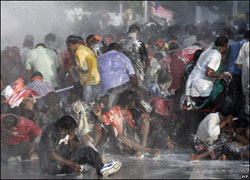
HindrafA concoction of a peppe-rlike substance and even soap may be added for extra “oomph!” to sting the eyes and irritate the skin and throat.

Where teargas is concerned, your eyes will begin to smart and then tear, your nose becomes runny, your throat gets parched, you begin coughing, nausea overwhelms you and in extreme cases, you start vomiting. If you’re asthmatic, there is the immediate danger of suffering an attack.

You may also experience a burning sensation on your skin, while dizziness and disorientation is also a known side-effect.

Well, there are others who of late have had similar experiences like me. They include the 2,000 people who gathered at the Kuala Lumpur City Centre (KLCC) last March to protest against the high price of fuel and essentials; and the 140,000 Malaysians (although the official figures vary from 4,000 to 40,000) who marched in the Golden Triangle in early November seeking free and fair elections in the Bersih-initiated march.

Then of course there were the 10,000 ethnic Indians who swarmed the streets of Jalan Ampang and the 1,000 holed up in the Batu Caves temple compound late November to highlight the plight of their community through the Hindu Rights Action Force (Hindraf) demonstrations.

Most recently 300-odd Hindraf protestors in Jalan Raja Laut got wet in last month’s “rose march”. The authorities and the leadership decided that these street demonstrations which are “not our culture” had to be quelled as they were detrimental to the economy and were scaring tourists away.

Teargas and water cannons had to be employed immediately to prevent the situation from getting any worse.

It is undeniable then when emotions are high and when a large group of people congregate in a highly-charged atmosphere, there are chances of people getting hurt. There is also the possibility of certain characters taking advantage of the situation for their own agenda. So perhaps, the authorities were justified in putting a swift and one may argue, callous, end to this mass expression of disapproval.

Now, I was half expecting the 1,000 people who gathered outside Komtar in Penang and the 500 outside the Selangor State Secretariat in Shah Alam last week to protest against the decision of the new governments of both states to review the New Economic Policy (NEP), to join their KLCC, Bersih and Hindraf brethren in exchanging tales of being sprayed and tear-gassed.

Unfortunately, they were robbed of this opportunity to trade anecdotes over a glass of teh tarik or kopi jantan, thanks to the unexpected restraint showed by the law enforcement authorities.
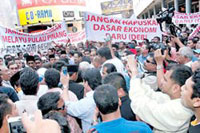
UMNOIn the case of Komtar, water cannons were deployed but never used, while in Shah Alam, all that happened was the seizure of loud-hailers from the protesters’ leaders. Just like the earlier protests, these two demonstrations too, did not have a police permit.

While five Hindraf leaders are being held under the Internal Security Act (ISA), those arrested in Penang were released the same day.

Now, the different treatment of the Hindraf, Komtar and Shah Alam protests is telling since the motives of the protestors were similar – each group demanding what’s due to them and highlighting the problems of their respective communities.

It must be said that the dissimilar enforcement on the different groups of protestors gets one to thinking that the authorities are playing favourites since the protests in Penang and Shah Alam were against an “Opposition” government. This suspicion is further compounded by the fact that the latest protests were organised by a political party.

Outside Komtar last week, just like in Kuala Lumpur last year, traffic was obstructed, businesses suffered for a while and the mass assemblies were witnessed by tourists. But this time, all we heard from the powers-that-be was that “they are merely demanding for their rights to be protected”.

There was no such “this is bad for the economy” rhetoric.

Now, I am sure many Malaysians like me are stumped. Just when does a demonstration become an acceptable icon of the democratic process, and when does it become a threat to national security?

There are those better equipped than this journalist to answer this question. But while I continue scratching my head, it would be good to ponder on the fact that for a leader, meting out justice and fairness is not a personal choice but a compulsory requirement to indicate that all are equal under the law.

A very confused Terence is deputy news editor (special reports & investigations) and is reachable at terence@thesundaily.com

Tuesday, March 25, 2008

BIG MISTAKE - deprivation of FREEDOM and RIGHTS , lack of DEMOCRACY....

The reporting by the main-stream newspapers radio and television was so-biased in favour of the UMNO-led Barisan Nasional......and in fact, I believe, what Prime Minister Abdullah Ahmad Badawi now really means is that they(the BN) made a big mistake in not controlling and/or shutting down the alternative media and sources of communications like Malaysiakini, other internet newspapers, web-sites, Blogs, etc...

Abdullah Ahmad Badawi, most Malaysians are SMART today and do not anymore uncritically believe what is being reported in the controlled and biased mainstream media.

Before, if something appears in the newspaper, radio and/or television, the ordinary Malaysians will unquestioningly take it to be the whole truth and nothing but the truth --- but NO MORE..no more.

Abdullah Ahmad Badawi and the BN should now really consider relinquishing the long-existing controls/restrictions that it has on MEDIA - it should relax all restrictions and make it easy for persons to be able to publish newspapers/ magazines that can sold and circulated to any person, easy for persons to start up radio and television stations, remove the restrictions placed on the Opposition newspapers/ magazines that state that it can only be circulated/sold to members of the party.

Of course, I do not think that our "independent" Election Commission will be going to do anything about how mainstream media was used unfairly by the BN and Abdullah Ahmad Badawi in GE 2008, and still now.

Election Commission will also not do anything about how the BN used "ground-breaking" ceremonies, handing out land events, and other such events during the election campaign period ..

Abdullah Ahmad Badawi, the BIG MISTAKE was the lack of freedom and rights in Malaysia, and the fact that the BN had forgotten that it is the people who they are supposed to listen to and serve whilst in government....

The BIG MISTAKE was the shutting out the voice of people .... and believing that THREATS like 'May-13" and the 'we will stop development if you vote Opposition' will still work...

The BIG MISTAKE list is long and definitely the "biggest mistake" was certainly not ignoring the 'cyber-campaigning on the Internet'.....The damage to the credibility and support for the PM and BN had been withered away long before elections was called..

BN still managed to win 140 seats because of the still existing fear, and/or ignorance perpetuated by the controlled media... but its hold on the people of Malaysia is slowly withering away ...and today we find that this "FEAR" is also withering away within the BN and UMNO, whereby members are getting courage to stand-up against the PM and the 'so-called leaders' - this was seen in PERLIS...and now in TRENGGANU...

If there was FREE elections within UMNO and by secret ballot, where division nominations are not taken as votes, where challengers to the top posts are permitted, where every member of UMNO is allowed to vote, I believe that both Abdullah Ahmad Badawi, Najib and the other top leaders will today be defeated -- and so the solution would be that the leaders of UMNO will try to cowardly delay UMNO elections...until maybe the time when they feel they can win...


Abdullah: Big mistake to ignore cyber-campaign
Mar 25, 08 2:45pm

Prime Minister Abdullah Ahmad Badawi today said his "biggest mistake" in disastrous elections was to ignore cyber-campaigning on the Internet which was seized by the opposition.

The powerful Barisan Nasional coalition suffered its worst-ever results in March 8 polls that left five states and a third of parliamentary seats in opposition hands.

The opposition, which was largely ignored by government-linked mainstream media, instead waged an enormously successful online campaign using blogs, news websites and SMS text messages.

abdullah ahamd badawi investment malaysia 250308 02"We certainly lost the Internet war, the cyber-war," Abdullah said in in a speech to an investment conference.

"It was a serious misjudgement. We made the biggest mistake in thinking that it was not important," he said.

"We thought that the newspapers, the print media, the television was supposed to be important, but the young people were looking at SMS and blogs."

The comments are a major about-face for the government, which had vilified bloggers, calling them liars and threatening them with detention without trial under draconian internal security laws.

In line with promises to reform after the humiliating election results, Abdullah said the government would "respond effectively" and move to empower young Malaysians.

"It was painful ... but it came at the right time, not too late," he said.

Malaysia's mainstream media are mostly part-owned by parties in the ruling coalition, and what was seen as biased coverage in the run-up to last month's vote alienated voters and boosted demand for alternative news sources.

Media watchdog Reporters Without Borders ranks Malaysia 124 out of 169 on its worldwide press freedom index. It says mainstream media are "often compelled to ignore or to play down" opposition events.

(AFP)

Monday, March 24, 2008

DEWAN NEGARA - some statistics


Our Senators are all members of Political Parties - save 2 (under Minority)

44 Senators literally chosen by the PM - and 26 from the States - surely a bit unfair. Even if number of Senators from the States are increased to 3 each, it will come to 39

The Federal Constitution states that "The members to be appointed by the Yang di-Pertuan Agong shall be persons who in his opinion have rendered distinguished public service or have achieved distinction in the professions, commerce, industry, agriculture, cultural activities or social service or are representative of racial minorities or are capable of representing the interests of aborigines." We really have to be told WHY the Yang di-Pertuan Agong appointed some of these SENATORS... this info should be available to the public..

It must be stated that no where is it stated that persons could be appointed SENATORS just because the PM wants them in his cabinet..


Dewan Negara


DIPILIH OLEH DEWAN UNDANGAN NEGERI LANTIKAN AGONG JUM
JOH KED KEL MEL NS PAH PRK PER PP SAB SAR SEL TRG WP KL WP LAB WP P/J LA
UMNO 1 1
1 1 1 1 2 1 1
1 2 1
1 20

35

MCA 1 1
1 1 1 1


1
1

5 13
MIC


5 5
PBB


2


1 3
GRM


1


1 2
UPKO


1


1
SPDP


1 1
PPP


1 1
LDP


SAPP


AKAR


SUPP


PAS

2


2
MINORITI


2 2
JUMLAH 2 2 2 2 2 2 2 2 2 2 2 2 2 2 - 1 36 65
J. BESAR 26 3 36 65


Jumlah Kerusi Dewan Negara

Singkatan Maksud


Lantikan Agong 44

JOH JOHOR

Pilihan Negeri 26

KED KEDAH

Jumlah Kerusi 70

KEL KELANTAN


MEL MELAKA


NS N. SEMBILAN

Kekosongan

PAH PAHANG


PRK PERAK

Lantikan Agong 5

PER PERLIS

Pilihan Negeri

-


PP PULAU PINANG

Jumlah Kerusi 5

SAB SABAH


SAR SARAWAK


SEL SELANGOR

Jumlah Sekarang

TRG TERENGGANU


WP KL WP KUALA LUMPUR

Lantikan Agong 39

WP LAB WP LABUAN

Pilihan Negeri 26

WP P/J WP PUTRAJAYA

Jumlah kerusi 65

LA LANTIKAN AGONG


LDP SABAH LIBERAL DEMOKRATIK PARTI


The PRIME MINISTER not the "Menteri Besar" maker ..

Datuk Ahmad Said has been appointed the Mentri Besar by the Sultan of Terengganu. He has the support of seven of the eight Umno division leaders in the state.

22 (or should we say 23) of the 24 BN ADUNs apparently supported the choice of the Prime Minister to be Menteri Besar of the State - that is the former MB, one Idris Jusoh..

Something is certainly not right here --- and this is what happens when the PM (or the so-called UMNO leadership) choses the candidates without considering the feelings of the local divisions... and now it seems that this is case when it is also reported that the 7 out of 8 UMNO divisions "lobbied" for the appointment. So, will the leaders and members of these 7 divisions of UMNO also be stripped of their membership without being accorded the right to be heard.

Datuk Ahmad Said has been stripped for disobeying party leadership -- where was the show-cause letter? Where was that Disciplinary Board Hearing? Where was that right to be heard and 'fair trial' principles --- but what am I talking about for it is UMNO ... and things work differently there -- Leader say jump - all who do not jump no more member... Since when has it become an offence for a member to disobey the party leadership??

"DERHAKA" -- would the behaviour and the boycott by the 23 amount to that? If the Sultan orders that you do A, and your PM orders that you do B? What do you do? Who will you obey? "Kesetiaan kepada Raja dan Negara".

According to a recent report, now, the Attorney General has come out with his ADVICE --- do we not have State Legal Advisors (and was he not also present during the appointment ceremony)? Remember, this is a State Matter....
(Star Online)
MYT 9:08:59 PM

Terengganu MB: PM or Sultan’s choice?

PETALING JAYA: The Terengganu Mentri Besar should be a person who has the confidence of the state assembly, a constitutional law expert said.

Universiti Teknologi Mara Law professor Dr Shad Saleem Faruqi said the position of Kijal assemblyman Datuk Ahmad Said would not be safe even if he was appointed the Mentri Besar by the Sultan of Terengganu.

He said although the Sultan had the discretion in appointing Ahmad as the new Mentri Besar, legally this could be disputed because the person has to command the confidence of the majority of the assembly.

“The Sultan has discretionary powers but this discretion is not absolute. The Sultan is not bound to listen to the advice of Umno divisions or the Federal Government but he has to listen to the state assembly,” he added.

Prof Shad also said that Ahmad, however, has the option of waiting 90 days – until May 13 – to consolidate his powers before convening the state assembly.

“This means he can appoint new state executive councillors, including those from the six PAS assemblymen, or he can even call for a state election,” he said.

Prof Shad said the state assembly or even Umno assemblymen could pass a vote of no-confidence against Ahmad.

“This scenario has happened several times before in Sarawak, Selangor and Kelantan in the 1960s and 1970s, where the Chief Ministers or Mentris Besar were either voted out of office or replaced,” he said.

The office of the Sultan of Terengganu announced Saturday that Ahmad would be the new Mentri Besar of Terengganu instead of Datuk Seri Idris Jusoh.

Idris was the choice of Prime Minister Datuk Seri Abdullah Ahmad Badawi as well as the majority of state assemblymen, but 51-year-old Ahmad had the support of seven of the eight Umno division leaders in the state who lobbied for his appointment at the last moment.

Ahmad was given his letter of appointment at 8.30am Sunday, but palace officials have fixed an indefinite date for the swearing-in ceremony, which was widely expected Sunday as well.

He was stripped of his Umno membership for disobeying the party leadership.

Prof Shad said that Ahmad could go to the courts and claim that his expulsion and removal as Mentri Besar were against "natural justice."

"Umno can also go to court on the basis that his appointment had gone against the Terengganu Constitution," he said.

Ahmad has two choices, Prof Shad added: He step down and let the Regency Advisory Council appoint a new Mentri Besar, or he could dissolve the state assembly.

Saturday, March 22, 2008

Barbers in work permit poser (NST)

2008/03/21 (NST Online)
Barbers in work permit poser
By : Evangeline Majawat and Kristina George


KUALA LUMPUR: The war between local and Indian barbers took a surprise turn yesterday when authorities denied any knowledge of work permit restrictions on foreigners.

This was revealed by Immigration Department foreign labour division director Abdul Rahman Othman, who said there have been no instructions to stop work permit renewals for Indian barbers.

The Penang Barbers' Association had on Wednesday, announced that they received a letter from the Prime Minister's Department stating that the government would no longer renew work permits of foreign barbers.

"I have not heard anything about this letter," Abdul Rahman said.

"Currently, those in the service sector, including barbers, are granted work permits which allow them to work in the country for five years."
The work permit , which has to be renewed annually, will not be extended after the five years are up.

Abdul Rahman said he was aware of the grouses of some local barbers who claimed that their livelihood had been affected by the Indian barbers.

Late last year, a delegation of 50 barbers from Penang and the Klang Valley held a meeting with representatives from the Home Affairs Ministry and Immigration Department.

Abdul Rahman said nothing was resolved at the meeting as delegates started bickering among themselves.

Some were strongly against the Indian barbers while others were supportive of them saying that everyone shared equal opportunities.

"We told them to discuss the matter among themselves before coming back to us," he said, adding that they have yet to hear from the local barbers.

He said an estimated 1,000 Indian nationals were working as barbers in the country.

Thursday, March 20, 2008

Will Opposition State allow RAKYAT to choose their SENATORS - or will the do what BN did...??

Looks like we will need to at least get a NEW Senator for Kedah soon - Chuah Kim Chuan term ends on 10/4/2008.

Will the Opposition Government just follow how it was done during the time when Barisan National ruled - that is "let the State Legislative Assembly choose" or will the Opposition government - the Barisan Alternative allow the RAKYAT to choose their Senators...

The Barisan Alternative may say that for the Senators to be "elected by the direct vote of the electors of that State", Parliament must past the law and now it is still a BN controlled Parliament and so we have to follow the old ways of doing things until the Barisan Alternative manages to win sufficient seats to form the Federal Government...

But, I say "Yes, you may not be able to have 'elections' BUT there is nothing stopping you from having a "referendum" to get the feelings of the people as to who they would want to be a Senator of that State ---- and once the RAKYAT has indicated their choice --- then the names could go through the State Legislative Assembly and the "peoples' choice" could be selected by the the Assembly...

The only question is whether you want to let the RAKYAT choose OR whether you want to do the choosing yourself (just like how the Barisan Nasional was doing...)

The same thing can be done with regard to local council elections --- and do not say that you cannot do it until Parliament amends laws..... this is an unacceptable JUSTIFICATION ---

I just went to the the Malaysian Parliment Website and look at the info on the members of the Senate --- and it is interesting that there is no information as to when Zaid Ibrahim became a Senator.... (http://www.parlimen.gov.my/DewNegara_KedAhli_detail.php?id=420) His name is listed....BUT --- see below

If Zaid Ibrahim is yet to be appointed Senator - then he is NOT YET in Cabinet...at least not until the Yang Di Pertuan Agung appoints him (or did it already happen but the official Parlimen Malaysia website is slow in updating its information)


~~ GAMBAR ~~


~~ MAKLUMAT ~~

Nama

Chua Kim Chuan, Y.B. Sen. Tuan

(Dipilih oleh Dewan Undangan Negeri Kedah)

Jawatan Dalam Kabinet

Tempoh

11.04.2005 - 10.04.2008

Parti

BN - MCA

No. Telefon

04-7309368

No. Fax

04-7337853

Alamat

~~ GAMBAR ~~


~~ MAKLUMAT ~~

Nama

Mohd Zaid Ibrahim, Y.B. Sen. Datuk

(Dilantik oleh Yang di-Pertuan Agong)

Jawatan Dalam Kabinet

Menteri di Jabatan Perdana Menteri

Tempoh

Parti

BN - UMNO

No. Telefon

No. Fax

Alamat

Which Senator had to resign so new people could be made SENATORS to be in new Cabinet?

There has been persons appointed as SENATORS by the Prime Minister just like that, it seems --- but then when we look at the Federal Constitution - we see that:-
1) There is a fixed number of Senators - 2 from each State, 2 from KL, 1 from Putrajaya, 1 from Labuan and 40 others.
2) The term of office is for a fixed period of THREE YEARS.

So when PM said this person made in Senator, the question is whether there were VACANCIES EXISTING that the Barisan Nasional can fill --- noting that now 5 States are controlled by Opposition (i.e. 10 Senatorial positions).

OR which Senator was asked to tender his resignation so that the PM's chosen could be made SENATORS...to become Cabinet Members..


FEDERAL CONSTITUTION

ACT 000

PART IV

THE FEDERATION

CHAPTER 4 - FEDERAL LEGISLATURE

45. Composition of Senate.

(1) Subject to Clause (4), the Senate shall consist of elected and appointed members as follows:

(a) two members for each State shall be elected in accordance with the Seventh Schedule; and

(aa) two members for the Federal Territory of Kuala Lumpur, one member for the Federal Territory of Labuan and one member for the Federal Territory of Putrajaya shall be appointed by the Yang di-Pertuan Agong; and

[Am. Act A1095 - Original Text read - (aa) two members for the Federal Territory of Kuala Lumpur and one member for the Federal Territory of Labuan shall be appointed by the Yang di-Pertuan Agong; and]

(b) forty members shall be appointed by the Yang di- Pertuan Agong.

(2) The members to be appointed by the Yang di-Pertuan Agong shall be persons who in his opinion have rendered distinguished public service or have achieved distinction in the professions, commerce, industry, agriculture, cultural activities or social service or are representative of racial minorities or are capable of representing the interests of aborigines.

(3) The term of office of a member of the Senate shall be three years and shall not be affected by a dissolution of Parliament.

[Am. Act A1130]

(3A) A member of the Senate shall not hold office for more than two terms either continuously or otherwise:

Provided that where a person who has already completed two or more terms of office as a member of the Senate is immediately before the coming into force of this Clause a member of the Senate, he may continue to serve as such member for the remainder of his term.

(4) Parliament may by law -

(a) increase to three the number of members to be elected for each State;

(b) provide that the members to be elected for each State shall be so elected by the direct vote of the electors of that State;

(c) decrease the number of appointed members or abolish appointed members.


SEVENTH SCHEDULE

[Article 45]

Election Of Senators

[Am. Act A1130]

1. (1) (Repealed).

(2) As often as there is a vacancy among the members elected to the Senate by a State the Yang di-Pertuan Agong shall give notice to the Ruler or Yang di-Pertua Negeri of the State that an election of a Senator is required and the Ruler or Yang di-Pertua Negeri shall require the Legislative Assembly to elect a Senator as soon as may be.

2.(1) The names of candidates for election shall be proposed and seconded by members of the Assembly and the member proposing or the member seconding shall submit a statement in writing, signed by the person nominated, that he is willing to serve as a Senator if elected.

(2) When all the nominations have been received, the presiding officer shall announce the names of the persons nominated in alphabetical order and shall then put their names to the vote in that order.

(3) Each member present shall be entitled to vote for as many candidates as there are vacancies to be filled, and the names of the members voting for each candidate shall be recorded; and if any member casts a vote in addition to those allowed by this subsection that vote shall be void.

(4) The presiding officer shall declare to be elected the candidate or candidates who receive the largest number of votes, but if two or more candidates have an equal number of votes and the number of those candidates is larger than the number of vacancies to be filled, the election of those candidates shall be determined by lot.

3. Notwithstanding anything in section 2, if a vacancy due to the expiry of the term of office of a Senator is to be filled at the same meeting as a vacancy arising in any other way there shall first be an election to fill the vacancy due to the expiry of the term and then a separate election to fill the other vacancy.

4. The presiding officer shall certify to the Clerk to the Senate, by writing under his hand, the name of a person elected as Senator in accordance with the provisions of this Schedule.

5. If any question arises whether a member of the Senate has been duly elected in accordance with the provisions of this Schedule, the decision of the Senate shall be taken and shall be final, but the failure to hold an election under section 1 (2) as soon as may be shall not of itself invalidate the election of any Senator.


There can only be MUSLIM Malay ----Federal Constitution says so...

Now that there is some interest about this "Malay Muslim" when it comes to the appointment of a Menteri Besar and/or Deputy Menteri Besar, it must be understood that the now existing Federal Constitution and the various State Constitutions is very much the doing the UMNO-Led coalition of political parties, especially the UMNO, the MCA and the MIC.

There are certain things that are rather odd about our Federal Constitution, which hopefully would one day be corrected. For example the fact that the special priviledges

MALAY

Article 160(2) of the Federal Constitution states that "Malay" means a person who professes the religion of Islam, habitually speaks the Malay language, conforms to Malay custom and -

(a) was before Merdeka Day born in the Federation or in Singapore or born of parents one of whom was born in the Federation or in Singapore, or is on that day domiciled in the Federation or in Singapore; or

(b) is the issue of such a person;


Therefore, there is no such thing as a non-Muslim Malay. A Muslim Malay who converts is no longer a Malay - and hence if Malay is an ethnicity, then conversion means a loss of ethnicity. Hence Malay may not be an ethnicity at all.

You are a Malay if:-
a) Muslim
b) habitually speaks the Malay language;
c) conforms to Malay custom
d) was before Merdeka Day born in the Federation or in Singapore or born of parents one of whom was born in the Federation or in Singapore, or is on that day domiciled in the Federation or in Singapore; or (b) is the issue of such a person


Therefore I am a Malay, if say that my father a British officer (and my mother a British) in Malaya gave birth to me in 1956, and I today am a Muslim and speak Malay and live a Malay lifestyle.

Therefore I am not a Malay, if parents and grandparents were all Malay - but I have chosen to be a free-thinker.

Therefore I am not a Malay, because although born of Malays, I now do not speak the Malay language.

Therefore I am not a Malay, because now I live a modern Western life-style and no longer conform to the Malay custom ( But then, what is Malay custom???)

A Malay not a Muslim is NOT a MALAY

A Malay who does not speak the Malay Language is not a Malay

A foreign national born of foreign national parents who happened to be in Singapore in 1961, who is now a Muslim, speaks Malay and conforms to Malay custom is a MALAY and according to some State Constitution would qualify to be Menteri Besar.

Interesting......

Before the Malays, in Peninsular Malaysia there were the Orang Asli - and they are called the Aborigine in the Federal Constitution, and is defined as the "aborigine of the Malay Peninsula" - and sadly this is the one group that interestingly is not accordered the special position and privileges (see Art 153) which only covers the Malays and natives of any of the States of Sabah and Sarawak.

So an Orang Asli or aborigine of the Malay Peninsula or a particular State cannot also be the Menteri Besar of Perak, Selangor and how many more States....

Even a native of Sabah and Sarawak who has been resident in the State of Perak or Selangor cannot be the Menteri Besar of Perak and/or Selangor...

INTERESTING...

So, what will happen if there were NO MALAYs elected in the party(or coalition of party) that has managed to wrest the majority of the seats in the State Legislative Assembly - would it mean that there will be NO MENTERI BESAR ...or will the Barisan Alternative just have to get someone from the Barisan Nasional UMNO party to be Menteri Besar....

INTERESTING....

In the Federal Constitution, there is no ETHNIC or RELIGIOUS or "MALAY REQUIREMENT" for a person to be chosen and appointed as the Prime Minister of a country --- and as such all State Constitutions must also be amended to be in line with the Federal Constitution...

WE HAVE TO MOVE AND BECOME MALAYSIAN - WE HAVE TO MOVE AWAY FROM THE POLITICS OF THE ETHNIC-BASED PARTIES LIKE UMNO, MCA AND MIC -- into MALAYSIANS-BASED POLITICAL PARTIES...

EVEN PAS - the only Religious-based party in the OPPOSITION (or rather the Barisan Alternative) is opening its doors , now through PAS Supporters Clubs --- who in fact even fielded a non-Muslim candidate..

We have to make a stand NOW about this "Malay Muslim" condition for being a Menteri Besar in some States -- IF WE WANT TO MOVE FORWARD...We cannot push it under the carpet and ignore it...

It was sad to see that there were 3 names forwarded to the Perak Sultan to choose and appoint as the Menteri Besar of Perak - when there was already a clear agreement that the person who shall be the Menteri Besar shall be from that Opposition partner party that won the biggest number of seats - and in the case of Perak, it was clearly DAP. There should have been just ONE name forwarded, the one name of the person who enjoyed the support of the majority in that State Assembly...However, if the DAP felt that it did not have a suitable candidate, then it could put forward a name of another from one of the other parties...and that is it...Submitting 3 names should never have been done - There whould have been ONE name submitted - the name of the one that enjoyed the support of the majority...

Now, we come to SELANGOR - the Menteri Besar has been chosen and now the question remain as to who will be the Deputy ...or Deputies...and let us see whether we have a "PKR and Barisan Alternative" Menteri Besar or really just another "UMNO or BN" Menteri Besar - there has, after all , always been doubts about Khalid, Anwar and the PKR --- and now is the test of fire... (After all , Khalid was the one who said that Mano swearing in can come later - possibly after he is released from the ISA - maybe in 2 years time or more.......that would have been the stand of a Barisan Nasional Menteri Besar -- and we all expected more from the Barisan Alternative...

Maybe, we must all go and read Orwell's Animal Farm -- about how people change and become like their predecessors when they get into power...

OH YES - WHEN ARE WE GOING TO HAVE OUR LOCAL COUNCIL ELECTIONS.... GIVE US A DEFINITE DATE --- SIX MONTHS TIME?...

Tuesday, March 18, 2008

Local government elections. Is this legally possible? - an Opinion


2008/03/13
Polls show democracy is very much alive
ROGER TAN

The then Sultan of Selangor Sultan Sir Hisamuddin Alam Shah  addressing the first meeting of the Selangor state legislative assembly in Kuala Lumpur on June 8, 1959.
The then Sultan of Selangor Sultan Sir Hisamuddin Alam Shah addressing the first meeting of the Selangor state legislative assembly in Kuala Lumpur on June 8, 1959.

The results of the 12th general election have rendered the Barisan Nasional government incapable of amending the Federal Constitution or making uniform laws for all the states without support from the opposition, observes ROGER TAN


THE people have spoken in the 12th general election. Their voice is supreme and we must respect it. The election results show that democracy is very much alive in our land. As American journalist Sydney J. Harris once said: "Democracy is the only system that persists in asking the powers that be whether they are the powers that ought to be."

The effect of this election not only means that the Barisan Nasional government will now be unable to amend the Federal Constitution without the support of the opposition, neither will it be able to make uniform laws for all the states in respect of any matter enumerated in the State List (Second List, Ninth Schedule of the Federal Constitution) under Article 76(3) of the Federal Constitution if the opposition states do not adopt them, save for matters relating to land and local government under Article 76(4).

The other effect will be on the local authorities and councillors appointed by previous state governments in Penang, Kedah, Perak and Selangor.

Under the Local Government Act 1976 (Act 171), it is the state authority (which is essentially the state executive council) and not the federal ministry of housing and local government which has control over the local authorities.

Under Section 10 of Act 171, the mayor or president and councillors of the local authorities are appointed by the state authority. Even though their terms of office cannot exceed three years, their appointments can still be revoked by the new state authority.

Therefore, the new state authority may replace the current mayor, president and the councillors with new appointees. Or it may also decide to keep some or all of the current councillors because the menteri besar and state authority can still give directions to the mayor or president and the local authorities from time to time.

Similarly, the penghulu or village heads and members of the Village Security and Development Committee or Jawatankuasa Keselamatan dan Kemajuan Kampung (JKKK) can be replaced too.

The next issue is the opposition's election promise to re-instate with immediate effect local government elections. Is this legally possible?

The last local government elections were held in 1963 under the Local Government Elections Act 1960. However, they were suspended after the Confrontation with Indonesia pursuant to the Emergency (Suspension of Local Government Elections) Regulations 1965 and Emergency (Suspension of Local Government Elections) (Amendment) Regulations 1965 made under the Emergency (Essential Powers) Act 1964.

Since then, councillors have been appointed by state authorities. The 1965 regulations were extended after the May 13, 1969 incident pursuant to Section 6 of the Emergency (Essential Powers) Act 1979, which provides that regulations made under the Emergency (Essential Powers) Act 1964 shall remain in force as if they had been made under the 1979 Act.

Then, when Act 171 was enacted, it was expressly provided in Section 15(1) that "notwithstanding anything to the contrary contained in any written law, all provisions relating to local government elections shall cease to have force or effect". This means that the provisions in the Local Government Elections Act 1960 relating to elections have also ceased to apply.

However, some have argued that this is still legally possible as Section 1(4) allows the state authority to exempt any area within any local authority from any provision of Act 171, including Sections 10 and 15(1). The state legislature can then enact state laws to govern local government elections as it is empowered to do so under Paragraph 4(a) of the State List.

Article 113(4) of the Constitution also provides that state law may authorise the Election Commission to conduct elections other than parliamentary and state legislative elections.

In other words, a state authority may suspend the application of Sections 10 and 15 of Act 171 and then cause the state legislature to enact laws governing elections for those local authority areas.

However, to enact state laws governing local government elections might still technically conflict with Sections 10 and 15(1) of Act 171 and the 1965 Emergency Regulations (presumably still in force).

As Act 171 is a federal law made under Article 76(4) and not under Article 76(3) of the Federal Constitution, which deems laws passed by Federal Parliament as state laws, it follows that Article 75 of the Constitution provides that if any state law is inconsistent with a federal law (Act 171 and the emergency laws), the federal law shall prevail and the state law shall, to the extent of the inconsistency, be void.

Of course, it can also be argued that with the exemption, the conflict does not arise. But that is a risky approach as the local government elections held pursuant to state laws can be challenged in court. If this is successful, the elections and decisions made by the councillors risk being declared null and void.

Therefore, holding local government elections is possible if Section 15(1) is repealed and Section 10 amended. This can only be done if the Barisan Nasional government, which has a simple majority in parliament, also wants it.

However, nothing is impossible these days. Politically, the federal government under the control of the Barisan Nasional may just do it, as most local authorities depend on the federal government for financial assistance. It may also be a gauge for the government to test public opinion before it calls the next general election.

To the rakyat, it is also a good thing as it will become a new tier of check-and-balance on state governments, under the Barisan Nasional or otherwise.

Sunday, March 16, 2008

If we STOP the Development --- People will come back to the BN..

So do we now pay our taxes to the Opposition wakil rakyat? Will they get the share of the income of the nation according to the percentage of the votes that they got in the last General Elections? Then, the Opposition will have the MONEY to use it for the people.

FREEDOM to CHOOSE your WAKIL RAKYAT -- and the end result is that the BN has won sufficient seat to form government --- and after election their duties and obligation is not just to the people in the constituencies that voted for the BN but to all Malaysians. All development must be brought to every region and all people irrespective of how they exercised their right to VOTE.

This "
Datuk Seri Mohd Ali Rustam" clearly do not understand this ---- IT is wrong to threathen the rakyat with "NO DEVELOPMENT" if you vote for opposition. It is also demonstrative to how unattractive the Barisan Nasional and UMNO have become so much so they have nothing to woo the support of the people save by using of threats and bullying them.

Why should the people support UMNO,...and the BN? Why should the people choose candidates from UMNO....and the BN? Clearly, even a Vice President of UMNO may not have a clue about the answer....I shall rephrase....if the Opposition coalition(the Barisan Alternative) won 140 seats in Parliament and formed the government , who now has the funds and the capacity to bring development ....why then at the next elections should the people vote for UMNO, MCA, MIC...the BN? Surely you cannot say that if you do not vote the BN - there will be no development for you...OR if you vote the BN there will be development...

Too long in power - 50 years - and this UMNO-led coalition of political parties, the Barisan Nasional, --- has just forgot the basics...and the answer of "why should I vote for you to be my representative...?" ...what is your ideology...what kind of development are you talking about --- what are your priorities..?...

"We have to stop all major projects to Penang as this is what the people wanted. If we continue with the project it would be almost impossible for us to regain control of the State in the next General Elections,” the Malacca Chief Minister said.

"If we stop all major projects, the people would realise what they had lost and would then come back to the BN. This is the only way we could recapture the State in the future from the opposition,"


2008/03/15(NST)

Umno veep supports halt to Penang mega projects
By : Jason Gerald John

MALACCA, Sat:

Supporting the call by Umno Penang for all BN mega projects in Penang be stopped, Umno vice-president Datuk Seri Mohd Ali Rustam put the blame on voters who decided that they did not want the major projects by voting in for the opposition.

"We have to stop all major projects to Penang as this is what the people wanted. If we continue with the project it would be almost impossible for us to regain control of the State in the next General Elections,” the Malacca Chief Minister said.

"If we stop all major projects, the people would realise what they had lost and would then come back to the BN. This is the only way we could recapture the State in the future from the opposition," he told reporters after visiting the Menara Taming Sari project near Dataran Pahlawan along Jalan Merdeka, here, today.

The proposed Penang mega projects include those planned under the Northern Corridor Economic Region (NCER), the second Penang Bridge, the light monorail transit system, the Penang Outer Ring Road, the Penang Sentral and the RapidPenang bus service.

"The people in Penang have clearly rejected development and they want a change," he said.
In the March 8 polls, Umno only won two parliamentary seats and 12 state seats in Penang.

Is it time to look for ANOTHER Menteri Besar for Selangor?

Embarassing position taken by Opposition Menteri Besar...of course Manoharan who has been chosen by the people should be sworn in at the same time as every other State Assemblymen - and the said "Menteri Besar Tan Sri Khalid Ibrahim" (who is behaving just like any Barisan Nasional Menteri Besar) should have insisted on it and demanded also that the said M Manoharan be immediately released.

He should even have gone ahead and chosen the said M Manoharan as one of the Deputy Menteri Besars, at the very least as a member of the State Exco.

It is before the HRH the Sultan of Selangor that the swearing-in will happen and it is unacceptable for the Abdullah Ahmad Badawi (the current PM) to disobey the Sultan or to show gross dis-respect to HRH. But alas now this said "Khalid Ibrahim" has just endorsed the continuous detention of M Manoharan under the ISA - not even insisting that he be brought in for the swearing-in before the Sultan NOW - and if this opportunity is missed, M Manoharan will never be sworn-in any time soon....

And if true, "...Khalid had said that Manoharan's detention was a political issue....", he certainly does not deserve to be Menteri Besar of Selangor.

If true, what "...Bar Council vice-president Ragunath Kesavan said: "He should be sworn in with the rest of the assemblymen because he is elected by the people. Only then can his name be gazetted as a state assemblyman.

"Not doing so deprives him of his rights, such as his allowances and access to information and documents which can be delivered to him."...", then it is a grave injustice..

A Menteri Besar who does not even stand-up for the rights of one of his own Barisan Alternative State Assembly person --- who have been chosen by a significant number of Selangor persons as their representative DOES NOT EVEN DESERVE TO BE MENTERI BESAR.

What is the stance of the leadership of the Barisan Alternative --- forget this Manoharan - let him languish in Kamunting ....OR WHAT?


2008/03/16


‘Manoharan has right to take office quickly’

M. Manoharan won the Kota Alam Shah state seat

KUALA LUMPUR: The Bar Council disagrees with the Selangor menteri besar that there is no urgency for Internal Security Act detainee M. Manoharan to be sworn in as an assemblyman.

Bar Council vice-president Ragunath Kesavan said: "He should be sworn in with the rest of the assemblymen because he is elected by the people. Only then can his name be gazetted as a state assemblyman.

"Not doing so deprives him of his rights, such as his allowances and access to information and documents which can be delivered to him."

Menteri Besar Tan Sri Khalid Ibrahim had said it was not urgent for Manoharan to be sworn in as an assemblyman because he was not being made an executive councillor.

Khalid had said that Manoharan's detention was a political issue and the opposition in parliament would call for the Internal Security Act to be repealed.
Manoharan, who is being detained at the Kamunting detention camp, won the Kota Alam Shah state seat under DAP.

Ragunath said although Manoharan was in detention, he could serve his constituents by communicating with them through his family members.

He said it did not make sense for Manoharan to be detained for "being a threat to national security" when he was elected as the people's representative.

Manoharan, meanwhile, has expressed his desire to be present at the swearing-in ceremony of the Selangor government.

In a press statement issued by his wife, Puspaneela Manoharan, it was stated that Manoharan was also keen on being made an executive council member so that he could serve his constituents.

Saturday, March 15, 2008

Cowards within the BN finds courage at last to fight for greater participation in decision making and more DEMOCRACY...

Now in a State, the Menteri Besar is suppossed to be a person than enjoys the support of the majority of the elected representatives to the State Legislative Assembly --- and that is how the Perlis Menteri Besar was chosen...and maybe that is what will happen in Trengganu too.

No more will even BN members accept the practice of the PM (or the Head of BN) unilaterally deciding on who is to be the Chief Minister of a State.

It is now SULTAN -vs- PM but clearly a movement against the dictatorial practices within UMNO and the BN - the cry is for greater participation in decision making processes and greater democracy...

An UMNO member and a member of Parliament asks Pak Lah to resign and Pak Lah's response is send him to be disciplined... so if you are a member of UMNO or any of the BN component parties, you have NO FREEDOM to say whether you want Pak Lah to be PM or NOT. If you say Pak Lah should be PM, it is OK. But, if you say you prefer somebody else to be PM - you will have to face the disciplinary Board. Is there NO RIGHT TO FREEDOM OF EXPRESSION AND OPINION WITHIN UMNO AND THE BARISAN - I believe that the answer is obvious.


Sultan Terengganu next to snub PM?
K Kabilan | Mar 15, 08 12:31pm

Signs are emerging that the Terengganu royal household is also set to follow the heels of the Raja of Perlis in appointing a menteri besar who is not the Barisan Nasional's choice, paving the way for a possible direct confrontation between the royalty and the federal government.

This morning all 23 BN state assemblypersons from Terengganu were called up for a meeting with the state's Regency Advisory Council.

The council representsTerengganu's 11-year-old regent Tengku Muhammad Ismail, whose father Sultan Mizan Zainal Abidin is the present Agong of Malaysia.

The incumbent menteri besar Idris Jusoh - who is also Prime Minister Abdullah Ahmad Badawi's choice to lead the state - was not invited for the meeting.

He was the only one not invited for the meeting scheduled to take place in Putrajaya.

Idris was also believed to be in Putrajaya to meet Abdullah.

In the aftermath of the general election, Idris led BN to a comfortable victory to retain the state by winning 24 of the 32 state seats. PAS won the remaining eight.

He was expected to be sworn in on March 9 but the ceremony was suddenly postponed.

According to an informed source, Idris had a massive fallout with Sultan Mizan. It is learnt that he has yet to have an audience with the king, who is also the Sultan of Terengganu.

The source said the sultan has been unhappy with Idris for sometime now and is seriously pondering to replace him with someone who can work with the Terengganu palace.

“The meeting involving the state representatives today is for the palace to put forward its candidate, seeking a total support for that candidate from the representatives,” said the source.

“The council will also tell the representative as to why the sultan disapproves Idris' candidacy as menteri besar,” he added.

Idris’ shortcomings

It is learnt that the palace was unhappy with the manner the police and the Idris-led state government had handled the Batu Buruk riot on Sept 8 last year.

“The sultan felt that the matter could have been handled in a better way, especially without any live bullets being fired,” added the source.

On that day, a ceramah by polls reform group Bersih which was forcibly dispersed by the police turned into a riot with scores injured, including two PAS supporters who were shot by a policeman. The police have since claimed that it was done in self defence.

"Similarly, the palace is also unhappy with the manner the police targeted PAS supporters on polling day in Rusila by firing teargas to disperse them. The palace feels that the state administration had influenced the police to act in such manner," he added.

He further said that the sultan was also unhappy with the “apparent cockiness” shown by Idris during his tenure as menteri besar.

“On several occasions, he acted as though he was the sultan, making decisions unilaterally and without giving consideration to the royal household.”

At the meeting today, the regency council is also expected to tap into the apparent unhappiness among the grassroots Umno leaders in the state towards Idris, especially over his choice of candidates for the elections.

Many claimed that BN lost some seats this time around due to boycott from Umno.

Several names are being bandied as a possible replacement for Idris, the more popular ones being Ajil assemblyman Rosol Wahid, Cukai assemblyman Mohamad Awang Tera, Telok Pasu state representative Abdul Rahin Mohd Said and Kijal assemblyperson Ahmad Said.

However, the palace is believed to be leaning towards Ahmad Said, who is also the Kemaman Umno division chief. A daily today called him a firebrand, but sources said that the palace has full confidence in him to lead the state .

Double blow for Pak Lah

It is uncertain as to how Abdullah would look into the role played by the palace in choosing a new menteri besar, especially with the rejection of his apparent choice.

If the Terengganu palace proceeds successfully in naming a new menteri besar, this will come as a second blow from the royalty to Abdullah’s administration.

Yesterday the Raja of Perlis, using the state consitution to his favour, named Bintong state representative Md Isa Sabu as the new menteri besar in place of Shahidan Kassim who was chosen by Abdullah to continue to be MB.

It is learnt that Abdullah is standing by his decision to reappoint Shahidan to the post and has sent his deputy Najib Abdul Razak to meet all Perlis BN state representatives to find a solution.

“Whatever happens in Perlis and Terengganu, one thing is certain. A constitutional crisis seems to be looming with the stand taken by the royalty against the expressed wishes of the prime minister,” said a constitutional expert.

Perlis MB confusion: Shahidan out, Md Isa in?

Perlis MB confusion: Shahidan out, Md Isa in?
Fauwaz Abdul Aziz | Mar 14, 08 3:10pm

Confusion reigns over the appointment of the new menteri besar for Perlis with the palace announcing one name while Prime Minister Abdullah Ahmad Badawi reveals another version.

Earlier today, it was reported that Shahidan Kassim had failed to retain the post which he has held since 1995.

Raja Perlis Syed Sirajuddin's private secretary Moh Adib Zakaria said that his highness had appointed Dr Md Isa Sabu as menteri besar instead.

Moh Adib said Article 39 (2) of the state constitution states that the Raja can appoint whoever he feels has the trust of the members to be menteri besar.

Md Isa is the state assemblyperson for Bintong.

Later, Prime Minister Abdullah Ahmad Badawi said he has given Shahidan his appointment letter.

"I gave the letter to Shahidan who is the Barisan Nasional (BN) Perlis liaison committee chairperson who won (in the elections).

"The letter has to be presented to his highness the Raja Perlis so that he (Shahidan) will be appointed menteri besar and form the state government," he was quoted as saying by Bernama.

Prior to the elections, Umno Perlis was embroiled in an internal squabble between factions led by Shahidan and, among others, Umno secretary-general Radzi Sheikh Ahmad over the choice of candidates.

Gathering in Putrajaya

This afternoon, backers of Shahidan had gathered at the Putra Mosque in the administrative capital of Putrajaya as a show of support.

The crowd of 100 consisted mostly of Perlis Umno Youth members as well as ‘supporters’ who looked no more than 18 years of age. They were said to have come from Kangar in two buses.

Shahidan was also present at the gathering - which was ostensibly to demonstrate Perlis Umno’s support for Prime Minister Abdullah Ahmad Badawi.

At the time of the gathering, it could not be ascertained if the former menteri besar knew he had been replaced.

Abdullah did not show up but BN deputy chairperson Najib Razak arrived at 1:30pm and immediately joined the Friday prayers together with Shahidan.

Letter from PM

Afterwards at about 2:15 pm, Shahidan was still speaking to reporters of the "letter" from Abdullah as the Barisan Nasional (BN) chairperson to the Perlis Sultan purportedly expressing his recommendation for Shahidan to be the Perlis MB.

"The MB has not been appointed yet, but I have the mandate from the BN chairperson, and I am the one heading the Perlis government," he said.

"If there is anybody else who has been appointed, then it means that the person is not from BN... If he is not in support of the (recommendation of) prime minister, then he is not BN.

"How can the person be from BN if the person does not support his (Abdullah’s) choice?" he said.

While the choice of MB is the prerogative of the Sultan, Shahidan said he will oppose whoever is appointed MB in his place.

"Whoever is swore in other than me, I am of the view he is not from BN, and I will oppose him," said Shahidan.

The Umno veteran also attributed the tussle over the post to "the work of hypocrites" and those who haboured "ill will" against him.

"They instigate people (against me), these people who are hypocrites. Do not go near hypocrites, because God will cast them to the depths of hell," he said.

'They like me'

Responding to questions about the reasons behind the gathering, Shahidan denied they were his group despite having earlier being seen issuing directions to them.

Asked about the many who were wearing tee-shirts with his face on them, Shahidan replied: "Depa syok dengan saya" (they really like me).

In a related development, Bernama said Md Isa has wide experience in administration, politics and education.

Dropped from the list of candidates in the 2004 general election, the 61-year-old former state executive councillor re-contested in Saturday’s polls and won the Bintong seat, beating a PAS candidate.

The former teacher who has been in active politics since the past 30 years, polled 4,882 votes to defeat PAS’ Mohd Anuar Tahir by a majority of 2,110 votes.

"His appointment today also put to rest the poser and days of uncertainties over who would be appointed to lead the state," stated the news agency.

Friday, March 14, 2008

Will there be freedom of assembly expression in Opposition States?

So, will there freedom of expression and assembly in the Opposition-governed states or NOT....

What are they protesting about .....some Barisan Nasional policy - the New Economic Policy (NEP) ....so what do you want? You want the Opposition - Barisan Alternative to follow and continue with ALL BN policies and Wawasans....

MYT 6:06:00 PM

Police disperse protestors in Penang (update 2)

PENANG: A big group of protesters, mostly Umno members and supporters, took to the streets around Komtar after Friday prayers to protest against Chief Minister Lim Guan Eng's remarks on the New Economic Policy.

Chanting “Hidup Melayu” (long-live the Malays) and “Allahuakbar” (God is great), the protesters marched towards Komtar in Jalan Dr Lim Chwee Leong at about 2.30pm.

They held banners with messages such as “Kami Penduduk Pulau Pinang Menyokong Penuh Kepimpinan Pak Lah” (We fully support Pak Lah’s leadership), “Anwar Ibrahim Pengkhianat Bangsa” (Anwar Ibrahim, traitor of the Malay race), “Tak akan Melayu Hilang di Pulau Pinang” (Malays will not be sidelined in Penang) and "Kepimpinan DAP dibantah oleh Melayu Pulau Pinang” (Penang Malays Protest Against the DAP-led goverment).

Among those who participated in the hour-long street protest were Penang Umno secretary and state opposition leader Datuk Azhar Ibrahim, former deputy Chief Minister Datuk Abdul Rashid Abdullah, Kepala Batas Umno Youth deputy chief Reezal Merican Naina Merican, Bukit Mertajam Umno division chief Senator Datuk Musa Sheikh Fadzir, Tanjung Umno division chief Datuk Ahmad Ibnihajar and former Penanti assemblyman Datuk Abdul Jalil Abdul Majid.

The protest was held in response to Lim's statement that DAP and PKR would run the government "free from the New Economic Policy (NEP) that breeds cronyism, corruption and systemic inefficiency".

Speaking to reporters, Musa said the state Umno would hand over a four-point memorandum to Yang di-Pertua Negeri Tun Abdul Rahman Abbas next week in protest of Guan Eng’s statement.

“We do not want to hand the memorandum to the Chief Minister as we believe he will not protect the rights of the Malays. We want Tun (Abdul Rahman) to advise him after we hand over the memorandum,” he said.

Ahmad Ibnihajar denied that the protest was led by the state Umno but claimed that the Malays had gathered in response to an SMS circulated on Friday.

He said the DAP-led government had not respected the rights of the Malays and that the Penang Malays “wanted them out”.

At 3.30pm, George Town OCPD Asst Comm Azam Abd Hamid advised the protesters to disperse, using a loud hailer but they continued to hang around the area.

Thirty minutes later, the Federal Reserve Unit (FRU) on stand-by nearby was called in to disperse the protesters. Only then did they leave.

Roadblocks were put up along Jalan Tunku Kudin near the Penang Bridge to prevent protesters from neighbouring states from joining the protest.

Police had received a tip-off about the protest on Thursday afternoon. Acting state police chief Senior Asst Comm (I) Datuk Salleh Mat Rasid said no untoward incidents were reported but two men were brought back for questioning.

"They were subsequently released after their statements were taken down. It was a relatively peaceful protest.

"Rumours of water cannons being used on protesters and bricks thrown into the shops in Komtar are all unfounded," he said.

Businesses such as jewellery shops and travel agencies located on the ground floor of the two nearby shopping complexes closed for business, but re-opened at 5pm.

Let people choose their SENATORS and Town Councilors

That they have settled on the State Exco is good but what is Syed Husin talking that one of the Senators from the State will be from PKR...

Oh no, it looks like just like the BARISAN NASIONAL of old, this new coalition is also going to APPOINT their people to SENATE, and....maybe also the Town Councils..

The people wants change - we want more DEMOCRACY - and the people should be allowed to elect the SENATORS and the Town Councillors..

For the SENATORS, the PKR and/or BA may come around and state that there must be a constitutional amendment of the Federal Constitution before the Rakyat can vote for their Senators ---- BUT I say then go for a referendum of the people of the State as to their preference of who should be representing the State in the Senate - and after than the State Legislative Assembly can just pick that peoples' choice as a Senator..

Announce now as to when there will be the TOWN COUNCIL Elections -- and it should be done no later than 3 months (or latest 6 months) from this date. The delay being for time for the new government to "un-earth' all the dirt and wrong-doings of the past municipal councils..

There is of course the risk that the Rakyat may choose persons from the old Barisan Nasional or some of the Opposition Party's enemies into Town Council and/or the Senate -- but that is always the RISK - and the choice must be given to the Rakyat..or will the new Opposition Government just be the "new BN government"?


Deal stitched, all systems go in Perak
Soon Li Tsin | Mar 14, 08 12:04pm

PKR, DAP an PAS have successfully averted an impasse after party leaders reached an amicable decision to reallocate the composition of the Perak state executive council posts last night.

PKR deputy president Dr Syed Husin Ali confirmed that the new composition will be six DAP, three PKR and one PAS to form the 10-person Perak state executive council.

Yesterday, PKR threatened to pull out from the Perak state administration upon hearing that eight posts would go to DAP.

But Syed Husin said today that a compromise had been reached after both Perak and central leaders concluded their discussions last night.

"(PKR de facto leader) Anwar Ibrahim, (DAP veteran) Lim Kit Siang and PAS secretary-general Kamaruddin Jaafar were in communication with each other to resolve the issue," he said.

Anwar in a statement today welcomed the deal.

"DAP, PAS and PKR have agreed on the composition of the new Perak state government in the spirit of unity," he said.

"Our immediate task will now be to look into the problems facing the people."

Two deputy MBs

Syed Husin also said that a second deputy MB post will be allocated to PKR. It is expected that Perak will follow Penang's example of naming two deputy MBs.

Earlier, it was decided between the parties that DAP chairperson and Setiawan state assemblyperson Ngeh Khoo Ham would be made deputy menteri besar (1) while an Indian candidate would be made deputy menteri besar (2).

The only Indian candidate from PKR is S Kesavan, who won the Hutan Melintang state seat.

Kesavan - who is PKR youth deputy secretary - defeated MIC women’s deputy chief S Thangasvari by 1,721 votes.

Syed Husin also said the new state government will also appoint a PKR representative to be one of its two senators.

However, Syed Husin stressed the finalised names will be announced after PAS’ Mohammad Nizar Jamaluddin is sworn in as the new MB at the Istana Iskandariah in Kuala Kangsar.

It is not known when Nizar will now be sworn in after the ceremony was cancelled at the last minute yesterday due to political wrangling within the coalition.

Contentious issue

The forming of the Perak state government has been a contentious issue since the general election ended last weekend.

It began with the DAP stalwart Lim Kit Siang saying that the party had only agreed for a DAP or PKR menteri besar and objected Nizar’s appointment.

Lim later retracted his objection after DAP was promised eight seats in the Perak 10-member state exco. However, PKR disagreed with the new arrangment and declined to be part of the exco.

It is believed that the new agreement differed from an earlier deal where DAP will be given six seats, PKR two and PAS two. With PAS taking the coveted MB post, the exco will now have a six-three-one formula.

The drama continued when the swearing-in ceremony for Nizar was called off due to some uncertainties as to whether the three parties will be able to work together to form a coalition, and a stable government, according to the royal palace.

The Regent of Perak Raja Nazrin Shah subsequently ordered all 31 state assemblypersons from the three parties to sign a letter in support of the regent's decision to appoint Nizar.

It is learnt that all the signatures were submitted 10pm yesterday to Perak Sultan Azlan Shah’s secretary.

Teething problems to be expected

"All the three parties signed their allegiance to the decision. Everything is OK, there are no more problems," said PAS state commissioner Ahmad Awang told AFP.

Perak DAP chief Ngeh Koo Ham said the chief minister's swearing-in ceremony, which had to be cancelled Thursday due to the wrangling, would likely be rescheduled for later today or Saturday.

"We can work together, we have resolved some minor differences," he said.

"I believe the public should not be too worried because we are very united and in principle we all agreed to form a government and we have agreed to a collective leadership."

Ahmad Awang also played down suggestions the public row had damaged confidence in the opposition, saying that teething problems were to be expected.

"The public knows that this is the first time in the history of Malaysian politics that these three parties are governing together," he said.

"We can show to them that we can cooperate with each other, even though we have differences in our political ideology."


Thursday, March 13, 2008

WHO DECIDES ON A MENTERI BESAR? .AND THE STATE EXCO?

“I have nine days to submit a list of exco members to the sultan. It’s only after that I would consider my deputy,” he (Abdul Khalid Ibrahim) said. What is he talking about "I" - this is a matter for the Opposition Coalition - the Barisan Rakyat to decide....

I hope that one of the 1st thinks that they do is to announce the date when local council elections would be held.....

I hope that the 2nd thing that they do is tell us when Selangor will need to choose someone to fill the post of the Senator -- and the fact that the people will decide by way of ballot the person that will be sent to the Senate..

There also need to be election for Kampung Committees, Taman Committees, etc...the old JKKK and JKKT must be revamped or its persons be elected by the RAKYAT.

What are you going to do with regards the TEMPLES, SURAUs etc... that have been demolished by the previous BN governments - will temples be re-built...

The plantation workers who still do not have HOUSING - will the State Government get them housing...

Will those have been given 99-year leases get free-hold land now...

I do not have much confidence in a person with "Abdul Khalid Ibrahim", considering his past....would he still be showing those "BN characteristics" of old...?? He sounds like that now with all that "I" rather than the "We"...

I also believe that that race religious requirements for Chief Ministers and Menteri Besars than now exist in some State Constituencies must be repealed -- and it should be in line with what we have in the Federal Constitution with regard the Prime Minister...see Article 43(2) of the Federal Constitution...

"

(2) The Cabinet shall be appointed as follows, that is to say:

(a) the Yang di-Pertuan Agong shall first appoint as Perdana Menteri (Prime Minister) to preside over the Cabinet a member of the House of Representatives who in his judgment is likely to command the confidence of the majority of the members of that House; "

and, by this I believe that whichever party (or group of parties) who wins more than 50% of the seats should sit down and chose ONE person - and that name should be submitted to the Yang Di-Pertuan Agung who will do the necessary...

The same should also be happening with regard to the State Menteri Besars - and for Perak, I was shocked that 3 names were submitted - there should have been just ONE name -- and since the understanding within the Opposition Parties was that it would be from the party that had obtained the most seats - it should have been a candidate from DAP - and then if the Sultan rejects that person should the next step be taken -- be it to submit another name OR to jointly protest any such refusal to appoint (noting that the Perak Constitution do have provisions for the Sultan to waive any ethnic religious requirements....)


Khalid sworn in as S'gor MB
Mar 13, 08 5:47pm
PKR secretary-general and Ijok state representative Abdul Khalid Ibrahim today received the appointment letter and was sworn in as the 14th Selangor menteri besar before Sultan Sharafuddin Idris Shah.

The 20-minute ceremony took place at Istana Bukit Kayangan in Shah Alam at 3.30pm.

After taking the oath of office, Khalid signed the appointment letter witnessed by Shah Alam High Court judge Syed Ahmad Helmy Syed Ahmad.

In a press conference that followed, Khalid said that he would not be appointing a deputy menteri besar any time soon.

“I have nine days to submit a list of exco members to the sultan. It’s only after that I would consider my deputy,” he said.

He however clarified that the deputy menteri besar need not be a Malay Muslim person, paving the way for DAP to nominate its candidate for that post.

Earlier it was believed that the sultan had insisted on a Malay Muslim candidate be chosen for the deputy menteri besar post.

But today the sultan’s private secretary Mohamad Munir Bani explained that the sultan would not mind anyone for the post.

Nevertheless Mohamad Munir said that it would still be "preferable" that the deputy menteri besar should also be a Malay Muslim for reasons of effectively administrating Islamic matters in the state in the absence of the menteri besar.

Malaysians first...and last - let us put behind us race-based politics..

Sad, but true that we now have PKR also sounding very much like the Barisan Nasional (the UMNO led-coalition), for they too are talking 'Malay', 'Chinese' ... and not Malaysians. Will we not come of age to be able to look at us as just 'Malaysians' - and not ethnically. If percentages are considered for who will be the 'Chief Minister' and who will be the "State Excecutive Members' - we, Malaysians are just back to square one. Racial politics we rejected but here we have PKR also talking like that....

So the minorities will never be the leaders in Malaysian governments - the Orang Asli, the Ceylonese, the Indian Muslims, the minor Chinese ethnic groups, the Siamese...

Let us get rid of all the polarization that the UMNO-led coalition of parties, the majority of whom were single-ethnic parties, have been propagating for the last 50 years. It is time we became Malaysians first and last....The choice of a leader or a rep should NEVER be based on the question of his/her ethnic background, religious belief, who is or her parents were, his class backgroud, his education achievements, his facial features, etc... only his ability to be the best of leaders or representative..

PKR, DAP and PAS PLEASE do not lead us again down that road where Malaysians were divided and SEEN as to what is their race, ethnicity, religion....

DAP has shown great maturity in allowing a PAS member be the Chief Minister in a State where DAP won far more seats that both PAS and PKR....

Is there not going to be collective leadership - and if that be the case does it really matter who be Chief Minister or State Exco???


PKR threatens to pull out of Perak state gov't
Mar 13, 08 1:52pm
Just as one fire has been doused in Perak over the appointment of a PAS man as the new mentri besar post, another one is taking place.

PKR has today threatened to pull out from the Perak coalition government on hearing that eight of the 10 executive council posts will go to DAP while the remaining two going to other parties.

In a statement issued by PKR deputy president Syed Husin Ali, the opposition party expressed its objection to “the agreement made between PAS and DAP with regards to the composition of the Perak state exco”.

“In the spirit of sincere openness, we stress that the composition of the exco must reflect the composition of the population of Perak and represent the interests of all ethnic groups fairly,” said Syed Husin.

“We ask that this composition be discussed again and if the composition is not altered to the satisfaction of all parties involved, PKR will not take part in the administration of Perak.”

However, he said that PKR will honour its agreement to support the coalition government.

According to available statistics, Malays represent 53.7 percent of the population in Perak, Chinese (31.4 percent) and Indians (13 percent).

It is believed that an earlier agreement between the three parties was for the 10 exco posts to be distributed among them where DAP will have six, PKR two and PAS two.

In last Saturday’s general election, the opposition won an unprecedented 31 of 59 state seats - DAP 18, while PKR has seven and PAS six. The remaining 28 are in the hands of BN, with Umno 27 and MCA 1.

According to Syed Husin, PKR accepts Sultan Azlan Shah’s decision to appoint PAS state assemblyman, Mohammad Nizar Jamaluddin, as menteri besar of Perak.

“While at first we stressed the need to choose an individual that will be well received by the majority, we now accept the decision in the spirit of cooperation between PKR, PAS and DAP as well as in the interests of stability and harmony for Perak and for the whole of Malaysia.”

Furore in Perak

Yesterday, DAP supremo Lim Kit Siang created a furore when he said DAP would boycott the swearing-in ceremony today in protest against Nizar’s appointment as mentri besar.

However, in a dramatic reversal this morning, he apologised for any offence caused to the Perak royalty over his statement, which he said was not made out of disrespect to the Perak sultan and regent.

Meanwhile, state DAP chairperson and Sitiawan state assemblyperson Ngeh Khoo Ham told Malaysiakini that all the party’s elected representatives will attend the swearing in ceremony before the Sultan of Perak in Kuala Kangsar at 4pm.

Tuesday, March 11, 2008

BN only gets 51% of the total number of votes cast -- and still gets 140 out of 222 seats in Parliament..

Some is this is really crap - how can you calculate popular vote of UMNO and MCA and MIC - they all are part of the one Barisan Nasional - and people voted for the coalition irrespective of whether the candidate standing was from MCA, UMNO, MIC, Gerakan, PPP or one the many other component parties of the BN.

In the same way, the vote was for the Opposition - the Barisan Alternative - not for PAS, PKR or DAP individually --- irrespective of whether it was a PKR or DAP or PAS candidate that was standing...

I really do not understand the INTENTION of the writer and/or the publication - for it would only cause 'problems' between members of the BN or the BA..

The IMPORTANT FACT is this the BN only got 51.3% of the popular vote in the 2008 elections - compared to the 63.4%


Tuesday March 11, 2008
MYT 3:04:32 PM

BN loses 12 percentage points in popular vote

KUALA LUMPUR: The popular vote for the Barisan Nasional dropped around 12 percentage points to 51% this election, but lead party Umno still drew the lion's share of the popular votes for both parliamentary and state seats.

Of the parties drawing the biggest of the popular votes in Parliament, Umno leads at 35.51% (2,462,749) followed by PAS (21.65% - 1,501,800), PKR (13.15% - 911,761) DAP (12.76% - 884,941) and MCA (9.14% - 633,985).

In the states, it was almost the same order with Umno leading at 29.99% (2,371,867) followed by PKR (18.6% - 1,471,150), PAS (14.75% - 1,166,918), DAP (14.01% - 1,107,960) and MCA (10.74% - 849,108).

However, the statistics show that Umno, PAS and PKR have greater popularity in Parliament while the DAP and MCA had greater popularity in the states.

In terms of actual votes, those voting for the opposition increased by over one million and that for the Barisan dropped by between 360,000 and 396,000.

This election, the popular vote for Barisan was biggest in Johor (15% - 613,813) and Selangor (12.8% - 522,091). The opposition scored big in Selangor (17.09% - 656,347) and Perak (11.74% - 450,929).

In the state election, the popular vote for Barisan dropped 12.5 percentage points from 63.8% in 2004 to 51.3% this time. In terms of votes, they lost 395,152 votes while the opposition gained 1,138,426 votes.

In the four "new" states that Barisan lost - Kedah, Penang, Perak and Selangor - the decrease in popular votes for the MCA, Gerakan, MIC and PPP was less than that for Umno, which ranged from two percentage points in Perak and Selangor to five percentage points in Kedah and seven in Penang.

In the distribution of popular votes within the DAP-PAS-PKR loose coalition in those four states, the DAP topped the list in Penang (54.62%0 and Perak (42.42%) while PAS led them in Kedah (69.89%) and PKR in Selangor (35.93%).

Although those voting for PAS in Kedah increased by 15% (32,792), its popular votes decreased 12.6 percentage points this time.

As for PKR, those voting for the party almost doubled from when it was known as Parti Keadilan in 2004. However, its popular vote dropped marginally by a 1.2 percentage points in Selangor.

Monday, March 10, 2008

Why stop at Local Council Elections - we can also have election of Senators by the people of the State, election of Kampung committees,Taman committee

It is time we have Local Council Elections (or what some call "Town Council Elections", and it is possible now and we hope that our FIVE(5) Opposition controlled states take the lead and do it immediately --- and my friend, Tuan Haji Sulaiman Abdullah, the learned lawyer has discussed about how it could be done in a Forum Post, which I have quoted below...

"Under the Federal Constitution, 9th Schedule List 11 the State List includes the power of the States to make laws relating to ;

4.(a) Local administration...........;local government elections.

But note that Article 76 which deals with "Power Of Parliament to legislate for States in certain cases" provides under Clause (4), "Parliament may, for the purpose only of ensuring uniformity of law and policy, make laws with respect to.......and local government.."

Parliament, acting under Article 76(4) has passed the Local Government Act, 1976 [LGA] to revise and consolidate the laws relating to local government.

Of relevance is LGA Section 15, "Provisions relating to local government elections ceasing to have effect.

(i) Notwithstanding anything to the contrary contained in any written law, all provisions relating to local government elections shall cease to have force or effect."

Does this mean that the new State Govts are unable to have local council elections unless Parliament so amends the LGA? I would contend, "Not necessarily so!"

My view is that say for PJ, Shah Alam and Klang the new Selangor State Govt should invoke Section 1(4) LGA, "The State Authority may, notwithstanding the provisions of subsection (2), by notification in the Gazette exempt any area within any local authority area from all or any of the provisions of [LGA}...."

This would mean that the State Authority could exempt PJ, Shah Alam and Klang from the provisions of Section 15 (1) LGA.

But, in the meantime,until the Selangor State Assembly finalises an enactment to revive local council elections the new Selangor State Govt should take note of the following provisions of LGA :

Section 10 "Concillors", "(1) The local authority [LA] shall consist of -

(a) the Mayor or President; and
(b) not less than 8 and not more than 24 other Councillors,
to be appointed by the State Authority.
................

(2) Councillors of the local authority shall be appointed from among persons the majority of whom shall be persons ordinarily resident in the local authority area who in the opinion of the State Authority have wide experience in local government affairs or who have achieved distinction in any profession, commerce or industry, or are otherwise capable of representing the interests of their communities in the local authority area.

(4) The seat of a Councillor shall become vacant.....if his appointment is revoked by the State Authority."

I would suggest that every corrupt or non-performing existing Councillor ("dead wood") be immediately served with a show-cause notice why their appointment should not be revoked. New Councillors should be appointed who fit the criteria in Section 10 (2).

So, it appears that the new State Govts can reform local councils if they so wish!"

51 percent of the popular vote63 percent of the seats contested - or 140 of 222

2008 polls - interesting facts
Mar 10, 08 6:20pm

Barisan Nasional only gained about 51 percent of the popular vote from the 7.9 million ballots cast on Saturday.

However, it took 63 percent of the seats contested - or 140 of 222 seats in Parliament.

Interestingly, its peninsula-wide popular vote was only 49.79 percent, which effectively means that the opposition received the majority vote in this part of the country.

However, when converted to parliamentary seats, BN has 85 of the constituencies in the peninsula, while the opposition bagged 80.

Almost 40 percent of the BN's seats are in Sabah and Sarawak - 55 out of 140.

In 2004, BN won about 64 percent of the popular vote nationwide and 92 percent of the 219 parliamentary seats on offer then.

As the dust settles on the 12th general election, we highlight a number of quirky facts and figures.

Election trivia

  • The youngest candidate was PKR’s Nik Nazmi Nik Ahmad, who is 26. He defeated Seri Setia incumbent Seripa Noli Syed Hussin.

  • The oldest candidate was grandma Maimun Yusuf, 89, who contested in the Kuala Terengganu parliamentary seat. She lost her deposit.

  • 56 also-rans from opposition parties and independent candidates lost their deposits after failing to secure one-eighth of the votes cast.

  • The largest majority was won by DAP’s Teresa Kok against BN’s Carol Chew, by 36,492 votes in the Seputeh parliamentary seat in Kuala Lumpur.

  • The smallest majority was just 14 votes for BN’s Hamdi Abu Bakar who beat Abu Bakar Haji Hussain of PAS in the Pengkalan Baharu state seat in Perak.

  • Four pivotal players in the Lingam tape scandal also won: Loh Gwo Burne (who recorded the footage), Wee Choo Keong (lawyer who represented VK Lingam’s brother during the inquiry) and R Sivarasa and Sim Tze Tzin (listed as witnesses but eventually not called). All four are from PKR.

  • There will be two ‘lone rangers’ in Parliament: Zulhasnan Rafique, the sole BN survivor in Kuala Lumpur’s 11 parliamentary seats - he took Setiawangsa; and DAP’s Chong Chieng Jen who won Bandar Kuching in Sarawak - the remaining 30 parliamentary seats went to BN.

  • The biggest number of candidates was in the Sukau state seat, Sabah, where eight candidates ran, including five Independents.

Debutant politicians

Prominent blogger Jeff Ooi - whose campaign was done online and funds were raised through his website - won the Jelutong parliamentary seat in Penang for DAP.

Other bloggers are Tony Pua (DAP, Petaling Jaya Utara parliamentary seat), Elizabeth Wong (PKR, Bukit Lanjan state seat) and Nik Nazmi Nik Ahmad (PKR, Seri Setia state seat).

Civil society activists who succeeded were Charles Santiago (DAP, water-privatisation issues), Edward Lee (DAP, local community), Elizabeth Wong and R Sivarasa (PKR, human rights).

Biggest blows

The losses in BN component parties will result in vacancies in various ministries, forcing a cabinet reshuffle.

Ministers

  • S Samy Vellu (Works Ministry)
  • Shahrizat Abdul Jalil (Women, Family and Community Development Ministry)
  • Zainuddin Maidin (Information Ministry)
  • Abdul Aziz Shamsuddin (Rural and Territory Development Ministry)

Deputy ministers

  • Chia Kwang Chye (Information Ministry)
  • G Palanivel (Women, Family and Community Development)
  • Tan Chai Ho (Home Ministry)
  • V Veerasingam (Domestic Trade and Consumer Affairs Ministry)
  • S Sothinathan (Natural Resources and Environment Ministry)
  • Donald Lim (Tourism Ministry)
  • Fu Ah Kiow (Internal Security Ministry)
  • M Kayveas (Prime Minister’s Department)

Parliamentary secretaries

  • Chew Mei Fun (Women, Family and Community Development Ministry)
  • P Komala Devi (Education Ministry)
  • Lee Kah Choon (Health Ministry)
  • Ng Lip Yong (Plantation Industries and Commodities Ministry)
  • S Vigneswaran (Youth and Sports Ministry)
  • Rahman Ibrahim (Home Ministry)
  • Dr Mohd Ruddin Ab Ghani (Science, Technology and Innovation Ministry)
  • Yew Teong Look (Federal Territories Ministry)

The full team from the Women, Family and Community Development Ministry all lost in the polls.

All top MIC leaders were wiped out - president, deputy presidents, two vice-presidents, women's chief and youth chief (one of the three vice-presidents, KS Nijar, did not contest).


Post-election quotes


Anwar Ibrahim, PKR de facto leader, quoted in Star today

Some mentris besar in the past spent half-a-million ringgit to renovate their offices. Such things cannot be an example in this new administration.

Nurul Izzah Anwar, Lembah Pantai MP at a press conference yesterday

(On whether she will vacate the seat to force a by-election so that her father, Anwar Ibrahim, can re-enter politics after a five-year ban): I have already started working in my constituency. The question does not arise.

PPP president M Kayveas, quoted in Star today

Prior to the elections, Barisan Nasional had kept on telling people to show their dissatisfaction through the ballot box. Now they have really shown it.

Sungai Petani losing BN candidate Zainuddin Maidin, quoted in Star today

It is not that they love PKR or PAS more that they voted against me.

The Chinese showed their resentment because of the economic backlash they often complained about. So, PAS and PKR should not be overly proud of their win (in Kedah).

The people may have to pay a price for their decision.

Friday, March 07, 2008

A FOOLISH QUESTION:- CANDIDATE, WHAT WILL YOU DO WHEN YOU GET ELECTED?

A FOOLISH QUESTION:- CANDIDATE, WHAT WILL YOU DO WHEN YOU GET ELECTED?

The question that is being thrown by many Barisan Nasional candidate, and also some of the voters is “What has the Opposition Candidate Done For the Community?” and “What can the Opposition Candidate do for you if they get elected?”. The Barisan candidate is also quick to list down all the things that the Barisan government has done for the country, the state and the constituency. They always have the difficulty of saying specifically what they are going to do for the area

THE OPPOSITION REPS, IF THEY WIN, CAN ONLY DO THIS….

Now, the truth is that all that any Opposition Member of Parliament or State Legislative person can do for the constituency after he gets elected is to be the people’s representative and Champion – the Wakil Rakyat. He can be that watch-dog in Parliament and outside to ensure that the government of the day is doing the right thing.

The Opposition ‘Wakil Rakyat’ can be out there shout against injustices and highlighting the wrongs being done, and the things not done. That is all. Oh yes, he may also be able to assist the constituents in bringing their problems to the relevant authorities and being the Champion of the people when needed – the service. He can use the media to highlight matters – and this do sometime bring about a speedier response from the authorities.

The Opposition ‘Wakil Rakyat’ cannot get you land or projects, or be able to give you money for this and that, or be able to get you scholarships, etc.

The Opposition Parliamentarian or ADUN only gets his salary and some allowance - there is no multi-million-dollar annual allocation that is given to an Opposition MP or ADUN, which could be utilized for the minor development projects in the constituency. The Barisan Nasional elected representative can reach into his pocket and give RM10,000-00 for this cause or that, whereby that money is really not his personally but money provided to him for just this reason BUT the Opposition representative cannot do so, and sometimes the little that he gives comes from his own pocket.

So, even after getting elected, the Opposition person cannot dole out money and goodies to its constituents – all that a good Opposition elected representative can do is to be a “wakil rakyat” and constantly be vigilant, brave and vocal in standing against injustice and human rights violations.

NOW, IF THE OPPOSITION FORMS THE GOVERNMENT…

Now, if the opposition manages to get more than 50% of the seats in Parliament and/or the State Legislative Assembly, then they will be able to form government and then they can do all those things like getting a bridge build over that river, creating more jobs for the community, providing better schools, abolishing toll and bringing the price of fuel down.

Now the Barisan Nasional party and candidates are going around parading what they have done when they were in power. Honestly speaking, if the DAP or PAS or the Barisan Alternative had been in power, many of the same things would also have been achieved by them (or maybe their achievements may be better.).

HOW WILL IT BE BEING GOVERNED BY THE OPPOSITION COALITION?

Whilst we have no experience of Malaysia being governed by any other party save for some UMNO-led coalition of parties, previously known as the Alliance (Perikatan) and today the Barisan Nasional, we do have states that have been governed by some other political parties – not the Barisan Nasional..

Sabah was governed by the PBS. Trengganu was governed by PAS for 4 years. And of course, there is Kelantan which have been governed by PAS for about 18 years.

Despite being deprived of funds, support and other assistance from the Barisan Nasional controlled Federal Government, these states, when under the Opposition, were well governed,. There was no chaos or ‘failure of government’ or a ‘mass exodus of refugees’ from these States. Life went on as usual – and some say that things were much better with regard to the quality of life.

Kelantan today is the state with the lowest debt, and that is really impressive. Christians in Trengganu finally did finally get churches approved and build during the reign of PAS. In fact, the PAS-led state governments seem to have provided much more assistance to churches, kuils and temples. When one speaks to even a non-Muslim in Kelantan, there is indication they are rather happy with the state of affairs when under PAS rule compared to when they were under the Barisan National.

WHAT WILL I GET IF I VOTE FOR ….

If you vote for someone, not a Barisan National candidate, then you has done so because you believe in check and balance and CHANGE. This is a great deal for it is so much easier to just not to “rock the boat”.

The Prime Minister and the Barisan National has always considered the fact that they have won the elections as a mark of approval of all that they had done over the past – and that is why if you are not happy with things that the Barisan Nasional has been doing , then you must bravely vote against the Barisan Nasional. The Barisan Nasional has never been beaten, and although they only need more than 50% of the seats in Parliament to govern, they have today more than 90% of the seats – and this has made the leadership of the Barisan Nasional arrogant.

Prior 2004, they used water cannons to disperse peaceful protesters – and they got elected. They now use tear gas and water-cannons and will they still get elected. Next they will just start shooting and killing these peaceful protesters – and they may still get elected.

They increased the price of fuel, the price of electricity, the toll charges – and if they still get elected in, for the Barisan National it is taken as that the people agree with what has been done. and thus in that same direction will they continue to move…

The choice is now in the hands of the Malaysian voter:-

- Who must set aside his FEAR,

- Who must set aside the fact that he may have just received land or house, promised projects and maybe even some money by the BN government,

- Who must set aside the possibility that his town may be deprived of some development if the Opposition gets elected,

- Who must just consider the good of the country, its people now and in the future

And then honestly go and cast her vote.

Charles Hector

7th March 2008

Thursday, March 06, 2008

U-turn on ink: A black mark for EC

The BN Government went overboard to ensure that EC chairperson Abdul Rashid continues to be EC Chairperson, did they not?

EC decided the use of the indelible ink which was to be used to mark the fingers of voters after they had voted - this would prevent the same voter going somewhere else and voting again. (This practice is also used in India - where the population is so much larger than Malaysia - and it has been successfully been used...)

We now find out from the police that there were 4 police reports made - 2 in Perlis, one in Kedah and one in Kelantan that third parties have bought the said ink... this is very interesting, so what can people who have bought the ink do - go around and mark the fingers of all those who will be voting for the opposing candidate of theirs. If this happens, would it not be easy for the police to arrest the perpetrators + possibly for the victims of this act to SUE the said persons in court for damages because they have wrongfully been deprived of their right to vote..

It is absurd for the IGP to interfere and ask the SPR to re-evaluate its decision to use that indelible ink....and it is so much more difficult to catch them voters who go around voting more than once....is it not.

There are always possibilities of this and that happening - and this ink has been used in Indian elections for so long --- so the EC action was WRONG.

The EC has also not come out and made any statements about the PM, DPM and the Barisan Candidates use of the media and government resources. There should NOT be any such "ground-breaking ceremony for this new school", "handing over of land titles, etc..." and all such nonsense especially during the campaign period of 13 days. And what are PUBLIC SERVANTS doing by coming out praising the BN. Teachers coming out saying BN good and we still want the same Education Minister....

During the campaign period, at the very least, PUBLIC SERVANTS must not be coming out in praise of the political party that had been governing the country. Hello....we are now in the process of choosing which political party will govern...who will be the people's rep for our area...


U-turn on ink: A black mark for EC
Mar 4, 08 6:32pm

Opposition parties today slammed the Election Commission for the last-minute reversal of its plan to use the indelible ink in the coming general election, which they claimed could have stopped the menace of phantom voters.

may 13 forum 140507 syed husin aliIn an immediate reaction, PKR’s deputy president Dr Syed Husin Ali did not mince his words when he charged that the cancellation of the use of indelible ink was clear proof that the “EC is colluding with BN to allow cheating in the coming general elections”.

“Despite all assurances and false gestures, it is now clear the (EC chairperson) Abdul Rashid (Abdul Rahman) is content to conduct the 12th general election in an atmosphere completely bereft of integrity,” he said in a statement.

“Citing 'public order' and 'security' is also nonsensical reasoning that is perfectly consistent with the language of forces around the world who seek to supress democratic freedoms,” he added.

Syed Husin said that polls reform group Bersih, which represents not just political parties but a wide swathe of civil society, has campaigned tirelessly for indelible ink to be used to battle the scourge of phantom voters.

He also said that candidates have observed irregularities in postal voting, and revealed "hundreds and thousands" of false addresses, dead individuals and voters over 100 years old in the electoral rolls.

“At a moment where the eyes of the entire world are upon us, the EC has now conclusively and irrevocably shown that any overtures towards reform that it had made previously were in bad faith, and that in decisive moments, the EC will yield to every demand of its political masters,” Syed Husin decried.

He however said that the PKR noted one positive outcome of this development - that the BN intelligence must clearly be showing a swing towards the opposition, thus forcing them to resort once again to phantom voters and other forms of cheating.

Under protest

Meanwhile PAS leader and member of Bersih's steering committee Dr Dzulkifli Ahmad also similarly expressed his outraged with EC's stunning reversal today.

bersih gathering press conference 110108 dzulkifli ahmad"This means that none of our demands are getting through. We thought it would at least go through with (using indelible ink)," said the director of PAS Research Centre.

"We want to make it clear that we are entering this election under protest," he said.

"We could foresee this coming. Now, our concerns and anxieties are immensely vindicated."

Despite his outrage with the EC's move, Dzulkifli urged opposition candidates and sympathisers to remain calm and focus on the task at hand - winning the upcoming polls.

"We will not be provoked. We will remain resilient, calm and relentless. We will maintain the due process of the elections. We will not destroy our chances of victory and will not do anything untoward."

After the polls, however, Bersih would "surely" file a petition on this matter, Dzulkifli said.

DAP looking at legal avenues

DAP secretary-general Lim Guan Eng also said that the decision today would only benefit BN as it amounted to the EC sanctioning the ruling party’s "cheating and abuses" in the election.

He said that the EC must also explain as to how the use of indelible ink can threaten public order and security issues.

“It is ridiculous that the use of indelible ink can put the whole country into chaos and ruination,” he said.

He also said that the decision to cancel the use of indelible ink meant that the EC was wasting the RM2 million spent on buying 47,000 bottles of indelible ink.

“The EC has also destroyed its credibility, integrity and independence by cancelling the use at the last minute when it had earlier touted the use of indelible ink as a sign of its commitment towards ensuring free, fair, clean elections,” he said.

He warned that the people might not accept the results of the election on March 8 if it was tainted by abuses, cheating and vote rigging.

Lim also said that DAP was exploring legal avenues to see how it can prevent the EC from abandoning the use of indelible ink.

Mafrel PC tomorrow

gmi election demands 270208 sivarasa rasiahPKR vice-president R Sivarasa, who is also the candidate for Selangor's Subang parliamentary seat, matched the indignation unleashed by Dzulkifli.

"I am completely shocked by this decision. It is tantamount to perpetuating a fraud on the elections," he said.

"From last July to just recently they told the Malaysian public that they were using indelible ink. And the reasons they give for cancelling the ink are nonsensical. How can marking someone's finger have anything to do with national security?" he asked.

Election watchdog Mafrel, when contacted, said that it would be commenting on the matter through a press conference tomorrow.

Earlier today, EC chairperson Abdul Rashid announced the cancellation of the use of the indelible ink for this general election, citing public order and security issues.


Polis ada alasan kukuh

Oleh Rosli Abdul Jalil dan Fatin Hafizah Mohd Shahar (Berita Harian 6/3/2008)


Tan Sri Musa Hassan

SPR batal guna dakwat untuk elak kekecohan pada hari mengundi

KUANTAN: Polis mempunyai alasan kukuh apabila meminta Suruhanjaya Pilihan Raya (SPR) menimbang semula penggunaan dakwat khas bagi menanda kuku atau jari pengundi pada Pilihan Raya Umum ke-12 Sabtu ini, kata Ketua Polis Negara, Tan Sri Musa Hassan.

"Seperti yang sudah saya katakan, polis menerima empat laporan, iaitu dua di Perlis dan masing-masing satu di Kedah dan Kelantan, daripada orang awam yang menerima maklumat dakwat itu sudah dibeli pihak tertentu.


"Siasatan menunjukkan kemungkinan mereka hendak gunakan dakwat berkenaan dengan mencalitnya pada jari pengundi," katanya dalam sidang media selepas mendengar taklimat mengenai persiapan pilihan raya di Ibu Pejabat Polis Kontinjen (IPK) Pahang di sini, semalam.

SPR kelmarin memutuskan untuk membatalkan cadangan menggunakan tanda dakwat kekal di kuku atau jari tangan pengundi pada pilihan raya umum Sabtu ini berdasarkan nasihat dari segi perundangan dan aspek ketenteraman dan keselamatan awam.

Tahun lalu SPR memutuskan untuk menggunakan dakwat khas dari India itu bagi menanda kuku atau jari pengundi dalam usaha mengelak penipuan pada pilihan raya umum kali ini.

What is the most important issue you feel your MP should deal with (as at 6/3/2008)


POLL

What is the most important issue you feel your MP should deal with

Environment
Public Safety
Consumer Price
Education
Employment
Illegal Immigrants


Environment 6.56424581006% 6.56%
Public Safety 32.9608938547% 32.96%
Consumer Price 26.2569832402% 26.26%
Education 9.77653631285% 9.78%
Employment 7.40223463687% 7.40%
Illegal Immigrants 17.0391061453% 17.04%
Total: 716.

Wednesday, March 05, 2008

Malayans elected their public officials at all three levels of government - TOWN, STATE - now we want to chose our reps at FIVE levels..

In the early years, Malayans elected their public officials at all three levels of government - TOWN(the federal government a pretext to suspend, in March 1965, local elections, most of which had been won by opposition parties), STATE & FEDERAL.

Percentage of total votes obtained by the Umno-led coalition over the years:-

1959 - 52%
1964 - 59%

1985 - 65%
1990 - 54%

1999 - 56.5%
2004 - 64%

It is time that Malaysians demand for greater democracy and ask for elections at not just the TOWN level (Majlis Perbandaraan or Dewan Bandaraya), but also at the Kampung level (now appointed JKKK), the Taman levels (now appointed JKKT), etc...

Time to also consider whether we want to change our "first past the post" system for the "proportional representative system"..

Time also to consider elections for members of the Senate --- the present method of appointment /selection is BAD - and it may be better then to just abolish the Senate. There should be elections made by the people for Senators as well...

So, now Malaysians must strive for the right to vote in their representatives at FIVE levels...
a) Kampung, Taman, etc
b) TOWN
c) STATE (we already have)
d) DEWAN RAKYAT (we already have)
e) DEWAN NEGARA /SENATE


Electing the government


Thursday, 19 July 2007, 10:35am

©The Sun
by Wong Chin Huat

IN Malaya, decolonisation happened after political unification and democratisation. In 1946, the 11 states of Peninsular Malaya were organised into a single political unit as the short-lived Malayan Union, which was replaced by the Federation of Malaya in 1948.

The federation had no popularlyelected government until 1951 but the democratisation process quickly picked up momentum.

In the early years, Malayans elected their public officials at all three levels of government. The gradual expansion of suffrage and voting began with the 1951 to 1952 local elections in major townships. Then, there were state elections in Johor, Terengganu and Penang, followed by the 1955 federal elections for a home rule government. The process was completed in 1959 when all Malayans went to the polls to appoint their representatives for the state governments and the federal Parliament.

The 1952 Kuala Lumpur municipal elections have arguably shaped the democratisation trajectory of Malaya/Malaysia more than any of the national elections, including the 1955 and 1969 elections, and certainly more than the 1990 and 1999 elections.

Prior to the 1952 municipal elections, Datuk Onn Jaafar had resigned as Umno president after members rejected his plan to transform the ethno-nationalist party into a vehicle for all Malayans. The multi-ethnic Independence of Malaya Party (IMP) he formed enjoyed the support of many fellow Malay aristocrats as well as non-Malay political leaders, including MCA founder and president Sir (later Tun) Tan Cheng Lock.

Umno’s political dominance, which was established with its effective veto of the Malayan Union, might have ended had the Selangor branches of Umno and MCA not teamed up to contest the 1952 Kuala Lumpur polls. The coalition of ethnic parties handsomely beat the multiethnic IMP by nine to two in the 12-seat contest. The victory in Kuala Lumpur, and later in other major towns, sealed the Umno-MCA pact, later known as the Alliance party, which MIC joined in 1954.

Feeling betrayed by the non-Malays, Onn soon abandoned multi-ethnic politics to return to Malay nationalism with Parti Negara, the effective successor of IMP.

The 1955 home rule elections which chose half of the Federal Legislative Assembly became the battlefield to determine which of the two Malay aristocrats, Tunku or Onn would lead the nation to independence.

A total of 1,280,000 persons, 84.2% among them Malay, registered as voters. The Alliance won 51 out of 52 seats with 82% of votes, PAS secured the sole opposition seat with 4% voter support, while Parti Negara candidates were wiped out despite winning 8% of voter support.

The dominance of the Umno-led coalition continued in 1959 and 1964 even though its vote shares dropped to 52% and 59% respectively.

In 1959, the Malay proportion of the electorate had fallen to 57% and nearly a third of Malay voters chose to support PAS. Meanwhile, possibly over 40% of non-Malays backed either the Socialist Front or the People’s Progressive Party (PPP).

However, thanks to the electoral system, the Alliance still controlled 71% of parliamentary seats and all but two state governments. Malaysia’s establishment in 1963 triggered the Confrontation by Soekarno’s Indonesia, which inadvertently strengthened support for the Alliance in the 1964 polls in Malaya as the electorate rallied behind the coalition in the face of a foreign threat.

The Confrontation also gave the federal government a pretext to suspend, in March 1965, local elections, most of which had been won by opposition parties and which had produced some very efficient administrators like the PPP in Ipoh.

The Malaysia project, however, also brought in a fierce competitor for the Alliance – Singapore’s People Action Party (PAP), whose initial intention to replace MCA as Umno’s Chinese partner was rejected outright.

After the rejection, the PAP planned to challenge the Alliance with a second coalition – the Malaysian Solidarity Convention with Malayan and Sarawakian parties that would champion a Malaysian Malaysia. The plan was terminated abruptly when Tunku chose to expel Singapore from the Federation on Aug 9, 1965.

This aborted first attempt at two-party competition in the larger federation has resulted in both Malaysia and Singapore being “electoral one-party states” today. (Malaysians had to wait 25 years for the next attempt when Semangat 46 contested in the 1990 elections).

The 1969 elections saw the boycott of the Labour Party, and the electoral pact of three other non-Malay based opposition parties: the DAP (PAP’s successor), Gerakan and PPP. In the peninsula, Umno lost 16 out of the 67 contested seats to PAS, and its two junior partners – MCA and MIC – 21 out of their allocated 36 seats to the opposition trio. At state level, not only did PAS retain Kelantan, Gerakan also grabbed Penang while no party controlled the majority in Perak and Selangor. The changed political landscape unfortunately resulted, not in more competitive legislative politics, but the bloodshed of May 13, the root causes of which still invite debate.

Worse, the post-riot political arrangement severely castrated electoral politics. Not only were certain “sensitive” issues removed from public debate, major opposition parties were co-opted by the Alliance, first through coalition governments in Sarawak (the SUPP), then Penang (Gerakan), Ipoh (PPP) and Kelantan (PAS), and eventually into the enlarged coalition of Barisan Nasional (BN), formally launched in 1974.

The only loyal opposition parties in Parliament were the DAP and the Sarawak National Party (SNAP). PAS, meanwhile, pulled out of the BN in 1977, after four years of being a coalition partner with its erstwhile arch rival Umno.

From 1978 to 1986, PAS and the DAP became the only two effective challengers to the BN with about 15% and 20% of total voter support respectively. Their parliamentary strengths in terms of seats were, however, unfortunately low. PAS’s strength in Parliament was between 1% and 3% while the DAP’s was between 6% and 14%.

The two schisms in Umno in 1987 and 1998, resulting effectively in the purge of Tengku Razaleigh Hamzah and of Datuk Seri Anwar Ibrahim, gave birth to new parties which were expected to serve as the core in new opposition coalitions that would bring together PAS and the DAP. Both the new parties, Semangat 46 and Keadilan, however, failed to win enough seats in 1990 and 1999 to command respect and unity from their partners. Since then, the opposition coalitions in 1990 and 1999 have either been dissolved or seriously weakened by the 1995 and 2004 elections. Not surprisingly, the BN has won these elections with phenomenal voter support – 65% in 1995 and 64% in 2004.

While Anwar and Keadilan soldier on and will contest for the third time in a general election, Razaleigh dissolved Semangat 46 to rejoin Umno one year after his second defeat.

The first-past-the-post electoral system has failed to produce bipartism in Malaysia as it did in countries like the US and the UK. Many blame it on the ethno-religious cleavage in Malaysian society.

The real root cause might actually be the electoral system itself coupled with excessive gerrymandering and mal-apportionment of constituencies. When united opposition parties are effectively nowhere closer to the seat of government despite winning between 43% (1999) and 46% (1990) of popular votes, what’s the good of remaining united?

198 out of the total of 219 parliamentary seats when BN only got about 65% of the votes cast in 2004

It is so NOT RIGHT when the BN who gets only about 62-65% of the total number of votes cast, ends up with more than 90% of the seats in Parliament.

BN won 62.37% of the
total votes cast, up from 56.5% in 1999. - (
The 2004 General Elections in Malaysia: A Mandate to Rule byAbdul Rashid Moten Tunku Mohar Mokhtar)

"..The March 2004 11th General Elections were billed to be one of, if not, the most interesting yet. Abdullah Badawi, Mahathir Mohammad's hand-picked successor who had only in October 2003 been appointed as Prime Minister and leader of UMNO, led the Barisan Nasional (National Front, henceforth referred to as BN) (1) campaign. His popular image and credentials as "Mr Clean" and "Mr Religious" was deemed to augur well for BN, bleaching it of various allegations of mismanagement, cronyism, corruption and, more importantly, bridging the bitter factions in the United Malays National Organization (UMNO), the leading member of BN. There was also widespread belief that the country could witness a repeat of the oppositional coalition Barisan Alternatif's (Alternative Coalition, henceforth referred to as BA) strong performance in the 1999 general elections.


Defying speculation, BN emerged victorious to win a two-thirds parliamentary majority, capturing 64 per cent of the popular votes, a little short of the stunning 65 per cent it won in the 1985 elections..."- (The politics of locality and temporality in the 2004 Malaysian parliamentary elections, Contemporary Southeast Asia - Balasubramaniam, V)

Malaysia's snap election

Feb 15th 2008
From the Economist Intelligence Unit Views Wire

Malaysia's government is likely, just, to win next month


Following Prime Minister Abdullah Badawi's decision to dissolve parliament on February 13th, Malaysia's Election Commission has called a general election for March 8th. Although Mr Abdullah's popularity has suffered in recent months amid rising inflation and social discontent, the ruling Barisan Nasional (BN) coalition hopes to win a new electoral mandate before economic conditions deteriorate and opposition parties manage to forge an effective alliance. This tactic is likely to succeed: the Economist Intelligence Unit expects the BN to retain its two-thirds parliamentary majority, although the coalition is unlikely to trounce the opposition as comprehensively as it did at the last election, in 2004.

Why now?

The BN has called an early election not because its position has strengthened in recent months, but because it fears that its position will weaken further before its current term expires in May 2009. Malaysia's economic environment remains generally positive, but it is likely to weaken in the months ahead. The government has struggled to keep commodity-led price increases in check, and has been forced to take measures to end an embarrassing shortage of cooking oil. The government also needs to raise fuel prices to cut its unsustainably high fuel-subsidy bill, which is likely to lead to a sharp rise in the consumer price index. In January it also became clear that the US may be heading into a serious slowdown, hitting Malaysian exporters harder than previously expected.

Politically, one incentive for the government to call an election in March is to take advantage of a weak and divided opposion. Although the three main opposition parties—the multi-racial Parti Keadilan Rakyat (PKR), the left-wing, predominantly ethnic-Chinese Democratic Action Party (DAP) and the conservative Islamic Parti Islam sa-Malaysia (PAS)—showed a united front campaigning for electoral reforms in recent months, talks aimed at hammering out seat-allocation pacts for the election have made slow progress. Another incentive for an early election is to ensure that the BN's greatest potential adversary, Anwar Ibrahim, a former deputy prime minister, cannot take part. Mr Anwar, who was convicted of corruption in 1998 and released from jail in 2004, is prohibited from standing for political office until April 2008.

The BN is also increasingly worried about rising social discontent. The authorities were surprised late last year by demonstrations in favour of electoral reform and by separate protests, organised by the Hindu Rights Action Force (Hindraf), citing discrimination against the country's ethnic-Indian population. Meanwhile, high-profile political scandals including allegations of judicial corruption and the murder trial of a top aide to the deputy prime minister have contributed to a drop in the government's approval ratings.

Electoral calculations

On March 8th the BN is likely to score another decisive electoral victory. But the ruling coalition is unlikely to achieve a landslide as spectacular as in 2004, when it won 198 out of the total of 219 parliamentary seats. This year, 222 are seats are up for grabs, so the BN only needs to win 149 seats to secure a two-thirds majority in the next parliament. We expect the BN to lose around 10-20 seats, but it will retain its two-thirds majority even if it loses 50 seats.

The most crucial aspect of the election will be how ethnic Malays vote and how many of them support opposition parties rather than the United Malays National Organisation, the largest component of the BN coalition. Although Malays make up 60% of the population, they account for over 80% of registered voters in some parliamentary constituencies. Pro-Malay gerrymandering also magnifies their electoral influence. In the 2004 election, the BN won less than 65% of the popular vote but captured 90% of parliamentary seats, including nearly all the seats in eight of the country's 16 states and federal territories. If voters in these states vote the same way next month, the BN will be guaranteed more than half of the seats in the next parliament even before the results from the rest of the country are taken into account.

The extent to which the BN can retain its parliamentary dominance will also depend on its ability to drum up the support of Malaysia's ethnic-minority communities. This support has been diminished by fears of marginalisation and creeping Islamisation. Regaining the traditional support of the ethnic-Indian community is a high priority. The government was shocked by the dissatisfaction among the Indian population that erupted into the open on November 25th 2007, when some 30,000 demonstrators protested in Kuala Lumpur in defiance of police orders. The protest indicated the declining appeal of the main ethnic-Indian party, the Malaysian Indian Congress, which is part of the BN. Without the support of the Indian community, the BN's hold on marginal constituencies could be at risk--although the recent demonstrations also strengthened support for the BN among conservative Malays, who oppose any change in the government's pro-Malay policies.

In recent weeks the government has used a mixture of inducements and threats to bolster its support among Indians. Examples of the latter include the detention of Hindraf members thought to be the organisers of the demonstration in November, who may be held without trial for two years under the Internal Security Act. The police have also opened investigations into Hindraf's funding activities and a possible link with terrorist activities. At the same time, however, the government has tried to appear openly concerned about the problems facing ethnic Indians. Mr Abdullah has pledged to combat poverty, while in January another top official promised that the government would ignore gender, colour and creed when recruiting civil servants. This implies a radical, if unlikely, change from the current policy of favouring Malays.

The opposition parties' chances of winning more seats in the next parliament will depend on their willingness to unite. Since his release from prison in 2004, Mr Anwar has failed to bridge the ideological divide between the DAP and PAS. (The two parties fell out in 2001 because PAS refused to renounce its intention of imposing Islamic law.) However, following a political rally in November 2007 organised by Bersih, an umbrella group of political parties and lobby groups campaigning for electoral reforms, the opposition has begun to show signs of greater cohesion. Extensive Internet coverage of the Bersih demonstration has helped to raise the profile of the opposition parties, which have limited access to other media. With no time to lose, Mr Anwar will now try to solidify a strategic political alliance between his party, the PKR, and other opposition parties.

After the election

Assuming that the BN wins another parliamentary majority, what will be the policy focus of the next government? Despite the rise in discontent among Malaysia's ethnic minorities, social policy will continue to favour ethnic Malays. This, along with the growing trend of referring court cases relating to Islam to sharia courts, is likely to fuel concerns about creeping Islamisation, which in turn could spark more protests and demonstrations by Hindraf or Chinese activists.

On the economic front, an electoral victory would enable the BN to implement a much-needed hike in fuel prices and in electricity and gas tariffs. The government might also sanction another increase in civil-servant pay to boost consumption and hence partially offset weakness in the external sector—although the pay rises would fall far short of the 7-35% awarded in 2007. Finally, the new government will focus its attention on attracting investment into regional hubs, and will start drafting the next five-year plan, the Tenth Malaysia Plan (2011-15).

Tuesday, March 04, 2008

Ayah Pin follower gets two years jail after declaring herself as apostate

This is a Syariah Court in Kuala Trengganu under the Barisan Nasional.

Here is a judge who decides on the question of sincerity because someone did not reply to his "Peace be with you" greeting... which is ABSURD

"...I am still not satisfied with the accused. When I walked into court and greeted her by saying ‘Assalamulaikum’, I observed you carefully (Kamariah) but you did not respond to the greeting....."

Freedom of Religion is also an issue within ISLAM and Muslims .... not just an issue of the non-Muslim within a country where Islam is given a special position.

There are many questions that Malaysians will have to decide, and amongst those would be the question of defining who is a "person professing the religion of Islam" and maybe also the question of what is that "religion of Islam" - are Sunnis of all schools
"person professing the religion of Islam"? are Sh'ites "person professing the religion of Islam"? are followers of Ayah Pin, Ahmadiyahs, Sufis, etc.. "person professing the religion of Islam"? Are born Muslims always a Muslim? What about "are born Christians always a Christian?" or "are born Hindus always a Hindu?"? How do we deal with persons who convert? How will it affect the rights of their spouse, parents, children? Which court should be deciding on these rights?...these are questions that must be decided on by multi-racial multi-religious Malaysia...in a muli-religious multi-racial way...

...and of course we really do not want judges who decide on whether you responded to his smile or his greetings or your face expressions...

SENSITIVE THESE ISSUES MAY BE ...BUT THEY ARE MATTERS THAT THE PEOPLE OF MALAYSIA MUST DECIDE ON TODAY...AND THE DECISION MUST BE MADE ON PRINCIPLES...

Below are extracts from the Malaysian Federal Constitution that deals with the issue of religion, and the Syariah Court..


"3. Religion of the Federation.

(1) Islam is the religion of the Federation; but other religions may be practised in peace and harmony in any part of the Federation.

(2) In every State other than States not having a Ruler the position of the Ruler as the Head of the religion of Islam in his State in the manner and to the extent acknowledged and declared by the Constitution of that State, and, subject to that Constitution, all rights, privileges, prerogatives and powers enjoyed by him as Head of that religion, are unaffected and unimpaired; but in any acts, observances of ceremonies with respect to which the Conference of Rulers has agreed that they should extend to the Federation as a whole each of the other Rulers shall in his capacity of Head of the religion of Islam authorise the Yang di-Pertuan Agong to represent him.

(3) The Constitution of the States of Malacca, Penang, Sabah and Sarawak shall each make provision for conferring on the Yang di- Pertuan Agong the position of Head of the religion of Islam in that State.

(4) Nothing in this Article derogates from any other provision of this Constitution.

(5) Notwithstanding anything in this Constitution the Yang di-Pertuan Agong shall be the Head of the religion of Islam in the Federal Territories of Kuala Lumpur, Labuan and Putrajaya; and for this purpose Parliament may by law make provisions for regulating Islamic religious affairs and for constituting a Council to advise the Yang di-Pertuan Agong in matters relating to the religion of Islam.


PART II

FUNDAMENTAL LIBERTIES

11. Freedom of religion.

(1) Every person has the right to profess and practise his religion and, subject to Clause (4), to propagate it.

(2) No person shall be compelled to pay any tax the proceeds of which are specially allocated in whole or in part for the purposes of a religion other than his own.

(3) Every religious group has the right -

(a) to manage its own religious affairs;

(b) to establish and maintain institutions for religious or charitable purposes; and

(c) to acquire and own property and hold and administer it in accordance with law.

(4) State law and in respect of the Federal Territories of Kuala Lumpur, Labuan and Putrajaya, federal law may control or restrict the propagation of any religious doctrine or belief among persons professing the religion of Islam.

(5) This Article does not authorise any act contrary to any general law relating to public order, public health or morality.


"121. Judicial power of the Federation.

(1) There shall be two High Courts of co-ordinate jurisdiction and status, namely -

(a) one in the States of Malaya, which shall be known as the High Court in Malaya and shall have its principal registry at such place in the States of Malaya as the Yang di-Pertuan Agong may determine; and

[Am. Act A1260]

(b) one in the States of Sabah and Sarawak, which shall be known as the High Court in Sabah and Sarawak and shall have its principal registry at such place in the States of Sabah and Sarawak as the Yang di- Pertuan Agong may determine;

(c)(Repealed),

and such inferior courts as may be provided by federal law and the High Courts and inferior courts shall have such jurisdiction and powers as may be conferred by or under federal law.

(1A) The courts referred to in Clause (1) shall have no jurisdiction in respect of any matter within the jurisdiction of the Syariah courts.


Ayah Pin follower gets two years jail after declaring herself as apostate


Monday, 03 March 2008 10:21pm

©NST Online
by Sean Augustin

KUALA TERENGGANU: The Kuala Terengganu Syariah High Court today jailed 'Ayah Pin' follower Kamariah Ali two years for declaring herself an apostate in 2005. On Feb 17, the court ruled that the 57-year-old was still a Muslim, but judge Mohamad Abdullah had postponed the sentencing till yesterday to give Kamariah a final chance to repent.

Kamariah had been charged under Section 7 of the Syariah Criminal Offence Enactment (Takzir)(Terengganu 2001) for declaring herself an apostate to avoid action being taken against her at the Syariah Lower Court in Besut. For this she risked a three year jail term or a RM5,000 fine or both.

Prior to sentencing Kamariah, Mohamad said he had prepared two versions of a judgment for Kamariah, pending on her conscience in court yesterday.

However, he felt Kamariah was insincere when she said she had repented.

Mohamad said: "I am still not satisfied with the accused. When I walked into court and greeted her by saying ‘Assalamulaikum’, I observed you carefully (Kamariah) but you did not respond to the greeting.

“I also find the argument that you were influenced by another in declaring yourself an apostate to be weak. The difference between you and your friend is that you were born and raised as a Muslim and you even graduated in Islamic studies,” he said.

Kamariah, who was represented by Sa'adiah Din, claimed that she was influenced by New-Zealander Judith Lillian who was released by the court in Besut after claiming apostasy when they were arrested along with 58 others in July 2005.

They were all charged under Section 10 of the Syariah Criminal Of fence Enactment (Takzir) (Terengganu 2001) for not adhering to the state fatwa (edict) which had ruled the teachings as deviant.

Lillian is said to have embraced Islam after marrying a Muslim here. The sentenced was also based on the fact that this was the second time she was charged after she was found guilty of a similar offence in 1992 in Kelantan.

She was initially to serve a 20-month jail term in Kelantan but the sentence was commuted to a five- year religious rehabilitation programme which she underwent on a monthly basis.

“Repeating the offence only shows you have not changed your ways,” he said.

Mohamad said the case was serious and sensitive in a multi-religious and multi-racial country like Malaysia. Thus, the decision took into account the public interest as it affected the Muslim community here.

Islam, he added, was not a religion to be ridiculed. “I pray God will open the doors of your heart, Kamariah,” he said.

Earlier, Kamariah pleaded for leniency. In mitigation, she said she was ill. However, Mohamad said there was no evidence to suggest she was ill and seeking treatment.

The former Al-Azhar University graduate will begin serving her sentence immediately. However, she has applied to delay sentencing pending an appeal to reduce her sentence. A decision on her application will be made on Thursday.

WHY HAVE THE PEOPLE NOT SEEN THE BENEFIT?

Impressive -looking data about the Barisan Nasional. It is good to note that the amount of monies flowing in seem to have increased BUT the question is WHY HAVE THE PEOPLE NOT SEEN THE BENEFIT?

If the country had been doing so well - then we should have seen a drop in fuel price - which would have benefited all the people. FUEL SUBSIDIES IS NORMAL, AND MOST (IF NOT ALL) DO SUBSIDIZE THE COST OF FUEL. The Malaysian government under the Barisan Nasional Party seem to try to make the people think that it has been so good in "subsidizing" the cost of fuel.

QUESTION AGAIN: If the country is doing so well - why did the government increase the cost of fuel - the cost of electricity, the cost of water, the cost of Gas, the cost of ASTRO..., the toll..

1.3 million new jobs created.
-This cannot be true at all. About 70% of tertiary students are unemployed. Where is this jobs - does this include the "poster-putting up jobs" during elections. Give us the statistics. (Government is reducing the number of civil servants. Bank employees are just about to lose their jobs. There has been so much retrenchments and VSS schemes..)

1.3 million new jobs created - but for whom... Has it been taken up by Malaysians. (We previously had about 1.8 million foreign workers - and today it is 2.01 million or more) Remeber that poorly paid migrant workers is what the Malaysian Government wants to be able to continue to say that Malaysia has "cheap labour", "docile and not-trouble making labour"... The question is where is these jobs and who has taken up these jobs.....BE OPEN AND TRANSPARENT...

Monthly income has gone up in HOW MANY FAMILIES...because most of us do not see this happening. What has gone up is definitely Family DEBTS...

Increased returns to the KWSP (EPF) would translate into higher interests --- are we getting even the 8% interest that we used to get once before --- NO.

On the face of it some statistics may look GOOD but we need to analyze the words used and what it really means...and it is sad that the BN does not give us ALL the statistics - not just the statistics that makes BN look good ---- look good - but an analysis of the meaning would result in the BN not looking good for the people...


Keluaran Dalam Negara Kasar (KDNK) meningkat 18% dari RM427 bilion kepada RM504* bilion
Semua sektor memperlihatkan pertumbuhan termasuk kegiatan baru seperti pertanian moden, bioteknologi, ICT dan perbankan Islam. Tahun Melawat Malaysia 2007 mencapai rekod ketibaan pelancong tertinggi, berjumlah 21 juta pelancong
Perdagangan antarabangsa meningkat 26% dari RM881 bilion kepada RM1.11 trilion
Pendapatan purata isirumah bulanan meningkat dari RM3,249 kepada RM3,617
Mengekalkan kawalan harga bagi barangan keperluan asas dan membelanja RM43.4 bilion dalam bentuk subsidi (2007) untuk menangani kenaikan harga barangan
1.3 juta peluang pekerjaan baru diwujudkan.
Program Transformasi GLC berjaya meningkatkan keuntungan serta memberi pulangan yang lebih tinggi kepada pemegang saham amanah dan pencarum KWSP
Lebih 204,000 IKS dibangunkan sejak tahun 2005, melibatkan pemberian pinjaman berjumlah RM107 bilion dan pelaksanaan 402 program
Melancarkan lima pelan pembangunan koridor ekonomi untuk menjana serta membawa pertumbuhan ke seluruh pelosok negara
Indeks Komposit Bursa Malaysia meningkat mengatasi paras tertinggi dalam sejarah; serta peningkatan 161% nilai permodalan pasaran dari RM460 bilion (2003) kepada RM1.2 trilion (2007)
Defisit fiskal berjaya dikurangkan dari 5.0% KDNK (2003) kepada 3.2% KDNK (2007)
Penarafan Malaysia dalam Indeks Daya Saing Global WEF meningkat dari tempat ke-25 (2005) ke tempat ke-21 (2007)

Sunday, March 02, 2008

Letter: Penang "bribed" Motorola to stay??

Is this true? Is this true? How many more "foreign companies" are being "bribed" to stay in Malaysia?

Is the BN government concerned with providing employment for its people? Before YES - but not anymore. Nothing was done when the Banks moved towards greater automation which resulted in about 20% of Bank Employees losing job after internet banking, phone banking, etc was put in place... (Oh, they were not terminated but just asked to join another company as the Banks had outsourced certain aspects of its work to other companies ---- but let us face it about 20% Bank employees are NO MORE Bank employees). Then now, the Banks are pushing its customers to the Automated Tellers, Phone Banking and Internet Banking - and number of counters and counter-staff will be reduced soon. We expect another 20-25% of Bank Employees to lose jobs soon.

Nowadays our current BN leaders are shown to be interested in the profits of companies....and not on the well-being of its people. Generating jobs for its people, Increasing Wages of its People, Reducing the Cost of Electricity, Water, Phone, Entertainment (like Television), Toll, Fuel...are not so much the priority of the BN led Malaysian Government

Things have gotten out of control - and the current leaders of the nation from the BN, most of whom are from the corporate sector, has left us in a REALLY BAD STATE - How was it that the gap between the richest 10% and the poorest 10% is amongst the worst in Asia and the world? The government should have been for an equitable distribution of wealth between persons and families - and should not have allowed the 10% to control about 40% of the country's wealth.

Beware Malaysian, do not get any heart ailment for now if you are NOT RICH, you will not be able to afford the charges of IJN. Before the government hospitals were there - but our BN government created IJN and all hospitals providing heart treatment has been asked to stop. The last 2 government hospitals that cover heart ailments was the hospital in Penang and Johor Bahru..

I would not be surprised if the allegations in the article below is true...

Letter: Penang "bribed" Motorola to stay??
Beh Lih Yi | Mar 2, 08 1:46pm

Highly-confidential correspondence confirms that the Penang state government had asked the federal government to offer a RM1 billion project to American telecommunications giant Motorola in a desperate attempt to retain the latter’s investment in the state.

If this wasn’t done, the Gerakan-led state government warned Prime Minister Abdullah Ahmad Badawi that its ‘catastrophic impact’ would be ‘politically very detrimental’ especially in the run-up to the general elections on March 8.

The three-page letter, signed by outgoing Penang chief minister Dr Koh Tsu Koon, was addressed to Abdullah and dated Dec 3 last year. Malaysiakini has seen a copy of the letter.

According to it, under the deal, the government will offer a RM1 billion project to Motorola involving the upgrading of the police force’s radio network. In exchange for this, Motorola agrees to stay put in Penang and pump-in an investment of RM350 million over the next five years.

Motorola, which has a manufacturing facility at Penang’s Bayan Lepas Industrial Zone, announced its latest investment of RM350 million for the state on Tuesday.

pak lah and koh tsu koon and motorola factoryThe stunning revelation comes as the opposition intensifies its attacks on the Gerakan state government over the sliding performance of the island’s economy. Koh has been on the defensive repeatedly denying such claims.

The state’s shaky economic performance has topped voters’ concern and is likely to be an influential factor when votes are cast on Saturday.

In the letter to Abdullah, Koh - who is also Gerakan acting president - began by stating that he was ‘very concerned’ over disclosures that Motorola was on the verge of announcing that they would be ‘pulling out their entire operations in Malaysia’.

Koh said that Motorola’s pending decision ‘was not a threat for a bigger and new contract’ but a ‘necessary business strategic response’ to the perceived lack of support from the Malaysian government.

The government had previously rejected Motorola’s request to continue to supply and expand the existing radio network of the police force due to the fact that the network project, dubbed the Government Integrated Radio Network, had been committed to another consortium.

Three ‘dire consequences’

The letter further stated that Abdullah had told Motorola executives during a meeting in February last year that the company should only work on expanding and upgrading the police’s radio network, which has been put in place by the American giant in 1992.

Koh, in the letter, went on at length to justify to Abdullah the importance of Motorola continuing to invest in the state. This included the company setting-up its worldwide headquarters in Penang for certain products.

The outgoing chief minister told Abdullah that Motorola ‘will have no choice’ but to move their product headquarters and related operations to another country, most probably China which Koh described as ‘wooing Motorola very aggressively’.

Motorola needed to make a decision whether to accept the offer to move by early this year, he added. Koh also listed out ‘three dire consequences’ should Motorola decides to pull out:

  • penang koh tsu koon komtar 290208It would cause a total of 10,000 jobs to be lost of which 4,000 are direct jobs in the Motorola facility in Penang and the remaining 6,000 jobs among Motorola suppliers and vendors in the country.

  • It would be a ‘bombshell’ on the electrical and electronics industry in the country and the decision will trigger a highly probable domino effect with other multinational companies pulling out.

  • It will be ‘politically very detrimental’ especially in the run-up to the general elections.

Koh, chief minister for 18 years, appealed to Abdullah and the federal government to reconsider its decision not to award Motorola a new project ‘in this special case’.

"From what I gather, the retention and expansion of the existing communication system for the Royal Malaysian Police radio network will cost less than RM1 billion for 10 years, and not more than RM4 billion as was erroneously conveyed," Koh stated.

He added that the cost will cover an upgrading of ‘an existing communication system already in full operation’ over a 10-year period and he will try his best to convince Motorola to further reduce the offer price.

Koh ‘arm-twisting’

Koh also stressed that Motorola has invested an accumulated amount of RM5 billion in Malaysia over the past 35 years and that it has ‘contributed significantly’ to the nation’s economic development.

He cited Motorola’s move to make an additional investment of RM350 million in research and development and manufacturing over the next five years to back his argument.

"I sincerely trust YAB Dato Seri (Abdullah) will assist Penang, and Malaysia, to retain a major investor, avoiding the catastrophic impact of a pull-out and also to allow the police to continue with expanding a tested and trusted radio network," said Koh.

The controversial deal was first hinted at by PKR leaders in Penang on Thursday, but without any proof to substantiate their claim or name of the corporation involved.

penang and election 200208PKR Penang chief Zahrain Mohamed Hashim - who is contesting the Bayan Baru parliamentary seat and who said he had read the letter - described it as Koh ‘arm-twisting’ Abdullah.

Koh, when quizzed on the matter by reporters on Friday refused to respond apart from saying the question was ‘vague’.

On Tuesday, Motorola had announced its latest deal to invest RM350 million in Penang over the next five years.

Coincidently, the announcement served as a lifeline to Koh who was cuaght in a whirlpool of opposition claims that Penang had lost its shine due the relocation of many multinational companies to other countries.

Launching the Penang Progress Report 2008 on Wednesday, a visibly relieved Koh had said: ‘The announcement by Motorola that it would be investing RM350 million more for its operations in Penang yesterday proves that the state is still competitive’.

‘The DAP is trying to run down everything but refuses to see the progress,’ Koh was reported to have said.