Friday, August 03, 2007

Prisoner-caning video clip whips up outcry

Prisoner-caning video clip whips up outcry

Thursday, 02 August 2007, 06:54am

Prisoner-caning videoby Eileen Ng
Associated Press Writer

KUALA LUMPUR, Malaysia --A Malaysian minister defended the country's use of corporal punishment on Wednesday amid protests from lawyers after a video clip surfaced on the Internet showing a prisoner being caned until he started bleeding.

The Bar Council, which represents 8,000 lawyers in Malaysia, earlier this year called for corporal punishment to be abolished.

The council stepped up its call after highlighting a "gory" video clip on its Web site over the weekend of a prisoner, whose face was not shown, being caned repeatedly even after his skin split in a bloody mess.

The six-minute clip, titled "Malaysian Caning Judicial Corporal Punishment," was posted on an international video sharing Web site, www.lifeleak.com, on March 3, said the council.

"We are against the death penalty and corporal punishment. It's against all international human rights norms and the various conventions on torture," council president Ambiga Sreenevasan told The Associated Press. "It's inhumane and degrading."

The opposition Democratic Action Party has called for an investigation into how the video was leaked, saying the image of the country has been tarnished.

But Deputy Internal Security Minister Fu Ah Kiow said the video clip was recorded at a local prison several years ago and now used in drug prevention and other anti-crime campaigns.

He said he didn't know how the video was made public, but added that its existence was "no big deal."

"The video is a means to educate the public and to show how hideous caning can be. It is a deterrence for drug traffickers and drug addicts," Fu told the AP.

"Somehow somebody duplicated it and posted it on the Web site, but it's not done by our officials. The video is for education and training purposes, there's no big deal about it."

Caning is lawful in Malaysia for various offenses including drug crimes, rape and illegal entry into the country.

Fu said caning was done according to proper procedure, including medical checks before the caning and treatment after the punishment.

"Let's not be hypocritical about this. Look at the harm done to victims of drug pushers and drug users, and the increase in violent crime," he said. "We must show more concern to the victims than to the convicts."

Wednesday, August 01, 2007

Suhakam reiterates call for abolishment of capital punishment on children (Bernama)

Suhakam reiterates call for abolishment of capital punishment on children Print E-mail
Tuesday, 31 July 2007, 05:53pm

SUHAKAM©Bernama

KUALA LUMPUR, July 31 (Bernama) --
The Human Rights Commission of Malaysia (suhakam) Tuesday reiterated its call to the government to abolish capital punishment for children.

Suhakam chairman Tan Sri Abu Talib Othman said: "We have expressed our view to the government. It's up to the government to reject or accept the recommendations".

He told reporters this after launching the Malaysian Journal On Human Rights at the Suhakam office here Tuesday.

Abu Talib was asked whether Suhakam was still recommending to the government to abolish capital punishment for children following a recent court decision on a 17-year-old-boy who was convicted of murder but freed because there was no provision for punishment for such offence in the Child Act.

The boy was found guilty in 2003 of stabbing to death the teenage daughter of his tutor and sentenced to prison at the pleasure of the king but the Court of Appeal ruled that the sentencing was unconstitutional.

Suhakam Commissioner Dr Chiam Heng Keng said the commission raised the matter of capital punishment again during the meeting of the national council on child protection in Kuantan last week.

"The meeting decided that we should relook into the exisitng Child Act," she said, adding that Malaysia would have to amend the Essential (Security Cases) Regulations 1975 to abolish the imposition of capital punishment on children.

Malaysia ratified the Convention on the Right of the Child (Prohibiting Torture and Regulating Deprivation of Liberty Situations for Children in 1995 but with some reservation on certain articles.

The United Nation has been urging Malaysia to abolish all forms of capital punishment, including caning and other forms of corporal punishment imposed on persons having committed a crime when under the age of 18 and as a disciplinary measure in penal institutions.

Abu Talib also said that Suhakam would organise a Human Rights Day conference on Sept 9.

Admission is free and those interested to attend can contact the Malaysian Human Rights Day 2007 secretariat at 03-26125600 or browse at www.suhakam.org.my.

MORE CHIN REFUGEES ROUNDED UP IN MALAYSIA IMMIGRATION RAIDS

Chin Human Rights Organization

3112 Deakin Street, #3, Berkeley, California, USA 94705

Tel: +1.510.981.1417

www.chro.org

FOR IMMEDIATE RELEASE

Contact: Amy Alexander

Amyalex_thailand@yahoo.com

Tel: +66.85.23.02.609

MORE CHIN REFUGEES ROUNDED UP IN MALAYSIA IMMIGRATION RAIDS

By: Amy Alexander

31 July 2007

Kuala Lumpur, Malaysia: About 60 refugees and asylum seekers from Burma’s Chin State are now behind bars in Malaysia awaiting an uncertain future after immigration raids yesterday in Kuala Lumpur’s Jalan Lokeyew neighborhood. About 20 women and children and 25 UNHCR-recognized refugees are among those rounded up during the raid.

Almost half of those arrested yesterday morning are recognized refugees with valid UNHCR documents. Many are in the final stages of a long process to be resettled to a third country, with some scheduled to depart within the next couple weeks. Instead of boarding an airplane to begin a new life abroad, they now face the possibility of being loaded onto a lorry bound for the Thai border.

The raid began in the early hours of the morning yesterday in Kuala Lumpur’s Jalan Lokeyew neighborhood, where a large number of refugees and asylum seekers from Burma’s Chin State reside. This neighborhood was targeted just one month ago in a similarly-styled raid, which resulted in the arrest and detention of mostly women and young children.

The raid was conducted by Malaysia’s controversial RELA or the People’s Volunteer Corps, an untrained, volunteer civilian unit endowed with considerable enforcement powers. This year RELA has come under increasing criticism for its member’s reckless conduct and abusive actions during raids, not only by international human rights groups but also by organization’s within Malaysia’s civil society. In March, the Malaysian Bar joined the Malaysia-based human rights group SUARAM in calling for RELA’s immediate disbandment following repeated complaints of torture and other human rights violations.

Despite continued condemnation by members of the international community and human rights organizations, yesterday’s raid is one of a mounting number of recently conducted raids targeting the refugee and undocumented migrant community in Malaysia. Since the beginning of this year, several hundreds of refugees and undocumented migrants have been caught up in similar immigration raids.

Malaysia refuses to recognize or give any protections to refugees or asylum seekers living within its borders. Rather, Malaysia has been conducting operations to target undocumented migrants as well as refugees and asylum seekers since March 2005. In February of this year, Malaysia’s Home Affairs Minister, Datuk Seri Radzi Sheikh Ahmad reaffirmed the government’s intolerance for the refugee population by criticizing the UNHCR for getting in the way of the operations of agencies such as RELA and the Immigration Department. The Minister further indicated that Malaysia “accepts UNHCR’s presence, but not their powers.”

Hundreds of thousands of Chins have been forced to leave their homes in Burma to escape severe ethnic and religious persecution committed by the military regime of Burma. They arrive in Malaysia in search of some sense of security. Currently, there are over 23,000 Chin asylum seekers and refugees living in Malaysia. Instead of finding safety, the Chin people are the constant target of harassment, arrest, detention, and deportation by the Malaysian authorities. In addition, they are unable to work, receive an education, access healthcare services, or find acceptable living accommodations. With the UNHCR registration process closed since July 2005, obtaining refugee status or any protective documents from the UNHCR is difficult. As a result, life for the Chins in Malaysia is full of abuses and uncertainties.

For more information on the Chin and their situation in Malaysia, please visit Chin Human Rights Organization (CHRO) on the web at www.chro.org or contact Amy Alexander at amyalex_thailand@yahoo.com.


Tuesday, July 31, 2007

RM80m to keep foreigners in jail for four months (NST)

2007/07/22
RM80m to keep foreigners in jail for four months
By : Aniza Damis

KUALA LUMPUR: We are punishing them for entering the country illegally.

But it is costing us almost RM80 million to keep foreigners in prison for just a few months.

This is because each foreigner who is convicted of Immigration Act offences is sentenced to a few months in prison.

According to Prison Department figures, as of June 25, the number of foreigners in our prisons held for Immigration Act offences stood at 19,041. Of this, 10,089 are in remand. The remainder are serving their sentences.

(If a person is convicted, his time in remand is taken into account in the sentencing.)

The average sentence served is between three and five months.
Based on the department’s 2004 budget estimates, the cost of incarcerating one person in prison for one day is RM35.

Of this, RM3.80 goes towards feeding the prisoner.

If the median stay is four months, this translates into RM4,200 to punish an illegal immigrant for 120 days.

The figure soars when we factor in the 19,041 illegal immigrants currently serving time. The bill comes to RM79.98 million.

Although light sentences would not serve as a deterrent, the fact remains that heavy sentences weigh on our pockets.

The burden is only going to increase as the number of foreigners who enter the country gets bigger every year.

As of June 26 last year, there were only 12,042 foreigners in prison for immigration offences.

This year’s figure reflects a nearly 60 per cent increase in foreign illegals who were convicted.

While this year-on-year comparison may not capture the true nature of the turnover rate of prison populations, it suggests that the overall annual number of illegals convicted may be higher.

Last year, Rela nabbed 25,045 illegal immigrants.

This year, in the first quarter alone, it arrested 9,691 illegals.

Last October, Rela director-general Datuk Zaidun Asmuni estimated that of the 1.8 million migrant workers here, nearly 500,000 might have overstayed, have expired work permits or entered the country illegally.

And, according to the Immigration Department, between last September and April 30, out of the 36,701 visas-on-arrival issued, 20,481 were abused.

The true cost is higher as they make up nearly 40 per cent of the total number of people being detained in the Prison Department’s 47 prisons and other detention centres nationwide.

As of July 6, there were 50,429 people in detention.

Given that these prisons and institutions were designed for an ideal capacity of 38,750, this means an overflow of 11,679 prisoners and detainees.

More than 23,000 are foreigners. In 1995, the number of foreign inmates was just 6,077.

To deal with the problem of overcrowding in prisons, the Eighth and Ninth Malaysia Plans approved 16 new penitentiaries. Construction has begun on six, of which only two will be ready this year.

The parole system, whose bill was supposed to have been tabled in parliament this session, is also meant to alleviate the problem of overcrowding.

Illegal Immigrant Detention Centres Told To Increase Capacity

July 23, 2007 12:26 PM

Illegal Immigrant Detention Centres Told To Increase Capacity

KUALA LUMPUR, July 23 (Bernama) -- All depots and temporary detention camps for illegal immigrants have been told to increase their capacity to accommodate more detainees.

Deputy Prime Minister Datuk Seri Najib Tun Razak said the directive was issued by the Cabinet last week after discussing the issue of worsening over-crowding at these centres.

Najib who was met by reporters at the parliament lobby here Monday, was asked to comment on the disclosure by Immigration Department enforcement director Datuk Ishak Mohamed yesterday that more than 300,000 foreigners were staying in this country illegally or had violated their work permits.

"Therefore, the Cabinet had asked that the detention depots and camps be expanded to accommodate these foreign illegals and other immigration offenders."

He said additional allocations were being provided for the purpose.

Najib added that at the moment it was not possible to mount a massive operation against foreign illegals as there were not enough detention centres to accommodate them before they be repatriated.

-- BERNAMA


Chin Peng asked to produce papers for action against govt

SHAH ALAM: Former communist leader Chin Peng will have to produce his birth certificate and citizenship papers before he could proceed with his legal action against the Malaysian government, the High Court ruled.

“Chin Peng’s main application was made based on the claim that he is a Malaysian.

“Therefore, it is relevant and important for him to produce his birth certificate and citizenship papers,” ruled High Court judge Justice Mohamad Zabidin Mohd Diah.

A lawyer for the 84-year-old former leader of the Communist Party of Malaysia (CPM), Darshan Singh Khaira, said the ruling was as good as throwing Chin Peng’s case out of court because those documents had been seized by the government a long time ago.

“He cannot produce the documents anymore. The court should allow him to prove his citizenship through his relatives or acquaintances here.

“One should also look at the treaty signed between the CPM and the Government in December 1989, where some of the former CPM leaders’ names were mentioned,” he said.

Lead counsel Raja Aziz Addruse said they would be appealing against the ruling.

Darshan Singh said he hoped that the appeal could be heard early such as before this year’s Independence Day celebration.

Chin Peng, whose real name is Ong Boon Hua, currently resides in Thailand.

In the originating summons filed on March 4, 2005, the octogenarian asked for a declaration that he and other CPM members be allowed to enter and live in this country.

Apart from the government, he named the home affairs minister, the inspector-general of police and the armed forces chief as defendants.

In June, Chin Peng withdrew two side applications he had filed namely his bid to attend the hearing of his main action and his application to compel the government to provide a copy of his birth certificate and other related identification documents.

The main reason cited was that Chin Peng did not want to prolong the matter.

Asean unanimous to setting up human rights body

Asean unanimous to setting up human rights body

Tuesday, 31 July 2007, 08:12am

©The Star (Used by permission)
by Mergawati Zulfakar and Lisa Goh

MANILA:
At the end of the day, the Asean comradeship and way of doing things won - all member countries agreed to the establishment of a human rights body.

And that was not all.

The foreign ministers also reached some kind of consensus on other matters including changing the way Asean reaches its decisions, membership criteria and legitimacy of decisions made in the absence of a member.

None of the ministers wanted to say how Myanmar, with its dismal human rights record, and the newer Asean members agreed to the setting up of the human rights body, a sensitive issue that had divided the group over the years.

The body is part of the landmark Asean Charter, now in its drafting stage, to be adopted by Asean leaders at their summit in Singapore.

Philippine Foreign Secretary Alberto Romulo said the ministers agreed to the inclusion of a provision in the Charter that mandated the creation of a human rights body.

“We have instructed the High Level Task Force (HLTF) to include this provision in the draft Charter,” he told reporters after the Asean ministers retreat here yesterday.

The HLTF, comprising senior officials and veteran diplomats, had been unable to agree on several issues including human rights and decided to let the ministers deliberate on them.

Foreign Minister Datuk Seri Syed Hamid Albar said the next step was working out the terms of reference of the body.

His Singapore counterpart, George Yeo, said Myanmar had “a positive attitude” towards the body, concurring with Syed Hamid that the terms of reference and other specifics would be done soon.

On revamping the Asean consensus method that will also be part of the Charter, Syed Hamid said the foreign ministers agreed that if decisions could not be reached at their level, it would be referred to the leaders.

As for the Asean membership criteria, the ministers agreed it would not be opened automatically to any country in Southeast Asia.

The ministers also agreed that if an Asean member was not present, it was still bound by whatever decisions made.

Syed Hamid was confident that the Charter would be ready by September.

Monday, July 30, 2007

JUDICIAL CORPORAL PUNISHMENT - MALAYSIA

JUDICIAL CORPORAL PUNISHMENT

caning under way

Video clips

Malaysia - judicial caning

Comment and analysis by C. Farrell

With many thanks to the reader who kindly provided the translations from Malay


scenes from the film

the caning trestle awaits


prisoner being shackled up to the trestle


We now have video footage of a genuine judicial punishment session in Malaysia, including several complete canings, ranging from a couple of one-stroke punishments to one of twenty strokes. The video, total running time 22 minutes, is divided into two parts. It was made, probably in 2004, at Seremban prison, not far from Kuala Lumpur.

It gives us a comprehensive, uncensored view of JCP being administered in one session to a batch of adult offenders on a production-line basis.

For the first time we are given a ringside seat at a dramatic spectacle in which a series of convicted men are made to undergo salutary retribution for their crimes, methodically delivered via their bared buttocks, with the full panoply of the State.

material shocking. It is not for the squeamish. You may not want to watch these films if you don't approve of severe corporal punishment for ruthless, violent, adult male criminals. It is your choice.

The film opens with a sign reading "Caning Station, Seremban Prison" (Tempat Menjalani Hukuman Rotan Penjara Seremban).

We then see prisoners waiting to be caned and being examined by the doctor. The caning operative is shown warming up with a few practice strokes.

Each prisoner to be caned is made to wear a sort of pinafore that covers the front but not the rear of his midriff, permitting modesty to be maintained in front while leaving his backside bare. Thus attired, he is brought out to stand in front of the officer in charge, who orders him to state his name and his prisoner number. The OIC then says that his court sentence was X years in prison and Y strokes of the cane. In a number of cases, the OIC asks the prisoner if he understands ("Paham?"), to which all prisoners reply in the affirmative, sometimes adding "Sir" (Tuan).

The OIC then says "So this morning we are going to give you X strokes of the cane" (jadi pagi ini kita akan sebat kamu dengan 13 kali sebatan). The prisoner is then taken to the frame and secured to it, and the special buttock-framing torso protection shield is fitted on. When all is ready, another officer, standing at the wall to the right of the frame, shouts out "Punishment of X strokes of the cane", and then calls out the number of each stroke before it is inflicted, just as described in the account by Robert Symes. As also in his description, the session takes place in an open-air compound.

The strokes are inflicted at intervals of about 15 seconds. On each stroke, the rotan slices into the prisoner's backside. A raw weal flashes up instantly.

Very evident in this film is what is clearly the standard Malaysian practice of having one or more officers holding the prisoner's head from behind the A-frame, just as shown in all the dummy demonstration pictures and stills from filmed reconstructions that we have seen, as well as in the still photo that is almost certainly of a real Malaysian caning in an earlier period before the one-piece torso shield was developed.

cane at the moment of impactThe instant the last stroke is laid on, the officer shouts "habis" ("finished"). In one case we can hear one of the attendants positioned closest to the prisoner at the frame telling him to "take a breath, take a breath" ("tarik nafas").

The prisoners shown come from all Malaysia's three main races, Malay, Chinese and Indian (identifiable when their names are read out). Oddly, their names have been left on the soundtrack although their visual identity has been obscured.

There is no mention in the interviews of what crimes the men committed, or what their ages are.

The first four punishments are of only one or two strokes each. This is a typical sentence for relatively minor and non-violent offences such as illegal immigration.

Next comes a 13-stroke caning for a Chinese prisoner, which here is split over the first and second parts of the film. He takes his punishment remarkably stoically, hardly moving or making a noise.

In the rest of the second clip we see a convict undergoing a rare 20 strokes of the rotan in full. He is a Malay, Azman bin Arsyad. When the OIC tells him that he is now going to get his whipping, the prisoner responds "Thank you, Sir".

This man's very heavy punishment takes over five minutes to administer, not counting his interview with the officer in charge immediately beforehand. It appears to be treated even by the prison staff, who are doing this job every week, as a bit of a special event. A new team of officers has taken over.

I have the impression that each stroke of this caning is being inflicted with even greater force than for any of the earlier ones. At all events, it is a gruesome sight. This prisoner writhes and struggles, and he shouts quite a bit, including "Allahu Akbar" ("God is great"). By the end of the process his posterior is bleeding freely. But bear in mind that to receive such a sentence he will most likely have committed a truly wicked crime such as, perhaps, the rape of young children.

Despite the condition he is in at the end, he manages to limp stiffly back into the building afterwards.

There are also remarkable scenes in the prison hospital showing a dozen or so freshly-caned criminals, each lying face down on a bed to receive medical attention. This must mean that there were other canings at the same day's session that were not included in this film. We see close-ups of several of the wounded posteriors. These already look less horrific after receiving first aid than they did immediately at the end of the punishment.

freshly caned convicts in prison hospitalWhy was this film made? There can be little doubt that it is the same footage as that referred to in this Nov 2006 news item, which says that it was taken in 2004 for an educational documentary "to deter people from taking up a life of crime", and that it was also shown to parliamentarians and other policymakers.

At any rate, it has been claimed anecdotally that films such as this are occasionally shown to older students and/or to juvenile offenders as a warning in Malaysia, as they are known to be in Singapore. And this June 2005 news item reports that "a video of prisoners being whipped" was shown to visitors to an exhibition in Sabah, and that the video had been approved by the Ministry of Home Affairs to deter the public from criminality. Conceivably this was regarded as a substitute for doing the actual flogging in public, which had been mooted in early 2004 for child-rapists, but not proceeded with. (There has never been public JCP in Malaysia or Singapore, or at least not in modern times.)

17 Indons given maximum sentence for entering country illegally (NST - 19/1/2007)

Corpun file 18728

masthead

New Straits Times, Kuala Lumpur, 19 January 2007

17 Indons given maximum sentence for entering country illegally

By Jaspal Singh

Seventeen Indonesians were given the maximum six strokes of the rotan each by the magistrate’s court today for entering the country without valid documents. They were also each sentenced to two weeks in jail after pleading guilty to the offence.

Edi, 28, Damik, 27, Yong, 34, Idol, 23, Yang, 20, Marse, 25, Rauz @ Franz, 20, Perdi, 25, Sius, 20, Tius, 26, Doni, 26, Makse, 21, Martinus, 25, Hila, 28, Fitor, 26, Natan Sifa, 28, and Martinuz @ Marcy, 28, were arrested last Nov 28 during Ops Tegas in the Kampar, Sungai Siput and Perak Tengah districts.

Magistrate Mohd Mazran Mohd Mazlan said the punishment would serve as a reminder to them not to treat the laws of this country lightly.

"I cannot understand why you have to give RM1,500 to RM3,000 to boat skippers to bring you to the shores of this country illegally when there are legal ways of coming here," he said.

"You could have used the same money to pay authorised agencies to bring you here with proper documents. At least you would not be caught for being here illegally even if you were unable to earn enough to send back home," he said, agreeing with Immigration Department prosecuting officer Khairul Anuar's submission that entering the country without valid documents is a serious offence.

Earlier this week, the special Sessions Court at the Langkap Detention Depot, near here, became the first in the country to impose the maximum six strokes of the rotan on seven Indonesians who entered the country illegally.

© Copyright 2007 The New Straits Times Press (M) Berhad. All rights reserved.

Six of the best for illegal entry (NST - 17/1/2007)


Corpun file 18721

masthead

New Straits Times, Kuala Lumpur, 17 January 2007

Six of the best for illegal entry

TELUK INTAN: The maximum six strokes of the rotan. That was the punishment meted out by a special Sessions Court on seven Indonesians who entered the country without valid documents. First-time offenders Sahwi, 31, Yusman, 23, Hanafi Aman, 27, Iksan Abubakar, 32, Mohd Tohir Ratnam, 46, Samino Kadir, 31, and Girianto, 25, who pleaded guilty to the offence, were also sentenced to jail terms of between 10 and 14 months each at Tapah prison.

Judge Rashidah Chik concurred with the submission by Perak Immigration Department prosecuting officer Khairul Anwar that the only way to effectively deter them and other foreigners from illegally entering the country was to impose the maximum strokes of the rotan.

Section 6(3) of the Immigration Act 1959/63 provides for either a fine of up to RM10,000 or imprisonment not exceeding five years and whipping of not more than six strokes.

The special court was set at the Langkap Detention Depot near here.

Arrested during "Ops Tegas" last Dec 19 in various parts of the state, Khairul said the seven men had been in the country for between one and two years.

He urged the court to impose the maximum sentence of whipping in view of public interest as well as sovereignty of the laws of the land.

"Parliament amended Section 6(3) in 2002 and made whipping a mandatory punishment. The amendment reflects the seriousness of the problem relating to illegal immigration in Malaysia."

He submitted that no leniency should be shown to the offenders although they pleaded guilty and were first-time offenders.

Four others who stayed in the country illegally for less than a year were given four strokes of the rotan and eight months’ jail.

© Copyright 2007 The New Straits Times Press (M) Berhad. All rights reserved.


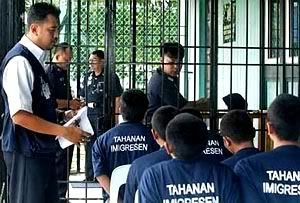
Fast forward: Detainees at the Langkap Immigration Detention Depot waiting for their cases to be heard outside the newly opened dedicated Sessions Court at the depot in Teluk Intan.
(Picture and caption from The Star, 16 January 2007)