Communist ideology, amongst others, is also about providing free services to all citizens, particularly emphasizing healthcare and education.
So, when the Home Ministry (PM Anwar Ibrahim, Home Minister Saifuddin Nasution and the MADANI government) banned 2 books - it is BEST that the government explains WHAT ASPECTS of the communism is going against national security interest?
Follow the Charles Hector channel on WhatsApp: https://whatsapp.com/channel/0029Vb6UokfB4hdNugYmph1B
The memoirs of two Communist Party of Malaya (CPM) members were banned for containing elements and ideologies of communism, says the home ministry.... recent developments show a tendency to normalise and glorify that ideology, which clearly goes against national security interests.
COLD WAR - Capitalism and communism represent opposite economic and political systems.
Capitalism is defined by private ownership, free markets, and profit accumulation, allowing individual initiative and class distinctions.
Communism advocates for communal ownership of production, a classless society, and state-directed distribution of resources to eliminate wealth gaps. - FREE EDUCATION and HEALTHCARE for all.
Under Capitalism(or Neo-liberalism) as it is known today - NO free education or healthcare. If you want, you pay for it - and if you cannot afford to pay, then too bad, you do not get it. It is how PRIVATE schools and PRIVATE hospitals/clinics operate in Malaysia today...
Most modern countries or economies, including Malaysia, are actually mixed systems that blend elements of capitalism (private enterprise) with state regulations or socialist policies to manage wealth inequality, rather than implementing a "pure" version of either system. They took what was good from the communist/socialist ideology, and also aspects from the capitalist/Neo-liberalism model.
THUS, today in MODERN MALAYSIA, the Malaysian Government must clarify WHAT ASPECTS OF THE COMMUNIST/SOCIALIST ideology it opposes - that threatens 'national security'?
Don't let PREJUDICES of the past affect Malaysia's current policies and stance?
'Communist Terrorists' was a term coined by the BRITISH colonial power - to 'demonize' all those that were 'fighting' for the end of the British colonial rule for Malaysian independence...
The US today calls all those who will not 'KOW TOW (act in an subservient manner) to the US as terrorists/rebels - so, HAMAS, IRAN, Hezbollah, etc are all terrorists - REGIME CHANGE agenda...
Today, the COMMUNIST States are China, Cuba, Laos, North Korea, and Vietnam.
As of 2024–2025, communist and socialist parties hold representation in the national parliaments of roughly 76 different recognized and non-recognized states worldwide.
As of 2026, Kerala is the only Indian state with a communist party-led government, where the Left Democratic Front (LDF), led by the Communist Party of India (Marxist) [CPI(M)], holds power. The Communist Party of India (CPI) also participates in this coalition. Historically, communist parties held power in West Bengal and Tripura.
THUS, will Malaysia SEVERE ties with Countries and States governed by COMMUNIST parties - because of 'national security interest'?
What about UK or Britain, the colonial power that 'demonized' and made illegal the Communist Party in Malaysia? Communist Party of Great Britain (CPGB) and a new Communist Party of Britain (CPB)
US - Communist Party USA (CPUSA), officially the Communist Party of the United States of America
Communist Party of Iran is an Iranian communist party founded on 2 September 1983...The Communist Party of Turkey (Turkish: Türkiye Komünist Partisi, TKP) was a political party in Turkey.
IS IT NOT TIME FOR MALAYSIA TO LIBERATE ITSELF FROM THE 'BRAINWASHING' BY ITS PAST COLONIAL MASTERS - And thus end actions of banning books, by reason the 'communist ideology' - and threat to 'national security' - what does the MADANI government consider 'national security' is confusing > should Parliament decide by law, the meaning of this 'national security'?
What aspect of 'Communist Ideology' is the MADANI government against - Please CLARIFY...
Many contributed to the struggle for INDEPENDENCE of Malaysia
Malaya's struggle for independence (merdeka) was a complex, multi-faceted process combining armed insurrection/struggle, peaceful diplomatic negotiations, and ...The struggle for INDEPENDENCE of Malaysia was a struggle for self-rule, and to kick out the British colonial power and many people were involved - though the methods they employed differed - some used 'peaceful' means, and some used 'violence'.
We may today disagree with the means used by some - but it is difficult to simply ignore the different contributions...
It is a FOLLY to believe that the BRITISH grant INDEPENDENCE to Malaysia out of their own benevolence and 'good will' . Was it really because the BRITISH could not take the 'resistance' and the struggle of the people for independence.?
BRANDING those who wanted to oust the British - 'communist terrorists' or terrorist. It is SAD that PM Anwar Ibrahim and the current MADANI government still seems to believe in this OLD British propaganda...
Likewise, today we begin to realize the TRUTH when we look at the actions of US and Israel. Any country/group that the US is not happy with are branded 'TERRORIST"
HAMAS - well, the fact is that this was the party that successfully defeated the Fatah party in the last General Elections in 2006, and is rightly governing GAZA - Fatah, despite losing in the elections, refused to hand over power in West Bank to the victors after the elections.
HEZBOLLAH - the fact is that this again is a political party that contested Lebanon elections - and in the last elections, formed an electoral bloc - which included the Christian Free Patriotic Movement. What? A Multi-Religious election coalition like BN and Pakatan Harapan?
The Shia Muslim Hezbollah movement and its allies have lost their majority in Lebanon's parliament, results from Sunday's election show. The bloc's candidates won 62 of the 128 seats, three fewer than it needed.Hezbollah retained its own seats, but President Michel Aoun's Christian Free Patriotic Movement lost support.
Interestingly, in the struggle for independence, the Malaysian workers and the Trade Union movement was considered a 'bigger threat' than the communist party - thus, the crackdown on unions, which saw the British colonial powers BANNING first the WORKERS UNION...
On 12 June 1948, the British colonial occupation banned the Pan Malayan Federation of Trade Union(PMFTU), Malaya's largest trade union. The Communist party, MCP, was banned later on 23 July.
It is time for Malaysia to wake up from the 'brainwashing' of then British colonial powers - and re-write our HISTORY acknowledging the contributions of many others in the fight/STRUGGLE for Malaysian independence...
The problem with HISTORY is who writes it - and, in Malaysia, that was done by the Malaysian government of UMNO-MIC-MCA, who sadly did not have much of a history of 'fighting for independence', an ongoing struggle that began even before World War II, and intensified thereafter... Note, UMNO also did not support the HARTAL...
ON Oct 20,1947,the whole of Malaya and Singapore bore witness to the first political action that involved the united action of people of all races – the Malaya–wide hartal.
The hartal, a general strike and the halting of economic activity, was effectively used in the Indian struggle for independence. It was used for the first time in Malaya by the left–wing coalition, Putera–AMCJA as a weapon against British colonialism....Putera–AMCJA succeeded in bringing together all the political parties in Malaya except the United Malays National Organisation (Umno) and the Communist Party of Malaya (CPM) in a popular people’s front to protest the Federation Constitution that was formulated by the British to replace the Malayan Union.
At each gathering, attended by thousands from all races, Putera–AMCJA leaders such as Tan Cheng Lock,Ishak Haji Muhammad, John Thivy, Philip Hoalim Sr, Dr Burhanuddin Helmy, Gerald de Cruz, Ahmad Boestamam, K. Ganapathy and Shamsiah Fakeh explained the importance of people from all races uniting to fight the Federation Constitution and to back Putera–AMCJA’s struggles.
And now, this Anwar Ibrahim's MADANI government has banned the Memoirs of Shamsiah Fakeh...
Malaysia need to look again at all currently BANNED books and movies - and decide whether these BANs ought to be removed...
2 books banned due to communist ideologies, says home ministry
It claims recent developments show a tendency to normalise and glorify communism, which goes against national security interests.
The ministry said continuous surveillance and intelligence gathered found that publications containing communist elements and ideologies had begun to circulate more openly in the market.
“If the dissemination of such materials was previously limited and restricted, recent developments show a tendency to normalise and glorify that ideology, which clearly goes against national security interests.
“In this context, the ministry rejects claims that the enforcement action was aimed at restricting intellectual freedom or academic discourse.
“On the contrary, this is a necessary preventive measure to protect society from the spread of ideologies that could undermine public harmony and order,” it said in a statement.
The ministry also said the publisher of the books, the Strategic Information and Research Development Centre, or SIRD, is under investigation.
“This is to ensure compliance with legal requirements, including registration with the Companies Commission of Malaysia and the Registrar of Societies.”
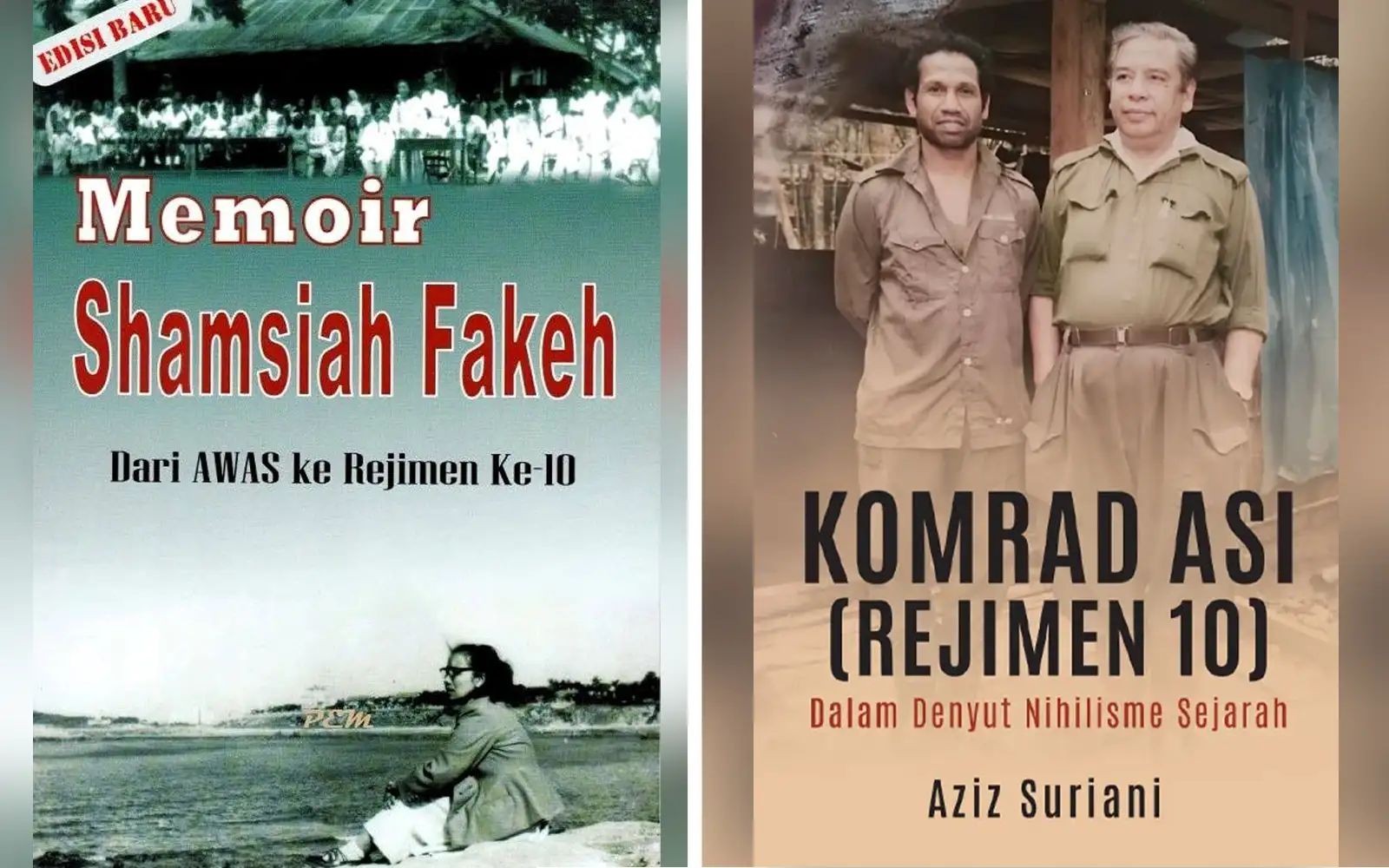
Yesterday, independent publisher Gerakbudaya said two books entitled Memoir Shamsiah Fakeh: Dari Awas ke Rejimen Ke-10 and Komrad Asi (Rejimen 10): Dalam Denyut Nihilisme Sejarah had been banned by the home ministry.
Gerakbudaya said the memoir of Shamsiah, a former CPM leader, had been reprinted three times and was first published in 2004 by Universiti Kebangsaan Malaysia, while the other book was published in 2022.
2 books banned due to communist ideologies, says home ministry
It claims recent developments show a tendency to normalise and glorify communism, which goes against national security interests.
The ministry said continuous surveillance and intelligence gathered found that publications containing communist elements and ideologies had begun to circulate more openly in the market.
“If the dissemination of such materials was previously limited and restricted, recent developments show a tendency to normalise and glorify that ideology, which clearly goes against national security interests.
“In this context, the ministry rejects claims that the enforcement action was aimed at restricting intellectual freedom or academic discourse.
“On the contrary, this is a necessary preventive measure to protect society from the spread of ideologies that could undermine public harmony and order,” it said in a statement.
The ministry also said the publisher of the books, the Strategic Information and Research Development Centre, or SIRD, is under investigation.
“This is to ensure compliance with legal requirements, including registration with the Companies Commission of Malaysia and the Registrar of Societies.”
Yesterday, independent publisher Gerakbudaya said two books entitled Memoir Shamsiah Fakeh: Dari Awas ke Rejimen Ke-10 and Komrad Asi (Rejimen 10): Dalam Denyut Nihilisme Sejarah had been banned by the home ministry.
Gerakbudaya said the memoir of Shamsiah, a former CPM leader, had been reprinted three times and was first published in 2004 by Universiti Kebangsaan Malaysia, while the other book was published in 2022.The publisher described the ban as a form of censorship and said it would challenge the matter in court.
Pakatan Harapan politicians have criticised the bans, including PKR’s Petaling Jaya MP Lee Chean Chung and DAP’s Bandar Utama assemblyman Jamaliah Jamaluddin, who is Shamsiah’s granddaughter.
Jamaliah said the memoir focussed more on her grandmother’s life journey and experiences, adding that it had not sparked any extremist movement all this time.
The Selangor executive councillor expressed disappointment with the home ministry’s “baseless” actions and called for the ban to be reviewed.
Separately, Lee pointed out the irony that the books were not banned by the previous Barisan Nasional and Perikatan Nasional-led administrations but by the PH-led government.
He added that the late Syed Husin Ali, a founding member of PKR, would have been critical of the home ministry banning books despite being led by a PKR leader.
Home minister Saifuddin Nasution Ismail is from PKR and is also the PH secretary-general. - FMT 16/4/2026
Why does Malaysia fear the books that tell our story? — Khoo Ying Hooi
APRIL 16 — The recent banning of two books published by Gerakbudaya, Memoir Shamsiah Fakeh: Dari Awas ke Rejimen ke-10 and Komrad Asi (Rejimen 10): Dalam Denyut Nihilisme Sejarah, is deeply unsettling.
As an educator, it feels personal. It raises a question that is hard to ignore, what happens when access to knowledge and difficult parts of our past is taken away?
These are not just books. They are attempts to tell a version of Malaysia’s past that is not always comfortable.
She was many things at once, a nationalist, a woman navigating male-dominated political spaces, and someone associated with a movement that remains deeply sensitive in Malaysia’s historical memory.
That discomfort is precisely why such works matter.
History, if we are honest about it, is rarely clean. It is layered with contradictions, silences, and competing interpretations.
Yet it is through this messiness that we begin to understand the complexity of nation-building.

When we remove certain narratives because they are inconvenient or unsettling, we are not protecting history. We are simplifying it.
In Malaysia, book banning is not new. Over the years, various titles have been restricted under broad categories such as public order, morality, or national security.
But what strikes me, especially when looking at the “Hall of Banned” compiled by Gerakbudaya, is how wide-ranging these bans are.
Books about May 13, reformasi, corruption, governance, sexuality, and religion all appear on the same list. They do not share a single theme. What they share is that they ask difficult questions.
That is perhaps what makes them vulnerable.
When books like Rebirth: Reformasi, Resistance, and Hope in New Malaysia are restricted for political critique, and others like Gay is OK! A Christian Perspective are banned on moral grounds, it becomes clear that the issue is not about one specific concern.
It is about drawing boundaries around what can be discussed. And those boundaries are not always clear. They shift, sometimes quietly, sometimes abruptly.
For writers, publishers, and educators, this creates a certain unease. It is not always the explicit ban that shapes behaviour, but the possibility of one.
You begin to wonder which topics might be too sensitive, which perspectives might invite scrutiny. Over time, this anticipation can be just as powerful as regulation itself.
The banning of the Gerakbudaya titles sits within this broader pattern, but it also touches something deeper.
It is about history, and more specifically, about who gets to tell it. The story of the Malayan Communist Party has long been framed in a particular way, often centred on security and threat.
But history is never just one story. Figures like Shamsiah Fakeh complicate that narrative. They force us to see the past not as a single, settled account, but as something contested and evolving.
To read about her is to understand that Malaysia’s past was shaped by multiple actors, not all of whom fit neatly into categories of hero or villain.
When access to such stories is restricted, something shifts. Students, readers, and the public are left with a narrower field of vision.
History becomes less about inquiry and more about acceptance. And over time, this shapes how we think, not just about the past, but about the present and the future as well.
I often think about what this means in the classroom. How do we encourage critical thinking if certain materials are out of reach? How do we ask students to engage with complexity when the sources themselves are limited?
Education, at its core, is about asking questions, sometimes uncomfortable ones. When those questions become harder to ask, something fundamental is lost.
And perhaps that is the most concerning outcome. A society that does not engage with its difficult histories does not resolve them. It carries them forward, often in ways that are less visible but no less significant.
A confident Malaysia should not need to fear books. It should trust Malaysians to read critically, to question what they encounter, and to disagree where necessary.
Understanding a perspective does not mean agreeing with it. It simply means taking the past seriously enough to engage with it.
Malaysia’s history is not singular. It is made up of many voices, some of which sit uneasily with one another.
From colonial resistance to post-independence politics, from official narratives to marginalised experiences, these layers are part of how the nation came to be.
To remove parts of that story is not to build unity. It is to construct a version of history that is incomplete, and therefore fragile.
So when books are banned, the issue is about what kind of relationship Malaysia wants to have with its own past.
Whether it is a relationship shaped by openness and critical engagement, or one defined by caution and control.
Because when books are banned, history does not disappear. It is rewritten, narrowed, and eventually remembered only in the ways we are allowed to see.
* Khoo Ying Hooi, PhD is an associate professor at Universiti Malaya. - Malay Mail, 16/4/2026
Shamsiah Fakeh And L. Ramasamy — Get To Know The 2 Historical Figures Whose Books Are Now Banned In Malaysia
Learn who Shamsiah Fakeh and Komrad Asi aka L. Ramasamy were, and why their books were banned by the Malaysian government.
Malaysian publisher Gerakbudaya will challenge the Home Ministry’s recent ban for two of its titles, deemed “unlawful” under the Printing Presses and Publications Act 1984.
The two memoirs feature — Shamsiah Fakeh and Komrad Asi (real name L. Ramasam) — now deceased figures who were once members of the Communist Party of Malaya (CPM).
According to Gerakbudaya’s public statement, — Memoir Shamsiah Fakeh: Dari Awas ke Rejimen ke-10 and Komrad Asi (Rejimen 10): Dalam Denyut Nihilisme Sejarah — have been in print for some years, with the former title having underwent three prior reprints to date.
“These two books are not dangerous texts; they merely tell the story of ordinary citizens who fought for our country’s freedom, not only from the colonial system but also from the colonial mindset,” Gerakbudaya said.
Shamsiah Fakeh’s self-authored memoir has been in the public domain for 22 years after its first publication by Universiti Kebangsaan Malaysia (UKM) in 2004. Gerakbudaya published Komrad Asi’s memoir in 2022.
The sudden ban has prompted criticism from some Malaysian writers and activists, who are questioning the basis of the Home Ministry’s decision and calling for greater transparency over how the prohibition was imposed.
Always credit Eksentrika for this article.

Always credit Eksentrika for this article.
Urgent concerns on Malaysia’s freedom of expression
In a press statement, PEN Malaysia strongly condemned the ban, stating that the prohibition of the two books raises urgent concerns about freedom of expression in Malaysia.
“Books are not weapons; they are repositories of evidence-based research, debate, and critical thought. To suppress them is to deny society the right to engage with its own past in all its complexity,” PEN Malaysia said, adding that it will be engaging the home ministry.
“PEN Malaysia will formally seek an engagement with the Ministry of Home Affairs, including requesting an appointment with the Minister, Saifuddin Nasution Ismail, to discuss the urgent need for a clear, transparent, and accountable standard operating procedure governing the banning of books.”
In a letter to Free Malaysia Today, former journalist Martin Vengadesan, questioned the ban of the books.
“I have to question the logic behind banning books that have been in circulation for many years. As a reporter with The Star, I interviewed the late Shamsiah in 2008, a few months before her passing. I read her memoir as part of my preparation for the interview, and her story is a most fascinating one that sheds light on forgotten eras of our history.”
Always credit Eksentrika for this article.
Who is Shamsiah Fakeh and Komrad Asi?
Always credit Eksentrika for this article.

Always credit Eksentrika for this article.
Shamsiah Fakeh was a nationalist, feminist, and former leader of Angkatan Wanita Sedar (AWAS), the first nationalist women’s organisation in Malaya.
Her memoir offers a rare first-person account of anti-colonial struggle from a woman associated with the 10th Regiment, the predominantly Malay regiment linked to the Malayan Communist Party. She writes of the pain of losing her children in the jungle and the decades of exile in China. For many, her book is a vital piece of the “Malaysian puzzle,” offering a female perspective on a history usually told by men in uniform.
Komrad Asi (Rejimen 10): Dalam Denyut Nihilisme Sejarah is a more recent addition, published by Gerakbudaya in 2022. Written by researcher Aziz Suriani, the book shifts the lens toward the “marginalised of the marginalised.”
It follows the life of Asi (real name L. Ramasam), an Indian child from a colonial rubber estate who became a courier for the 10th Regiment. Through Asi’s eyes, we see a side of the insurgency that official history textbooks often omit: the involvement of the Indian working class and the complex socio-economic grievances that drove them toward the left.
Taken together, both books unsettle the tidy versions of history often found in official narratives.
Challenging the ban
In its statement, Gerakbudaya said it will challenge the ban of the two books in Malaysian courts.
“The books chronicling their lives may have been banned, but their stories will remain with us,” it said.
The publisher is requesting readers to share messages of solidarity in response to the sudden ban here.
“We may be sharing the collected messages on our social media, so we kindly request that you avoid including any identifying information,” Gerakbudaya added.
As of 15 March 2026, Gerakbudaya has listed some 3,166 of its published books that were banned by the Malaysian government. The latest two titles take the tally to 3,168 books. - Eksentrika
Printing Presses and Publications Act
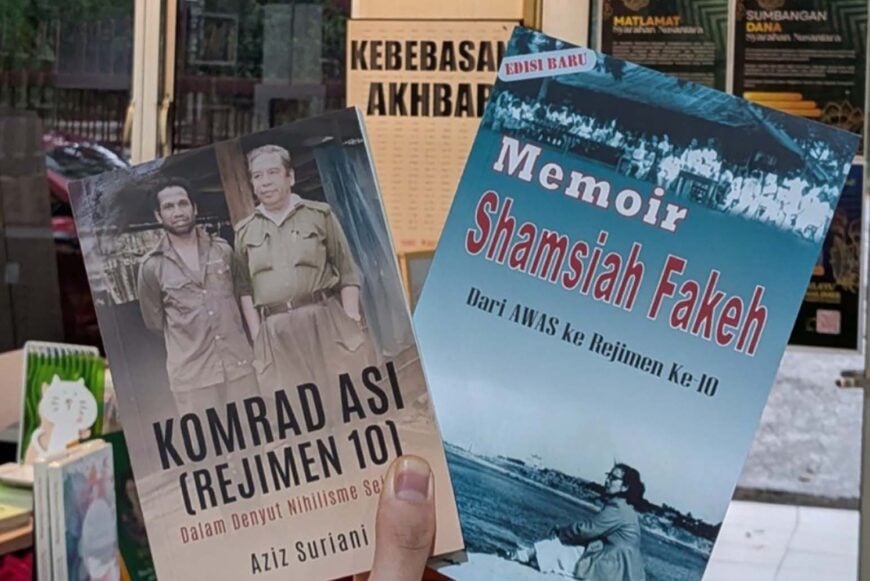
The two books recently banned in Malaysia. Photo courtesy Gerakbudaya
On 15 April, book publisher and distributor Gerakbudaya received a notice from Malaysia’s Ministry of Home Affairs informing it of a ban on two of their books, Memoir Shamsiah Fakeh: Dari AWAS ke Regimen ke-10 (Shamsiah Fakeh’s Memoir: From AWAS to the 10th Regiment) and Komrad Asi Regimen 10: Dalam DenyutNihilisme Sejarah (Comrade Asi Regiment 10: In the Pulse of Historical Nihilism). Both books recount the struggles of the Malayan Communist Party in their fight against British colonialism for full independence. According to Gerakbudaya, the ban was imposed under Sections 7(1)1, Section 8(1)2 and Section 8(2)3 of the Printing Presses and Publications Act 1984 (PPPA). The ban is unnecessary and disproportionate, and ARTICLE 19 calls on the government to immediately lift the ban and repeal the PPPA.
This arbitrary action from the Ministry of Home Affairs represents yet another instance of this draconian Act being used to restrict access to information in a manner that contravenes international human rights standards.
‘The continued reliance on the PPPA to suppress historical and political narratives that are indispensable to a healthy democracy is deeply troubling. Removing parts of history – regardless of how uncomfortable or controversial they may be – not only limits our access to information but also shuts down our ability to recognise and understand different viewpoints. To truly progress as a nation, we must be able to learn from all sides of our history, rather than being confined to a narrative sanctioned by the authorities for us. Malaysia’s history was not created by single actors, but shaped by many, including people like Shamsiah Fakeh. Shamsiah Fakeh is recognised as one of Malaysia’s most prominent feminist and leftist women’s leaders who contributed to the struggle against colonialism and the fight for independence from the British. Banning her memoirs is an attempt to diminish the important role of women in Malaysia’s history,’ said Nalini Elumalai, ARTICLE 19’s Senior Malaysia Programme Officer.
ARTICLE 19 has repeatedly warned that the PPPA is incompatible with international human rights law and standards relating to freedom of expression. The law gives sweeping discretion to the Minister of Home Affairs to ban publications, opening the door to arbitrary and discriminatory application of the law.
‘As long as this law remains on the books, it will continue to enable arbitrary censorship and suppress the free exchange of ideas – even erasing critical sections of history. We urge the Malaysian government to immediately reverse the ban and take concrete steps to repeal the PPPA. Such steps are vital to safeguarding freedom of expression and ensuring that all individuals can access, share, and engage with information without fear of repercussions,’ added Nalini.
- 1Section 7(1) gives the Minister of Home Affairs ‘absolute discretion’ to ban any publication deemed undesirable if it poses a threat to public order, morality, security, or the national interest, or likely to alarm public opinion or to be contrary to any law.
- 2Section 8(1) makes it an offence for any person to possess a prohibited publication without lawful excuse, punishable by a fine of up to 5,000 ringgit.
- 3Section 8(2) states that anyone involved in printing, importing, distributing, or selling such publications can face imprisonment for up to three years, a fine of up to 20,000 ringgit, or both. - ARTICLE 19


 Posts
Posts




No comments:
Post a Comment